





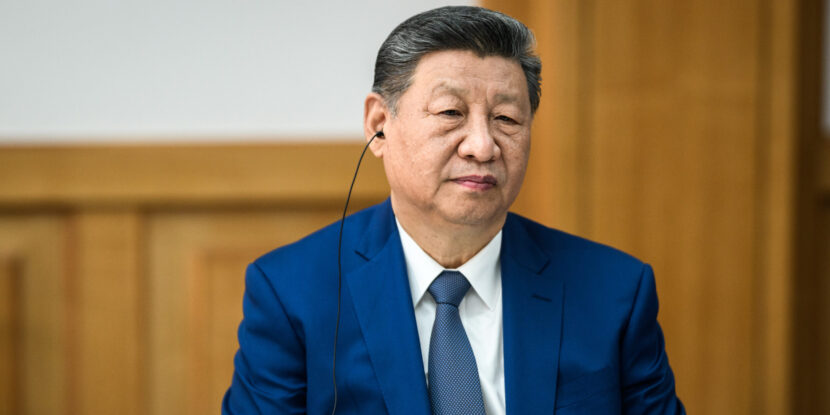
❓WHAT HAPPENED: Chinese Premier Li Qiang criticized tariffs, including those imposed by U.S. President Donald J. Trump, claiming they have harmed the global economy—seen by many as an admission that Trump’s tariff policies have had a significant impact on China specifically.
👤WHO WAS INVOLVED: Premier Li Qiang, President Trump, French President Emmanuel Macron, and global trade partners.
📍WHEN & WHERE: Tuesday, during an international forum in Beijing.
💬KEY QUOTE: “Starting from the beginning of this year, we’ve seen the stick of tariffs being wielded around the world with growing restrictive measures on the economy and trade, which have dealt a severe blow to the global economy.” – Li Qiang
🎯IMPACT: China’s trade surplus reached a record $1.076 trillion, though Chinese exports to the U.S. fell by nearly 30 percent year-on-year last month.
Chinese Premier Li Qiang—the Chinese Communist Party’s (CCP) second most powerful leader next to President Xi Jinping—says global trade tariffs have dealt a “severe blow” to the world economy. Alluding to the tariffs on China imposed by U.S. President Donald J. Trump, Li told attendees at an international forum in Beijing on Tuesday that trade levies have resulted in significant supply chain disruptions, claiming “Starting from the beginning of this year, we’ve seen the stick of tariffs being wielded around the world with growing restrictive measures on the economy and trade, which have dealt a severe blow to the global economy.”
Implicit in Li’s remarks is the admission that U.S. tariffs enacted by the Trump administration have caused a significant negative impact on China’s export economy, which is highly reliant on selling goods to American consumers. Data released by Chinese customs officials shows that exports to the United States year-on-year fell by 28.7 percent in November. Notably, Chinese government data is often manipulated to present a more favorable picture than reality, suggesting that Trump tariffs have likely had an even more profound impact on Chinese exports.
Meanwhile, Chinese officials claim the country’s exports to other nations grew by 5.4 percent, fueling a record $1.076 trillion trade surplus. Again, the Chinese claims should be viewed with caution, given the country’s history of manipulating official government data for propaganda purposes.
Over the last year, international finance experts have noted that the Chinese economy has experienced persistent deflation, well outside the parameters considered acceptable by the CCP. The deflationary cycle in China has seen the rapid collapse of consumer and producer prices, driven by supply-side overcapacity—meaning Chinese manufacturers are producing more goods than the country can export or consume internally.
Western nations—and, critically, Europe—appear to be growing wary of Beijing’s predatory trade practices. French President Emmanuel Macron floated the possibility of European Union (EU) tariffs on Chinese goods during a recent visit to Beijing, while the European Commission—the bloc’s unelected executive—is moving to address China’s practice of dumping imports to undermine domestic industries on the continent.
Join Pulse+ to comment below, and receive exclusive e-mail analyses.




















.jpg)

.jpg)


.jpg)
