



❓WHAT HAPPENED: New DNA evidence reveals that the “Beachy Head Woman,” previously pushed by academics and media as the “first Black Briton,” was likely a local white woman from Eastbourne.
👤WHO WAS INVOLVED: Researchers at the Natural History Museum in London, England, conducted the genetic study.
📍WHEN & WHERE: The skeleton was found in Eastbourne Town Hall in 2012; the study was completed recently.
💬KEY QUOTE: “By using state-of-the-art DNA techniques we were able to resolve the origins of this individual.” – Dr. William Marsh
🎯IMPACT: The findings challenge previous, politically driven narratives about “diversity” in ancient Britain.
New DNA analysis has revealed that the “Beachy Head Woman,” previously presented as the earliest known black Briton, was actually a white woman local to the Eastbourne area. Her skeleton, found in 2012 at Eastbourne Town Hall, had initially been linked to sub-Saharan Africa due to her cranial features, with academia and the media rushing to push this as evidence that Britain has always been ethnically diverse.
Advances in DNA technology have now enabled scientists at London’s Natural History Museum to perform a comprehensive genetic examination. The results indicate that her ancestry actually matches that of people living in Roman-era Britain far more closely than anyone from Africa.
“By using state-of-the-art DNA techniques we were able to resolve the origins of this individual,” said Dr. William Marsh, who co-led the museum’s genetic study.
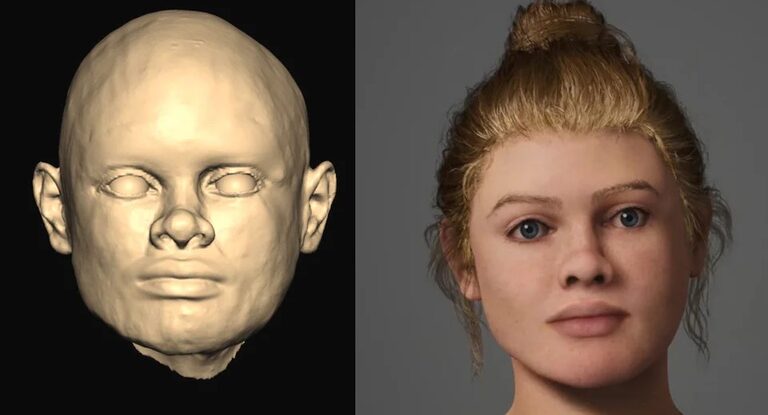
The earlier assumption of African heritage had inspired facial reconstructions and stories about her life that are now under review. A plaque installed in 2016 asserting her African roots has been taken down in light of the updated evidence.
Previously, academics and media members attempted to push a narrative that the prehistoric Cheddar Man was black-skinned, only for researchers to quietly admit that testing could not prove his skin color, partly because the DNA had degraded over 10,000 years in Cheddar Gorge. Nevertheless, Cheddar Man was featured as a “black Briton” by the BBC in children’s programming intended to prove ethnic minorities have “been [in Britain]” from the start, alongside other historical figures such as Roman Emperor Septimus Severus—who was also not black, and not even from Britain.
Image via Face Lab at Liverpool John Moores University.
Join Pulse+ to comment below, and receive exclusive e-mail analyses.