





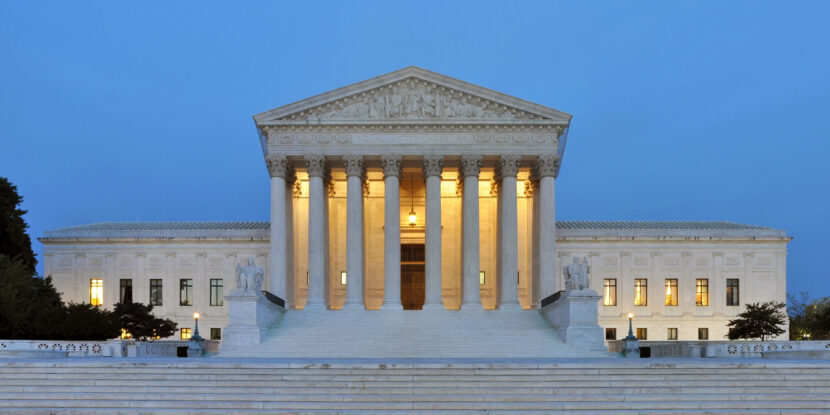

❓WHAT HAPPENED: The U.S. Supreme Court struck down President Trump’s power to impose tariffs under the International Emergency Economic Powers Act (IEEPA).
👤WHO WAS INVOLVED: The U.S. Supreme Court, President Donald J. Trump, and dissenting Justice Brett Kavanaugh.
📍WHEN & WHERE: February 20, 2026, United States.
💬KEY QUOTE: “We claim no special competence in matters of economics or foreign affairs. We claim only, as we must, the limited role assigned to us by Article III of the Constitution. Fulfilling that role, we hold that IEEPA does not authorize the President to impose tariffs” – Supreme Court ruling
🎯IMPACT: The decision could lead to the refunding of billions of dollars to importers and undermine President Trump’s efforts to protect American workers and his leverage in striking trade deals.
The U.S. Supreme Court has struck down President Donald J. Trump‘s power to impose tariffs under the International Emergency Economic Powers Act (IEEPA). According to the mixed six-to-three ruling, the justices found that IEEPA’s emergency and regulatory powers, granted to the President by Congress, do not extend to forms of taxation like tariffs.
“We claim no special competence in matters of economics or foreign affairs. We claim only, as we must, the limited role assigned to us by Article III of the Constitution. Fulfilling that role, we hold that IEEPA does not authorize the President to impose tariffs,” the ruling states.
While the Supreme Court struck down the tariff powers President Trump claimed under IEEPA, the majority acknowledged that other laws and statutory provisions do allow the executive branch to impose trade levies unilaterally. So, while the high court has reached a firm conclusion on the IEEPA, the decision becomes fractured with no clear majority on the general powers of the President to impose tariffs—a departure from its frequent recent use of the Major Questions Doctrine to settle such matters.
Should the Trump administration seek to reimpose its tariff measures, it could do so through other means than the IEEPA; however, with some avenues subject to review by trade courts, this process could take well over a year. Notably, President Trump did use a number of these other provisions to impose tariffs on China during his first term.
Importantly—and as Justice Brett Kavanaugh highlighted in his dissent—the majority’s opinion does not address refunds. The issue of what will happen to the estimated $168 billion in tariff revenue collected by the federal government is essentially left to Congress. However, any effort to return the funds is likely to be a protracted and legally messy process.
“[T]he interim effects of the Court’s decision could be substantial. The United States may be required to refund billions of dollars to importers who paid the IEEPA tariffs, even though some importers may have already passed on costs to consumers or others,” Justice Kavanaugh wrote. “As was acknowledged at oral argument, the refund process is likely to be a ‘mess.'”
Kavanaugh also noted that the court’s decision is likely to jeopardize a number of foreign trade deals struck by President Trump. “[A]ccording to the Government, the IEEPA tariffs have helped facilitate trade deals worth trillions of dollars—including with foreign nations from China to the United Kingdom to Japan, and more. The Court’s decision could generate uncertainty regarding those trade arrangements,” the justice warned.
Interestingly, Kavanaugh took to task the core of the majority’s findings—namely, that IEEPA does not mention the word “tariff” and that trade levies are categorically the same as taxes. “The tariffs at issue here may or may not be wise policy. But as a matter of text, history, and precedent, they are clearly lawful. I respectfully dissent,” Justice Kavanaugh wrote.
Jack Montgomery contributed to this report.
Join Pulse+ to comment below, and receive exclusive e-mail analyses.









.jpg)

.jpg)


