





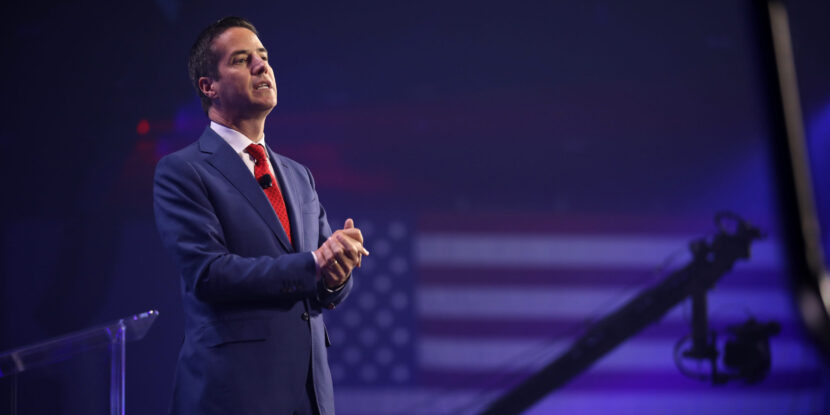

❓WHAT HAPPENED: U.S. Senator Bernie Moreno (R-OH) is demanding that Congress immediately take up a new reconciliation bill to codify the tariffs imposed by President Donald J. Trump under the International Emergency Economic Powers Act (IEEPA).
👤WHO WAS INVOLVED: Sen. Moreno, President Trump, the U.S. Supreme Court, and Congressional Republicans and Democrats.
📍WHEN & WHERE: Friday, February 20, 2026.
💬KEY QUOTE: “This betrayal must be reversed and Republicans must get to work immediately on a reconciliation bill to codify the tariffs that had made our country the hottest country on earth!” — Sen. Moreno
🎯IMPACT: Earlier on Friday, the U.S. Supreme Court has struck down President Trump’s authority under the IEEPA to enact tariffs, finding that Congress’s legislative intent did not extend taxation power to the executive branch under the law’s regulatory provisions.
U.S. Senator Bernie Moreno (R-OH) is demanding that Congress immediately take up a new reconciliation bill to codify the tariffs imposed by President Donald J. Trump under the International Emergency Economic Powers Act (IEEPA). Earlier on Friday, the U.S. Supreme Court struck down President Trump’s authority under the IEEPA to enact tariffs, finding that Congress’s legislative intent did not extend taxation power to the executive branch under the law’s regulatory provisions.
“SCOTUS’s outrageous ruling handcuffs our fight against unfair trade that has devastated American workers for decades. These tariffs protected jobs, revived manufacturing, and forced cheaters like China to pay up,” Sen. Moreno wrote in a post on X (formerly Twitter) following the high court’s decision. “Now globalists win, factories investments may reverse, and American workers lose again. This betrayal must be reversed and Republicans must get to work immediately on a reconciliation bill to codify the tariffs that had made our country the hottest country on earth!”
A reconciliation bill could be a viable avenue to effectively reverse the Supreme Court‘s ruling. This type of legislation only requires a simple 51-vote majority in the Senate and is not subject to a filibuster. Additionally, reconciliation bills—though limited by the number of times the legislative vehicle can be used—must pertain to spending, revenue, and debt limit changes, including tariffs.
Still, the path of a reconciliation measure would be uncertain. It is not clear if there are 51 votes in the Senate in favor of tariffs, with at least three Republican lawmakers in the upper chamber—Sens. Mitch McConnell (R-KY), Thom Tillis (R-NC), Rand Paul (R-KY), and Lisa Murkowski (R-AK)—all opposed to the trade levies. Additionally, the narrow majority in the House could complicate passage as well.
Join Pulse+ to comment below, and receive exclusive e-mail analyses.










.jpg)


.jpg)

.jpg)


