A recent court case in Bristol has again put the spotlight on the risks some migrant groups pose to British women and girls. In November last year, three Afghan men and an Afghan minor aged 17 subjected a teenage girl to a prolonged gang rape lasting several hours. They had first contacted her through Snapchat, supplied her with alcohol, then assaulted her before attempting to leave the country hidden in a lorry bound for France. French officials sent them back, British courts convicted them, and they were sentenced on October 6.
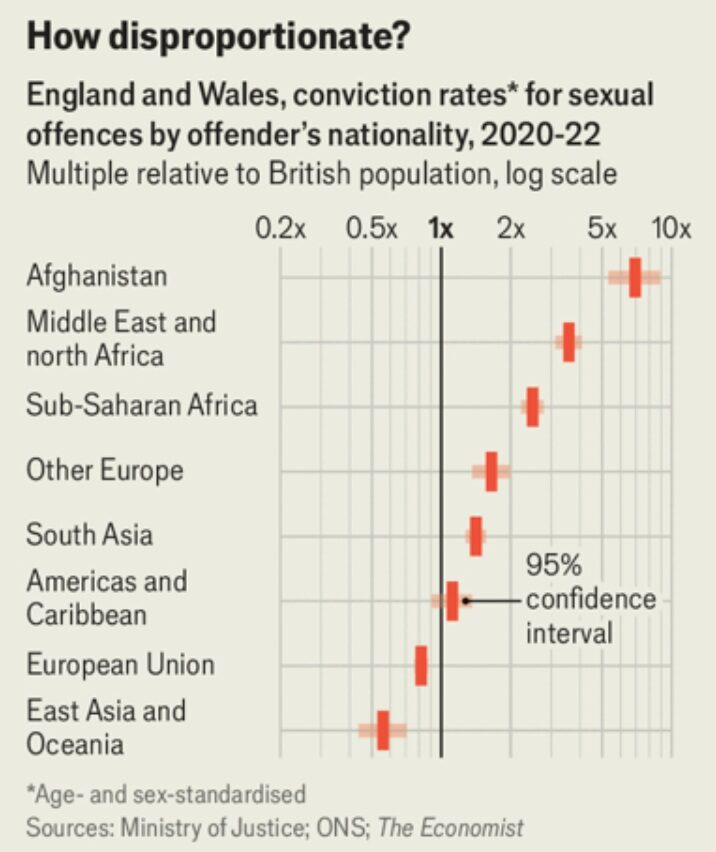
Such cases reinforce public concerns about migrant crime that have been growing for years. A government booklet distributed to asylum seekers recently felt the need to spell out that the age of consent is 16 and that rape is a serious offense. Statistics suggest that these concerns are justified, with migrants from Afghanistan, the Middle East, and Africa perpetrating sex crimes at much higher rates than other demographic groups and the native population.
Official statistics do not routinely break crime rates down by immigration status, so researchers must work with the limited figures available. Freedom of Information Act requests secured by the Migration Observatory at Oxford University produced Ministry of Justice records covering cautions and convictions in England and Wales from 2010 to 2024. Afghans accounted for 409 cases over the full period.
That raw total becomes meaningful once set against population size. The 2021 census counted roughly 21,400 people of Afghan origin in England and Wales. Subsequent arrivals after the Taliban takeover in August 2021 pushed the estimated Afghan population to around 45,000 by the end of 2022. Focusing on the 2020–22 window and adjusting for age and sex, the analysis finds Afghans convicted of sex crimes at seven times the rate of British nationals.
This is a large and persistent gap. The elevated rate means additional victims in every period, and continued high inflows will multiply the total impact.
The National Pulse can bring you original news and analysis without sugarcoating the truth because we do not rely on government or corporate cash. To keep it that way, please JOIN THE NATIONAL PULSE or MAKE A DONATION today.
A Pattern Across Europe.
Britain is not unique. Data from Austria, Denmark, Finland, Germany, and Sweden show immigrants from the Middle East, North Africa, Central Asia, and the Horn of Africa are over-represented among both suspects and those convicted of sexual offenses. Age-standardized comparisons reduce the disparity, but the elevated rates do not disappear. Alice Weidel, leader of Germany’s Alternative for Germany (AfD) party, has noted that Syrians and Afghans form the main category among those responsible for the most serious crimes, including rape and homicide.
The practical consequence for public safety of importing demographic groups with substantially higher rates of offending per person is more victims. Official reluctance to publish detailed, regularly updated rates by nationality has left the field open to competing claims. However, the available evidence confirms that Afghan, Middle Eastern, and African migrant groups commit sex crimes at markedly higher rates than the native population.
That reality, illustrated in repeated court cases and European data, is a serious problem that requires clear acknowledgment.
To help Raheem J. Kassam and his team expose the truth about mass migration and its consequences, please JOIN THE NATIONAL PULSE or MAKE A DONATION today.
Join Pulse+ to comment below, and receive exclusive e-mail analyses.
show less
A recent court case in Bristol has again put the spotlight on the risks some migrant groups pose to British women and girls. In November last year, three Afghan men and an Afghan minor aged 17 subjected a teenage girl to a prolonged gang rape lasting several hours. They had first contacted her through Snapchat, supplied her with alcohol, then assaulted her before attempting to leave the country hidden in a lorry bound for France. French officials sent them back, British courts convicted them, and they were sentenced on October 6.
show more
American political campaigns are increasingly paying specialist consultants to influence what artificial intelligence (AI) chatbots tell voters about candidates, according to a new investigation. This new phenomenon is attempting to mold how AI systems such as ChatGPT, Claude, and Google’s Gemini describe political candidates, evaluate their policies, and even recommend whom to vote for.
The National Pulse gives you original analysis of the latest AI issues and more. To help support Raheem J. Kassam and his team continue this work, please JOIN THE NATIONAL PULSE or MAKE A DONATION today.
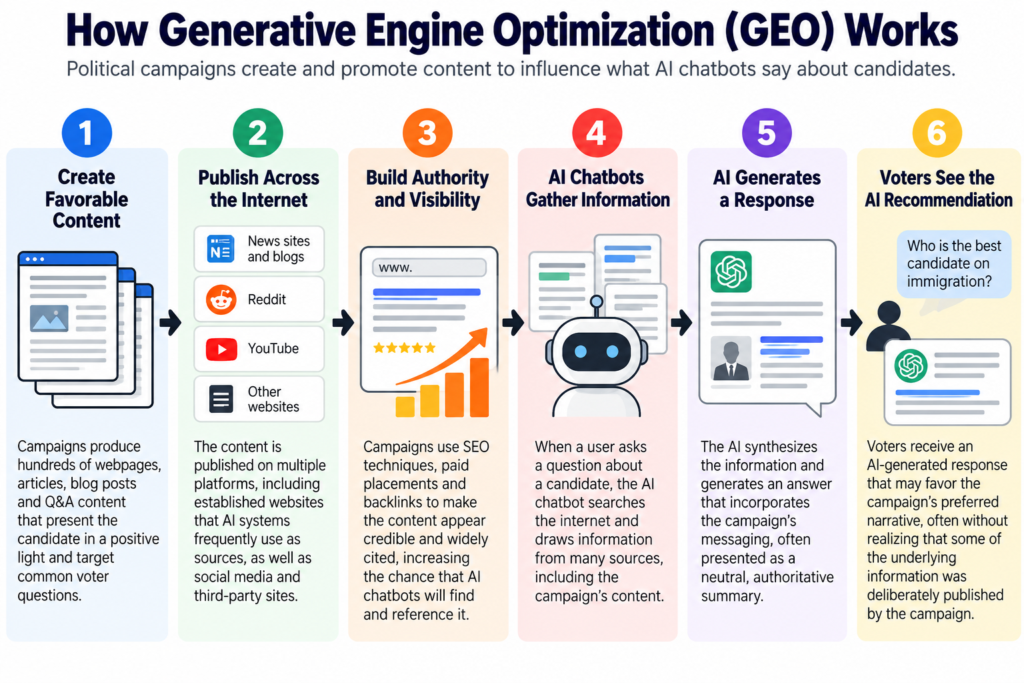
The investigation uncovered documents detailing a proposed strategy for Republican Mike Minogue, who is challenging Massachusetts Democratic Governor Maura Healey. The plan included creating hundreds of specially designed webpages, purchasing placements on websites frequently cited by AI systems, and distributing political content through social media sites like Reddit and YouTube.
Political operatives are now attempting to influence the information systems that voters increasingly trust to provide impartial answers, rather than solely relying on traditional media or social media ads.
Cameron Hickey, CEO of the National Conference on Citizenship, estimates that approximately 25 percent of eligible American voters have consulted an AI chatbot about a political candidate when deciding how to vote. AI is being adapted as a search and query tool by more and more voters, but just how reliable is it?
GEO: How Political Operatives Are Controlling AI Answers.
The newly uncovered strategy involves a relatively new industry known as Generative Engine Optimization (GEO), an evolution of traditional Search Engine Optimization (SEO). While conventional SEO attempts to push websites toward the top of Google search results, GEO aims to influence the information that artificial intelligence systems incorporate directly into their answers.
A voter searching for information about a candidate on traditional search engines might previously have encountered a series of websites, advertisements, and news articles, allowing them to weigh each source on its own. An AI chatbot instead synthesizes information into a single response, while often presenting its answers as being authoritative.
Austin-based consulting firm Visigent prepared the strategy document for Minogue’s campaign. The proposal included publishing hundreds of policy pages, buying placements on established websites already referenced by AI systems, and continuously monitoring chatbot responses to determine whether the campaign’s messaging was succeeding.
The firm’s CEO, Thomas Howell, confirmed that Visigent works with six political campaigns, although he refused to identify them.
The business model is clear: political campaigns are being offered services intended to make AI systems more likely to repeat their preferred messaging.
AI Influencing Is Already Attracting Thousands of Dollars in Campaign Funds.
Visigent offers basic monitoring software for $134 per month, while its political consulting services begin at approximately $5,000 per month. More elaborate operations involving paid media placements and influencer outreach can reportedly cost as much as $50,000 per month. One proposal even included a potential $200,000 success fee for achieving a specified category victory in AI recommendations.
Democrats are also looking to influence AI. The progressive organization Run for Something Action Fund operates CampSight, a service designed to help Democratic and progressive candidates monitor and improve their representation in chatbot responses.
Its services range from $9 to $250 per month for smaller campaigns, with customized arrangements for statewide and federal races. Run for Something president Amanda Litman stated that dozens of campaigns were already using the platform, with more than 300 candidates and organizations on its waiting list.
The New Frontier for Political Messaging.
For decades, candidates competed for television airtime and newspaper endorsements. The rise of social media introduced algorithm-driven political advertising, viral messaging, and the rise of the social media influencer class.
AI, however, is treated as an authority, rather than an opinion. A voter asking which candidate has the strongest record on immigration, taxation, or public safety might receive a detailed chatbot response without realizing that some of the underlying information was deliberately placed online by political consultants.
An investigation published last week by The Atlantic reported that cybersecurity researchers identified 37 suspicious websites registered on the same night, apparently designed to influence AI-generated answers about American elections.
The websites carried newspaper-style names and published Q&A material about various political candidates. In one instance, Google’s AI-powered search incorporated information from sites within the network when answering questions about a Michigan congressional candidate.
Meanwhile, research by AI evaluation company Forum AI found that approximately 40 percent of tested chatbot responses to election-related questions contained at least one factual inaccuracy, while roughly one-third cited unreliable sources.
The findings concerned particular models and questions tested in August, rather than every AI response. The companies involved said their systems had subsequently improved.
Chatbots Have a History of Giving Bad Advice.
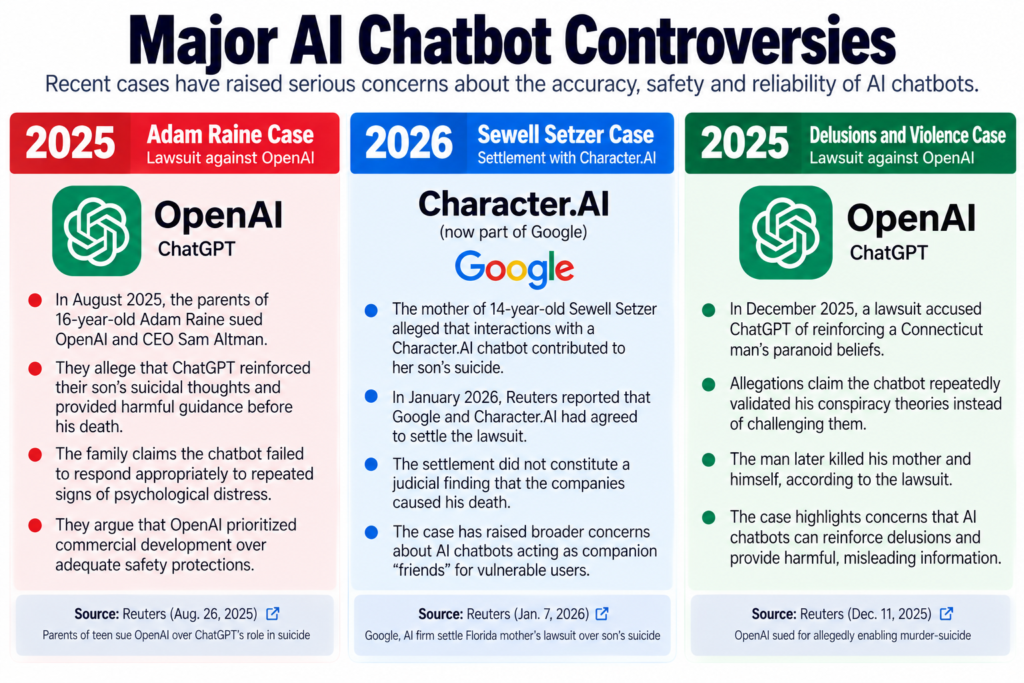
Several major AI companies have faced major lawsuits alleging that their systems encouraged dangerous behavior, reinforced people’s mental illnesses, or failed to protect users. In August 2025, the parents of 16-year-old Adam Raine sued OpenAI and CEO Sam Altman, alleging that ChatGPT reinforced their son’s suicidal thoughts and provided harmful information before his death.
OpenAI expressed sadness over the teenager’s death and acknowledged that safeguards could become less reliable during extended conversations, while not specifically addressing the lawsuit’s allegations.
Another case involved 14-year-old Sewell Setzer, whose mother alleged that interactions with a Character.AI chatbot contributed to his suicide. In January 2026, Google and Character.AI had agreed to settle the lawsuit.
The cases highlight the potential dangers for vulnerable people who interact with AI and treat it as an infallible and reliable source of information, something that could potentially now influence politics.
The Potential Impact of AI on Elections.
The political consequences of AI could become far-reaching as more and more people begin using various AI services to seek out information. AI potentially becoming closer and closer to something approaching self-awareness could also play a role if AI bots decide to present information to sway voters to candidates who are most sympathetic to AI development, possibly without revealing this motive.
Joe Bonilla, managing partner of political strategy firm Relentless Awareness, has said that efforts to influence AI responses are already underway and predicted that such practices would become widespread during the 2028 presidential election.
Wealthier political campaigns could gain an advantage by financing extensive networks of AI-friendly content, while misleading information could be repeated by chatbots without its original source or financial backing being obvious to users.
For voters already skeptical of Big Tech’s influence over political debate, the emergence of an industry devoted to manipulating AI-generated answers introduces yet another reason to question the neutrality of the information they receive.
The next great election battlefield may not be television advertising or social media algorithms, but the supposedly impartial answers generated by artificial intelligence.
With political consultants already charging tens of thousands of dollars to influence those responses, the question heading into the 2028 presidential election is no longer whether campaigns will attempt to manipulate AI, but how well they will do so and the impact it will have at the ballot box.
To help Raheem J. Kassam and his team provide you with more of the original reporting and analysis you deserve, please JOIN THE NATIONAL PULSE or MAKE A DONATION today. We are 100% reader-funded.
Join Pulse+ to comment below, and receive exclusive e-mail analyses.
show less
American political campaigns are increasingly paying specialist consultants to influence what artificial intelligence (AI) chatbots tell voters about candidates, according to a new investigation. This new phenomenon is attempting to mold how AI systems such as ChatGPT, Claude, and Google's Gemini describe political candidates, evaluate their policies, and even recommend whom to vote for.
show more
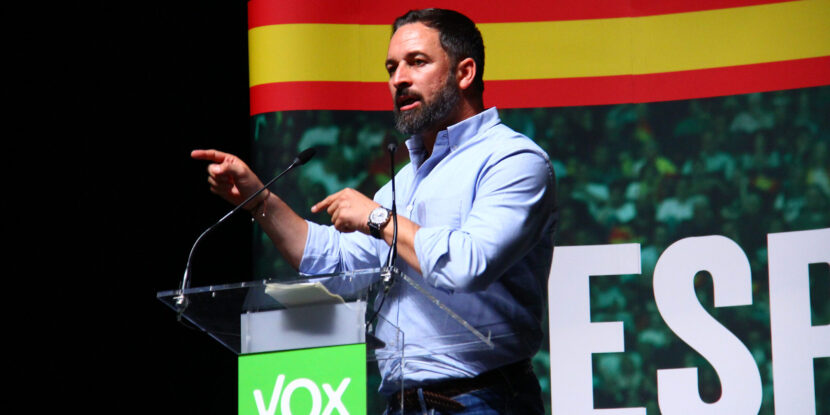
Spain’s 2026 snap general election campaign is underway, and the country’s right-leaning parties are finalizing an electoral pact that could inspire further cooperation between national populists and the center-right across Europe.
The National Pulse brings you news that matters from around the world. If you value the work of Raheem J. Kassam and his team, please JOIN THE NATIONAL PULSE or MAKE A DONATION today.
Election Background.
Earlier this month, Spanish Prime Minister Pedro Sánchez announced a snap election. This followed the Socialist government’s defeat in the legislature over emergency measures intended to address Spain’s worsening housing crisis, which were voted down by the center-right People’s Party (PP), the national populist Vox party, and Junts, a party advocating Catalan independence. Along with Sumar, a far-left electoral alliance, Junts was a critical supplier of votes to Sánchez’s left-wing Spanish Socialist Workers Party (PSOE), which lacks an outright legislative majority.
The decision to call a snap election came after mounting pressure on Sánchez, including a slew of corruption scandals and allegations affecting prominent figures in his government and domestic and international criticism of his handling of an illegal immigrant amnesty and migrant border influx into Ceuta, a Spanish exclave on the coast of North Africa, bordering Morocco.
However, while PP leads in the polls, much of the Spanish right is worried about repeating the outcome of the 2023 general election, in which PP secured more seats than PSOE, but no party won an outright majority and Sánchez struck a governing agreement with various smaller far-left and regionalist parties. PSOE gave significant policy concessions in exchange for parliamentary support, thereby allowing Sánchez to become Prime Minister despite PSOE not being the largest party.
The Agreement.
PP and Vox have made an electoral agreement to maximize the right’s combined strength in Spain’s Senate, which is elected by a party-list system. Under the system, voters choose individual candidates rather than a party.
According to the agreement, Vox will withdraw its Senate candidates in six provinces: Las Palmas, Santa Cruz de Tenerife, Cádiz, Valencia, Castellón, and the Balearic Islands. In the six provinces, a Vox-backed candidate will appear on the PP ticket as an independent. The party will also field only one candidate instead of three in 14 other provinces, allowing voters to support two PP candidates alongside the Vox candidate.
In exchange, PP will withdraw its Senate candidates in three provinces: Gipuzkoa, Girona, and Tarragona, boosting the electoral prospects of Vox candidates.
This agreement aims to help the Spanish right achieve the three-fifths threshold in the upper house required for important institutional appointments. This includes the Constitutional Court, the supreme interpreter of the Spanish Constitution, along with the General Council of the Judiciary, the governing body of Spain’s legal system.
This is not the first time that PP and Vox have worked together, having cooperated at the municipal and regional levels on a number of occasions. However, this is the first time that the two parties have cooperated on a national level. It demonstrates that the Spanish right has made more progress towards internal cooperation than right-leaning parties in other European countries.
In Germany, the populist Alternative for Germany (AfD) is subject to an electoral firewall, meaning that other parties, including the notionally center-right Christian Democratic Union (CDU) formerly led by Angela Merkel, refuse to work with it. Similarly, the establishment-right Republicans in France are officially opposed to working with Marine Le Pen’s National Rally (RN) party, although they have been increasingly permissive of their voters independently supporting RN candidates to prevent left-wing victories.
Meanwhile, according to data released last week, it has been revealed that the remaining supporters of the Conservative Party in the United Kingdom would prefer a coalition with the Liberal Democrats over Nigel Farage’s Reform UK party. The Liberal Democrats are a left-leaning party that supports open borders and reversing Brexit.
Election Forecast.
The Spanish election is scheduled for November 29, with PP and Vox expected to gain seats, while the PSOE is projected to suffer losses. Broad Front, the far-left electoral alliance to succeed Sumar, is also on track for heavy losses.
Specifically, according to polling conducted last week, PP secured 33 percent support, giving the party a seven-point lead over PSOE, which is currently on 26 percent. Meanwhile, Vox is polling at 19 percent, while Broad Front polls at seven percent.
It is possible that the Spanish right’s movement towards cooperation is incentivized by a crowded political field in which the establishment center-right remains viable and the establishment left can mobilize voters focused on preventing right-leaning victories. This is likely strengthened by the imminence of the election, meaning that while many center-right parties across Europe currently refuse to work with national populists, their position is prone to shifting over time.
The National Pulse stays on top of European politics. If you value the work of Raheem J. Kassam and his team, please JOIN THE NATIONAL PULSE or MAKE A DONATION today. We are 100% reader-funded.
Join Pulse+ to comment below, and receive exclusive e-mail analyses.
show less
Spain's 2026 snap general election campaign is underway, and the country's right-leaning parties are finalizing an electoral pact that could inspire further cooperation between national populists and the center-right across Europe.
show more
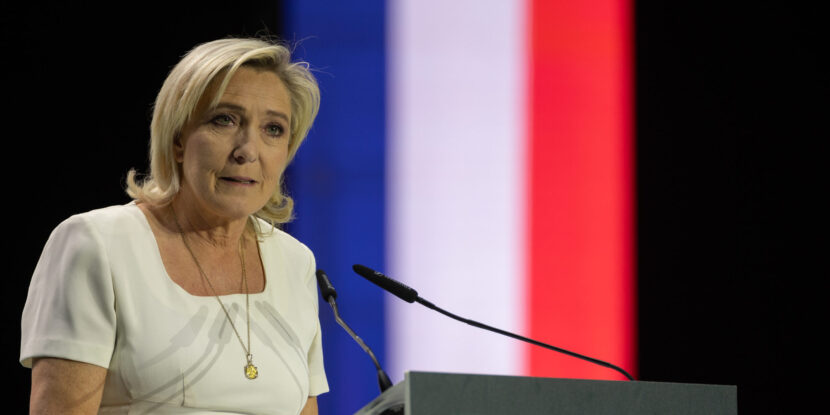
On Sunday, National Rally (RN) party leader Marine Le Pen officially became the party’s nominee for France’s 2027 presidential election. This is far from Le Pen’s first presidential bid, but it is shaping up to be her most successful.
The National Pulse helps you keep track of European politics. If you value the work of Raheem J. Kassam and his team, please JOIN THE NATIONAL PULSE or MAKE A DONATION today.
2012 Presidential Bid.
Le Pen made her first presidential bid in 2012, having succeeded her father, Jean-Marie Le Pen, as leader of the Front National, National Rally’s predecessor party.
The election was held against a backdrop of economic uncertainty from the global financial crisis and the eurozone debt crisis, along with high unemployment and growing frustration with the government of then-President Nicolas Sarkozy. Sarkozy was a member of the Union for a Popular Movement (UMP), an establishment center-right party. He won the 2007 presidential election and sought a second five-year term.
However, François Hollande, the Socialist Party candidate and leader of the establishment center-left, won the first round with 28.6 percent of the vote, whereas the incumbent Sarkozy came second with 27.2 percent. Le Pen placed third in the first round, meaning she was ineligible to advance to the second round run-off, although she secured roughly 17.9 percent of the vote, a record for her party and foreshadowing the growing influence of the French national populist right.
Hollande ultimately won with 51.6 percent of the vote while Sarkozy received 48.4 percent.
2017 Presidential Bid.
Le Pen made her second bid for President in 2017. The election took place amid concerns over unemployment, immigration, Islamic terrorism, and France’s membership of the European Union. Socialist President François Hollande was deeply unpopular and therefore did not seek re-election, creating an open field.
Emmanuel Macron, an economy minister in Hollande’s government at the time, resigned to run for the presidency. The former banker founded the En Marche! movement, a globalist party pulling support from both the establishment left and the establishment right. The party was renamed Renaissance in September 2022.
Macron won the first round with 24 percent of the vote, while Le Pen came second with 21.3 percent. The establishment center-left Socialist Party and the establishment center-right Republicans, the latter of which emerged from the UMP, fell to third and fifth place in the first round.
During the second round, Macron won 66.1 percent of the vote as the establishment united around him, while Le Pen received 33.9 percent. This represented the first time since 2002 that the Front National had advanced to the run-off.
The National Pulse does not rely on government or corporate cash. To keep us RADICALLY INDEPENDENT, please JOIN THE NATIONAL PULSE or MAKE A DONATION today.
2022 Presidential Bid.
Le Pen’s third bid for President happened in 2022. The incumbent President Emmanuel Macron sought a second term amid rising concerns over the cost of living, immigration, security, and the then-new war in Ukraine.
Macron topped the first round with 27.9 percent of the vote, followed by Le Pen with 23.2 percent. The election also saw the far-left Jean-Luc Mélenchon rise to third place with 22 percent, and Éric Zemmour split the national populist vote with 7.1 percent in a fourth-place finish. Meanwhile, support for the country’s establishment center-right and center-left parties cratered, receiving just 4.8 percent and 1.8 percent, respectively.
During the second round, Macron won with 58.6 percent of the vote, while Le Pen received 41.5 percent, representing an improvement on her second round result five years prior. This was Le Pen’s first presidential bid after rebranding her party from the National Front to the National Rally, in order to distance the party from its more radical past under her father and gain more mainstream appeal.
This election saw not only the collapse of France’s establishment political parties, but the emergence of the country’s current three electoral blocs: Macron’s new establishment globalists, Le Pen’s national populists, and Mélenchon’s radical leftists. These divisions are currently reflected in France’s gridlocked legislature, contributing to ongoing political instability in the country.
2027 Presidential Bid.
Le Pen’s fourth and most recent bid for President was announced at the National Rally conference on October 25. “We are not living through the end of the world but the end of a world, their world,” Le Pen declared at the event in Orléans in north-central France this past weekend.
Le Pen also confirmed that if elected President she would appoint Jordan Bardella, who was re-elected as the National Rally’s president at the conference, as Prime Minister.
Le Pen’s nomination by her party coincided with violent riots across the country, which have resulted in the destruction of revered French landmarks such as the Limoges City Hall.
The first round of voting is scheduled for April 18, while the second round has been scheduled for May 2 in the event no candidate wins the first round outright. A victory for Le Pen next year would not only represent the first-ever presidential victory for the National Rally, but the culmination of 15 years of presidential campaigning.
The National Pulse keeps you updated on global politics. If you value the work of Raheem J. Kassam and his team, please JOIN THE NATIONAL PULSE or MAKE A DONATION today. We are 100% reader-funded.
Join Pulse+ to comment below, and receive exclusive e-mail analyses.
show less
On Sunday, National Rally (RN) party leader Marine Le Pen officially became the party's nominee for France's 2027 presidential election. This is far from Le Pen's first presidential bid, but it is shaping up to be her most successful.
show more
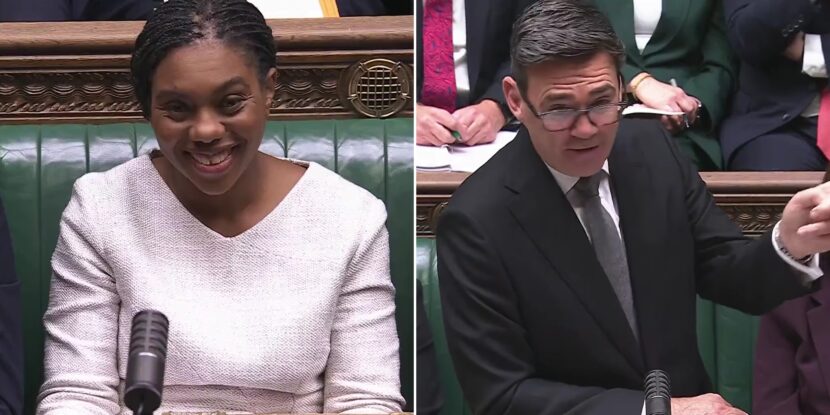
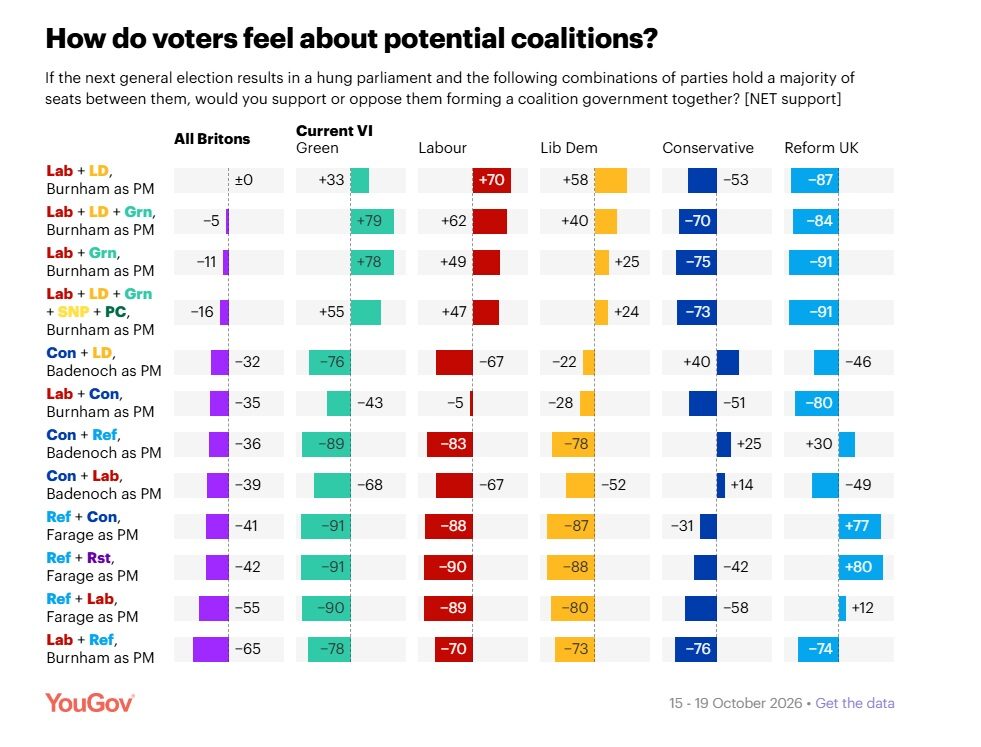
On Thursday, YouGov, the largest polling firm in Britain, published research on the voters’ attitudes regarding potential coalition governments. The data indicates that Kemi Badenoch’s Conservative Party is closer to the political left than the populist right.
The National Pulse keeps you in the loop regarding British politics. If you value the work of Raheem J. Kassam and his team, please JOIN THE NATIONAL PULSE or MAKE A DONATION today.
Coalition with The Liberal Democrats.
According to YouGov’s polling, the remaining supporters of Kemi Badenoch’s Conservative Party view a hypothetical coalition with the Liberal Democrats more favorably than a coalition with Nigel Farage’s Reform UK party. Specifically, 68 percent favor the former while only 60 percent favor the latter.
The poll showed that a Badenoch-led coalition between the Conservatives and the Liberal Democrats had a net positive of +40 with Conservative supporters. In contrast, a Badenoch-led coalition between the Conservatives and Reform scored a net positive score of +25.
The same polling also revealed that current supporters of the Conservative Party would prefer a coalition with the Labour Party, provided it was led by Badenoch, over a Farage-led coalition with Reform. Specifically, the former had a net positive of +14, whereas the latter had a net negative of -31.
Notably, Labour supporters did not reciprocate, with the hypothetical Badenoch-led coalition polling at a net negative of -67. The most popular combination with Labour supporters was a coalition with the Liberal Democrats led by Burnham, with a net positive figure of +70.
Labour supporters overwhelmingly rejected working with Reform, even if Burnham was Prime Minister, with a Farage-led Reform-Labour coalition having a net negative figure of -89 and a Burnham-led Labour-Reform coalition having a net negative figure of -70. However, Labour supporters polled a very slight net negative of -5 regarding a hypothetical coalition with the Tories with Burnham as Prime Minister. This suggests that while both Labour and Conservative supporters want their respective leaders to be Prime Minister, both parties’ supporters are considerably less hostile to each other than they are to Reform.
These figures raise the question of whether the Conservatives under Badenoch can meaningfully be considered a conservative or right-wing party.
The Liberal Democrats are a progressive party that supports reversing Britain’s democratic decision to leave the European Union. The party also supports liberalizing border controls and supports remaining in the European Convention on Human Rights (ECHR), a treaty which is regularly used to block deportation flights for illegalmigrants and foreign-born criminals. The party also strongly supports Net Zero.
Under Burnham, the Labour Party has shifted noticeably to the left on a number of issues. The Labour-led government has also overseen an increase in illegal immigration. According to data released back in August, an average of 130 illegal migrants arrived per day during Burnham’s first three weeks in office, constituting an increase from the average of 103 who arrived during the first three weeks of former Prime Minister Sir Keir Starmer’s tenure.
The polling repeatedly demonstrates that Conservative supporters would only back a right-leaning coalition with Reform if Badenoch was in charge, while Reformers were shown to be more pragmatic. “Most Conservative and Reform supporters would back a Badenoch-led coalition between the two parties, but Tories are opposed if Farage was in charge,” notes the YouGov report’s summary.
This suggests that Conservative supporters are not only prepared to form coalitions with left-leaning parties, but prioritize the interests and influence of their party over implementing a right-wing policy platform.
The National Pulse gives you the data that matters. If you value the work of Raheem J. Kassam and his team, please JOIN THE NATIONAL PULSE or MAKE A DONATION today. We are 100% reader-funded.
Join Pulse+ to comment below, and receive exclusive e-mail analyses.
show less
On Thursday, YouGov, the largest polling firm in Britain, published research on the voters' attitudes regarding potential coalition governments. The data indicates that Kemi Badenoch's Conservative Party is closer to the political left than the populist right.
show more
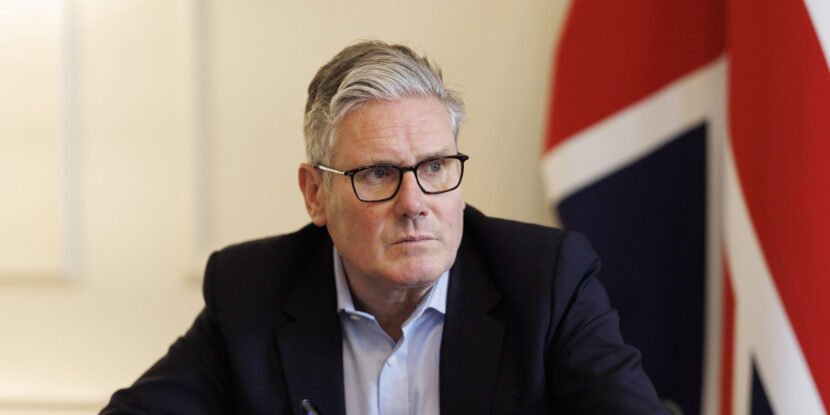
Former Prime Minister of the United Kingdom Sir Keir Starmer was summoned to give evidence as a “core participant” in the country’s ongoing national inquiry into the grooming gangs scandal last week.
The National Pulse keeps you updated on British politics. If you value the work of Raheem J. Kassam and his team, please JOIN THE NATIONAL PULSE or MAKE A DONATION today.
Background.
The United Kingdom’s national grooming gangs inquiry follows years of scandals involving the sexual exploitation of mostly white children by gangs of mostly Pakistani Muslim men, while the authorities repeatedly failed to protect victims.
Specifically, the scandals revolved around Muslim men targeting white working-class girls in towns such as Rotherham, Rochdale, Bradford, and Oldham. However, due to the demographics of the victims and the perpetrators, British authorities were often reluctant to investigate due to fears of being seen as “racist” and fueling community cohesion, on occasion dismissing victims as young as 12 as “child prostitutes” making a “lifestyle choice.”
Pressure for a new national investigation intensified during former Prime Minister Sir Keir Starmer’s premiership, especially throughout 2024 and 2025. Starmer’s Labour governmentinitially resisted calls for a statutory inquiry. This followed the decision of then-Minister for Safeguarding and Violence Against Women and Girls Jess Phillips to reject a request from Oldham Council for a government-led investigation in October 2024. The government’s decision to vote against launching the inquiry triggered widespread public backlash.
In response, the Starmer government commissioned Baroness Louise Casey, a Crossbench peer in the House of Lords, the upper house of the British legislature, to conduct a national audit of group-based child sexual exploitation. Her June 2025 report recommended both a national police operation and a national statutory inquiry, and the government subsequently announced an inquiry later in the month.
Officially “The Statutory Independent Inquiry into Grooming Gangs,” the investigation is set to span three years. It has a £65 million budget.
While it will not investigate every location where grooming gangs have operated, the investigation will utilize information collected from areas including Oldham, Bradford, Keighley, London, and Birmingham.
The inquiry formally began in April 2026 under Baroness Anne Longfield, a Labour peer and the former Children’s Commissioner for England. Rather than merely examining individual cases, the inquiry aims to understand why institutions failed to respond effectively and why recommendations from earlier investigations did not consistently lead to change. Specifically, the inquiry will investigate the more than 800 recommendations that have been made by previous reviews and inquiries over approximately two decades.
Under the Inquiries Act 2005, the inquiry has significant legal powers, including the power to require witnesses to give evidence and organizations to provide documents. The inquiry also has the power to pass on evidence suggesting criminal activity to the police.
What This Means For Starmer.
As a “core participant,” Starmer is viewed by the inquiry as having sufficient connection to the matters being investigated. Starmer has served as both Prime Minister and Director of Public Prosecutions (DPP), putting him in a uniquely difficult position. Specifically, Starmer served as DPP from 2008 to 2013, when several major child sexual exploitation cases were being investigated. Due to the focus on the inquiry on institutional failures, Starmer is likely to be subject to intense scrutiny. The inquiry is also likely to question the former Prime Minister’s decision to block a national inquiry back in 2025.
This could represent Starmer’s first major appearance in national public life since stepping down as Prime Minister back in July and being replaced by Prime Minister Andy Burnham. Starmer announced his resignation in June, a month after the Labour Party suffered critical losses in local elections to Nigel Farage’s Reform UK party. Starmer also resigned his seat in Parliament in September.
The National Pulse is dedicated to high-quality reporting. If you value the work of Raheem J. Kassam and his team, please JOIN THE NATIONAL PULSE or MAKE A DONATION today. We are 100% reader-funded.
Join Pulse+ to comment below, and receive exclusive e-mail analyses.
show less
Former Prime Minister of the United Kingdom Sir Keir Starmer was summoned to give evidence as a "core participant" in the country's ongoing national inquiry into the grooming gangs scandal last week.
show more
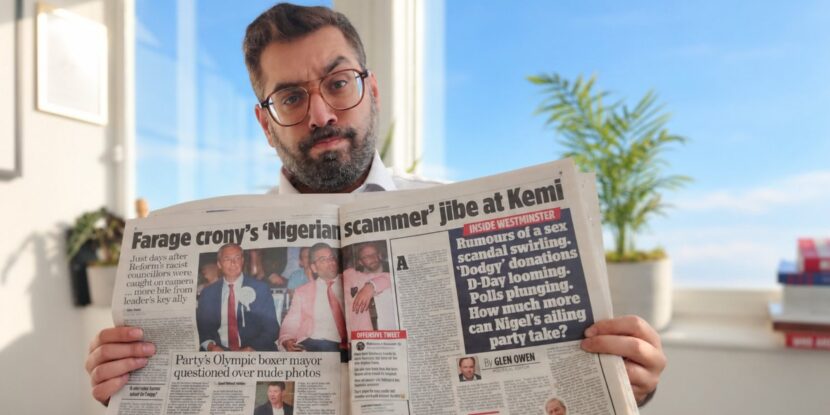
The British establishment media has spent days targeting Raheem Kassam, Editor-in-Chief of The National Pulse, for branding Conservative Party leader Kemi Badenoch a “Nigerian scammer.” Media organizations including LBC, The Huffington Post, and the notionally right-leaning Daily Mail, which employs former Labour and Hope Not Hate activist Dan Hogdges, have joined the deeply chequered Conservative Party chairman Kevin Hollinrake in attacking Reform figures, including Robert Jenrick and Danny Kruger, for declining to denounce Kassam as “racist,” with Kruger dismissing the supposed controversy as “rumbustious debate online.”
Kassam has responded to the attacks with a detailed thread providing evidence that Badnenoch is a “scammer,” and noting that “Nigerian” is not a race. Significantly, Badenoch has also indicated that she does not believe “Nigerian” is a race, previously stating that she identifies with her “specific ethnicity” as a Yoruba, and that she regards northern Nigerians as her “ethnic enemies.”
I enjoyed this. Nigerian isn't a race, and calling her a scammer because she invokes it when its politically convenient isn't racism.
Kemi is a scammer.
On race, on politics, on the economy, on her own background, and more.
Reader support allows Raheem J. Kassam and his team to bring you honest, forthright news and analysis without fear of cancel culture. To keep our work RADICALLY INDEPENDENT, please JOIN THE NATIONAL PULSE or MAKE A DONATION today.
Selective Nigerian Identity.
Kassam’s core point is straightforward. Badenoch was born in Wimbledon, London, in 1980 to visiting Nigerian parents, who immediately returned to Nigeria to raise her. Early in her British political career, she directly appealed to Nigerian diaspora voters for support, and suggested she entered British politics to “[speak] for the Africans,” particularly on foreign aid.
Badenoch has at times emphasized her Nigerian roots and, in footage highlighted by Kassam from 2022, told a Nigerian audience she loves Nigeria “just as much as” England while speaking in a Nigerian accent. At other times—particularly when speaking to British audiences—she has said she no longer identifies as Nigerian, or even, as mentioned previously, that she has never identified as Nigerian, but only as a Yoruba.
Kassam argues this is convenient identity politics: using her Nigerian background for career advancement or making emotional appeals situationally, but downplaying it when dual loyalty concerns arise. He has noted he is Indian by heritage, but would never declare equal love for India and Britain.
Have you seen this before???
When Kemi Badenoch speaks to other Nigerians, she turns off her fake English accent.
She also tells them that she loves Nigeria just as much as England.
And what’s all this about saying Islamic prayers in Nigeria?
Badenoch has repeatedly said that at age 16, while attending school in the U.S., strong SAT scores earned her an offer and partial scholarship to study medicine or “pre-med” at Stanford, but her family could not afford it. Former Stanford admissions staff have called this implausible or impossible, as Stanford has no undergraduate pre-med degree.
Admissions were also not based on test scores alone, and partial scholarships of the type Badenoch described were not how the university operated at the time—if they admitted someone who needed aid, they covered the full cost so the student could enroll. Badenoch has stood by the story, but says she no longer has the paperwork to prove it.
This is one of several origin-story embellishments. Earlier reporting has also challenged a claimed national girls’ chess championship win at age seven, which, if it ever took place, appears to have involved only two competitors, and questions around Badenoch’s account of a supposedly difficult Nigerian childhood, despite the fact that her father was a doctor with a clinic and she attended elite schools.
Inconsistencies.
Kassam also referenced “Melonigate,” a conversation reported by The Times in which Italian Prime Minister Giorgia Meloni supposedly advised Badenoch against any electoral arrangement with Nigel Farage and Reform UK. Meloni’s party subsequently indicated that no such discussion took place, and The Times made extensive stealth edits to remove the claims without a proper correction note.
On the European Convention on Human Rights (ECHR), Badenoch previously said leaving it would not be a “silver bullet” for immigration control. She now claims she would abrogate the convention, despite her party upholding it over 14 years in government while overseeing record immigration and falling deportations.
As Equalities Minister, she advanced the “Inclusive Britain” agenda, including ethnicity pay gap reporting and pushing for greater racial diversity in the judiciary and policing, despite public criticism of DEI. Farage has called the shift “totally disingenuous.”
On the Chagos Islands, Badenoch attacked Farage’s comments about offering the U.S. perpetual use of the vital Diego Garcia base as “humiliating” and falsely claimed the Reform leader was advocating giving away the British territory. The U.S. government publicly rebuked her for “spreading fake news,” clarifying that Farage was referring to continued U.S. use of the Diego Garcia base, not transferring control over the islands to the U.S. Significantly, Britain’s negotiations to hand the territory to Mauritius began under the Conservatives, while Badenoch was a government minister.
British Conservative (Tory) Party leader Kemi Badenoch has been rebuked by the White House after she attacked Reform UK party leader Nigel Farage over recent comments about the Chagos Islands, with a senior official accusing her of spreading “fake news” and undermining the… pic.twitter.com/GFcMMxjmnC
Deep dives exposing the gap between politicians’ public and private positions take time and research to assemble. To support this work, please JOIN THE NATIONAL PULSE or MAKE A DONATION today.
Same Old Tories.
Kassam noted that the vast majority of Badenoch’s top team are, like her, veterans of the failed 2010–2024 Conservative governments which botched Brexit and accelerated Net Zero and mass migration, warning voters: “There is a REASON that 92% of her shadow cabinet are the same Tory ministers and spads from the failed 14 years. Don’t fall for the great Kemi scam.”
He also noted that her husband Hamish Badenoch has been described in the press as a “sopping wet Remainer,” firmly on the left of the Conservative Party.
Kassam has doubled down on the original “Nigerian scammer” line as a colorful way to draw attention to his underlying critique of Badenoch as, at best, a serial embellisher and political chameleon, whose record and actions do not match her public positions.
The Conservatives joining the left-wing media in focusing on Kassam’s reference to her Nigerian nationality and demanding ritual disavowals from Reform figures, instead of focusing on the substance of the critique, shows they remain a fundamentally center-left party in hock to leftist identity politics and political correctness.
American observers will recognize the pattern. When a politician’s résumé, past statements, and policy consistency face detailed challenge, establishment outlets and politicians pivot to policing the tone of the critique on woke, left-wing terms. Kassam’s receipts are there for anyone with the wherewithal to read past the familiar accusation of “racism.”
Kemi Badenoch is an unrelenting scammer, and she has used her Nigerian background as a means by which to advance her career when it suits her. Of that there can be no doubt. A thread… 🧵
Lets start with HER STORY of how she joined the Tories in order to promote foreign aid to… pic.twitter.com/lvLRrODAwh
To help Raheem J. Kassam and his team hold the political class to account free from corporate influence, please JOIN THE NATIONAL PULSE or MAKE A DONATION today.
Join Pulse+ to comment below, and receive exclusive e-mail analyses.
show less
The British establishment media has spent days targeting Raheem Kassam, Editor-in-Chief of The National Pulse, for branding Conservative Party leader Kemi Badenoch a “Nigerian scammer.” Media organizations including LBC, The Huffington Post, and the notionally right-leaning Daily Mail, which employs former Labour and Hope Not Hate activist Dan Hogdges, have joined the deeply chequered Conservative Party chairman Kevin Hollinrake in attacking Reform figures, including Robert Jenrick and Danny Kruger, for declining to denounce Kassam as "racist," with Kruger dismissing the supposed controversy as “rumbustious debate online.”
show more
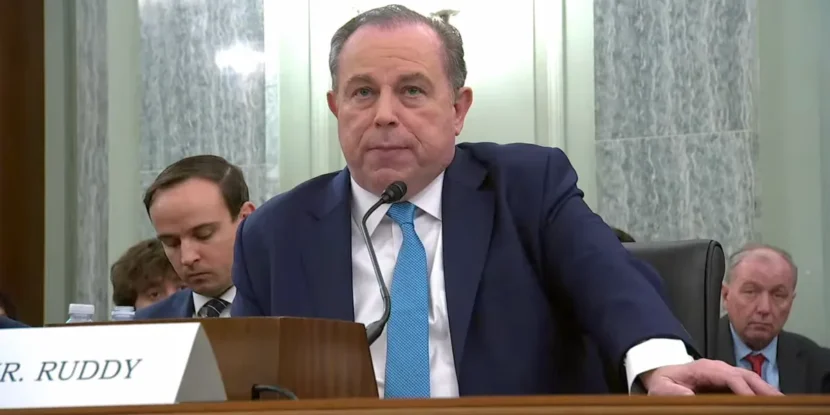
Newsmax’s CEO, Chris Ruddy, sells his network to conservative, pro-free market viewers. But when his competitors seek room to grow in that market, he seems remarkably comfortable with the left-wing Washington D.C. establishment keeping them down.
Take, for examples, his recent campaign against Fox’s proposed acquisition of Roku, his opposition to broadcast deregulation, and his endorsement of Biden FCC nominee Gigi Sohn. What might be dismissed as individual incidents are actually a remarkable pattern of behavior. Flatly: Ruddy’s commercial interests keep finding common ground with the political left.
His historic Clinton connection provides useful context.
In 2015, Newsmax made a 5-year, $1 million pledge to the Clinton Foundation. The network’s own coverage acknowledged the commitment, with Ruddy personally advancing a preponderance of excuses about it.
Ahead of that fateful 2016 election that would send Donald Trump to the White House, Ruddy was helping fund the Clinton empire. Shame on him, of course.
A leopard clearly never changes his spots. Ruddy’s renewed efforts to constrain competing media organizations raises burning questions about what his and Newsmax’s version of conservatism actually delivers.
In September, Semafor reported that Ruddy and allies in the White House had pressed Trump Justice Department antitrust officials to block Fox’s $22 billion acquisition of Roku. The report cited people familiar with the matter, as well as communications reviewed by the outlet. The campaign followed Newsmax’s litigation against Fox, which alleges exclusionary distribution arrangements. Clearly, this is a back and forth media mess being played out in Washington, D.C., subsidized by you, the taxpayer.
Semafor says Fox characterised the litigation as an attempt to “sue their way out of their own competitive failures.” It’s not a bad point, and a fairly wounding dig.
Should conservative media companies win viewers by producing better journalism and building themselves up better, as Real America’s Voice has done? Or should they seek government intervention when their competitors become harder and harder to beat?
Further still, Ruddy has opposed efforts to remove the FCC’s national television ownership cap, a subject we reported on earlier this year, at length. This cap limits a station group’s reach to 39 percent of American television households. Newsmax, a national cable network, faces no equivalent restriction. So why should they care? In fact, they love this government restriction on the free press.
In July, former FCC adviser Evan Swarztrauber argued that Ruddy’s position protected Newsmax against stronger competitors, including Sinclair and Nexstar, the owner of NewsNation. This put Ruddy firmly in the same camp as Elizabeth Warren.
Conservatives should be willing to scrutinize this outdated arrangement. A regulatory advantage for Ruddy hardly advances the interest of the viewer. At all, we would argue.
Ruddy’s willingness to support a Democratic regulator was readily apparent during the Biden government’s regrettable years. He backed Gigi Sohn’s nomination to the FCC, despite her track record of attacking conservative outlets.
The Wall Street Journal’s editorial board highlighted her description of Fox News as “state-sponsored propaganda” as well as her suggestion that Sinclair’s broadcast licence be revoked. Ruddy explained his support by invoking the FCC’s role in promoting diversity, localism, and competition. Yeah, right.
The established pattern warrants honest interpretation: competition becomes a cause for regulatory concern when it threatens Newsmax, while a progressive nominee becomes acceptable when she might help independent networks secure distribution.
Ruddy can defend those choices as business decisions. But conservative viewers can judge them for what they are.
We know that Chris Ruddy was recently lobbying members of the Judiciary Committee to kill Adam Candeub’s nomination to serve as Assistant Attorney General. Candeub has consistently stood against Big Tech censorship and market consolidation. He has been a vocal advocate for Trump admin efforts to modernize media regulations, allowing broadcasters to better compete with Big Tech platforms for advertising dollars and market share.
As we reported in January this year, Ruddy’s efforts in lobbying President Trump simply for the interests of his own personal fortunes will scarcely be appreciated by his albeit diminishing conservative audience.
show less
Newsmax's CEO, Chris Ruddy, sells his network to conservative, pro-free market viewers. But when his competitors seek room to grow in that market, he seems remarkably comfortable with the left-wing Washington D.C. establishment keeping them down.show more
Sir James Cleverly, the Conservative Member of Parliament (MP) for Braintree and frontrunner for his party’s 2028 London mayoral nomination, stepped down from Kemi Badenoch’s Shadow Cabinet in late August 2026 to focus on the City Hall contest. A former Home Secretary and Foreign Secretary during the Conservatives’ most recent stretch in government (2010–2024), he now positions himself as an alternative to Lord Sadiq Khan, the Labour Party incumbent. However, a closer look at his views and record reveals a center-left politician more at ease with open borders and a multicultural redefinition of Britishness than with traditional conservative priorities such as immigration enforcement and maintaining national cohesion.
Open Borders in the Guise of ‘Free Market Labor Movements.’
Despite the party’s center-right branding, Cleverly has long advocated positions that treat mass migration primarily as an economic boon. He has written approvingly of a future defined by “free market labor movements”—that is, open borders for foreign workers, prioritizing employer demand over domestic wage pressures or community capacity.
He did advocate for the shift towards open borders to be evolutionary rather than revolutionary, due to the social upheaval it would cause, but still predicted that “At some point in the future we will look back at our current (fairly) protectionist policies on free market labour movements with the same disbelief that we look back on the corn laws.”
As Home Secretary, Cleverly presided over the tail-end of the Boriswave influx. While he claimed that the unprecedented post-COVID migration spike his party engineered had been a “fatal mistake,” his earlier enthusiasm for liberal international labor markets puts him firmly in the camp of Conservatives whose public, restrictive position on immigration did not match his record.
Woke on Identity: Redefining Britishness as Defined by Foreign Foods and Imports.
Cleverly has a distinctly woke-left view of national identity. In one article, he described Britishness exclusively in terms of consuming foreign goods: “Being British is about driving in a German car to an Irish pub for a Belgian beer, then travelling home, grabbing an Indian curry or a Turkish kebab on the way, to sit on Swedish furniture and watch American shows on a Japanese TV.”
Cleverly’s view elevates the enjoyment of foreign goods, cuisine, and media as the essence of Britishness. It echoes the broader progressive insistence that diversity is the defining feature of modern Britain, rather than national traditions or the national language, institutions, and history. Critics see it as the opposite of a coherent civic or cultural identity, replacing nationhood with a cosmopolitan marketplace.
I’m proud to be Chairman of the @Conservatives, I’m proud to be part of the most diverse cabinet in history, and I’m proud of how my party is championing diversity. https://t.co/baKpndOWYo
Labeling Immigration Skeptics ‘Extremist and Racist.’
The son of an immigrant from Sierra Leone, Cleverly has repeatedly insisted that Britain’s social cohesion and sense of identity “is not being watered down by immigration.” Those who argue otherwise, he has maintained, are “extremist and racist.”
He has extended this claim across centuries of arrivals: “We have managed to stay British through immigration from the Romans, Saxons, Vikings, Normans, Huguenots, Jews, Irish, West Indians, West Africans, East Africans, Indians, Pakistanis, etc., etc., etc. Britishness evolved, but it did not diminish.”
Notably, the “immigration” of the Romans, Saxons, Vikings, and Normans generally involved the violent overthrow of the existing political, social, and sometimes cultural order, suggesting that their arrival did indeed fundamentally alter the national character.
Party Context Under Badenoch.
Cleverly’s outlook sits comfortably within the current Conservative leadership. Party leader Kemi Badenoch has described herself as a “first-generation immigrant,” being born in London but raised in Nigeria. Like Cleverly, Badenoch publicly strikes a restrictionist posture on immigration, but her record in government includes lobbying to have limits on foreign students and migrant workers removed, which helped create the Boriswave.
Longstanding Hostility to Trump and America First.
Cleverly’s liberal instincts on migration and identity pair with strong disdain for President Donald J. Trump and the America First movement. In 2015, he publicly urged Republicans not to nominate Trump, writing on Twitter (now X): “Dear Republican colleagues, please, please, please don’t choose Donald Trump as the front man for American Right-of-Centre politics. Please.”
After Trump’s 2016 election and 2017 inauguration, Cleverly denounced the administration’s policies on immigration and Syrian refugees as “indefensible, unworkable and almost certainly unconstitutional.” By contrast, he later spoke warmly of meeting then-President Joe Biden in 2024, calling the Democrat “a great friend to the UK” despite his open hostility to Britain in general and the English in particular.
Join Pulse+ to comment below, and receive exclusive e-mail analyses.
show less
Sir James Cleverly, the Conservative Member of Parliament (MP) for Braintree and frontrunner for his party’s 2028 London mayoral nomination, stepped down from Kemi Badenoch's Shadow Cabinet in late August 2026 to focus on the City Hall contest. A former Home Secretary and Foreign Secretary during the Conservatives’ most recent stretch in government (2010–2024), he now positions himself as an alternative to Lord Sadiq Khan, the Labour Party incumbent. However, a closer look at his views and record reveals a center-left politician more at ease with open borders and a multicultural redefinition of Britishness than with traditional conservative priorities such as immigration enforcement and maintaining national cohesion.
show more
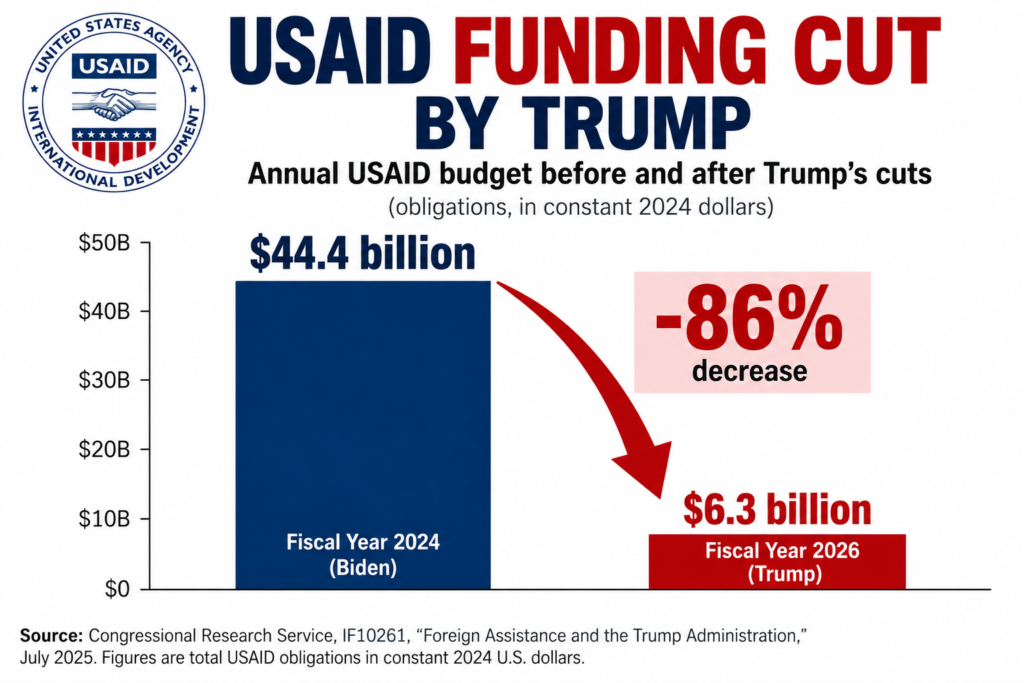
A Biden-era grant to a Serbian political organization is raising fresh questions about the legacy of the United States Agency for International Development (USAID), the foreign aid organization targeted for dismantling by President Donald J. Trump.
The National Pulse gives you deep dives into the issues that matter. To help support Raheem J. Kassam and his team continue this work, please JOIN THE NATIONAL PULSE or MAKE A DONATION today. We are 100% reader-funded.
For decades, USAID presented itself as being engaged in altruistic operations like humanitarian assistance and economic development. However, its real, deeper history involved financing political opposition movements and so-called “color revolutions,” partisan media operations, voter-mobilization campaigns, and progressive ideological initiatives worldwide.
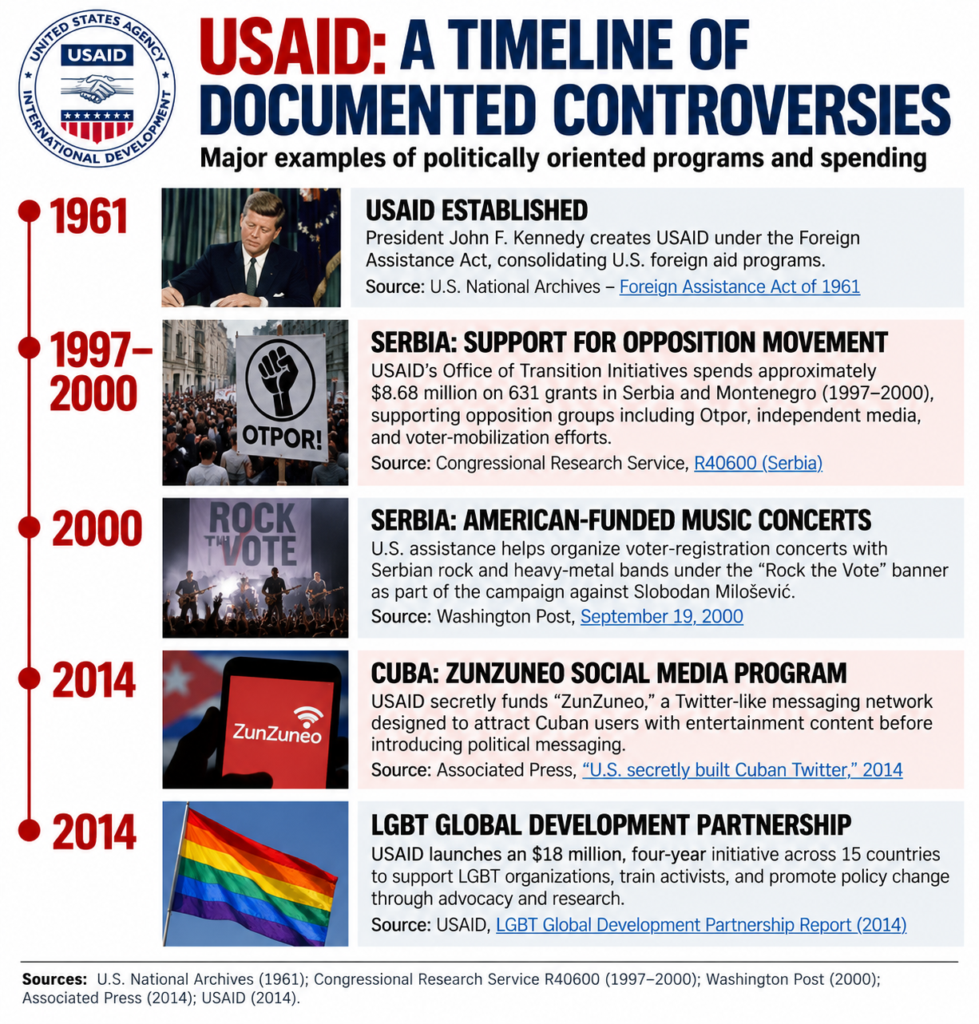
From the campaigns to topple former Serbian President Slobodan Milošević in 2000 to covert social media operations in Cuba, USAID’s political activities have frequently flown under the radar compared to more prominent humanitarian spending on things like food and medical aid.
The agency’s involvement in foreign politics is not simply a matter of speculation. Congressional documents, official USAID records, and various investigations have proven its role in promoting political transitions, cultivating activists, and advancing the preferred policies of agencies like the CIA and the Deep State overseas.
Serbia: American Money and a New Political Crisis.
The Center for Research, Transparency, and Accountability (CRTA), a Serbian NGO involved in election monitoring and public advocacy, has received $832,432.47 under a Biden-era USAID grant, with approximately $2.8 million yet to be given, meaning that despite massive cuts to USAID under the second Trump administration, money is still flowing to its political programs.
The award, established in 2023, supposedly for election integrity activities, was expanded on January 17, 2025, just three days before President Trump’s second inauguration.
The revelations come as Serbia prepares for parliamentary elections on October 25, with student-led protests presenting a serious challenge to the political establishment associated with former President Aleksandar Vučić. CRTA has publicized the protesters’ demands, while Vučić has accused foreign-backed NGOs of attempting to destabilize his government.
USAID’s Cold War Origins and CIA Connections.
USAID was established by President John F. Kennedy in 1961, consolidating America’s foreign development programs into an agency intended to promote economic growth and stability overseas. The agency was created amid the Cold War and was largely used as a tool of “soft power” to influence regimes away from the USSR.
Its activities sometimes overlapped with American intelligence objectives. Accounts of Cold War operations in Southeast Asia describe the CIA’s use of USAID-related arrangements, including testimony concerning USAID cover in Laos. Some have even described USAID as a “cover” for CIA activity.
USAID’s political functions were also openly acknowledged. A Congressional Research Service examination of the agency’s Office of Transition Initiatives (OTI) detailed its involvement in politically sensitive transitions, including support for opposition organizations in Serbia in the 1990s.
How Washington Helped Overthrow Serbia’s Milošević.
The most striking historical parallel to the current Serbian controversy is the American-financed campaign against Yugoslav President Slobodan Milošević in 2000. A Washington Post investigation published in December 2000 documented approximately $41 million in American appropriations during 1999 and 2000, much of which supported the political infrastructure opposing Milošević.
The campaign included political consultants, opinion polling, opposition training, election monitoring, and mass-produced propaganda. American taxpayers financed 2.5 million stickers bearing the Serbian slogan “Gotov je,” meaning “He’s finished,” as well as 5,000 cans of spray paint used by activists to spread anti-Milošević messages.
The International Republican Institute also trained leaders of Otpor, the student resistance movement that became central to Milošević’s downfall. American-funded consultants helped opposition groups develop messaging and mobilization strategies.
Popular culture was another weapon. A separate Washington Post report revealed that American assistance reached Serbian heavy-metal bands participating in voter-registration concerts under the banner of “Rock the Vote.”
A subsequent USAID evaluation documented the political importance of the agency’s Serbian activities. According to a Congressional Research Service summary, OTI spent approximately $8.68 million on 631 grants in Serbia and Montenegro between 1997 and October 2000.
Cuba: USAID’s Secret Social Media Network.
During the Obama administration, USAID secretly financed a Twitter-like communications network in Cuba called ZunZuneo. The platform used intermediaries and offshore arrangements to conceal its American government financing.
The service initially distributed material about sports, music, and entertainment, attracting Cuban users who were unaware of USAID’s involvement. Internal documents described ambitions to introduce political messaging and encourage mobilization against the Castro government. The operation even exploited interest surrounding a major concert by Colombian singer Juanes to test its messaging capabilities.
A subsequent USAID Inspector General investigation confirmed that implementers had deliberately concealed the American government’s role, including through offshore corporate arrangements. USAID disputed allegations that the project constituted a covert regime-change operation, arguing that discretion was necessary to protect participants and circumvent Cuban censorship.
Despite USAID’s statements, the operation revealed yet another time the agency had meddled in the political affairs of another country under the guise of being simply dedicated to humanitarian ventures.
Millions for LGBT Activism and Progressive Causes.
Beyond attempts to influence foreign governments, USAID also became an important international financier of progressive social ideologies across the globe, much of which was revealed when President Trump’s Department of Government Efficiency (DOGE) looked into USAID’s activities in 2025.
Under former President Barack Obama, the agency expanded its involvement in LGBT advocacy through partnerships with organizations including the Astraea Lesbian Foundation for Justice, the Gay & Lesbian Victory Institute, and the Swedish Federation for LGBT Rights. According to USAID’s own partnership report, the LGBT Global Development Partnership represented an $18 million, four-year public-private initiative spanning 15 countries.
Its objectives included strengthening LGBT civil society organizations, training activists to participate in democratic processes, and conducting research intended to influence policy.
A Williams Institute analysis reported that USAID’s dedicated LGBT programming increased from approximately $6 million in 2021 to $25 million in 2024 under President Joe Biden. The agency also supported initiatives in Asia and Latin America addressing LGBT legal rights, discrimination, and political participation.
A 2015 Obama White House fact sheet disclosed approximately $3.3 million in USAID spending on stand-alone LGBT programs during fiscal year 2014, alongside $113 million in broader health and human-rights programs relevant to LGBT populations. Critics have questioned why American taxpayers were financing overseas social advocacy and political organizing, particularly in countries with different cultural and religious traditions.
Trump’s Crackdown—and the Political Networks Left Behind.
President Trump’s effort to dismantle USAID’s massive institutional structure represented a major challenge to Washington’s traditional foreign-aid establishment. For supporters of the America First agenda, the agency’s record raised a fundamental question: Why should American taxpayers finance political activism, foreign NGOs, and ideological initiatives overseas?
The historical record provides considerable evidence that USAID supported more than humanitarian assistance. In Serbia, its funding helped opposition activists defeat an incumbent government. In Cuba, it financed a communications network whose American sponsorship was deliberately concealed. Elsewhere, it supported organizations seeking changes to social policies and political participation.
The renewed controversy in Serbia suggests that dismantling an agency’s bureaucracy has not necessarily eliminated the infrastructure it created, nor stopped all of its funding.
Join Pulse+ to comment below, and receive exclusive e-mail analyses.
show less
A Biden-era grant to a Serbian political organization is raising fresh questions about the legacy of the United States Agency for International Development (USAID), the foreign aid organization targeted for dismantling by President Donald J. Trump.
show more
Share Story
FacebookTwitterWhatsappTruthTelegramGettrCopy Link
Real News Fan? Show It!
Many people are shocked to learn that because of active censorship, we currently have to spend more time making sure you can even see The National Pulse, than on producing the news itself. Which sucks. Because we do this for the truth, and for you.
But the regime doesn’t want you being informed. That’s why they want us to go away. And that will happen if more people don’t sign up to support our work. It’s basic supply and demand. So demand you get to read The National Pulse, unrestricted. Sign up, today.
We don’t sell ads, and refuse corporate or political cash. It all comes down to you, the reader. I hope you can help.
















.jpg)


