



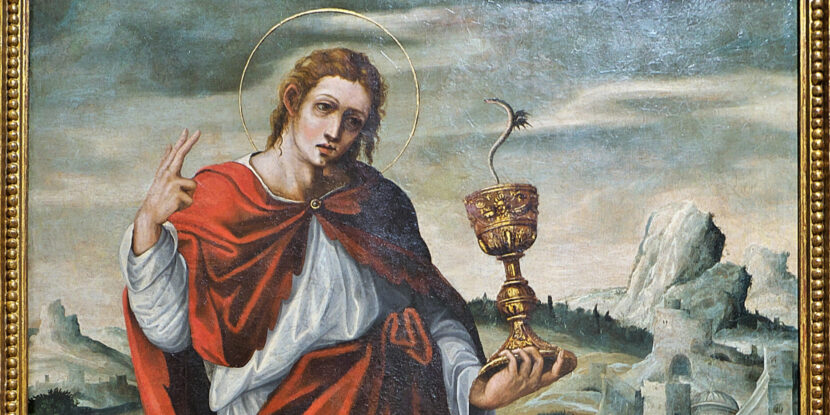

The Third Day of Christmas is the Feast of Saint John the Apostle, also known as St. John the Evangelist and St. John of Patmos. In the New Testament, he is affectionately referred to as “the disciple whom Jesus loved.”
While St. Stephen, commemorated on the Second Day of Christmas, died as a martyr, St. John lived to a ripe old age, and he is unique among the Twelve Apostles as the only one of them to die of natural causes rather than violence. His lasting gifts to Christianity include the Gospel of John, three New Testament epistles (letters), and the awe-inspiring Book of Revelation, composed during his exile on the Greek island of Patmos.
According to tradition, St. John once escaped his own martyr’s death when conspirators in Ephesus offered him a cup of poisoned wine. He blessed it, and the poison slithered out in the form of a serpent. Many of the depictions of St. John show him holding this cup, often complete with the serpent.
This story inspires a cherished custom on his feast day: drinking a warm, spiced wine called “St. John’s Love,” typically flavored with cinnamon, cloves, and other seasonal spices. In England, this mulled wine was historically shared from a large communal wassail bowl.
Catholic Christians will often bring wine to Mass on the Third Day of Christmas for a special blessing. The blessed wine is saved for important events, such as weddings, or sometimes administered to Christians nearing the end of their earthly lives.
But whether you’re Catholic or not, gathering with family and friends to share a cup of St. John’s Love is a wonderful way to extend the Christmas cheer. If your mother is still with you, perhaps you might offer the first cup to her, in memory of Christ entrusting His own mother to St. John’s care—and vice versa—from the Cross: “When Jesus therefore saw His mother, and the disciple whom He loved standing by, He said to His mother, ‘Woman, behold thy son!’ Then He said to the disciple, ‘Behold thy mother!'”
Join Pulse+ to comment below, and receive exclusive e-mail analyses.