❓WHAT HAPPENED: The Consumer Price Index (CPI) rose just 2.4 percent in January compared to the same month last year, marking the slowest pace of inflation since May 2025.
👤WHO WAS INVOLVED: The Bureau of Labor Statistics and U.S. consumers.
Newsletter
Need to Know.
Your free, daily feed from The National Pulse.
Thank You!
You are now subscribed to our newsletter.
📍WHEN & WHERE: January 2026, with data released Friday, February 13, 2026, following a delayed report due to a recent government shutdown.
🎯IMPACT: Easing inflation may provide some relief to consumers, though many still feel burdened by rising costs of living.
IN FULL
The Consumer Price Index (CPI) increased by just 2.4 percent in January compared to the previous year, according to data released by the Bureau of Labor Statistics on Friday. This marks the slowest annual inflation rate since May 2025 and is a decrease from December’s 2.7 percent pace.
Economists polled by FactSet had forecast a 2.5 percent rise in January’s CPI. While food and shelter costs climbed at a faster rate, a 1.5 percent decline in energy prices helped offset the overall inflation rate.
Core inflation, which excludes volatile food and energy prices, rose 2.5 percent over the past 12 months. The CPI measures changes in the cost of a basket of goods and services commonly purchased by consumers, such as food and clothing.
The delayed release of January’s inflation report was due to the recent partial government shutdown.
While inflation continues to ease, the news could throw cold water on hopes that the Federal Reserve will begin a new interest rate-cutting cycle this year after the central bank decided to pause rate cuts in January. Incoming Fed chairman Kevin Warsh is likely to initiate another rate cut or two, but whether the central bank pushes much lower remains to be seen.
Join Pulse+ to comment below, and receive exclusive e-mail analyses.
By Popular Demand.
The National Pulse Now has an on-site comments section for members. Sign up today and be part of the conversation in our community of almost 15,000.
More From The Pulse
WE ARE 100% INDEPENDENT AND READER-FUNDED. FOR A GUARANTEED AD-FREE EXPERIENCE AND TO SUPPORT REAL NEWS, PLEASE SIGN UP HERE, TODAY.
The Trump Administration secured a victory in the Supreme Court this week that will allow the government to resume deporting illegal aliens whose countries, for one reason or another, refuse or are unable to take them back. Since President Donald J. Trump took office in January of 2025, over 25,000illegal aliens have already been deported to third countries, but legal challenges paused the policy in February of this year.
The National Pulse carries out original research to bring you the full story. If you want to support Raheem J. Kassam and his team, please JOIN THE NATIONAL PULSE or MAKE A DONATION today. We are 100% reader-funded.
Newsletter
Need to Know.
Your free, daily feed from The National Pulse.
Thank You!
You are now subscribed to our newsletter.
The pause presented a real problem for the Trump administration in terms of dealing with potentially violent or criminal illegals who could not be sent home because their countries refused to take them back. The administration has described third-country deportations as an important mechanism to remove people who would otherwise have to remain in the United States.
Meaningless Deportation Orders.
Deportations go through a variety of stages, from warnings and court hearings to the eventual physical removal of those deemed to be in the United States illegally, whether by having entered the country illegally, overstaying a legal visa, or for other reasons, such as committing crimes and having their residency or visa revoked.
Agencies like Immigration and Customs Enforcement (ICE) also require basic information about foreign nationals scheduled for deportation, such as their identities, proven nationality, and more, for the receiving country to accept them back. Sometimes this is done through existing passports and other documents, and sometimes through other means, such as fingerprint databases. In other instances, lawyers and leftist human rights groups argue that a foreign national’s identity cannot be clearly established, or that deportations to certain countries are too dangerous for those being deported.
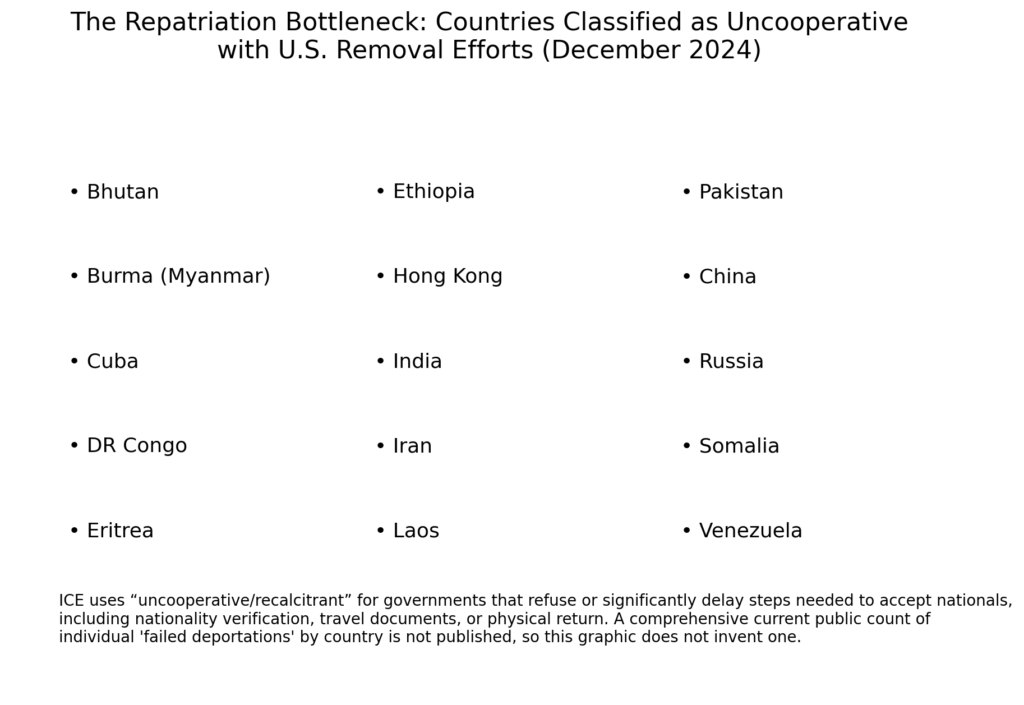
ICE classifies countries that refuse or delay deportations for their nationals as “uncooperative” or “recalcitrant,” and under the court case Zadvydas v. Davis (2001), the Supreme Court ruled that migrants waiting for deportation cannot be held indefinitely and that authorities like ICE can generally only hold them for a six-month period. This has led to thousands of illegals subject to deportation orders, including convicted criminals, being released back into the United States.
In 2024 alone, a Government Accountability Office (GAO) report showed that obtaining travel documents was a major obstacle for ICE officials who were trying to facilitate the deportations of certain nationals. 4,768 Vietnamese and 2,496 Laotians that year were awaiting travel documents in order to be properly deported, with many released into the U.S. due to the wait time. India and China, two other countries that are reluctant to take their countrymen back, often took months to process any documents for travel.
The National Pulse team wants you to be informed, and we take the time to research the facts. Please JOIN THE NATIONAL PULSE or MAKE A DONATION to support this work today.
The Countries That Refuse to Take Back Their Nationals.
It may be understandable that countries in the midst of civil war or severe instability, like Libya, are unable to take back their nationals, or can only do so in limited quantities. Countries the U.S. has limited relations with, like North Korea or Afghanistan, are also understandable.
However, a June 2023 ICE list found that many countries not at war and even some with relatively normal diplomatic relations with the United States were among those most likely to refuse to take back their own people. Among them are Bhutan, Pakistan, Samoa, Ethiopia, China, Laos, Cambodia, Lebanon, and Somalia. Cuba and Iran appeared on the list as well, though it can be noted neither has official diplomatic relations with the U.S.
Several other countries were listed as “at risk of noncompliance,” including India, Vietnam, South Sudan, Jamaica, and Bosnia-Herzegovina.
Third Country Deportations Are the Only Answer.
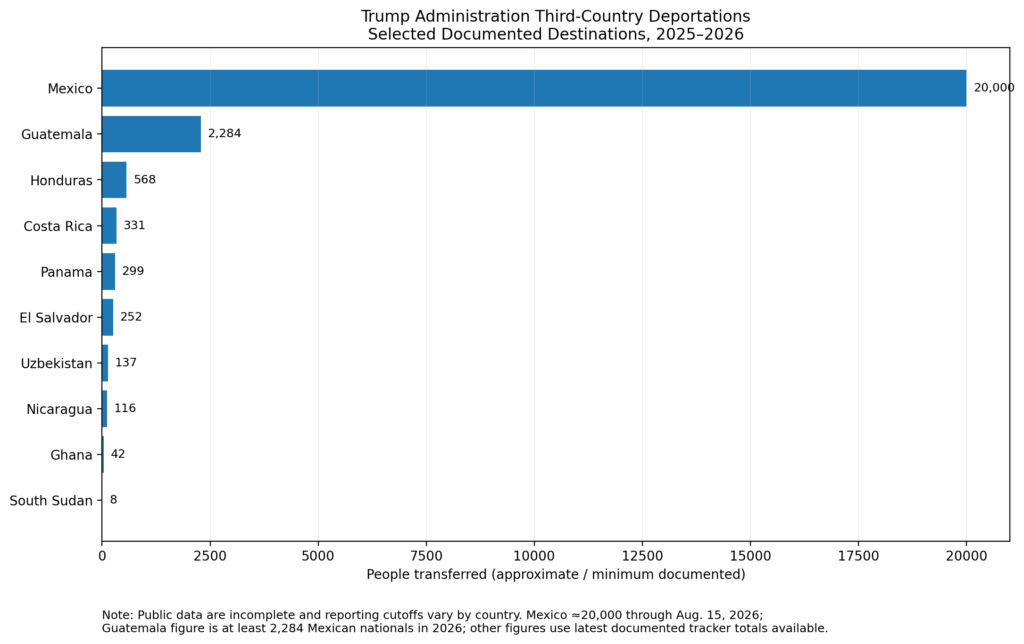
The Immigration and Nationality Act (INA) allows the government to deport illegals to third countries when sending them back to their actual country of origin is deemed “impracticable, inadvisable, or impossible.” The Trump administration has been able to set up a network of 35 different countries around the world to receive foreign nationals so far, with over 25,000 illegals sent to 29 countries already. In return, those countries have collectively received over $49 million in U.S. government funding.
Mexico has taken in the most illegals under these agreements, with roughly 20,000 or so non-citizens of Mexico being sent to the country between January 20, 2025, and August 15, 2026. Most of these deportations are said to be illegal from other Latin American countries like Cuba, Guatemala, Honduras, and Venezuela. The statistics show that the administration often uses third countries in the same region as the deportees’ home countries. The chance of a Salvadoran being deported to a country in Africa is low, but not zero, providing a significant deterrent against resisting deportation.
Allowing deportations to these third countries destroys any leverage over the United States that countries have by rejecting the deportation of their nationals. It also greatly reduces the incentives for migrants to obstruct their return by destroying their papers and otherwise refusing to help facilitate their removal, as the consequence can be deportation to somewhere like the Central African Republic rather than release into the United States.
The Lawfare Campaign Against Third Country Deportations.
While the recent SCOTUS victory allows the Trump Administration to resume deportations to third countries, the legal battle over the policy is not over. Leftist “human rights” groups continue to push for an end to the practice, often arguing that deportees have issues with language or culture in the countries they are deported to, or that they could potentially be sent to countries where they may face some sort of persecution.
The First Circuit previously upheld a lower court finding that the Department of Homeland Security (DHS) procedure for third country deportations did not provide adequate notice and opportunity to raise fear-based claims. The Trump administration argues that those requirements, which put the comfort of illegal aliens over public safety, impede lawful removals, and have caused flight cancellations and other logistical problems.
The Supreme Court has now allowed removals to continue temporarily and will consider statutory authority, due process, and the lower court’s jurisdiction over the matter in December.
Join Pulse+ to comment below, and receive exclusive e-mail analyses.
show less
The Trump Administration secured a victory in the Supreme Court this week that will allow the government to resume deporting illegal aliens whose countries, for one reason or another, refuse or are unable to take them back. Since President Donald J. Trump took office in January of 2025, over 25,000 illegal aliens have already been deported to third countries, but legal challenges paused the policy in February of this year.
show more
By Popular Demand.
The National Pulse Now has an on-site comments section for members. Sign up today and be part of the conversation in our community of almost 15,000.
WE ARE 100% INDEPENDENT AND READER-FUNDED. FOR A GUARANTEED AD-FREE EXPERIENCE AND TO SUPPORT REAL NEWS, PLEASE SIGN UP HERE, TODAY.
Joshua Kerry, 28, has been charged with preparing acts of terrorism, including a plot against Reform UK party leader Nigel Farage.
PULSE POINTS
❓ WHAT HAPPENED:Joshua Kerry, a 28-year-old from Rotherham, England, has been charged with preparing acts of terrorism, including a plot against Reform UK party leader Nigel Farage. The charge was authorized by the Crown Prosecution Service (CPS) under section 5(1)(a) of the Terrorism Act 2006. Kerry is the suspect in the murder of Ann Widdecombe, the legendary former Conservative Party lawmaker and government minister turned Reform immigration and justice spokeswoman, who was beaten to death in her home in July.
📰 DETAIL: The alleged activities took place between May 31, 2024, and July 8, 2026. The investigation was described as “hugely intensive and complex” by Deputy Assistant Commissioner Vicki Evans, involving a dedicated team of detectives, analysts, and forensic experts.
📍 WHEN & WHERE: Kerry is scheduled to appear at Westminster Magistrates’ Court on October 7, 2026.
💬 KEY QUOTE: “A 28-year-old man has been charged with engaging in conduct in preparation of acts of terrorism, including against Nigel Farage MP. Joshua Kerry, of Byrley Road, Rotherham, South Yorkshire, was charged today (Friday 2 October), with one count of preparation of terrorist acts, contrary to section 5(1)(a) of the Terrorism Act 2006, following authorisation from the Crown Prosecution Service.” – Counter Terrorism Policing statement
💬 SECONDARY QUOTE: “The charge announced today is a result of the tireless work of investigators across the Counter Terrorism Policing network. This investigation has been led by a dedicated team of detectives, analysts, and forensic experts, working on multiple lines of enquiry, which has resulted in this very serious charge.” – Deputy Assistant Commissioner Vicki Evans, Senior National Coordinator for Counter Terrorism Policing
Join Pulse+ to comment below, and receive exclusive e-mail analyses.
Newsletter
Need to Know.
Your free, daily feed from The National Pulse.
Thank You!
You are now subscribed to our newsletter.
show less
Joshua Kerry, 28, has been charged with preparing acts of terrorism, including a plot against Reform UK party leader Nigel Farage.
show more
By Popular Demand.
The National Pulse Now has an on-site comments section for members. Sign up today and be part of the conversation in our community of almost 15,000.
WE ARE 100% INDEPENDENT AND READER-FUNDED. FOR A GUARANTEED AD-FREE EXPERIENCE AND TO SUPPORT REAL NEWS, PLEASE SIGN UP HERE, TODAY.
The annual cost of Britain rejoining the European Union is still being quoted, even by committed Eurosceptics, at around £25 billion. The budget arithmetic now coming out of Brussels suggests it would be far higher.
To help Raheem J. Kassam and his team research the numbers behind the headlines and bring you the facts that matter, please JOIN THE NATIONAL PULSE or MAKE A DONATION today. We are 100% reader-funded.
Newsletter
Need to Know.
Your free, daily feed from The National Pulse.
Thank You!
You are now subscribed to our newsletter.
The European Commission, the EU’s unelected executive body, has proposed a 2028–34 Multiannual Financial Framework worth 1.26 percent of EU gross national income (GNI). Britain’s latest GNI stands at £3.0 trillion (~$4.0 trillion). Apply the Commission’s own ratio to that figure, and the indicative gross burden is about £38 billion (~$50.3 billion) a year, or roughly £730 million (~$970 million) a week. That calculation sits upstream of receipts, the precise EU financing formula, and whatever terms an accession deal might eventually contain.
Significantly, a returning Britain would not receive the old rebate on its budget contributions secured by Margaret Thatcher as compensation for historic overpayment. This partial refund was negotiated in 1984, defended for decades, gradually eroded, and disappeared altogether with Britain’s withdrawal from the EU. Nothing in the bloc’s current budget proposals, and nothing in the politics of Brussels, suggests those terms would be restored.
Preferential accession arrangements on issues such as committing to eventually adopting the euro currency are equally unlikely.
For some reason I’m currently the most realistic source of information on the subject of Britain rejoining the EU.
Even the most ardent Eurosceptics are quoting a £25bn annual rejoining figure.
The figures that follow from the gross calculation, once the absence of a rebate is allowed for, are roughly:
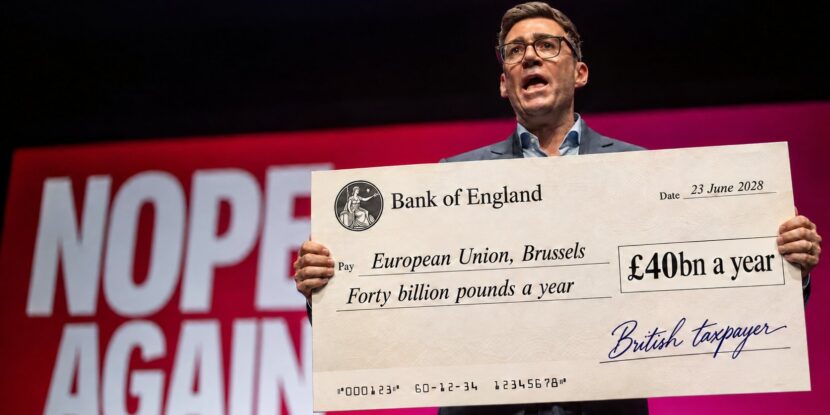
— £40 billion a year — £3.3 billion a month — £770 million a week — £110 million a day
An inflation adjustment between now and the start of the new budget period takes the annual cost to about £42 billion (~$55.6 billion) by 2028. These are membership costs only, describing only the scale of the contribution Britain would be expected to make toward the EU budget, not the wider consequences of membership, which would require giving up independent trade deals and an additional share of Britain’s fishing stocks, among other concessions.
The weekly number is worth dwelling on because it is the unit the public already understands from the EU referendum campaign. £770 million a week is more than double the famous £350 million cost advertised by the Vote Leave campaign in 2016. EU grants, subsidies, or research funding might reduce the net figure, but they would not return it to the £25 billion range still being cited.
What the Membership Fee Leaves Out.
Rejoining the EU on ordinary terms would reimpose the bloc’s Free Movement migration regime on Britain. This carries immense and unpredictable fiscal, housing, and infrastructure costs that never appear in the GNI contribution. The National Pulse has separately modeled those migration effects; the budget’s cash cost is independent of them and must be met either way.
As mentioned above, reaccession would also require a commitment to eventual adoption of the euro. Britain would surrender its independent monetary policy and absorb the transition costs of a currency change. State aid rules would once again limit the support that governments can offer to national industries. Steel, energy, automotive production, and defense supply chains have all been treated as strategic priorities since 2020. EU competition law restricts that kind of support.
The Terms of the Argument.
The “rejoiner” case has so far been able to lean on lower estimates of potential British budget contributions, and on the claim that Brexit’s opportunity costs exceed any subscription fee. The European Commission’s 1.26 percent proposal, applied to a £3 trillion GNI and stripped of the old rebate, changes the baseline. £40 billion a year, £770 million a week, and £110 million a day are the numbers that now have to be answered before the conversation moves on to borders, the currency, or industrial policy.
To put these figures in context, spending on Britain’s overcrowded prisons is only around £8.4 billion annually. Spending on the courts, which are also extremely overburdened, stands at £2.538 billion. Border Force funding stands at only around £730 million, and funding for the Immigration Enforcement directorate is somewhere around £470 million.
£40 billion a year as an annual subscription fee for EU membership is therefore an extremely high price to pay, especially considering Britain currently has a longstanding trade deficit with the EU and would be required to surrender sovereignty on issues ranging from immigration and international trade to state aid and fisheries alongside the fee.
Join Pulse+ to comment below, and receive exclusive e-mail analyses.
show less
The annual cost of Britain rejoining the European Union is still being quoted, even by committed Eurosceptics, at around £25 billion. The budget arithmetic now coming out of Brussels suggests it would be far higher.
show more
By Popular Demand.
The National Pulse Now has an on-site comments section for members. Sign up today and be part of the conversation in our community of almost 15,000.
WE ARE 100% INDEPENDENT AND READER-FUNDED. FOR A GUARANTEED AD-FREE EXPERIENCE AND TO SUPPORT REAL NEWS, PLEASE SIGN UP HERE, TODAY.
The Sinaloa Cartel is at the epicenter of the Trump administration’s heightened campaign against drug trafficking into the United States from Latin America this week, with the Treasury’s Office of Foreign Assets Control (OFAC) sanctioning 46 entities and individuals, including corrupt Mexican politicians, linked to the organization. But where did the cartel come from, what crimes has it orchestrated, and what are its future prospects under pressure from the Treasury and, as a designated terrorist organization, the Department of War?
The National Pulse is dedicated to helping you understand the news. If you value this originally researched work, please JOIN THE NATIONAL PULSE or MAKE A DONATION today.
Newsletter
Need to Know.
Your free, daily feed from The National Pulse.
Thank You!
You are now subscribed to our newsletter.
The Origins of the Sinaloa Cartel.
The Sinaloa Cartel is a drug-trafficking syndicate based in the northwestern Mexican state of Sinaloa. It is one of the oldest and most powerful drug trafficking organizations in the country, emerging out of criminal networks associated with the Guadalajara Cartel, which dominated Mexican drug trafficking throughout the 1980s.
After the Guadalajara Cartel was dismantled, Joaquín “El Chapo” Guzmán and Ismael “El Mayo” Zambada, two former members, co-founded the Sinaloa Cartel, using former Guadalajara Cartel networks. Initially dealing in marijuana and heroin, the Sinaloa Cartel later moved into trafficking cocaine, methamphetamine, and fentanyl.
Since its creation, the Sinaloa Cartel is estimated to have integrated tens of thousands of criminals into its operations, and it continues to operate through decentralized networks throughout Latin America, the United States, and beyond.
The Crimes of the Sinaloa Cartel.
The Sinaloa Cartel’s crimes span drug trafficking and manufacturing, money laundering, weapons trafficking, people smuggling, murder, kidnapping, bribery, terrorism, and narcoterrorism. The organization’s networks involve suppliers, brokers, transporters, distributors, and money launderers.
U.S. authorities have identified Sinaloa-linked activity in at least 40 countries, with networks extending into markets including Europe, Asia, and Australia. According to reports from the U.S. Drug Enforcement Administration (DEA), during one week of Sinaloa-targeted operations in late August 2025, authorities seized 480 kg of fentanyl powder, 714,707 counterfeit pills, 2,209 kg of methamphetamine, 7,469 kg of cocaine, and 16.55 kg of heroin.
The Sinaloa Cartel’s crimes have triggered a campaign from the United States and its allies in Latin America which has lasted for roughly four decades, and radically stepped up throughout the second term of President Donald J. Trump.
The United States has pursued the Sinaloa Cartel through criminal prosecutions, extraditions, financial sanctions, intelligence operations, international cooperation, and rewards for information leading to the capture of senior members. In 2009, the cartel was designated as a “significant foreign narcotics trafficker” under the Foreign Narcotics Kingpin Designation Act, which aimed to freeze its assets, among other actions. After being arrested in 2016, Guzmán was extradited to the United States the following year and convicted in 2019. He was sentenced to life imprisonment. Zambada was taken into U.S. custody in July 2024, pleaded guilty in August 2025, and was sentenced in July 2026 to life imprisonment.
The Trump administration significantly escalated its campaign against the Sinaloa Cartel last year. In February 2025, the Department of State designated the Sinaloa Cartel as a Foreign Terrorist Organization (FTO) and Specially Designated Global Terrorist (SDGT) following an executive order by President Trump.
@USTreasury OFAC sanctions against Sinaloa Cartel leader Ismael Zambada Sicairos, “Mayito Flaco,” and nearly 50 targets show what going after the entire network means. Not just leaders but also traffickers, money launderers, front companies, corrupt officials—everyone who keeps… pic.twitter.com/FY4AdExOAg
While “El Chapo” and “El Mayo” have both been captured and arrested, the Sinaloa Cartel’s drug-trafficking networks remain in place. The networks remain hard to dismantle due to their decentralized nature, although reports have revealed that the cartel has descended into infighting between “Los Chapitos” (networks and personnel associated with El Chapo) and “Los Mayitos” (networks and personnel associated with El Mayo).
Despite this, it has managed to develop clandestine laboratories, which can be used to manufacture drugs while avoiding law enforcement. Nevertheless, since the start of the year, the Trump administration has escalated its campaign against the cartel, signaling a willingness to conduct land strikes in tandem with the strikes on cartel-linked boats it is already carrying out at sea.
U.S. authorities have also indicted cartel-linked Mexican officials, such as Rubén Rocha Moya, the Governor of Sinaloa. The cartel may also have to contend with further escalations, Treasury sanctions, and joint military operations between the U.S. and Latin American countries, such as Colombia.
Join Pulse+ to comment below, and receive exclusive e-mail analyses.
show less
The Sinaloa Cartel is at the epicenter of the Trump administration's heightened campaign against drug trafficking into the United States from Latin America this week, with the Treasury’s Office of Foreign Assets Control (OFAC) sanctioning 46 entities and individuals, including corrupt Mexican politicians, linked to the organization. But where did the cartel come from, what crimes has it orchestrated, and what are its future prospects under pressure from the Treasury and, as a designated terrorist organization, the Department of War?show more
By Popular Demand.
The National Pulse Now has an on-site comments section for members. Sign up today and be part of the conversation in our community of almost 15,000.
WE ARE 100% INDEPENDENT AND READER-FUNDED. FOR A GUARANTEED AD-FREE EXPERIENCE AND TO SUPPORT REAL NEWS, PLEASE SIGN UP HERE, TODAY.
Since former Vice President Kamala Harris’s loss to President Donald J. Trump in the 2024 presidential election, the Democrats have been radicalizing. Across a series of facets, from support for socialism and a lack of patriotism to support for political violence and open borders, along with victories for the Democratic Socialists of America, a far-left movement intent on cannibalizing the party, in Democratic primaries, the Democrats are moving further toward the radical left than ever before.
The National Pulse keeps you updated on the political trends that matter. If you value this work, please JOIN THE NATIONAL PULSE or MAKE A DONATION today.
Newsletter
Need to Know.
Your free, daily feed from The National Pulse.
Thank You!
You are now subscribed to our newsletter.
Most Democrats Prefer Socialism Over Capitalism.
More than half of Democrats have a positive view of socialism, according to polling from YouGov published in August. Specifically, 58 percent of Democrats were recorded as having a positive view of socialism, compared to just 32 percent of Democrats who have a positive view of capitalism. In contrast, 50 percent of Democrats were recorded as having a negative view of capitalism, whereas only 18 percent had a negative view of socialism.
This followed similar polling by CNN in July, which showed that roughly one-third of Democrat and Democrat-leaning adults identified as “Democratic Socialists.” Support for socialism was particularly prominent among younger members, with 59 percent of self-described “Democratic Socialists” in the party being under the age of 45.
Democrats Are Not Proud to Be American.
Only eight percent of Democrats regard the United States as “the greatest” country in the world, according to polling from YouGov published in June. This contrasts with 52 percent of Republicans and 54 percent of MAGA Republicans who regard the U.S. as “the greatest” country in the world.
Roughly one in five Americans who supported Kamala Harris in 2024 believe that the U.S. is “among the worst” countries in the world. Meanwhile, zero percent of Americans who voted for President Donald J. Trump viewed the United States as “the worst” country in the world.
This polling not only revealed a stark divide between Democrats and Republicans, but also between liberals and conservatives more broadly, with 26 percent of liberals viewing the U.S. as “worse than average,” while 53 percent of conservatives described their country as “the greatest” in the world.
According to polling from the Center for Strategic Politics published back in September, 32 percent of Democrats would feel positive if President Donald J. Trump were assassinated at a campaign rally. The same polling also revealed that 59 percent of Democrats would feel “very positive” or “somewhat positive” if President Trump were removed from office by the military.
Roughly a year prior, following the assassination of Turning Point USA founder Charlie Kirk, YouGov revealed that 25 percent of “very liberal” Americans and 17 percent of “liberal” Americans think political violence is justifiable, compared to only six percent of “conservative” Americans. The polling also revealed that younger liberals are more supportive of political violence, with 26 percent between the ages of 18 and 44 suggesting it was justifiable.
Democrats Support Open Borders.
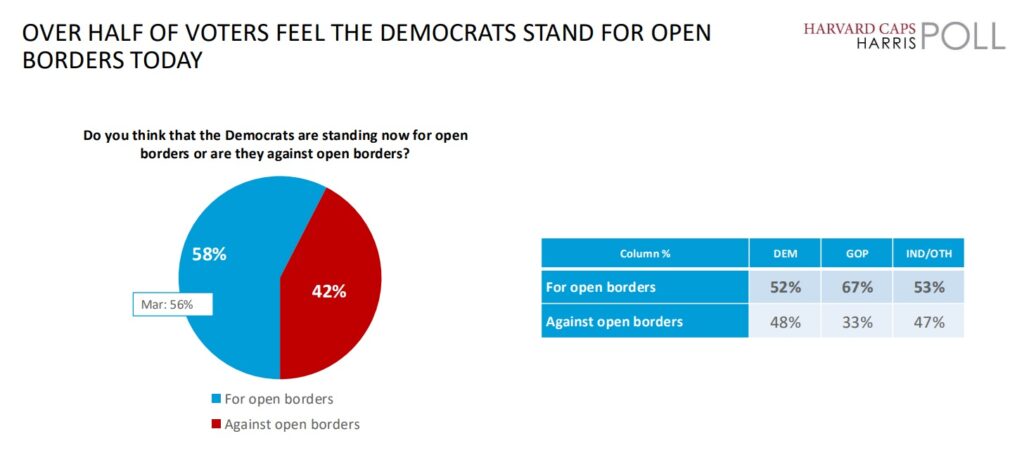
Most Americans believe that Democrats support open borders, including most Democrats themselves. According to a Harvard/Harris Poll published back in April, 52 percent of Democrats believe the party supports open borders, while 58 percent of Americans generally view Democrats as being in favor of open borders. This followed polling from YouGov published back in January, which showed that 76 percent of Democrats support abolishing U.S. Immigration and Customs Enforcement (ICE) .
The fact that even Democrat supporters view their party as supportive of open borders suggests that Democrats have pivoted against border control, or at a minimum, do not view it as an important issue. This is despite the fact that most Americans support border control, regulated migration, and efforts to deter illegal entry into the country.
Join Pulse+ to comment below, and receive exclusive e-mail analyses.
show less
Since former Vice President Kamala Harris's loss to President Donald J. Trump in the 2024 presidential election, the Democrats have been radicalizing. Across a series of facets, from support for socialism and a lack of patriotism to support for political violence and open borders, along with victories for the Democratic Socialists of America, a far-left movement intent on cannibalizing the party, in Democratic primaries, the Democrats are moving further toward the radical left than ever before.show more
By Popular Demand.
The National Pulse Now has an on-site comments section for members. Sign up today and be part of the conversation in our community of almost 15,000.
WE ARE 100% INDEPENDENT AND READER-FUNDED. FOR A GUARANTEED AD-FREE EXPERIENCE AND TO SUPPORT REAL NEWS, PLEASE SIGN UP HERE, TODAY.
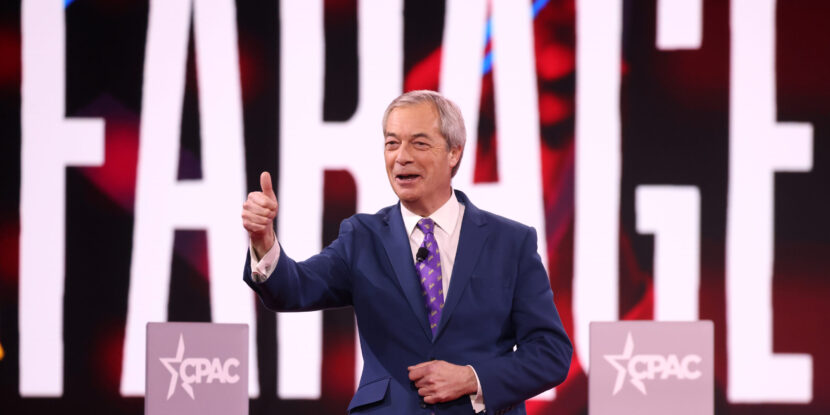
For over a quarter of a century, the political establishment and the corporate media have tried to convince the public, and themselves, that Nigel Farage is a temporary anomaly. Yet time and again, the undisputed godfather of Brexit and British populism has defied their expectations.
The National Pulse brings you deeply researched news and analysis from around the world with no corporate or government backing. If you want to help keep us RADICALLY INDEPENDENT, please JOIN THE NATIONAL PULSE or MAKE A DONATION today.
Newsletter
Need to Know.
Your free, daily feed from The National Pulse.
Thank You!
You are now subscribed to our newsletter.
Here are seven times Nigel Farage rewrote the rules of Western politics:
2009: Breaking the Two-Party Monopoly.
Before the 2009 European Parliament elections, the conventional wisdom dictated that third parties in the United Kingdom were relegated to perpetual protest status. Operating within a tightly controlled media environment, the UK Independence Party (UKIP) under Farage weaponized the European stage to bypass the Westminster gatekeepers.
Earning 13 Members of the European Parliament (MEPs), Farage achieved a historic first and pushed then-Prime Minister Gordon Brown’s governing Labour Party into a humiliating third place. It was a tremendous breakthrough; just two election cycles prior, UKIP secured just one percent of the national vote. It was the first structural crack in Britain’s century-old Labour-Conservative duopoly, proving that a disciplined populist message could break the establishment’s grip.
2014: The First Nationwide Victory for an Insurgent Party.
If 2009 proved the duopoly could be wounded, 2014 proved they could be beaten outright. Farage marched UKIP into the 2014 European Parliament elections and secured an outright nationwide victory, taking 24 seats and 27.5 percent of the vote.
This was an electoral earthquake. It marked the first time since December 1910 that a party other than Labour or the Conservatives had won the popular vote in a nationwide British election. Farage had taken a fringe independence movement and transformed it into the most potent electoral force in the country, completely upending the institutional calculus in London.
The 2014 By-Elections: Forcing Cameron’s Hand.
The Westminster commentariat insisted that Farage’s success was confined to Brussels and could never translate to the First Past the Post (FPTP) system used to elect national lawmakers to the House of Commons. Farage killed this myth by orchestrating high-profile defections to UKIP by Conservative Members of Parliament (MPs) Douglas Carswell and Mark Reckless.
In the subsequent Clacton and Rochester & Strood by-elections (special elections), Farage’s ground game delivered two devastating blows, securing UKIP’s first-ever parliamentary election victories. Terrified of a total collapse on his right flank as he led a fragile coalition government, Conservative Prime Minister David Cameron was panicked into formally promising the public a referendum on leaving the European Union in his 2015 election platform.
2016: Defeating the Globalists.
On June 23, 2016, Farage achieved his most impossible victory. The campaign to keep Britain inside the European Union deployed the full force of “Project Fear.” Farage faced down the entire British state apparatus, the leadership of every major political party, corporate boardrooms, the BBC, international banking cartels, and even the direct intervention from U.S. President Barack Obama.
Against all odds, the British public voted for Brexit. Farage’s decades-long crusade successfully severed Britain from the bureaucratic clutches of Brussels. Within hours, David Cameron resigned in disgrace, his political career permanently extinguished by the populist wave Farage had spent a lifetime building.
Writing and researching political deep dives takes time and resources. If you value the work of Raheem J. Kassam and his team and want to support it, please JOIN THE NATIONAL PULSE or MAKE A DONATION today.
2019: The Six-Week Resurrection That Saved Brexit.
By 2019, the Westminster “uniparty” had successfully gridlocked the Brexit implementation process, deliberately attempting to dilute and derail the 2016 mandate. Believing Farage was safely retired, Prime Minister Theresa May—who had voted to remain in the EU—assumed Farage, who had retired as UKIP leader after his referendum win, was now a spent force.
She was wrong. In an unprecedented display of political agility, Farage launched the Brexit Party from scratch. Within a staggering six-week window, he built a nationwide infrastructure that wiped the floor with the establishment parties in the 2019 European Parliament elections. The sheer force of this electoral execution shattered the legislative deadlock, forced the near-immediate resignation of Theresa May, and compelled the Conservative Party to finally deliver Brexit.
2024: Cracking the Westminster First-Past-the-Post Barrier.
For years, establishment media figures mocked Farage for failing to win a Westminster seat, relying on the structural biases of Britain’s national elections to keep him out. But in 2024, with the Brexit Party having been transformed into Reform UK, Farage mounted a high-velocity campaign that shattered the Westminster glass ceiling once and for all. In 2019, the Brexit Party had stood down in constituencies held by the Conservatives on a promise that they would “get Brexit done,” even though the Conservatives refused to reciprocate in Labour-held seats where the Brexit Party had the better chance of winning.
Farage was comfortably elected as the MP for Clacton, leading a disciplined vanguard of Reform MPs directly into the House of Commons. By establishing a permanent beachhead inside the palace walls, Farage proved that Reform was not just a pressure group, but could become a legitimate government-in-waiting. The Conservatives, who had delivered a half-measures Brexit and record-breaking immigration, hemorrhaged voters to Farage’s party and suffered their worst defeat in a century.
Post-2024: Toppling Starmer and Topping National Polls.
Following the 2024 elections, which saw Labour return to power on a low turnout after years of Conservative failure on Brexit and immigration, Reform first displaced the centuries-old Conservatives as Britain’s leading right-wing party and then began regularly topping national opinion polls, drawing massive support from both disillusioned working-class Labor voters and abandoned Conservatives.
The tipping point arrived during the English local elections in 2026, where Reform inflicted historic losses on the incumbent Labour Party. Suffering catastrophic losses in former industrial strongholds, the sheer scale of the Reform surge induced an immediate leadership crisis within Labour, ultimately toppling Prime Minister Sir Keir Starmer from power. He was at least the third prime minister to be brought down by Farage; arguably the fourth, including Rishi Sunak in 2019.
Institutional panic over the rise of Reform is palpable, and the establishment’s playbook is becoming increasingly transparent. According to data analyzed by The National Pulse using recent YouGov MRP figures, corporate-backed splinter parties—such as the Rupert Lowe-led, Elon Musk-backed “Restore Britain”—fail to win a single seat of their own in a general election, but threaten to split the right-leaning vote just enough to hand dozens of seats back to the left-leaning uniparty.
Yet history shows that artificial, top-down political experiments can rarely duplicate the organic success of movements like Farage’s. As Britain prepares for its next constitutional turning point, the data makes one thing clear: betting against Nigel Farage is a losing proposition.
To keep independent reporting at The National Pulse alive, we need your support. Please JOIN THE NATIONAL PULSE or MAKE A DONATION today. We are 100% reader-funded.
Join Pulse+ to comment below, and receive exclusive e-mail analyses.
show less
For over a quarter of a century, the political establishment and the corporate media have tried to convince the public, and themselves, that Nigel Farage is a temporary anomaly. Yet time and again, the undisputed godfather of Brexit and British populism has defied their expectations.
show more
By Popular Demand.
The National Pulse Now has an on-site comments section for members. Sign up today and be part of the conversation in our community of almost 15,000.
WE ARE 100% INDEPENDENT AND READER-FUNDED. FOR A GUARANTEED AD-FREE EXPERIENCE AND TO SUPPORT REAL NEWS, PLEASE SIGN UP HERE, TODAY.
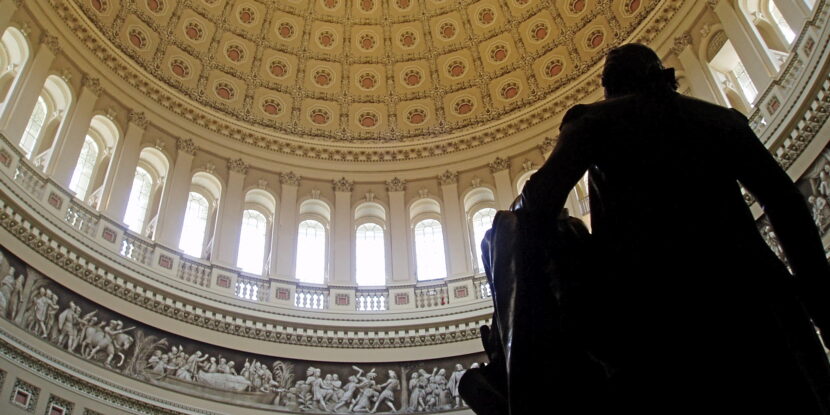
As the United States celebrates its semiquincentennial, popular memory naturally turns toward the triumphant moments in the Revolutionary War—moments like George Washington crossing the Delaware, the British surrender at Saratoga, and the decisive victory at Yorktown. Yet some of the greatest chapters in the story of America are not the Patriots’ victories, but the survival of their fragile experiment in the dark autumns of the late 1770s.
The National Pulse publishes original work on the history and culture of the West, as well as politics and current affairs. If you value it, please JOIN THE NATIONAL PULSE or MAKE A DONATION today. We are 100% reader-funded.
Newsletter
Need to Know.
Your free, daily feed from The National Pulse.
Thank You!
You are now subscribed to our newsletter.
Yesterday, for instance, was the anniversary of some of the lowest moments of the Revolution in 1776 and 1777, marked by crises of faith and governance. One saw Washington in despair, the other saw the physical eviction of the Continental Congress from its capital. Yet these low moments became the catalysts that forced a fractured alliance of thirteen colonies to organize their fledgling country under its very first constitution.
September 30, 1776: Washington Hits Rock Bottom.
By the final day of September 1776, General Washington was trapped in a nightmare. In the preceding weeks, the British had smashed the Continental Army at Long Island, seized Manhattan, and sent the Americans into a disorganized, demoralized retreat. Raw militia forces were panicking and fleeing the field at the mere sight of the redcoats. Supplies were virtually exhausted, and the army was on the verge of melting away as winter approached.
Pushed to his limits, Washington sat down on September 30, 1776, to write a deeply candid, private letter to his cousin, Mount Vernon estate manager Lund Washington. “In confidence I tell you that I was never in such an unhappy, divided state since I was born,” he wrote, confessing that he was “wearied to death all day with a variety of perplexing circumstances.” The Commander-in-Chief feared his reputation would be ruined by an army incapable of standing its ground, yet he knew he could not resign: “If I fall, I shall fall with a property that will give me no respectability… and yet, if I do not satisfy the public expectation, I must expect to be the scapegoat,” he said.
The general turned the remainder of his letter to providing meticulous instructions on how to repair the fireplaces and chimneys at Mount Vernon, an escape for a man who genuinely believed he might be facing the ruin of his cause.
September 30, 1777: The Continental Congress Is Exiled.
A year on, the crisis had reached through the military front lines and into the halls of government. Following a crushing victory at the Battle of Brandywine, the British Army under General William Howe successfully outmaneuvered Washington and marched into Philadelphia.
The capital had fallen. The delegates of the Continental Congress were forced to pack their legislative papers onto wagons and flee into the countryside in the dead of night. On September 30, after days of exhausting travel, the fugitive delegates crossed the Susquehanna River and reassembled in the small, frontier town of York, Pennsylvania. Gathering in the modest brick courthouse, they declared York the temporary capital of the United States. They were a government in exile, isolated and operating entirely on a handshake agreement between thirteen separate, sovereign states.
The National Pulse publishes original political, economic, and data analysis alongside historical retrospectives. If you value the work of Raheem J. Kassam and his team, please JOIN THE NATIONAL PULSE or MAKE A DONATION today.
The Articles of Confederation.
It was the sense of fragility created by this flight into exile, perhaps reinforced by the memory of Washington’s near-collapse a year prior, that altered the mindset of the delegates in York. For more than a year, Congress had bickered and stalled over how to formally bind the colonies together. Big states argued with small states over voting power; Northern merchants clashed with Southern planters over taxation and Western land claims.
But as the delegates looked around their cramped, temporary quarters in York, resolve hardened. They realized that a loose association of independent states could not survive a war against a global empire. They needed foreign alliances—specifically with France—and European powers would not sign treaties or lend millions to a rogue committee of politicians in hiding. They needed a legitimate, legally recognized government.
Spurred by the desperation of their situation, Congress threw themselves into the stalled draft of a national constitution. Working through the bitter cold of that autumn in York, the delegates compromised on state sovereignty, representation, and war powers.
Less than two months after arriving as fugitives, on November 15, 1777, the Congress officially adopted the Articles of Confederation and Perpetual Union.
The Legacy of the Dark Autumn.
The Articles of Confederation were imperfect. To avoid creating a new tyranny like the British monarchy, the writers created a central government that was unable to levy taxes directly or easily enforce national laws. A decade later, it would be replaced by the current U.S. Constitution.
Nevertheless, the Articles were an enormous step forward out of the dark autumns of 1776 and 1777. They legally transformed a rebellious colonial alliance into a singular political entity recognized by international law. They provided the legal framework that kept the army funded, secured the French alliance, and guided the nation to victory at Yorktown.
The United States was not forged in a moment of easy triumph. It was hammered out in a drafty courthouse by fleeing politicians, under the protection of a Commander-in-Chief who was wearied to death, but refused to give up.
Join Pulse+ to comment below, and receive exclusive e-mail analyses.
show less
As the United States celebrates its semiquincentennial, popular memory naturally turns toward the triumphant moments in the Revolutionary War—moments like George Washington crossing the Delaware, the British surrender at Saratoga, and the decisive victory at Yorktown. Yet some of the greatest chapters in the story of America are not the Patriots’ victories, but the survival of their fragile experiment in the dark autumns of the late 1770s.
show more
By Popular Demand.
The National Pulse Now has an on-site comments section for members. Sign up today and be part of the conversation in our community of almost 15,000.
WE ARE 100% INDEPENDENT AND READER-FUNDED. FOR A GUARANTEED AD-FREE EXPERIENCE AND TO SUPPORT REAL NEWS, PLEASE SIGN UP HERE, TODAY.
President Donald J. Trump is making moves to tie congressional representation to the total number of citizens and legal immigrants living in each state, with illegal aliens discounted. New polling data reveals that a majority of Democrat voters are in favor of changing the current system.
The National Pulse analyzes the data to show you how policies drive political change. If you want to support our work, please JOIN THE NATIONAL PULSE or MAKE A DONATION today. We are 100% reader-funded.
Newsletter
Need to Know.
Your free, daily feed from The National Pulse.
Thank You!
You are now subscribed to our newsletter.
Under the current system, the number of seats in the House of Representatives for each state is determined by the state’s population, including not just citizens and legal immigrants, but also illegal aliens. Crucially, this gives extra seats to states with high concentrations of illegals and noncitizens, which are often centered in Democrat sanctuary cities.
A new Census Bureau proposal, released on September 10, seeks to radically change the existing structure by counting only citizens and lawful permanent residents when determining a state’s population for the purpose of congressional apportionment in the next census in 2030.
President Trump has been arguing for changes to the system since his first term, noting in 2020 that the current system essentially encourages and rewards states that allow violations of U.S. immigration law by counting illegal aliens in the census and increasing their power in Congress.
Under the 14th Amendment, congressional seats are detemined by the “whole number of persons in each State” but, the Trump administration has consistently argued that while in practice that has counted noncitizens and illegals, the amendment itself “does not specifically define which persons must be included for the purposes of apportionment and requires only that Representatives be apportioned according to what has long been understood to mean the ‘inhabitants’ of each State.”
Even Democrat Voters Support the Change.
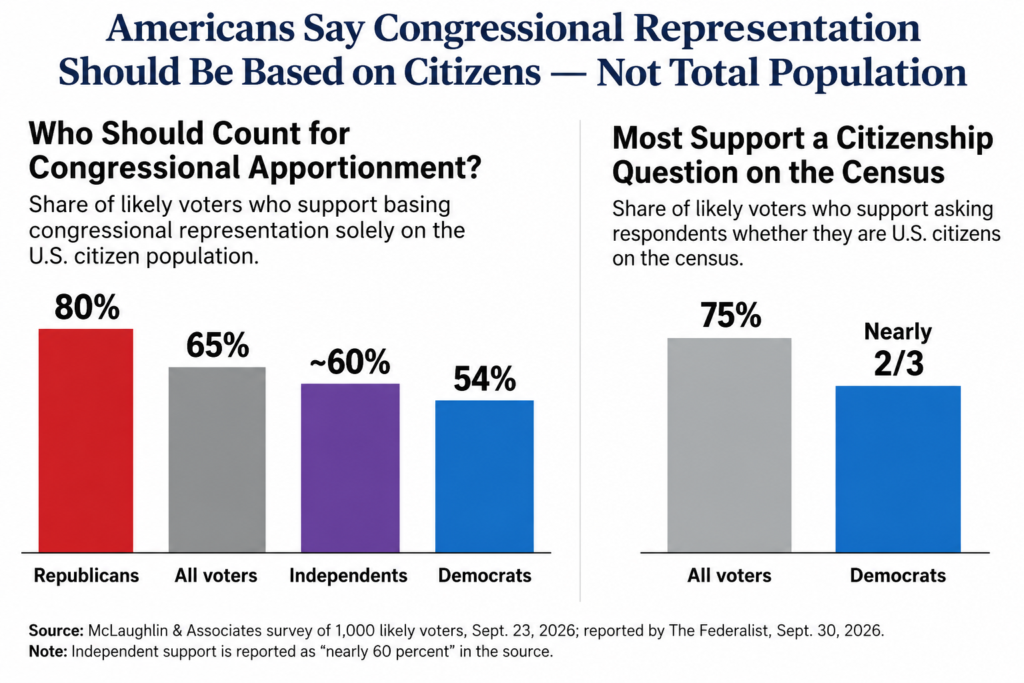
Polling released on September 30 by McLaughlin & Associates reveals that of 1,000 likely voters, 65 percent support President Trump’s proposed changes to the congressional apportionment base. The highest support, 80 percent, comes from Republicans, but even a majority of Democrats, 54 percent, agree with the changes.
The results of the polling also revealed that 75 percent of voters believe that those responding to the census should indicate whether or not they are citizens of the United States, a question that would make it much easier to allocate congressional seats under Trump’s proposed changes.
Some Democrat politicians have been quite open and frank about how counting illegal aliens in their areas benefits them in the form of redistricting.
In 2021, Democratic New York Rep. Yvette Clarke made a case for resettling Haitian migrants in her district, saying, “I need more people in my district, but just for redistricting purposes,” during a meeting of the House Foreign Affairs Committee.
Democrat Yvette Clarke said the quiet part out loud. They want to flood our country with illegals just for redistricting. This is why they want open borders! pic.twitter.com/VxtRoe23Yw
The National Pulse team takes the time to research these reports and bring you the big picture. Please JOIN THE NATIONAL PULSE or MAKE A DONATION to support this work today.
How Trump’s Reform Could Affect the States.
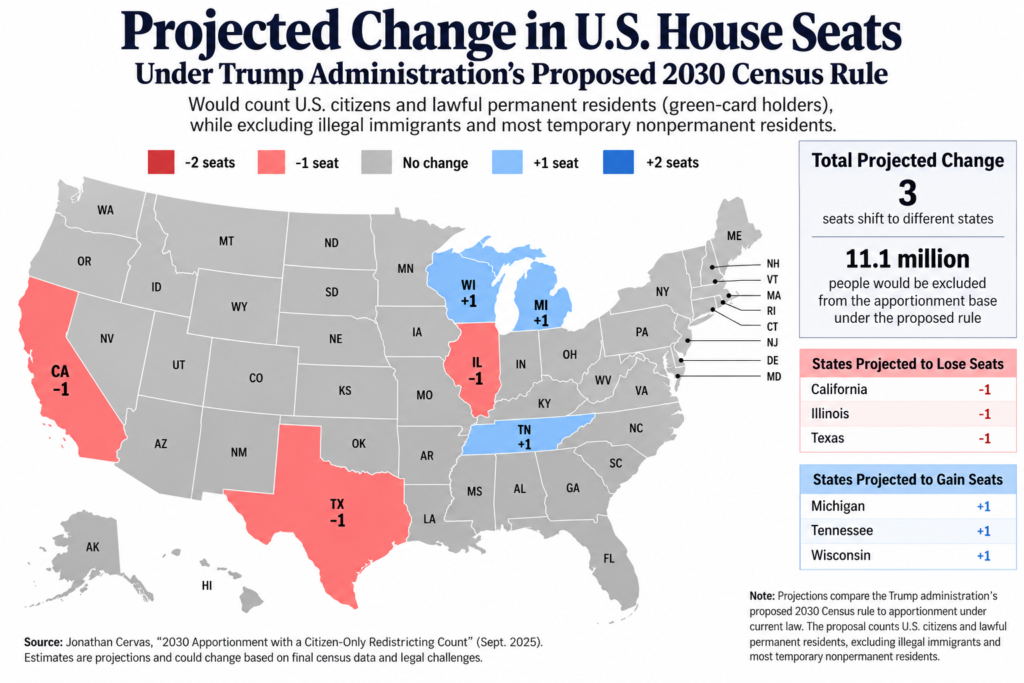
Given that the changes will only be made to the 2030 census, Trump’s policy will have no immediate effect on Congress and will have no impact on the upcoming midterm elections in November. However, projections have been estimated by redistricting researcher Jonathan Cervas, who published an independent study suggesting that California, Illinois, and Texas would each lose a seat, while Michigan, Tennessee, and Wisconsin would each gain a seat.
Cervas states that overall, the policy would likely benefit Republicans, as the seats gained are in states that voted for President Trump in 2024, even though, because of its high population of illegal aliens, the Republican stronghold of Texas would lose a seat. California, projected to lose a seat according to Cervas’s projections, was already set to lose seats by 2030 due to population trends, with many leaving the state in recent years due to high taxes, housing costs, and a generally high cost of living.
A citizen-only policy, which goes beyond the Trump administration’s proposal to apportion seats based on citizens and legally resident foreigners, would have far different results, and give Republicans a far clearer advantage, according to projections from the American Redistricting Project.
Under a citizen-only counting system, blue states would lose the most seats, with California losing six seats instead of one, New York losing two, Illinois losing one, and New Jersey and Rhode Island each losing one. Florida and Texas would gain two seats, and Ohio, North Carolina, Tennessee, Georgia, Idaho, Utah, and Arizona would all gain a seat each.
Join Pulse+ to comment below, and receive exclusive e-mail analyses.
show less
President Donald J. Trump is making moves to tie congressional representation to the total number of citizens and legal immigrants living in each state, with illegal aliens discounted. New polling data reveals that a majority of Democrat voters are in favor of changing the current system.
show more
By Popular Demand.
The National Pulse Now has an on-site comments section for members. Sign up today and be part of the conversation in our community of almost 15,000.
WE ARE 100% INDEPENDENT AND READER-FUNDED. FOR A GUARANTEED AD-FREE EXPERIENCE AND TO SUPPORT REAL NEWS, PLEASE SIGN UP HERE, TODAY.
The Falkland Islands are British. They have been British for 260 years. Yet this has not stopped successive governments in Argentina from repeatedly claiming sovereignty of the southern Atlantic islands. President Javier Milei has become just the latest Argentine leader to claim the islands, referred to as “Las Malvinas” in Argentina, at the latest United Nations General Assembly in Manhattan.
The National Pulse publishes original international analysis to help you understand the political landscape worldwide. If you value this work, please JOIN THE NATIONAL PULSE or MAKE A DONATION today. We are 100% reader-funded.
Newsletter
Need to Know.
Your free, daily feed from The National Pulse.
Thank You!
You are now subscribed to our newsletter.
Milei’s newest claim to the islands includes threats of international legal action over the development of an offshore oilfield named Sea Lion, which lies north of the islands and nowhere near Argentina’s national waters, more than 400 miles from the Argentine coast. Discovered in 2010, the oilfields are currently being developed, with extractions of around 50,000 barrels of oil per day scheduled to begin in 2028.
“If in 2 weeks the United Kingdom does not halt the illegitimate exploitation, we will go to the International Tribunal for the Law of the Sea. THE MALVINAS ARE ARGENTINE, and they are defended with facts, not words,” Milei wrote on X on September 28.
Yet despite Milei’s claims, the history of the Falklands, from the first European to discover them until today, shows they are fundamentally British in character.
Found By an Englishman and Named By an Englishman, After An Englishman.
English navigator John Davis is widely considered the first European to ever set eyes on the Falklands in 1592, although it was not until nearly a hundred years later, in 1690, that English captain John Strong actually landed on the remote islands. Strong was the one to name them the Falklands, after Anthony Cary, the 5th Viscount Falkland, who served as a Member of Parliament at the time.
Settlements on the island were not established until the latter part of the 18th century, with France establishing Port Louis on East Falkland in 1764. Britain asserted possession of West Falkland for King George III in 1765, establishing Port Egmont a year later. France later gave up its settlements in the Falklands, handing them over to Spain, which managed to briefly expel the British in 1770. The British returned shortly after, but left again in 1774 due to economic issues.
Argentina, during this time, did not exist as an independent state, and was still part of the enormous Spanish Empire in Latin America. Spain abandoned the Falklands in 1811, and Colonel David Jewett, an American-born mercenary, claimed them for the United Provinces of the River Plate in 1820. The United Provinces included modern-day Argentina, but it was not an exact predecessor state, including portions of other modern-day countries, including all of Uruguay and southern Bolivia.
Britain maintained that the Falklands remained British and sent a warship to the islands in 1833, expelling the Argentine military garrison that had been placed there a year prior. Argentina has claimed that Britain also expelled civilians, but British sources indicate that the majority of the just 30 or so people living in the Falklands at the time stayed there.
An agreement was signed by both Argentina and Britain in 1850 settling the differences between the two nations over issues like the Falklands. This peace was to last nearly a hundred years, with only one diplomatic complaint by Argentina about the islands in 1888. Britain’s rule was unquestioned, and virtually the entire resident population of the Falklands was British.
A Failing State Declares a Hopeless War.
After the Second World War, aside from giving refuge to some of the most notorious members of Hitler’s Third Reich, Argentina became plagued with government instability. This occurred particularly following the death of President Juan Peron in 1974. Peron, who is still seen as a major political figure in Argentina and a source of inspiration for many of its presidents, had been overthrown in 1955, but returned to power in 1973 after almost two decades in exile, only to die a year later.
By the 1980s, the country was no longer ruled by a charismatic strongman like Peron, but a military junta of assorted generals and admirals who had overthrown Peron’s wife, Isabel Peron, in 1976. Under the junta, Argentina’s economy deteriorated sharply, with runaway inflation and a severe recession in 1981.
On April 2, 1982, seeking to shore up support, the junta decided to invade the Falkland Islands.
The National Pulse is RADICALLY INDEPENDENT, bringing you original news and analysis free of corporate influence. To keep our work independent, please JOIN THE NATIONAL PULSE or MAKE A DONATION today.
The Royal Navy Sails to Victory.
Shortly after the Argentine invasion, the United Nations Security Council passed Resolution 502, demanding that Argentina leave the islands. When this was ignored, British Prime Minister Margaret Thatcher dispatched a large naval task force on a voyage of around 8,000 miles. The British declared an exclusion zone around the islands, warning the Argentine navy to stay out of it.
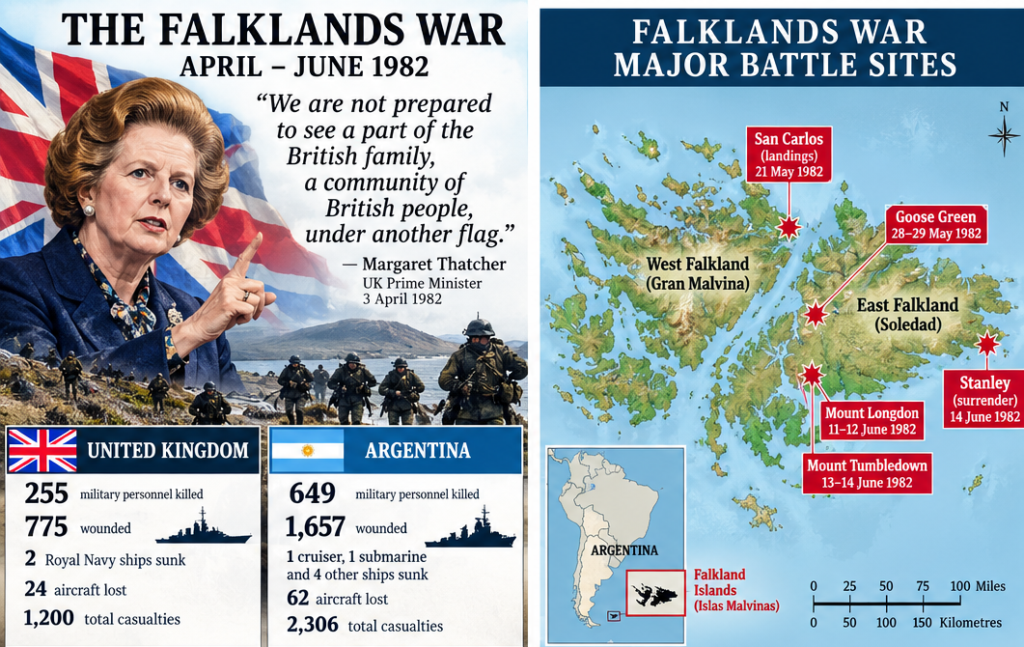
On May 2, the British nuclear-powered submarine HMS Conqueror fired three Mark 8 torpedoes at the Argentinian cruiser ARA Belgrano, a former American naval vessel from the Second World War. Two struck the ship, sinking her and killing 323 sailors on board, a full half of Argentina’s total military deaths during the conflict. While some argued that the ship had not been in the exclusion zone, the British navy countered, saying the Belgrano had been part of a pincer movement against British forces. Regardless, the sinking led to Argentina removing nearly all of its surface fleet from the theatre for the remainder of the war. In retaliation, the Argentinians sank the British destroyer HMS Sheffield on May 10, using French-made Exocet missile systems. Twenty British sailors died.
British forces finally landed on the Falklands proper later in May, making amphibious landings from May 21 to 25. On May 28, British forces fought a decisive battle at Goose Green, and later surrounded the Falklands’ occupied capital, Port Stanley, on June 11. Just days later, on June 14, Argentine forces surrendered, returning the islands to Britain and liberating the local population.
On July 3, 1982, Prime Minister Thatcher addressed the victory, saying:
When we started out, there were the waverers and the fainthearts. The people who thought that Britain could no longer seize the initiative for herself.
The people who thought we could no longer do the great things which we once did. Those who believed that our decline was irreversible—that we could never again be what we were.
There were those who would not admit it—even perhaps some here today—people who would have strenuously denied the suggestion but—in their heart of hearts—they too had their secret fears that it was true: that Britain was no longer the nation that had built an Empire and ruled a quarter of the world.
Well they were wrong. The lesson of the Falklands is that Britain has not changed and that this nation still has those sterling qualities which shine through our history.
The Men (and Women) Who Cry ‘Malvinas.’
Since the British victory in the Falklands War, multiple Presidents of Argentina have addressed the Falkland Islands and their sovereignty. This tends to occur when Argentina faces severe domestic problems, such as hyperinflation or a recession. Former President Cristina Fernández de Kirchner is the best-known, claiming the Falklands were a “colonialist enclave” in 2012. Fernández went even further in 2011, convincing other Mercosur (a trading bloc of South American nations) members to refuse to allow vessels with the Falkland Islands flag into their ports.
The escalation from President Kirchner was the greatest since the buildup to the Falklands War, and in response, Britain took steps to put an end to the question of sovereignty: they asked the Falklanders what they wanted.
The Falklanders Choose Britain.
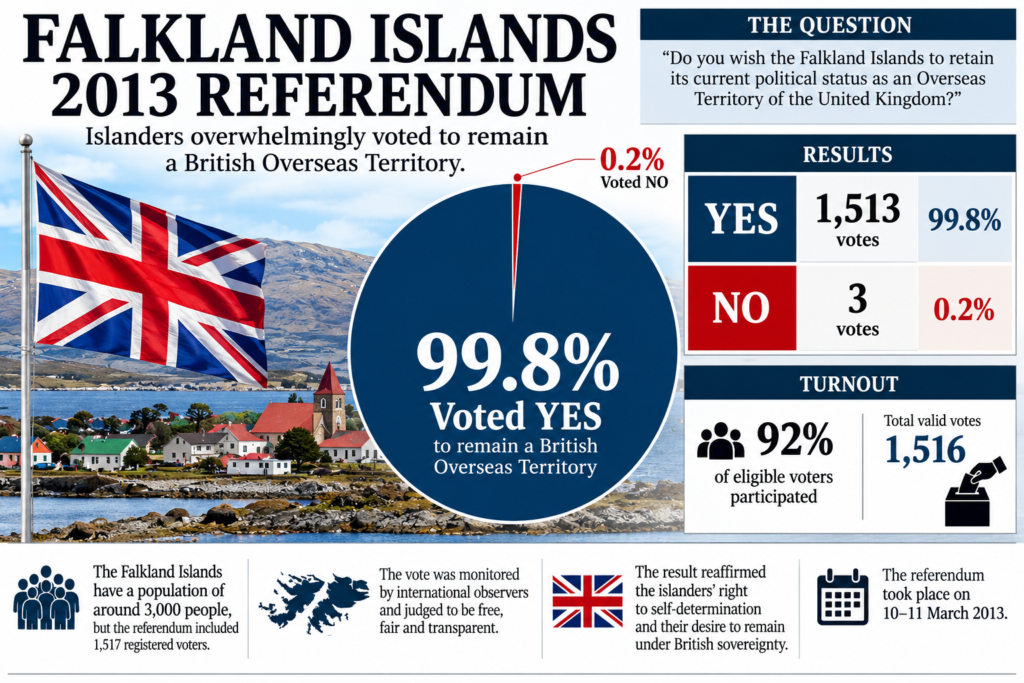
In March 2013, the Falkland Islands held a vote on whether the residents wanted to remain part of Britain as an Overseas Territory. With a turnout of 92 percent, the vote was 1,513 to three. This 99.8 percent vote to remain British remains one of the most lopsided votes on such a question in the 21st century.
“I’m very happy. Everyone has come together to express ourselves. I think this is massively significant. It’s important to show how much we want to stay British,” Falklander Kyle Buiggs said at the time. Another local resident, Barry Nielsen from Stanely, said, “We are British and that’s the way we want to stay.”
Argie Bargie.
In response to the referendum vote, President Kirchner at the time simply said that the views of the island residents did not matter. The current President, Javier Milei, believes the same thing, and has explicitly stated the vote does not count, accusing the Falklanders of being colonists.
As with the junta, Milei’s rallying cry of “Las Malvinas” comes amid economic crisis and declining popularity at home. For Milei, like so many other Argentinian leaders, the islands are just a distraction from failure.
If you want to help Raheem J. Kassam and his team deliver high-quality analysis from around the world, please JOIN THE NATIONAL PULSE or MAKE A DONATION today.
Join Pulse+ to comment below, and receive exclusive e-mail analyses.
show less
The Falkland Islands are British. They have been British for 260 years. Yet this has not stopped successive governments in Argentina from repeatedly claiming sovereignty of the southern Atlantic islands. President Javier Milei has become just the latest Argentine leader to claim the islands, referred to as "Las Malvinas" in Argentina, at the latest United Nations General Assembly in Manhattan.
show more
By Popular Demand.
The National Pulse Now has an on-site comments section for members. Sign up today and be part of the conversation in our community of almost 15,000.
WE ARE 100% INDEPENDENT AND READER-FUNDED. FOR A GUARANTEED AD-FREE EXPERIENCE AND TO SUPPORT REAL NEWS, PLEASE SIGN UP HERE, TODAY.
On Wednesday, the British and French governments confirmed the end of the so-called “One In, One Out” migrant returns deal on boat migrants, casting doubt about the ability of Prime Minister Andy Burnham’s Labour Party to end the boat migrants crisis in the English Channel.
The National Pulse publishes original political analysis that takes time any money to put together. If you value the work of Raheem J. Kassam and his team, please JOIN THE NATIONAL PULSE or MAKE A DONATION today. We are 100% reader-funded.
Newsletter
Need to Know.
Your free, daily feed from The National Pulse.
Thank You!
You are now subscribed to our newsletter.
The “One In, One Out” deal was widely regarded as the British government’s flagship policy to address the Channel crisis. This is how it started, how it failed, and how Nigel Farage’s Reform Party could replace it:
Origins of the “One In, One Out” Deal.
The “One In, One Out” deal between Britain and France emerged from negotiations between former British Prime Minister Sir Keir Starmer and French President Emmanuel Macron in July 2025. The deal was supposedly intended to stop the influx of small boats carrying illegal migrants from France’s northern coast across the English Channel to Britain.
The deal stated that Britain could return migrants who had illegally crossed the English Channel to France, while France could send an equal number of migrants with family connections in Britain onward via an agreed legal route to Britain. Critics complained from the outset that this would likely keep the overall number of migrants arriving in Britain the same, but it came into force by August of the same year regardless.
🚨 NEW: The Government has confirmed the "one in, one out" migrant deal with France has now ended
Following a year of operation, the number of migrants affected by the deal remained small compared to the total number illegally crossing the Channel. August 2026 data from the British government revealed that 1,117 people were allowed into Britain under the deal, while only 1,087 were returned to France, resulting in a slight net increase in migrants.
Also in August, it was revealed that the agreement was costing £56,000 (~$74,000) per migrant. This followed an extensive lawfare campaign by pro-immigration charities and numerous reports of people been returned to France under the deal simply crossing the Channel again.
The National Pulse is RADICALLY INDEPENDENT. We rely on readers, not corporates, to fund our work. If you want to keep it that way, please JOIN THE NATIONAL PULSE or MAKE A DONATION today.
The End of the Deal.
On Wednesday, it was announced that the “One In, One Out” deal would not be renewed for another year, effectively ending the policy. This followed a previous three-month extension. The French Interior Ministry confirmed that Britain and France are discussing the terms of the deal’s termination, while the British Home Office has confirmed that it has stopped processing cases under it.
While both governments have mentioned future co-operation in dealing with the illegal migrant crisis, neither has proposed an exact alternative to the now-defunct deal, and reports of the French authorities turning a blind eye to Channel crossings are persistent.
Earlier this month, Jordan Bardella, President of Marine Le Pen’s National Rally (RN) party in France and current favorite to become the country’s next Prime Minister, co-signed a memorandum of understanding (MOU) with Reform Party leader Nigel Farage at Reform’s annual party conference in Birmingham, England.
The MOU states that France will prevent illegal migrants from crossing the English Channel, and that migrants deported by Britain back to France will ultimately be returned to their countries of origin. “Together, we must take back control of our borders,” Bardella declared in his speech to Reform members. While Macron and other establishment politicians have often seemed to allow the Channel crisis to spiral out of control on purpose, Bardella and Le Pen believe it is in France’s interest to stop the crossings, to deter migrants from entering France and setting up disorderly, often crime-ridden camps along the northern coast in the first place.
The month prior, Reform had announced “Operation Fortress,” a plan to deter the boats carrying illegal migrants with the Royal Navy. “We will ensure that not a single unauthorized vessel crossing the English Channel makes it to the shores of the United Kingdom,” declared Zia Yusuf, Reform’s Shadow Home Secretary, at the time.
If you want to help Raheem J. Kassam and his team unpick the policies shaping the migration crises across the West, please JOIN THE NATIONAL PULSE or MAKE A DONATION today.
Join Pulse+ to comment below, and receive exclusive e-mail analyses.
show less
On Wednesday, the British and French governments confirmed the end of the so-called "One In, One Out" migrant returns deal on boat migrants, casting doubt about the ability of Prime Minister Andy Burnham's Labour Party to end the boat migrants crisis in the English Channel. show more
By Popular Demand.
The National Pulse Now has an on-site comments section for members. Sign up today and be part of the conversation in our community of almost 15,000.
Share Story
FacebookTwitterWhatsappTruthTelegramGettrCopy Link
Real News Fan? Show It!
Many people are shocked to learn that because of active censorship, we currently have to spend more time making sure you can even see The National Pulse, than on producing the news itself. Which sucks. Because we do this for the truth, and for you.
But the regime doesn’t want you being informed. That’s why they want us to go away. And that will happen if more people don’t sign up to support our work. It’s basic supply and demand. So demand you get to read The National Pulse, unrestricted. Sign up, today.
We don’t sell ads, and refuse corporate or political cash. It all comes down to you, the reader. I hope you can help.























.jpg)


