



On the night of Thursday, February 5, President Trump’s Truth Social account posted a video about election fraud that included a two-second splice featuring Barack and Michelle Obama, portrayed as apes in the style of The Lion King.
The outrage machine swung into gear, culminating in the likes of CNN’s Bakari Sellers demanding a “fumigation” of Trump and MAGA from the United States.
But as the aching “anti-racism industry” locomotive groaned back into a pathetic trundle, distracted editors at the Guardian – a 205-year-old progressive publication – were weighing a story that would have staggering implications for President Trump, his Director of National Intelligence, Tulsi Gabbard, his Chief of Staff Susie Wiles, and indeed his entire administration.
It was, in large part, an attempt to lay the foundations for a fresh impeachment of the 47th President of the United States.
“NSA detected phone call between foreign intelligence and a person close to Trump,” the headline roared.

It could have been a stomach-dropping, monster revelation… if it was true.
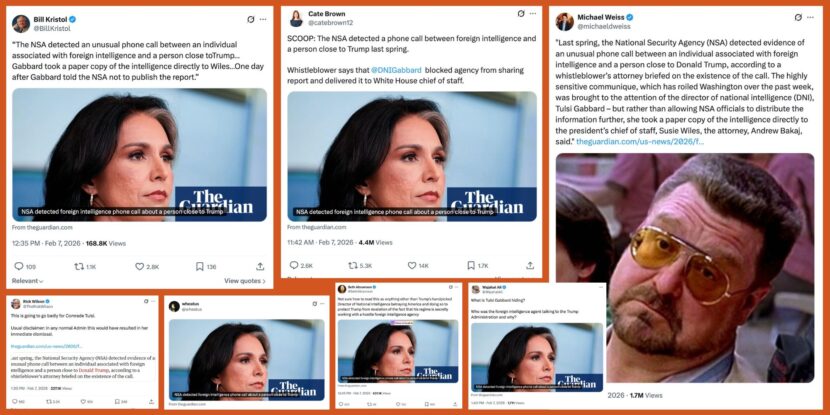
The story was immediately seized upon by NeverTrump™ figures like Bill Kristol, Rick Wilson, Michael Weiss, and even the band Wheatus – of ‘Teenage Dirtbag’ fame – garnering millions of impressions over the next few hours.
At the time of publication of this Substack piece, the Guardian’s author, Cate Brown, still hadn’t removed her original tweet, asserting what would soon be debunked as “fake news.”

If the story had even been a little bit true, it could have triggered months of investigations, jamming up the Trump agenda in a Russia collusion-style hoax.
There was just one problem: when the Guardian’s single source saw what they had written about his testimony, it was his stomach that dropped.
They had the story wildly wrong. Was it their mistake, or his? There was no “person close to Trump” on any call, he hurriedly informed them. Either the Guardian reporter misheard or he misspoke.
Over Saturday afternoon, evening, and late into the night, the Guardian agonized about what to do with this damaging revelation. They even considered eschewing a correction and instead publishing a whole new story, with more accurate details.
Eventually, they succumbed to basic journalistic standards. Eventually.
It was only on Sunday morning that they decided to change the headline to: “NSA detected foreign intelligence phone call about a person close to Trump.” [Emphasis added]

In other words, there was never a “person close to Trump” picked up on a foreign intelligence intercept. Instead, a “person close to Trump” was being discussed by two other, unidentified people.
Furthermore, the paper admits: “The person close to Trump is not understood to be an administration official or a special government employee.”
Well, if that ain’t just the non-story of the year.
Editors reluctantly added a humiliating addendum, right at the bottom, with a sort of jaw-dropping nonchalance about it all:
Editor’s Note: This story was updated to clarify that the phone call was between two people associated with foreign intelligence who discussed someone close to Donald Trump, not between someone and a person close to Trump. The earlier version was based on multiple phone calls with a source who later said he mispoke and clarified the actual details of the call.
This also then changed, with the Guardian forced into naming the source himself:
This story was amended on 7 February 2026 to clarify that the phone call was between two people associated with foreign intelligence who discussed someone close to Donald Trump, not between someone and a person close to Trump. The earlier version was based on multiple phone calls with the whistleblower’s attorney, Andrew Bakaj, who later said he misspoke and clarified the actual details of the call.
The Guardian’s report isn’t the first time a claim was made that a “whistleblower” had filed an inspector general (IG) complaint. Rupert Murdoch’s Wall Street Journal popped a story on February 2, which alleged in an uncharacteristically alarming tone:
A cloak-and-dagger mystery reminiscent of a John le Carré novel is swirling around the complaint, which is said to be locked in a safe. Disclosure of its contents could cause “grave damage to national security,” one official said. It also implicates another federal agency beyond Gabbard’s, and raises potential claims of executive privilege that may involve the White House, officials said.
In journalistic parlance, this means it is being heavily “shopped around.”
The complaint itself appears to date back to May 2025, just two and a half months into Tulsi Gabbard having her feet under the DNI desk. And despite a spokesman for the IG telling the Wall Street Journal that allegations against Gabbard weren’t credible, the Guardian pursued the story.
It was only on Friday, February 6, that Guardian reporter Catherine (“Cate”) Anne Brown would speak with the alleged whistleblower’s lawyer, Andrew Bakaj (say: ‘Buh-kai’), at length.
Brown herself began a formal career in investigative reporting around four years ago, starting with the Washington Post in late 2022, before her final piece was published in January 2026. Before that, she worked as a freelancer for outlets like Business Insider and completed what she calls “OSINT research training” with Bellingcat, an “intelligence agency” closely linked to pro-establishment U.S. and UK operatives. Bellingcat has received funding from the “CIA sidekick,” the National Endowment for Democracy (NED), as well as from George Soros’s Open Society Foundations.
Brown and Bakaj would speak about the whistleblower’s claims, with Bakaj taking the final rap for the factual flub on the front page of one of the world’s oldest newspapers. And while it is unclear whether the two knew each other very well before their call, almost everyone in Washington, D.C., knows to treat Bakaj’s claims with a ladleful of salt, given his role in the first failed Trump impeachment effort.

Bakaj, of Ukrainian descent, is a former CIA officer who also worked for Hillary Clinton and the Bush State Department in Kiev. After bouncing around government, he landed with Democrat lawyer and ‘Disney adult’ Mark Zaid at the Compass Rose Legal Group.
The pair cooked up the first Trump impeachment, with Bakaj serving as legal counsel for whistleblower Yevgeny “Eugene” Vindman. His twin brother, Alexander Vindman, now running for Senate as a Democrat, served as one of the most hyped witnesses in this process before anyone knew his own brother was the progenitor of the claim against President Trump. Vindman was even offered the job as Ukrainian defense secretary, a bizarre turn of events for a U.S. Army officer inside America’s national security apparatus.
So Bakaj’s claims, at least to a serious investigative reporter, should be viewed as extremely partisan – especially when it comes to whistleblowers and national security. His previous clients failed in their attempt to oust a sitting president, and repeatedly disgraced themselves in apparent fealty to a foreign nation of which they all share recent ancestral lineage.
For Brown, however, these characters would become the backbone of a story rushed out amid the media’s monkey meltdown, provided on a “single source” basis and without appropriate consultation with ODNI and its communications team.
For a story as explosive as the Guardian’s, one would expect a reputable news outlet to:
- Have more than a single, hyper-partisan source;
- Wait to hear back from the government department they’re reporting on;
- Consult with its other employees and reporters in town;
- Work overtime to verify the claims made by the partisan lawyers.
The Guardian’s editors did none of these things, with sources indicating they were transfixed on the Trump Truth Social monkey mania, distracting them from what should have been basic journalistic rigor.
If this had been a Breitbart News report about Hillary Clinton gone wrong, it would currently be leading the nightly news and even have pseudo-comedic mentions on late-night.
Instead, it is being hurriedly brushed under the carpet. There has been no accountability inside the Guardian, thus far. No one has been suspended. No one has been taken off their beat. And no form of apology has been offered, neither to the subjects of the piece nor to the Guardian’s readership.
Andrew Bakaj won’t be disinvited from any television shows. The American Bar Association will do nothing to him. His firm will not place any sanctions on him. The swamp, as they say, is alive and well.
The story here is of critical importance because this is precisely the playbook that was run during the first impeachment, and almost certainly represents a botched trial run for new impeachments come November 2026, if the Republicans lose the House.