




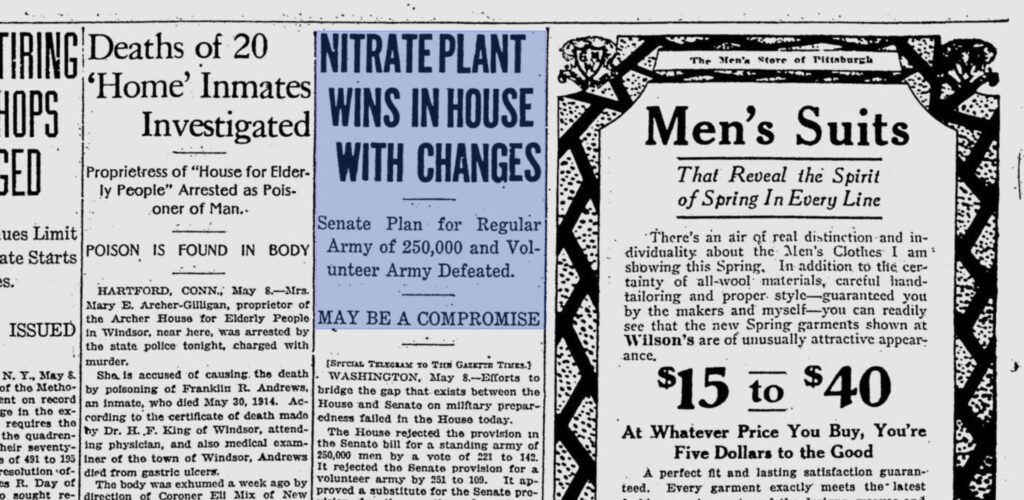
One hundred and ten years ago, on May 9th, 1916, The Gazette Times of Pittsburgh printed a special telegram from Washington, D.C. entitled ‘Nitrate Plant Wins in House With Changes.’
The report made the second page, with the front reserved for a slightly more pressing matter: World War I. One year prior, the Germans had torpedoed the British ocean liner the RMS Lusitania, killing over one hundred Americans in the process. While the Americans had not formally entered the war by May 1916, it was only a matter of time.
As a result, the nation was once again confronted with Alexander Hamilton’s thesis from his 1791 Report on the Subject of Manufactures, which concluded: “In countries where there is great private wealth much may be effected by the voluntary contributions of patriotic individuals, but in a community situated like that of the United States, the public purse must supply the deficiency of private resource. In what can it be so useful as in prompting and improving the efforts of industry?”
As a result of the war, America was becoming increasingly concerned about the availability of nitrates, or the German ability to disrupt the trade from Chile. Nitrates were especially important for the production of explosives, the likes of which the U.S. would need when it eventually joined the war a year later.
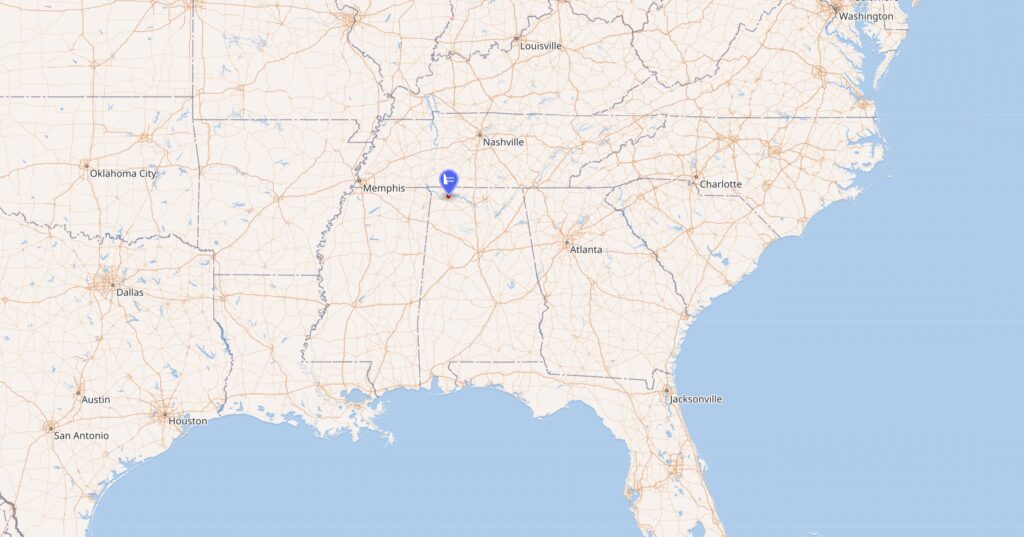
The National Defense Act (1916) mandated the construction of two new plants, with an adjacent hydroelectric plant. The location? Muscle Shoals, Alabama, right on the Tennessee River – a particularly treacherous terrain that had long stymied trade, commerce, and economic growth.
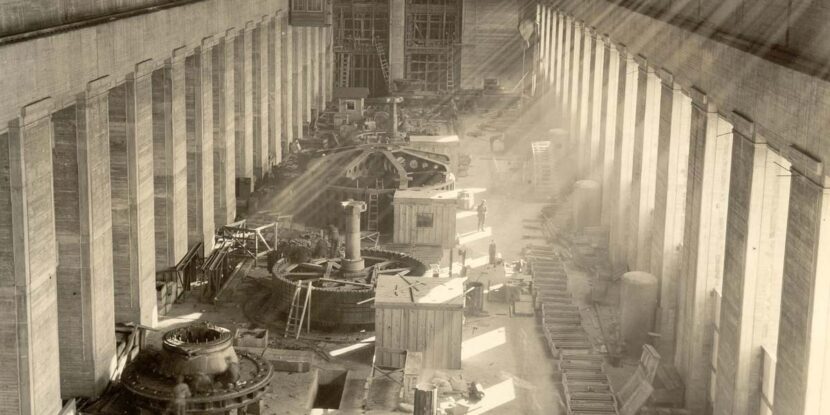
There was just one problem. The war ended before the plant – known as the Wilson Dam – had been completed. The government, stuck with a massive boondoggle, almost sold the whole thing to Henry Ford for just three percent of its total value. Sadly for him, the political will to shift this giant operation into private hands for a fraction of the cost simply wasn’t there, and in 1933, President Franklin Delano Roosevelt (FDR) established the Tennessee Valley Authority (TVA) in the hope of providing cheap energy for locals. It worked.
Today, the Wilson Dam has 21 generating units with a net dependable capacity of 663 megawatts. It is a National Historic Landmark and serves over 10 million people across seven states.
Neither Woodrow Wilson, for whom the dam is named, nor FDR, nor the 18,000 workers who built the dam could have ever realised what an important role the TVA would play over a century later. Though perhaps Hamilton foresaw it all.
American energy demand is currently skyrocketing, with power-hungry AI data centers creating genuine political and logistical insecurity and anxiety, especially on Capitol Hill.
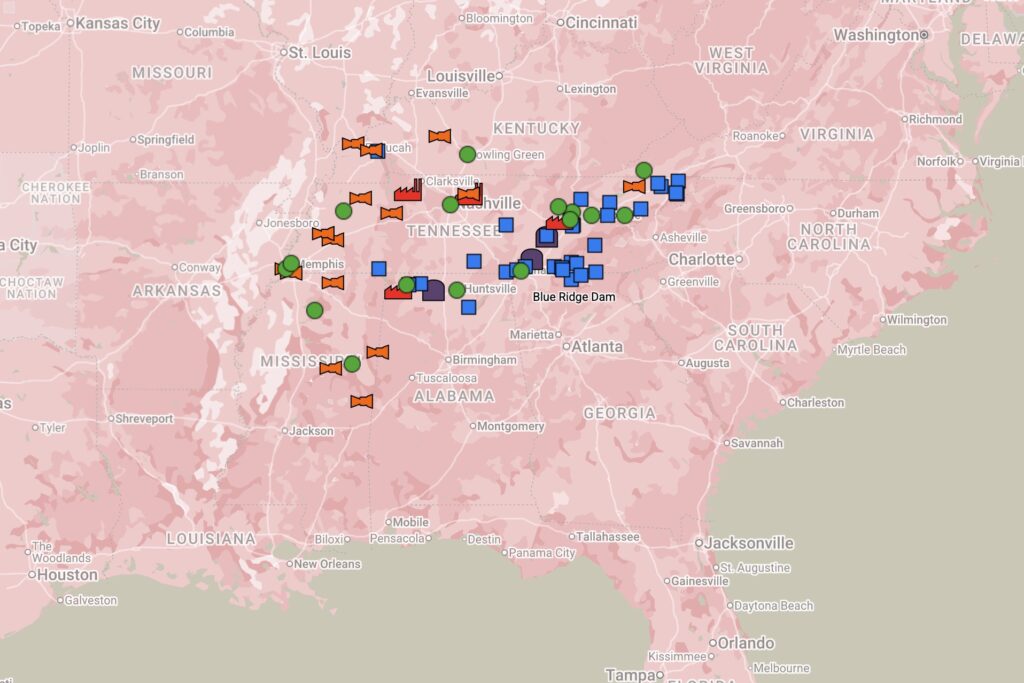
Meanwhile, legislators long dead are having a greater impact than the current crop, with the TVA recently voting unanimously to reverse plans to shutter its critical Kingston and Cumberland coal plants and build a bridge to high-tech nuclear power.
The decision was predicated on arguments President Trump and his team have been making for over a decade now: that you can’t run a 21st-century superpower on unreliable “renewals” and the wishful thinking that surrounds them.
When the TVA board, bolstered by Trump-appointed members, ran the numbers, the threat became abundantly obvious. Earlier plans had been tied to a 2035 full-coal retirement goal that prioritized green ideology over America’s energy grid needs. Massive shortfalls loomed, with electricity demands on track to double in some areas.
Without this course correction, ratepayers face sky-high bills, and industry faces blackouts. Sticking to the old retirement schedule, which would have forced Kingston offline in 2027 and Cumberland into a phased retirement starting in 2026, would have been outright economic self-sabotage, the likes of which Americans 100 years into the future could not have forgiven.
Now, Kingston and Cumberland will stay online indefinitely, modernized to work alongside new natural gas and battery storage facilities. Their combined 3.8 gigawatts of output will help keep the grid stable and bills low, ensuring energy security while the next generation of clean, reliable power plants comes of age: small, nuclear-powered modular reactors, or SMRs.
But the TVA is not constructing new coal-fired facilities. It doesn’t need to.
It’s preserving American energy infrastructure and local jobs to provide the breathing room needed to scale up new technologies without spiking prices. One source close to the TVA explained it to me as follows: “With data centers and manufacturing booming, we can’t risk reliability on unproven timelines. Coal extensions buy time for nuclear to scale.”
The TVA’s nuclear deployment program may now be the largest in American history.
Already in 2025, it submitted the nation’s first utility-led construction permit application for a small modular reactor (SMR) at a site near Oak Ridge to the Nuclear Regulatory Commission (NRC). With $400 million in Department of Energy funding already secured in late 2025, the project is moving at a pace rarely seen in nuclear.
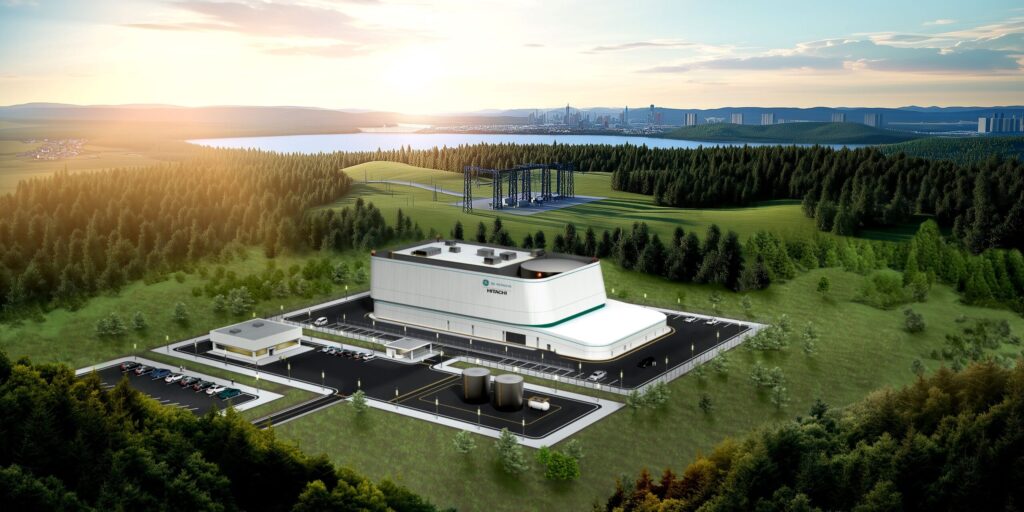
Construction of its GE Vernova Hitachi BWRX-300 model reactor is likely to begin in late 2028, with commercial operations targeted for 2032. This, they say, is just the tip of the spear, with the TVA already exploring up to six gigawatts of capacity across its service area through agreements with firms such as ENTRA1 Energy and NuScale.
This is a genuinely future-proof energy strategy.
Like so-called renewables, nuclear produces zero air pollution. Unlike renewables, it also produces reliable, 24/7 baseload power that isn’t held hostage by things like weather, or birds, or mechanical failures.
By maintaining existing coal assets, the TVA is effectively self-funding its own high-tech future, using the energy of today to attract, support, and expand the AI and advanced manufacturing industries that will eventually run on the small modular reactors of tomorrow.
It’s fitting that a firm with such an august history in national security, manufacturing, and energy production appears to be living up to the promise of those who first brought it into existence. It’s a very American story.