






❓WHAT HAPPENED: A new report released by the Center for Immigration Studies (CIS) sheds critical light on the scope of American welfare benefits accessed by noncitizens, revealing surprising variation by country and level of educational attainment.
👤WHO WAS INVOLVED: Noncitizen households—including both permanent legal residents and illegal immigrants, American taxpayers, and the Center for Immigration Studies (CIS).
📍WHEN & WHERE: The study was released on March 18, 2026.
💬KEY QUOTE: “Although most new legal immigrants and illegal immigrants are barred from accessing most means-tested programs, these restrictions have not prevented a large share of noncitizen-headed households from accessing the welfare system.” — CIS
🎯IMPACT: According to the data, 47 percent of households headed by a noncitizen—both permanent legal residents and illegal immigrants—utilize at least one government-funded welfare program. This number jumps to 54 percent when including refundable tax credits, such as the Earned Income Tax Credit (EITC) and the Additional Child Tax Credit (ACTC).
A new report released by the Center for Immigration Studies (CIS) sheds critical light on the scope of American welfare benefits accessed by noncitizens, revealing surprising variation by country and level of educational attainment. According to the data, 47 percent of households headed by a noncitizen—both permanent legal residents and illegal immigrants—utilize at least one government-funded welfare program. This number jumps to 54 percent when including refundable tax credits, such as the Earned Income Tax Credit (EITC) and the Additional Child Tax Credit (ACTC). For native-born Americans, the percentages are 28 percent and 31 percent, respectively.
“Although most new legal immigrants and illegal immigrants are barred from accessing most means-tested programs, these restrictions have not prevented a large share of noncitizen-headed households from accessing the welfare system,” CIS explains, continuing, “This is primarily because non-citizens often receive benefits on behalf of their U.S.-born children and the restrictions only apply to some programs. These facts coupled with the large share of noncitizens who have modest levels of education and their resulting low incomes mean many can use means-tested anti-poverty programs.”
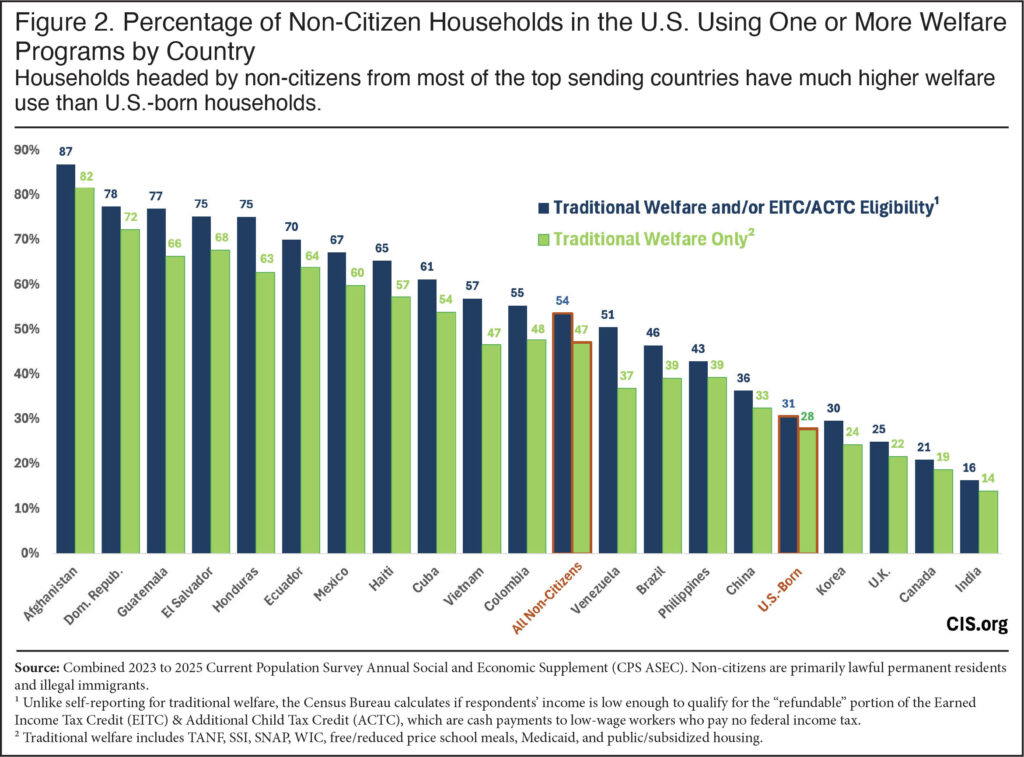
Households headed by noncitizens from Afghanistan are the top beneficiaries of American welfare programs. The CIS report shows that 82 percent of Afghan immigrant households are dependent on traditional government welfare assistance. This number rises to a stunning 87 percent when the EITC and ACTC are included.
After Afghanistan, noncitizens originating from the Dominican Republic are the next largest welfare users. Next in line, 78 percent of Dominican households rely on either traditional welfare programs or refundable tax credits. Similarly, 77 percent of households headed by noncitizens from Guatemala are reliant on the same.
The lowest welfare use among noncitizen households is by those headed by individuals from South Korea, the United Kingdom, Canada, and India, respectively. Other national origin groups falling below the average welfare use for all noncitizens are Venezuela, Brazil, the Philippines, and China.
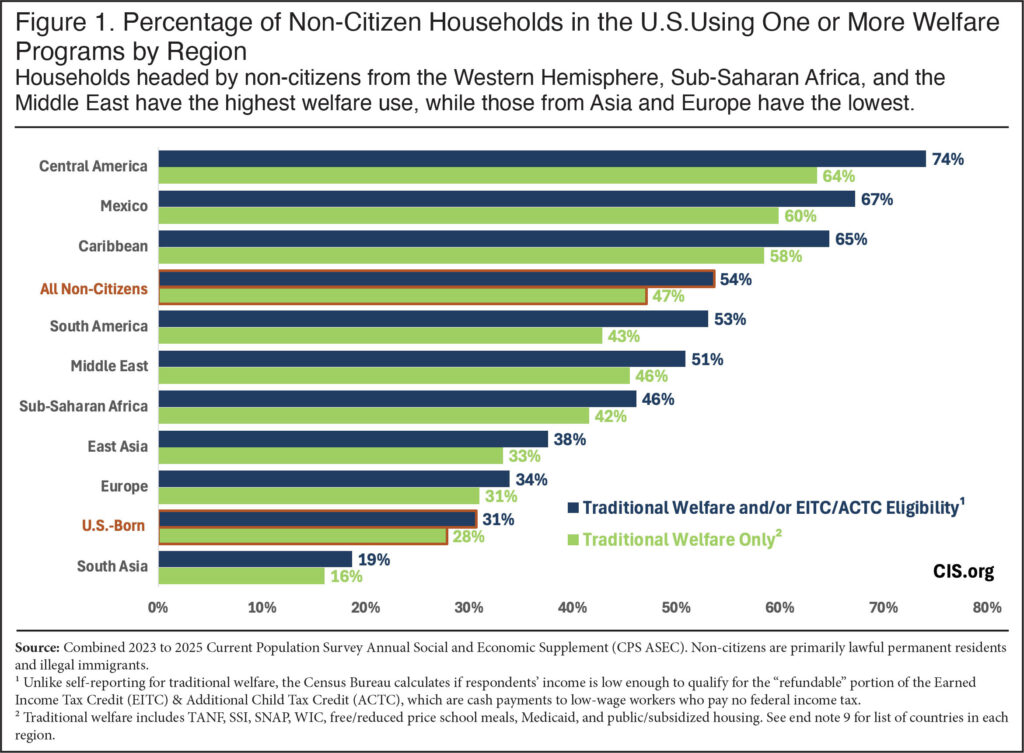
When broken down by region, Central American noncitizens are the most likely to use welfare, with 74 percent utilizing government aid programs or refundable tax credits. Interestingly, immigrants from South Asia are the only regional group to utilize welfare programs less than native-born Americans, with just 19 percent benefiting from both traditional and non-traditional government assistance. Noncitizen households headed by individuals of European origin, meanwhile, are nearly on par with native-born Americans, with just 34 percent accessing refundable tax credits or traditional welfare programs.
Join Pulse+ to comment below, and receive exclusive e-mail analyses.















.jpg)


