



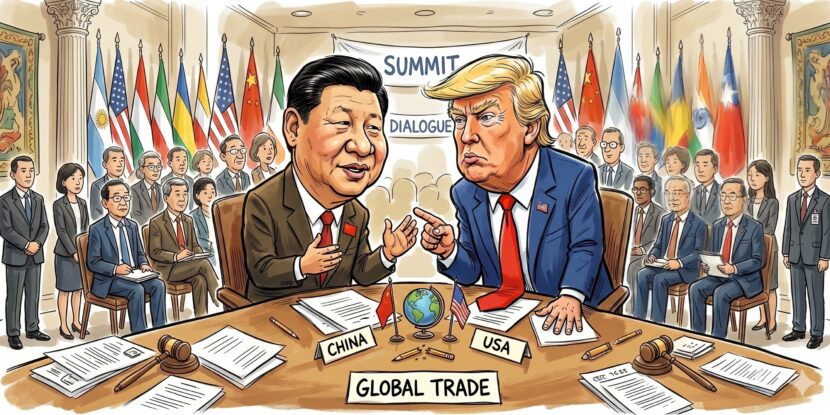

President Trump will fly to Beijing on May 14, and when he sits down across the table from Xi Jinping, the Chinese Communist leader will almost certainly reach for the same card he has played against every American administration for a decade.
Whenever a trade negotiation turns tough, with tariffs climbing and tempers fraying, Beijing picks up the phone and orders its state buyers to stop purchasing American farm goods. Soybeans, mostly. Beef and pork have had their turns, too. The effect is immediate and brutal. Within days, commodity prices collapse, and somewhere in the American South, a man who planted forty acres for a harvest that was supposed to ship to China in October watches his year’s income evaporate.
No U.S. president can let that stand, of course, so the checks go out. In 2018 and 2019, after Xi halted Chinese purchases of American soybeans during President Trump’s first trade fight, the Treasury cut roughly $23 billion in emergency payments to farmers — a figure larger than the annual budget of several federal departments, wired out in lump sums to compensate American families for damage inflicted by a single foreign leader. In 2025, when the trade fight resumed, Beijing ran the play again. Blocked American beef. Canceled soybean orders. Another $12 billion in aid was duly announced. Another round, another patch on a wound inflicted by a foreign adversary.
It is, if you stop and think about it for more than a moment, an astonishing state of affairs. And hardly sustainable.
The big agricultural companies shrug all of this off because multinationals with grain operations across three continents can ride out a trade war. They have the lawyers, the diversification, the patience of people who aren’t missing a mortgage payment over it. What they do not have is four hundred acres outside Decatur and a son who wants to take over the farm. The family farmer does. When Beijing freezes a purchase order, it is not anybody’s boardroom that absorbs the blow. It is a kitchen table in rural Illinois.
There is, mercifully, a bill sitting in Congress that takes the trick off the table.
It is called the Grown in America Act, and the idea is about as uncomplicated as legislation ever gets. When an American food or beverage company sources its ingredients from American farmers rather than importing them, the company gets a tax break. Buy more from American farmers, get more. Buy foreign, get nothing. That is more or less the whole thing.
What this builds, year by year and quietly, is a steady and compounding domestic market for American farm goods. A buyer that doesn’t hang up the phone when a summit in Beijing goes sideways. The soybean farmer in Iowa stops being a chess piece in a game he didn’t sign up for and becomes what he always should have been: a supplier to the American food economy, in a country that grows more than enough of its own food to feed itself. Xi’s favorite card loses its power for the simple reason that the American farmer no longer depends on him.
Will it cost the Treasury money? It will. Will it cost less than the $23 billion the Treasury was forced to write out the last time Beijing pulled this stunt? Considerably. And unlike the emergency checks, it actually buys something: a structural change that doesn’t evaporate the moment the next negotiation ends.
Which brings us to May 14.
When the President walks into that room roughly three weeks from now, he will do so in one of two conditions. Either he will walk in the way every American president before him has walked in — with American farmers dangling behind him like hostages, a fact Xi will have calculated to three decimal places before Air Force One has even landed — or he will walk in having had that weapon taken off the board by a Congress that finally understood what was at stake.
Every day this bill sits unsigned is another day Xi holds a card he is eager to play. It would be a good idea to pass it, and have Trump sign it, before the he boards the plane.