



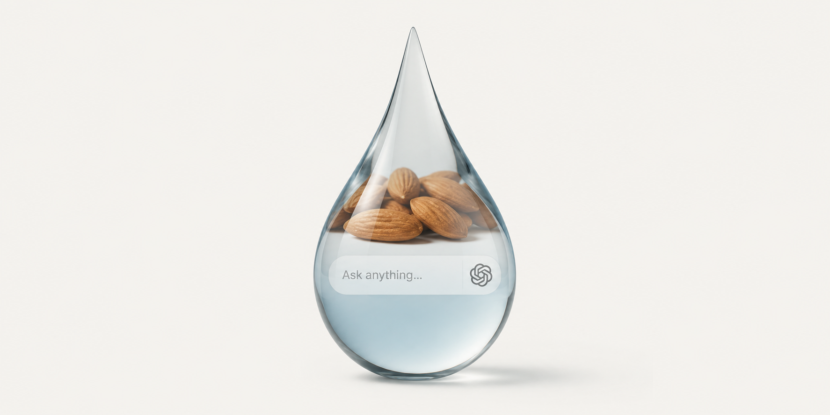

The water-usage argument against artificial intelligence has become the climate left’s favorite scold. The pitch runs as follows: every time you ask ChatGPT a question, somewhere a data centre guzzles a bottle of water to keep itself cool, and the planet pays the price. Stop using AI, the lecture concludes, or you are complicit in environmental ruin.
The numbers, however, tell a different story (if anybody bothered to check them).
A single pair of cotton jeans takes roughly 1,800 gallons of water to manufacture, the equivalent of somewhere between 136,000 and 681,000 ChatGPT queries, depending on what you’re asking.
A single almond, the smug snack of the wellness influencer class, requires a full gallon of water to produce, and there are around 300 almonds in a standard bag. Yet no one on TikTok films themselves weeping over Trader Joe’s, and no one is writing essays about the moral catastrophe of denim.
I asked a family friend whether she’s using AI (she’s in high school) and her response was: “I try not to because I heard AI uses a lot of water”
I don’t know how to process that interaction.
— Marty Kausas (@marty_kausas) March 7, 2026
The figure that launched a thousand finger-wags came from a 2023 paper out of UC Riverside and UT Arlington titled “Making AI Less Thirsty,” by Pengfei Li, Jianyi Yang, Mohammad A. Islam, and Shaolei Ren.
Its central claim is that roughly 500 milliliters of water, the size of a small bottle, is consumed by data centre cooling systems for every 10 to 50 medium-length responses from GPT-3, the model in circulation at the time. The study went viral on TikTok last year. Subsequent research has noted that the water footprint of an AI query varies enormously by location, depending on the energy source feeding the data centre, the cooling system in use, and the surrounding infrastructure. A query routed through Iceland is not the same as query routed through Phoenix, for example.
AI obviously consumes resources. But a sane argument about scale and proportion has been abandoned, once again, due to climate alarmists.
If water consumption is a genuine concern, their targets should be more obvious. Agriculture accounts for around 80 percent of the nation’s consumptive water use. The almond industry alone uses roughly 10 percent of California’s agricultural water. Fast fashion, much of it worn by the same influencers lecturing the rest of us, is among the most water-intensive sectors on earth. Then there are golf courses in the desert, lawns in Las Vegas, and the bottled water industry itself.
None of these generates anything close to the moralizing fervor reserved for a chatbot.
The reason is not difficult to identify. AI threatens the professional and ideological monopoly of a knowledge class that has spent two decades insisting it alone could be trusted with the truth. The water argument is the convenient cover story, dressing an old anxiety about losing the gates in the green language of environmental virtue.