



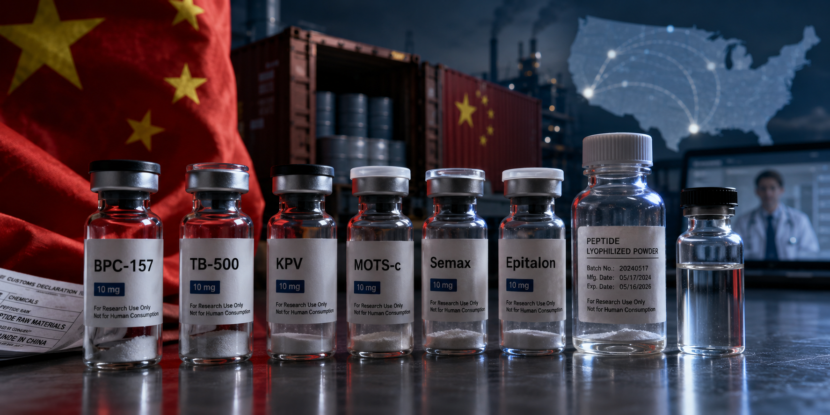

Next week, a Food and Drug Administration (FDA) advisory committee will decide whether seven still-unapproved peptides should be added to the list of substances America’s compounding pharmacies can legally use. The FDA’s own career scientists have already reviewed the evidence and recommended against it. The committee weighing that recommendation, however, is stacked with people who make money selling these peptides. The broader gray market this vote would help legitimize already includes Chinese chemical manufacturers who, until recently, were supplying the precursor chemicals behind America’s fentanyl epidemic.
CHINA’S EXPLOITATION.
Fentanyl remains the leading cause of death for Americans aged 18 to 45, involved in roughly seven in ten of the 107,000-plus annual overdose deaths recorded at the crisis’s peak, according to the DEA. The good news is that Trump-era enforcement is working. CDC data released in May show overdose deaths falling for a third straight year, down almost 14 percent to an estimated 69,973 in 2025, with opioid deaths dropping from 55,296 to 44,564. Broken down by drug type, fentanyl and its analogues killed an estimated 38,084 Americans in 2025 alone, down from 48,913 the year before. Add those two years together and fentanyl has killed nearly 87,000 Americans since the start of 2024. That’s a body count generated year after year by a Chinese chemical industry that has treated the American public as a market to exploit rather than a nation to deal with honestly.
But when a smuggling route gets squeezed, the people running it don’t suddenly retire. They pivot. Which appears to be happening before our very eyes.
A Chainalysis investigation published in June, recently reported on by Axios, found crypto payments to gray-market peptide vendors rose from $12 million to $32 million in a single quarter, up 159 percent, pushing the sector past a $100 million annual run rate. Two of the manufacturers traced were not newcomers, either.
Shanghai Sigma Audley had operated as a fentanyl precursor supplier with documented links to darknet vendors and cartel-connected money laundering, before rebranding into weight-loss peptides using the same Chinese contact number, and shutting down altogether last September. Bigreat Technology, a supplier of precursors for fentanyl and synthetic amphetamines, spun up a shell called Zhengzhou DEPU Technology to sell peptides directly to Western buyers, laboratory unchanged. Nobody is alleging these firms shipped finished fentanyl to Baltimore. What the chain of custody record shows is precursor suppliers rebranding once the drug trade got too hot, chasing the same American money through a legal side door that draws less DEA attention (and better margins).
THE PEPTIDE BOOM.
Peptides are not inherently sinister, and some have genuine, well-studied therapeutic value. The question is who profits when Americans chase the next Ozempic-style miracle from a compounding pharmacy or telehealth site rather than a properly reviewed product, and whether Washington is about to make that shortcut easier.
Consider what the FDA has already documented about compounded GLP-1 drugs, the broader category these peptides fall into.
It has logged nearly 1,000 adverse event reports tied to compounded semaglutide and more than 730 for tirzepatide as of May, numbers it concedes are likely undercounted. It has found counterfeit product under the names of pharmacies that never made it. It has warned telehealth companies for marketing Retatrutide directly to consumers, despite the fact that Retatrutide and cagrilintide cannot legally be used in compounding at all, full stop, because neither has ever been found safe and effective for any use. Gray-market operators kept breaking the rules anyway, and patients absorbed the consequences: dosing errors, contaminated product, medicine shipped without refrigeration, and more.
Nor is a compounded medicine a generic. Generics undergo FDA review and must prove equivalence to the branded product they replace. Compounded drugs get no comparable premarket review for safety, effectiveness or quality. Compounding has a narrow, legitimate purpose, the child who cannot swallow a pill, the patient allergic to a dye, the hospital facing a genuine shortage. But it was never meant to become a parallel industry selling nationally marketed approximations of drugs nobody has approved.
The seven peptides in question, BPC-157, KPV, TB-500, MOTS-c, emideltide (also called DSIP), Semax, and Epitalon, would join the Section 503A Bulk Drug Substances List, not some blanket manufacturing license. This is not a vote to let compounders mass-manufacture peptides the way a factory runs a line; 503A covers medicines compounded for a named patient under a valid prescription. But telehealth has spent years proving how thin that line can get when the same prescription is written for tens of thousands of people who filled out nothing more than an online questionnaire.
The GLP-1 boom is the proof of concept, and widening the list hands that playbook seven new products.
The FDA’s own scientists got there first. That recommendation came from career scientists, in briefing documents posted ahead of the meeting, citing insufficient evidence of both safety and effectiveness.
But the upcoming committee meeting is not neutral.
Reporting from the Associated Press and STAT News describes it as stacked with more than half a dozen members who run peptide clinics, businesses or pharmacies, including a Tennessee state senator and pharmacist whose mother, a member of Congress, has publicly pushed the FDA to loosen peptide rules. A former FDA official who now leads the Center for Science in the Public Interest made the obvious point: a panel this weighted toward people who sell the product is poorly placed to overrule its own agency’s scientists.
None of this argues for banning peptides or treating every compounder as a front for Beijing, by the way. Washington should cut the real red tape slowing legitimate American manufacturers, and require, at minimum, that patients know the country of origin of whatever ingredient actually fills the vial, not just the pharmacy’s name on the label. Streamlining approval solves the problem.
The FDA should not open this side door to China. Its own scientists already said so. That argument gets tested in a Washington conference room in days, in front of a panel with every incentive to disagree.