


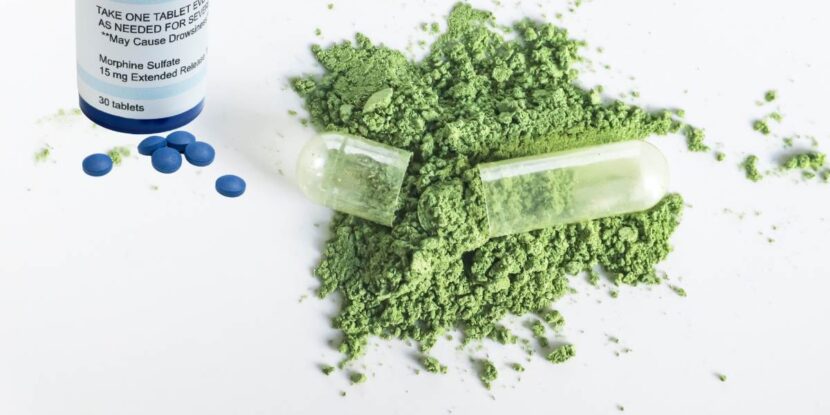

The Trump administration should throw its plan to temporarily schedule 7-hydroxymitragynine (7-OH) into the trash.
Not revise the threshold. Not negotiate over whether the government should allow one milligram, five milligrams or some other politically acceptable number. The entire premise is backwards. The federal government is preparing to use extraordinary emergency powers to place widely used products into Schedule I before establishing the science necessary to justify doing so.
Under the Controlled Substances Act, temporary scheduling is reserved for circumstances in which action is “necessary to avoid an imminent hazard to public safety.” Yet HHS has just reopened the public comment period for another 15 days, acknowledging it still needs data to determine what amount of 7-OH constitutes an imminent hazard. Meanwhile, the DEA has proposed a threshold of more than 0.050 percent or more than one milligram in certain finished products, a threshold critics say is not scientifically established.
If the government still needs the public to tell it where an “imminent hazard” begins, it should not already be preparing emergency scheduling based on an unproven threshold.
The right response to uncertainty is research, not prohibition.
Scientists have identified major gaps in clinical data, including safe dosing, drug interactions and effects on different populations. Those questions deserve rigorous human research. But unanswered questions are not evidence of an imminent public-health emergency.
Nor should policymakers ignore tens of thousands of consumers who say they use 7-OH for chronic pain, to remain functional, as an alternative to prescription opioids, or to avoid returning to more dangerous illicit drugs. Their experiences do not prove 7-OH is risk-free. But they do demonstrate that removing access could have consequences of its own, potentially including increased overdoses and deaths. Most states are regulating kratom and 7-OH rather than banning them outright; Rhode Island even overturned its kratom ban.
This is also a dangerous precedent for government emergency powers. In 2016, during the Obama administration, the DEA issued a Notice of Intent to temporarily schedule mitragynine and 7-OH. After receiving numerous public comments, the DEA withdrew the proposal to consider the evidence and await FDA’s scientific evaluation. There simply wasn’t enough data to justify emergency scheduling then. The same fundamental problem remains today.
If something merely could become a public-health threat, does that justify emergency federal action? If so, where does that authority end? Emergency powers should not become a tool for eliminating products from the marketplace before an actual emergency exists.
The administration should also ask: Who is actually asking for a ban?
According to a Compass poll, only 5% of Republican voters supported completely banning plant-based supplements like these, while 59% supported safety testing and 45% supported over-the-counter access to plant-based opioid alternatives if proven safe. Trump voters showed nearly identical support. A Schedule I action would move directly against the principles of individual choice and limited government that helped elect this administration.
Recent reporting also raises questions about political and financial influence. The New York Times reported that JW Ross, founder of Botanic Tonics, donated $1 million to the MAHA PAC and later urged the administration to crack down on 7-OH. WIRED also reported that Homeland Security Secretary Markwayne Mullin disclosed an investment worth as much as $1 million in Botanic Tonics. These reports do not prove money dictated policy, but they make independent science and transparency even more important.
And where did the proposed threshold come from? If HHS believes one milligram constitutes an imminent threat, it should be able to show the science establishing that. Dosage, formulation, metabolism and other alkaloids can all matter.
If all that weren’t enough, representatives are already considering H.R. 8000, the END 7-OH Act. Congress can hear evidence, debate the science, question stakeholders and answer to constituents before changing federal law.
That is how this should work.
HHS should withdraw its recommendation. DEA should abandon the temporary scheduling action. The government should fund researchers to conduct independent 7-OH studies and let the evidence guide what comes next.
Emergency powers should be reserved for emergencies. Science should come before politics. And when 95% of Republican voters do not support an outright ban, the administration should think carefully before imposing one anyway.
Jackie Subeck is the Executive Director of the 7-Hope Alliance Foundation