President Donald J. Trump’s war against Iran appears to have played a major role in the Republican Party’s major defeat in Tuesday’s midterm elections, with exit polling showing that 74 percent of voters considered the conflict a crucial or major factor in their decision. Meanwhile, immigration enforcement, one of Trump’s signature policies, remained one of the few issues on which Republicans retained an advantage over Democrats.
The political consequences of the conflict were acknowledged Wednesday by Vice President JD Vance, who publicly blamed the war for the Republican Party losing control of both chambers of Congress.
“The reason we lost is the war. The president himself said so last night,” Vance wrote on X.
The Vice President went further, challenging defenders of the conflict to acknowledge its political consequences.
“If you’d like to argue it was worth it, that losing the Senate for the next 6 years was worth it, then do so,” he wrote. “Argue it was a worthwhile cost to pay.”
Trump himself conceded that the conflict contributed to the Republican defeat, telling an interviewer, “Iran was a piece of it.”
A War Americans Never Wanted.
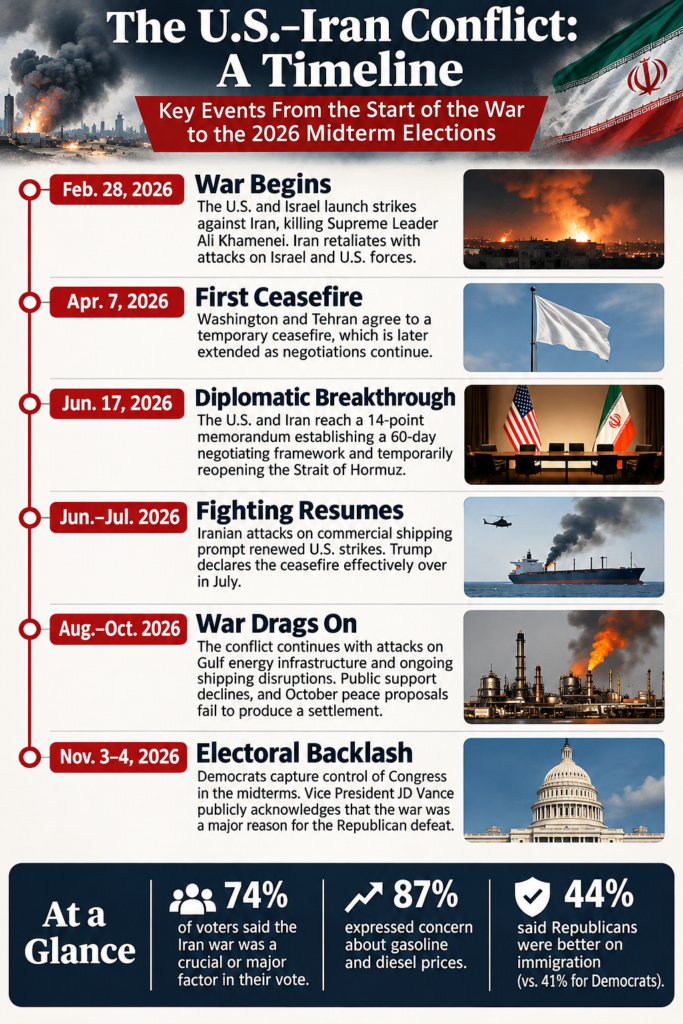
The conflict began on February 28, when American and Israeli forces launched strikes against Iran, killing Supreme Leader Ali Khamenei and triggering retaliatory Iranian attacks across the Middle East.
A temporary ceasefire was reached in April, followed by a diplomatic framework in June. However, renewed attacks on commercial shipping and American military operations brought further fighting during the summer, while subsequent diplomatic initiatives failed to secure a lasting settlement.
Public opposition emerged almost immediately. A March 1 survey found just 27 percent of Americans approved of the initial strikes, compared with 43 percent who disapproved. By August, another national survey found support for American military action had fallen to 31 percent. Even among Republicans, support reportedly declined from 77 percent in March to 69 percent in August.
The November 3 exit polling suggested the conflict remained unpopular, with most voters believing Washington had been wrong to attack Iran, including approximately one-quarter of Republicans.
Iran and the Cost-of-Living Crisis.
Iranian attacks on shipping and Gulf energy infrastructure disrupted global energy markets, driving concerns about oil prices, transportation costs, and household expenses. An investigation into the conflict documented the growing political backlash, while election analysis highlighted how higher gasoline and freight costs connected the war directly to voters’ economic grievances.
According to national exit polls, 89 percent of voters considered affordability a crucial or major factor in their decision, while 87 percent expressed concern about gasoline and diesel prices. Another 88 percent expressed concern about grocery costs, with 58 percent of those voters supporting Democrats.
The economy was identified as the country’s most important issue by 39 percent of voters, compared with just 14 percent who selected immigration. The findings suggest that the administration’s foreign policy may have compounded existing economic frustrations, particularly among voters who backed Trump in 2024 expecting cheaper energy, greater prosperity, and an end to America’s involvement in foreign conflicts.
Immigration Remained a Republican Strength.
The same exit polling found Republicans held a 44-to-41-percent advantage over Democrats when voters were asked which party they preferred on immigration. Among voters who considered immigration enforcement a crucial or major factor in their decision, 52 percent supported Republican candidates.
The figures suggest that Republicans were not necessarily rejected across their entire policy platform. Rather, their relative strength on immigration was overwhelmed by dissatisfaction with economic conditions, the administration’s handling of the war, and other concerns.
MAGA Coalition Under Threat.
Trump’s 2024 landslide victory rested partly on his promises to restore economic prosperity, secure America’s borders, and avoid unnecessary foreign wars. The 2026 midterm rout suggests that the administration’s military intervention in Iran has strained that political coalition, particularly among voters who expected an America First presidency to prioritize domestic economic concerns over yet another Middle Eastern conflict.
Vance’s post-election intervention also suggests that at least some senior Republicans recognize the scale of the problem. “Everyone knows why we lost,” the Vice President said. “And any honest conversation about where we go from here must start there.”
We told you so: how The National Pulse predicted the Iran war political fallout. https://t.co/Fxv0iARgCj
— Raheem J. Kassam (@RaheemKassam) November 4, 2026