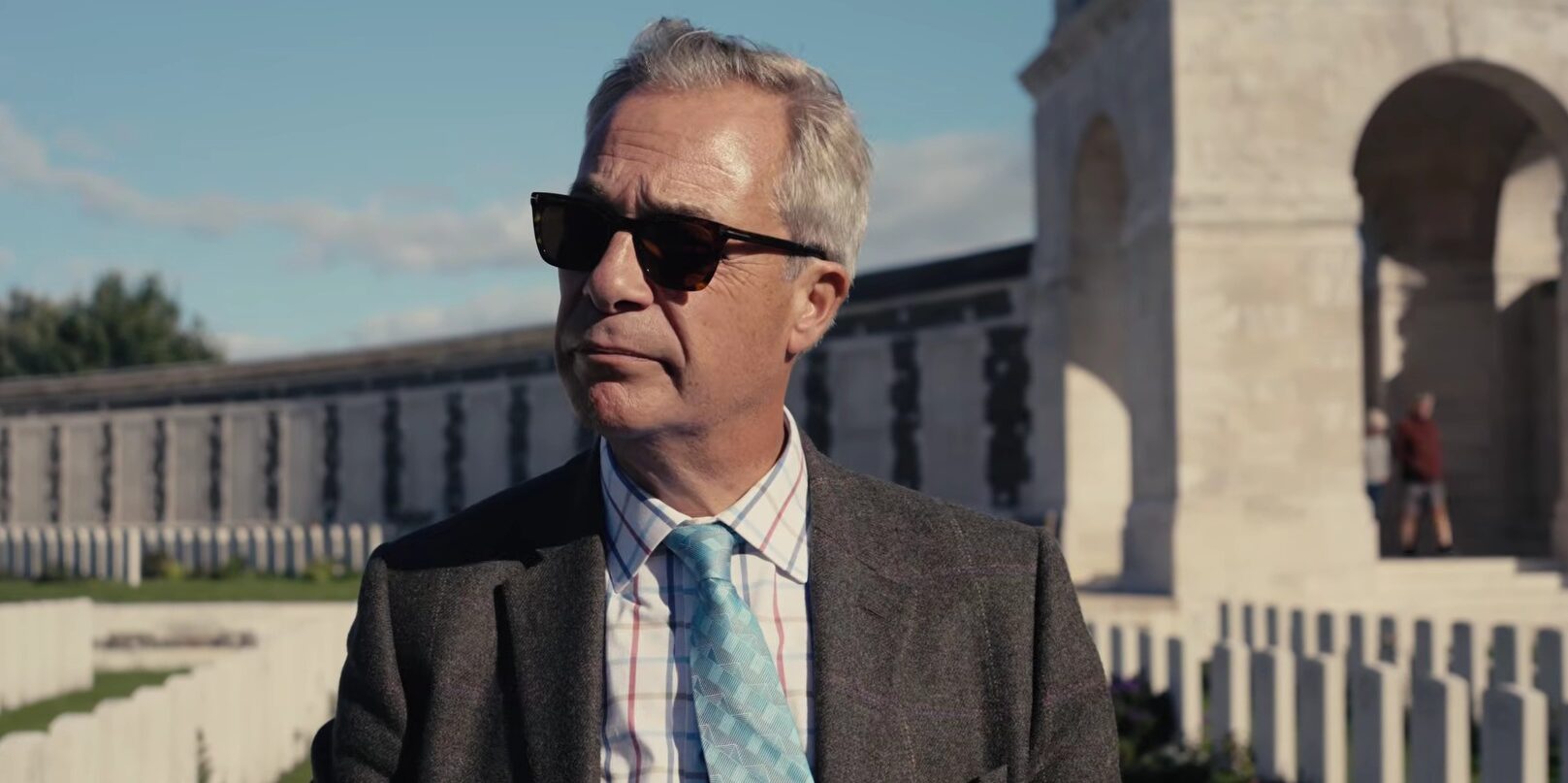
Nigel Farage released a 42-minute First World War documentary, We Will Remember Them, on his YouTube channel on Remembrance Sunday, Britain’s annual commemoration of the war dead. The film, directed by Harry Parslow, is battlefield history and remembrance — individual stories, cemeteries, Vimy Ridge, Flanders and the poppy, Passchendaele.
In it, he says that the Commonwealth’s part in the two world wars ought to be taught in British schools as “a bit more of a unifier.”
“One of the untold stories is of all of our effort in two wars, 40 percent of it came from the Commonwealth,” Farage said. “It came from India. It came from the West Indies. It came from Australia, New Zealand, Canada.” He stressed that “not one of them was conscripted,” adding: “I would like to think that in some ways this story could be used in modern Britain as a bit more of a unifier, that there is a collective sense of shared history amongst all of these people. And I think schools ought to do that.”
He opens and closes the documentary with Laurence Binyon’s Ode of Remembrance:
They shall grow not old, as we that are left grow old:
Age shall not weary them, nor the years condemn.
At the going down of the sun and in the morning
We will remember them.
Three weeks ago, he said, he took a group along the old Western Front in France and Belgium, ground he has visited “many, many times over the course of the last 40 years.”
The trips began in a mid-1980s City trading room, reading Telegraph obituaries of a disappearing generation. Four colleagues booked a coach; he later started organizing the tours himself. “Farage’s Foragers was born.” At Dulwich School, he said, his PE master had been an ex-Regimental Sergeant Major of the Royal Sussex, his chemistry teacher had flown a Spitfire in the Battle of Britain, and his maths teacher had been on Field Marshal Montgomery’s staff at El Alamein. Veterans would talk over a pint at the Royal British Legion or a regimental reunion, but their wartime experience was “not particularly to be discussed in front of the wives and children, and I think that was a very British approach.”
“You can read history in lots of different ways,” he said. “I just find the individual stories of ordinary people doing extraordinary things and finding themselves in remarkable positions.” Why Britain fought, as he tells it, was that a Serbian nationalist assassinated the Habsburg heir, and Germany invaded through Belgium. “Did the Germans have to do that? No. Was it opportunism by [German Chief of the General Staff Helmuth] von Moltke who was in charge of the German army? Yes.” Britain was “honour-bound, duty-bound to defend Belgian independence and that’s what dragged us in.”
We owe a great debt of service to the young men who died for Britain.
We must ensure that the country they fought for continues, and that it remains a country that they could take pride in.
These brave men deserve better than to have the war they fought for us fade into the…
— Nigel Farage (@Nigel_Farage) November 9, 2026
He lingered at a number of graves that make the point. Valentine Joe Strudwick of the Rifle Brigade was killed on January 14, 1916, aged 15. Sid Lewis of Surrey, he said, joined at 12, fought on the Somme at 13 with a Vickers .303 team and survived. He visited the grave of Noel Chavasse, who won the Victoria Cross and Bar, whose twin “went on to become a bishop and married my aunt and uncle.”
At Thiepval, he pointed to 73,000 names and a memorial designed, he says, so it could be recognized by Muslim and Sikh soldiers of the empire as well as Christians. He recounted John McCrae writing In Flanders Fields, and the poppy becoming the Royal British Legion’s official symbol in 1921. He quoted Harry Patch, at 108, saying on Today with John Humphrys in 2006: “Any man that tells you he wasn’t scared is either a liar or a fool.”
“I feel that Remembrance Sunday is a time when we should look back, and whilst there has to be quite a big mournful, I think we should be very grateful,” he saie. “I mean there is no doubt that if we hadn’t taken on Germany twice, they would have completely taken over the entirety of the continent. And the likelihood is that the German Empire would have lasted the same time as the USSR.”
He recalled “two old boys” in a village pub when he was a teenager, one a Communist after 1945, one “very much on the right,” who argued every day and still met. When he asked why, the answer was: “Oh, son. You don’t understand. We fought a war to be able to do this.”