





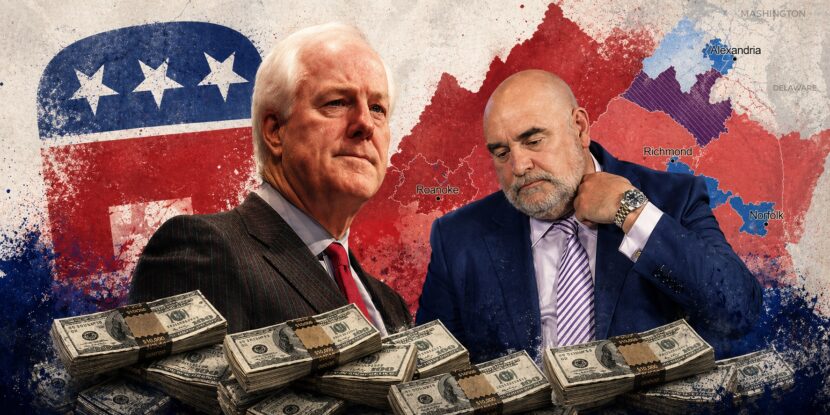

Virginia voters have narrowly approved a Democrat-drawn mid-decade congressional gerrymander, handing Democrats up to four additional U.S. House seats. But how did Republicans lose, given the vote was so close, and given their massive funding advantage? We break it down here:
| PULSE POINTS |
❓ WHAT HAPPENED: Virginia voters narrowly approved a Democrat-drawn mid-decade congressional gerrymander by a margin of roughly 81,188 votes — 51.3 percent to 48.7 percent with more than 95 percent reporting at the time of publication. The constitutional amendment hands the Democrat-controlled General Assembly power to redraw Virginia’s congressional districts through October 31, 2030. 🗺️ THE MAP: HB 29 — passed by the legislature and signed by Governor Abigail Spanberger on February 20 — flips Virginia’s U.S. House delegation from 6-5 to 10-1. Net Democrat gain: up to four seats. 📊 COST PER VOTE: A snap analysis by The National Pulse shows the “Yes” (Democrat) side spent $62.3 million, divided by 1,545,736 votes (at the time of publication), which comes to around $40.30 per vote. Meanwhile, the Republican “No” side spent around $20 million, divided by 1,464,548 votes, for an average of $13.66 per vote. Democrats spent three times as much per head — and still only cleared 51.3 percent. 🪙 PENNY WISE: Closing the 81,188-vote gap at the “No” side’s own efficiency rate would have cost around $1.1 million — just over one percent of what the GOP burned on John Cornyn’s primary campaign against Ken Paxton in Texas last month. Even a generous real-world multiplier, accounting for diminishing campaign returns, lands at just $2 million to $4 million. 🏦 DRY POWDER: The Republican National Committee is sitting on roughly $109 million cash on hand — nearly $100 million more than the Democratic National Committee, which has just $15.9 million and is carrying $17.4 million in debt. Trump-aligned super PAC MAGA Inc. entered 2026 with more than $304 million in the bank, by itself. In fact, combining all the major Republican groups leaves the GOP with over $807M cash on hand in total. Which means they’d only have had to spend 0.25% of total funds to salvage Virginia. 💰 CORNYN CALCULUS: Republicans spent roughly $95.1 million on the Cornyn–Paxton primary in Texas. The “No” side in Virginia spent roughly $20 million. That is about five times more on a single Senate incumbent than on a referendum that could cost the party four House seats. 🏢 THE FIRM: Virginians for Fair Maps — the losing “No” campaign — was run by Mike Young, a partner at FP1 Strategies, which was founded by Chris LaCivita. LaCivita is simultaneously the senior campaign consultant for the Cornyn super PAC which has spent all that money attacking Ken Paxton, and pushing Trump to endorse Cornyn, who has repeatedly stabbed the President in the back. Ninety-five million dollars went one way. Twenty million went the other. And much of it through LaCivita’s own companies and partners. 💬 VA SOURCE: A Virginia source tells The National Pulse: “The money diverted to LaCivita’s groups and away from the Republican Party of Virginia/county parties was hard to accept. We had no money.” 🗣️ KEY QUOTE: Sean Davis of The Federalist on X tonight: “Good thing Republicans spent $100 million on John Cornyn.” ⚖️ “FAIRNESS” FARCE: The ballot asked voters a convoluted question: “Should the Constitution of Virginia be amended to allow the General Assembly to temporarily adopt new congressional districts to restore fairness in the upcoming elections, while ensuring Virginia’s standard redistricting process resumes for all future redistricting after the 2030 census?” On February 19, Tazewell Circuit Judge Jack Hurley ruled that the phrase was misleading and unconstitutional and blocked the referendum. 👨⚖️ SCOVA’D: The Supreme Court of Virginia had two chances to stop this — January and March — and twice punted past the election, writing that courts “generally should not prematurely enjoin an upcoming election.” The justices reserved the right to review the map de novo after the vote. Cold comfort: the seats are banked in November either way. 🧑⚖️ STILL IN COURT: Briefs are due to the Supreme Court of Virginia two days after tonight’s vote. The map could still be struck down — after the 2026 seats are already counted. Chaz Mizelle has an alternative idea, as we reported this morning. |
FEC: CASH ON HAND
🔴 MAGA Inc — $312M
——
🔴 SLF — $166.4M
🔴 RNC — $116.8M
🔴 CLF — $91.4M
🔴 NRCC — $78.2M
🔴 NRSC — $43M
——
🔵 SMP — $74.8M
🔵 DCCC — $70M
🔵 HMP — $63.9M
🔵 DSCC — $36.5M
🔵 DNC — $13.9M ($18.4M debt)
——
Total
🟥 GOP/Trump: — $807.8
🟦 Democrats — $259.1M— InteractivePolls (@IAPolls2022) April 21, 2026
Join Pulse+ to comment below, support our work, and receive exclusive email updates.
show less










.jpg)


.jpg)

.jpg)
