




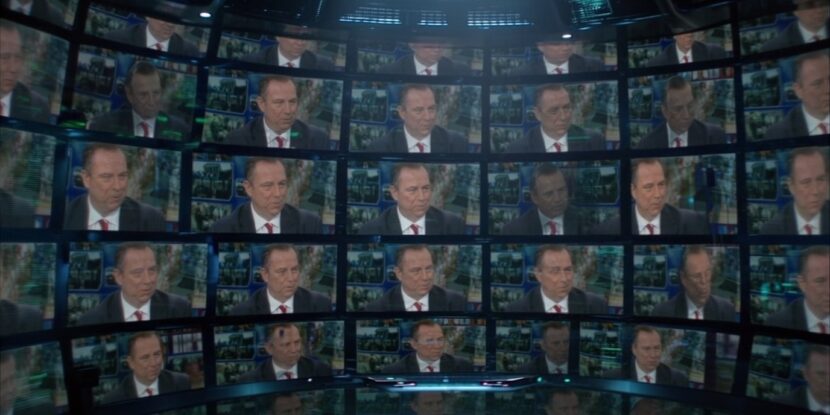

As you know, I’ve had it up to here *gestures quite high indeed* with ‘Conservative, Inc.’ Twas ever thus, perhaps. But at the same time, never more so than with Newsmax’s Chris Ruddy. I declare a pre-existing disdain for their treatment staff during COVID-19, including some of my friends at the time. No coincidence that I haven’t been invited back on the network since critiquing their Cuomo-style mandates.
But today’s beef is slightly more well-rounded and with more depth than the simple smash burger they cooked up during COVID. As surprisingly well argued by the Wall Street Journal‘s Editorial Board last month, the Newsmax chief’s latest scheme of self-interest would stifle upcoming conservative networks (think Real America’s Voice, Sinclair, etc.), especially in the unforgiving battle against big corporate internet giants like Google (i.e., YouTubeTV).
Ruddy keeps telling President Trump that easing television ownership caps, as I discussed with Daniel Suhr on my War Room Boxing Day special, is a bad idea. It is. But only if you want to maintain the status quo of broadcast in America. Dominance by a handful of networks in the face of what should be a reasonably competitive marketplace. Some barriers to entry have never been lower – think about how much it now costs to put together a passable TV studio, for example.
Which is why it makes little sense in a digital streaming age to have an antiquated, government-imposed limit on broadcast “reach” when anyone can pick up their phones and get whatever they want online. In the long term, this would leave the one remaining corporate cartel in place, perhaps as the final broadcasters in American history, doomed to go down with the ship.
But broadcast news is essential. Millions of people still tune into it every night, especially at a local level, to find local news that major cable networks don’t cover, and that don’t ‘trend’ online. Think about, say, Sinclair – a company imperative to challenging both liberal and RINO orthodoxies.
This makes it foolish not to lift the existing 39 percent cap and open up the marketplace, as long as there are safeguards in place to prevent existing corporates from dominating the entire market.
The rule currently limits broadcast organizations from owning stations that reach more than 39 percent of American households. It dates back to the 1940s, when broadcast television operated in a closed world with almost no competition.
Ruddy argues that easing ownership limits would empower left-wing networks and damage Republican electoral prospects. But what have we had under the EXISTING system, until now? Precisely that. What he’s actually upset about is that a more consistently conservative broadcaster than Newsmax (one that won’t fire staff for breaching COVID rules, perhaps?) might come along and eat his lunch. And boy does he love a Smith & Wollensky lunch.
To make his case, Ruddy invokes Ronald Reagan. The historical record, however, does not cooperate. Reagan’s Federal Communications Commission (FCC) aggressively deregulated broadcast ownership because he believed in competition, not petty protectionism for Newsmax and its portfolio of paywalled content.
Even Ruddy’s case against left-wing broadcast dominance is losing weight, with CBS having just been bought out, and Bari Weiss being named Editor-in-Chief. It was remarkable to watch, for instance, the Trump-Kennedy Center Honors being broadcast on CBS in all its glory (trust me, I attended in person), and even the correct new name for the institution being used. None of this would’ve been possible in Ruddy’s pessimistic little world.
Maybe under the new proposals, you won’t see more conservatives on television. However, you certainly won’t see fewer, which is what might happen if the anti-market forces prevail. See, if we leave the current system in place, we have to wait for another Skydance-Paramount style merger, or indeed a blue moon. In the other scenario, both current and new networks will race to create new stations and content to serve emerging markets.
Ruddy recently also opposed the proposed Tegna and Nexstar merger because it would give NewsNation, which just brought on Katie Pavlich, greater scale. His concern is not philosophical, and he should stop taking Reagan’s name in vain. At the end of the day, he’s worried about his business flanks. Which is fair, but he should just come out and say as much.
A movement that claims to oppose monopolies and elite capture should not defend media protectionism when it suits a friendly executive. President Trump should reject his entreaties.
His FCC chairman is trying to unwind rules that belong to another century. Conservatives should support that effort on principle, not abandon it because one network prefers a protected marketplace.