




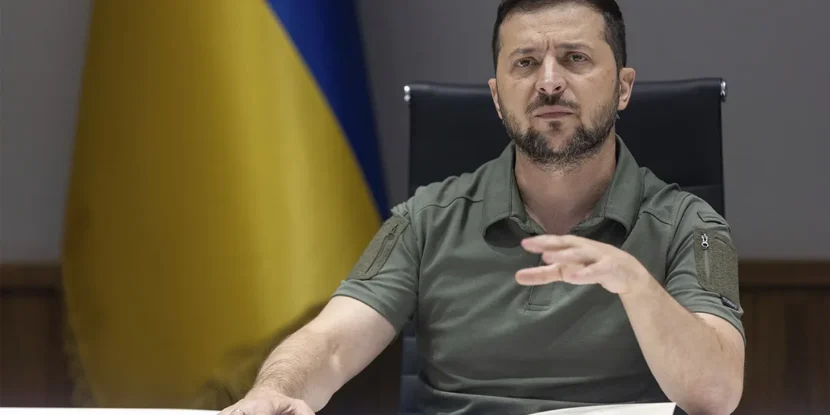

Ukraine’s long-standing reputation as one of the most corrupt countries in Europe has only gotten worse under President Volodymyr Zelensky, especially during the war with Russia. Very recently, a top ally of Zelensky fled to Israel after being accused of taking part in a $100 million corruption scheme. Despite previously being close to Zelensky and his right-hand man, Andriy Yermak, Timur Mindich is now claiming he never was.
It’s the same situation over and again in the embattled nation.
Political corruption is now so common that the country was forced to create a National Anti-Corruption Bureau (NABU) in 2015. While NABU was intended to be independent and non-partisan, Zelensky and his allies attempted to bring it under their direct control just last year, sparking protests across the country. Once again, they backpedaled when caught out.
This smash-and-grab culture is as responsible for the nation’s fortunes as its misplaced trust in Brussels.
The military fares no better, with countless stories of bribes from men who wish to avoid being sent to the front lines against the Russian armed forces. In 2023, Zelensky and his regime fired conscription officials and promised criminal cases against at least 30 people, some of whom were accused of accepting cryptocurrency bribes to help men avoid military service. The problem has not disappeared, however, as another corruption case involving a lieutenant colonel was reported just this month.
The corruption in Ukrainian media, however, is rarely discussed, but appears to be just as prevalent as in other sectors of society, from pay-to-play articles to outright coercion from the Zelensky government.
It’s not a new phenomenon, but it does appear to be worsening.
JEANSA.
In 2013, the European Journalism Observatory (EJO) decried a phenomenon known in Ukraine as “jeansa,” a term for media bribery in which politicians, companies, and others pay journalists or outlets for favourable coverage disguised as traditional “unbiased” news.
“Unlike direct advertising, “jeansa” disguises itself as traditional news, with money or other benefits received by journalists for publication going into their jeans pockets – hence the name “jeansa” bribery, as the urban legend suggests,” the non-profit stated. The EJO claimed that as much as $2.5 billion was spent on “jeansa” bribes in 2012, and that some journalists could be bought off for as little as $1000.
The Institute of Mass Information (IMI), a media watchdog created by Ukrainian and Western journalists in the 1990s, states that this form of bribery is still relatively common in 2025. That politically motivated bribes account for around 26 percent of paid influence in online media, most of which comes from corporations.
Regarding specific political figures, the head of Zelensky‘s Servant of the People Party, Olena Shulyak, appeared to be most fawned over by material showing signs of jeansa bribes, according to the IMI. Paid attacks on activists and other politicians were also reported. Kiev Mayor Vitali Klitschko has also reportedly been a major beneficiary of jeansa.
It is not only Ukrainian businesses, organizations, and individuals paying off journalists for favourable coverage. On a much larger scale, Ukrainian journalism, almost entirely, was beholden to funding from the United States Agency for International Development (USAID) under the Biden government.
IMI stated that up to 90 percent of Ukrainian media relied on USAID funding, claiming that actual regular advertising accounted for as little as 3 percent of revenues. President Donald J. Trump overhauled and reformed USAID earlier this year, canceling billions of dollars in taxpayer funds spent on various woke projects globally.
While some journalists are bribed to give favourable coverage to politicians and government figures, others face active coercion from the government and other authority figures, particularly when reporting on government corruption.
Sevgil Musayeva is the editor of Ukrainska Pravda, one of Ukraine’s largest online news websites, and claimed in July of last year that Zelensky and his regime were actively threatening the website’s advertisers, telling them not to pay the site.
“I don’t like what is happening with people that criticise the government. In this terrible time, with all these Shahed [drones hitting Kiev], Zelensky still has time to pressure journalists,” Musayeva stated. She claimed the presidential office pressured large businesses to drop their ads, resulting in a loss of over $240,000 to the website from just six major companies. According to Musayeva, the pressure was related to investigative work done by the outlets’ journalists regarding corruption.
Ukrainian authorities have also put pressure on individual journalists for exposing corruption. In one case, investigative journalist Yevhenii Shulhat claimed that soldiers handed him a draft notice in a shopping mall after he had published a story about corruption within the country’s secret intelligence service, the SBU.
“I regard this as intimidation and obstruction of my journalistic activity,” Shulhat said.
Ukraine’s corruption problem is not confined to politics and procurement. It extends into the information space itself—where paid narratives, foreign dependence, and alleged government pressure risk turning “independent media” into just another managed institution.
After decades, you still can’t trust much coming out of Ukraine, and President Trump and his State Department would do well to ensure that any funding that has landed in the pockets of corrupt individuals–politicians, reporters, or otherwise–is not just highlighted, but also clawed back.
Chris Tomlinson and Raheem Kassam contributed to this editorial.