




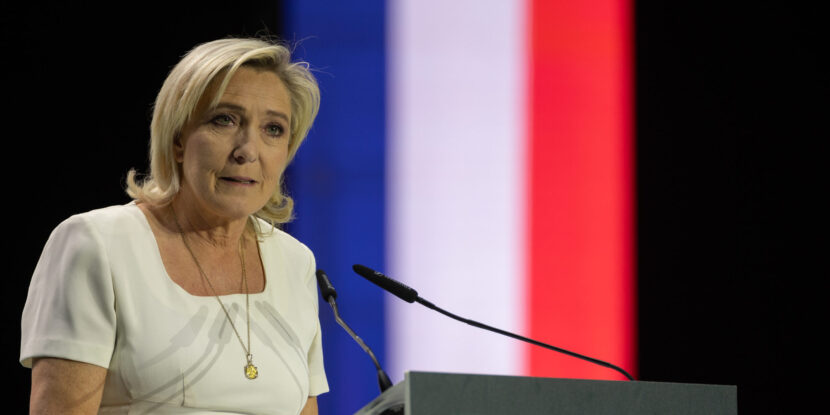

On Sunday, National Rally (RN) party leader Marine Le Pen officially became the party’s nominee for France’s 2027 presidential election. This is far from Le Pen’s first presidential bid, but it is shaping up to be her most successful.
The National Pulse helps you keep track of European politics. If you value the work of Raheem J. Kassam and his team, please JOIN THE NATIONAL PULSE or MAKE A DONATION today.
2012 Presidential Bid.
Le Pen made her first presidential bid in 2012, having succeeded her father, Jean-Marie Le Pen, as leader of the Front National, National Rally’s predecessor party.
The election was held against a backdrop of economic uncertainty from the global financial crisis and the eurozone debt crisis, along with high unemployment and growing frustration with the government of then-President Nicolas Sarkozy. Sarkozy was a member of the Union for a Popular Movement (UMP), an establishment center-right party. He won the 2007 presidential election and sought a second five-year term.
However, François Hollande, the Socialist Party candidate and leader of the establishment center-left, won the first round with 28.6 percent of the vote, whereas the incumbent Sarkozy came second with 27.2 percent. Le Pen placed third in the first round, meaning she was ineligible to advance to the second round run-off, although she secured roughly 17.9 percent of the vote, a record for her party and foreshadowing the growing influence of the French national populist right.
Hollande ultimately won with 51.6 percent of the vote while Sarkozy received 48.4 percent.
2017 Presidential Bid.
Le Pen made her second bid for President in 2017. The election took place amid concerns over unemployment, immigration, Islamic terrorism, and France’s membership of the European Union. Socialist President François Hollande was deeply unpopular and therefore did not seek re-election, creating an open field.
Emmanuel Macron, an economy minister in Hollande’s government at the time, resigned to run for the presidency. The former banker founded the En Marche! movement, a globalist party pulling support from both the establishment left and the establishment right. The party was renamed Renaissance in September 2022.
Macron won the first round with 24 percent of the vote, while Le Pen came second with 21.3 percent. The establishment center-left Socialist Party and the establishment center-right Republicans, the latter of which emerged from the UMP, fell to third and fifth place in the first round.
During the second round, Macron won 66.1 percent of the vote as the establishment united around him, while Le Pen received 33.9 percent. This represented the first time since 2002 that the Front National had advanced to the run-off.
The National Pulse does not rely on government or corporate cash. To keep us RADICALLY INDEPENDENT, please JOIN THE NATIONAL PULSE or MAKE A DONATION today.
2022 Presidential Bid.
Le Pen’s third bid for President happened in 2022. The incumbent President Emmanuel Macron sought a second term amid rising concerns over the cost of living, immigration, security, and the then-new war in Ukraine.
Macron topped the first round with 27.9 percent of the vote, followed by Le Pen with 23.2 percent. The election also saw the far-left Jean-Luc Mélenchon rise to third place with 22 percent, and Éric Zemmour split the national populist vote with 7.1 percent in a fourth-place finish. Meanwhile, support for the country’s establishment center-right and center-left parties cratered, receiving just 4.8 percent and 1.8 percent, respectively.
During the second round, Macron won with 58.6 percent of the vote, while Le Pen received 41.5 percent, representing an improvement on her second round result five years prior. This was Le Pen’s first presidential bid after rebranding her party from the National Front to the National Rally, in order to distance the party from its more radical past under her father and gain more mainstream appeal.
This election saw not only the collapse of France’s establishment political parties, but the emergence of the country’s current three electoral blocs: Macron’s new establishment globalists, Le Pen’s national populists, and Mélenchon’s radical leftists. These divisions are currently reflected in France’s gridlocked legislature, contributing to ongoing political instability in the country.
2027 Presidential Bid.
Le Pen’s fourth and most recent bid for President was announced at the National Rally conference on October 25. “We are not living through the end of the world but the end of a world, their world,” Le Pen declared at the event in Orléans in north-central France this past weekend.
Le Pen also confirmed that if elected President she would appoint Jordan Bardella, who was re-elected as the National Rally’s president at the conference, as Prime Minister.
According to recent polling, Le Pen is on track to win the first round of presidential voting in April next year. She is also predicted to win the second round, regardless of whether she faces off against Mélenchon or a Macron-adjacent centrist, such as former Prime Ministers Édouard Phillipe and Gabriel Attal.
Le Pen’s nomination by her party coincided with violent riots across the country, which have resulted in the destruction of revered French landmarks such as the Limoges City Hall.
The first round of voting is scheduled for April 18, while the second round has been scheduled for May 2 in the event no candidate wins the first round outright. A victory for Le Pen next year would not only represent the first-ever presidential victory for the National Rally, but the culmination of 15 years of presidential campaigning.
The National Pulse keeps you updated on global politics. If you value the work of Raheem J. Kassam and his team, please JOIN THE NATIONAL PULSE or MAKE A DONATION today. We are 100% reader-funded.
Join Pulse+ to comment below, and receive exclusive e-mail analyses.
show less













.jpg)
