



Monday, February 23, 2026

Israel Just Started ANOTHER War.

PULSE POINTS

❓WHAT HAPPENED: Israeli aircraft launched airstrikes on key military targets of the new Syrian regime after attacks on the Druze minority.

👤WHO WAS INVOLVED: Israel, Prime Minister Benjamin Netanyahu, Syrian President Ahmed al-Sharaa, Syrian military, Druze minority.

📍WHEN & WHERE: The strikes took place on Wednesday, July 16.

đź’¬KEY QUOTE: “Do not cross the border. You are risking your lives; you could be murdered, you could be taken hostage, and you are impeding the efforts of the IDF.” — Benjamin Netanyahu.

🎯IMPACT: The attacks could resume the hostility between the two nations that subsided somewhat following the ouster of former President Bashar al-Assad. Notably, Netanyahu’s corruption trial has been adjourned due to the strikes.

IN FULL

Israel has a series of major military strikes against the Syrian capital of Damascus and against a tank unit that was approaching Syria’s southern city of Suweida. The city is predominantly Druze—a religious minority group that the Israelis say they intend to protect. The strikes in Damascus targeted and destroyed the Ministry of Defense and the General Staff Headquarters of the Syrian military.

Notably, Israeli Prime Minister Benjamin Netanyahu’s long-running corruption trial has been adjourned as a result of the strikes.

The renewed conflict, which could reignite hostilities across the region, stems from what began as a Sunni Bedouin attack on the Druze population of Suweida. This escalated as Syrian government forces appeared poised to join the Bedouin tribal fighters against the Druze, who are alleged to remain loyal to the ousted Assad regime.

The Israeli military confirmed the operation, stating it was a “message to [Syrian President Ahmed] al-Sharaa regarding the events in Suweida.” Israel has also targeted Syrian tanks and conducted drone strikes over the past three days, killing regime soldiers.

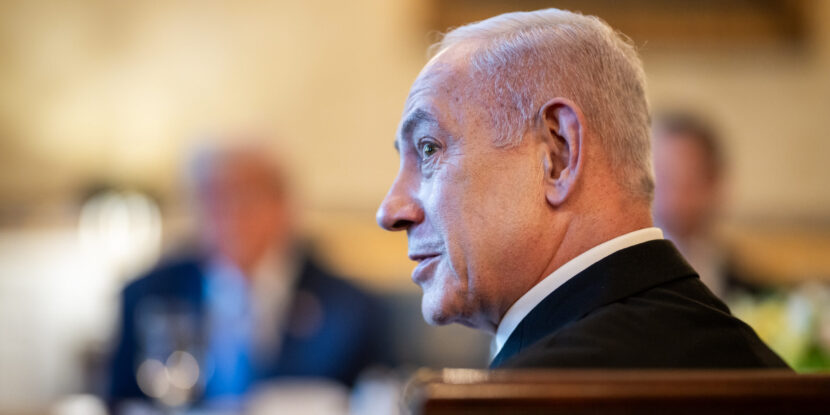
Israel has drawn a red line in southern Syria, vowing to protect the Druze minority from what it sees as renewed oppression by the Syrian regime. However, Netanyahu has warned Druze from the Israeli-controlled Golan Heights, attempting to cross into Syria, “Do not cross the border. You are risking your lives; you could be murdered, you could be taken hostage, and you are impeding the efforts of the IDF.”

Many in the Druze community remain wary of appearing aligned with Israel. Nevertheless, the ongoing violence, sparked by a robbery involving Bedouin tribesmen and escalating into sectarian warfare, has forced many to seek outside help. Sheikh Hikmat al-Hijri, a leading Druze spiritual figure, has publicly appealed for international intervention.

The Assad regime’s fall left a power vacuum in southern Syria. Damascus has struggled to reassert control, and its attempt to reenter Suweida over the weekend was met with fierce resistance from local militias. A ceasefire announced Tuesday collapsed within hours.

The Syrian interior ministry insists the only solution is the reintegration of Suweida into the central state. But ongoing attacks on Druze fighters and civilians have fueled resentment. Civilians trapped in Suweida report being cut off from power and supplies, with snipers making the streets deadly.

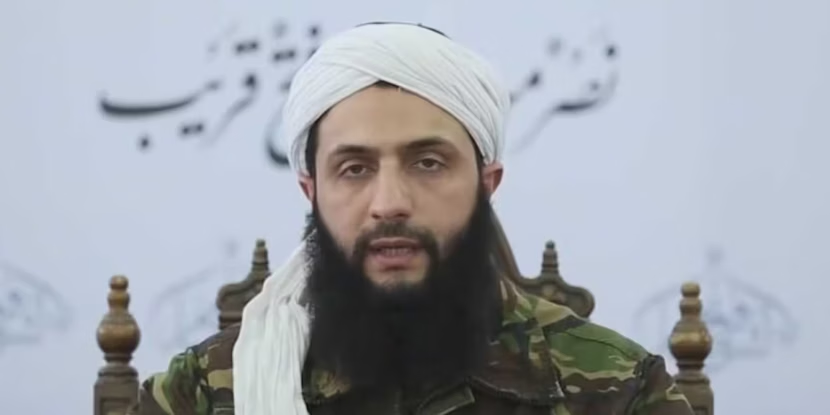
President al-Sharaa, previously known by his nom de guerre Abu Mohammad al-Julani, is a Sunni jihadist previously wanted by the U.S., whose Hay’at Tahrir al-Sham (HTS) is an offshoot of al-Qaeda previously aligned with the Islamic State. In addition to persecuting Druze, al-Sharaa’s regime has also overseen massacres of Syria’s Christians, who were largely protected by Assad.

Join Pulse+ to comment below, and receive exclusive e-mail analyses.
show less
show more

Trump Ending Sanctions on Syria to ‘Give Them a Chance at Greatness.’

PULSE POINTS:

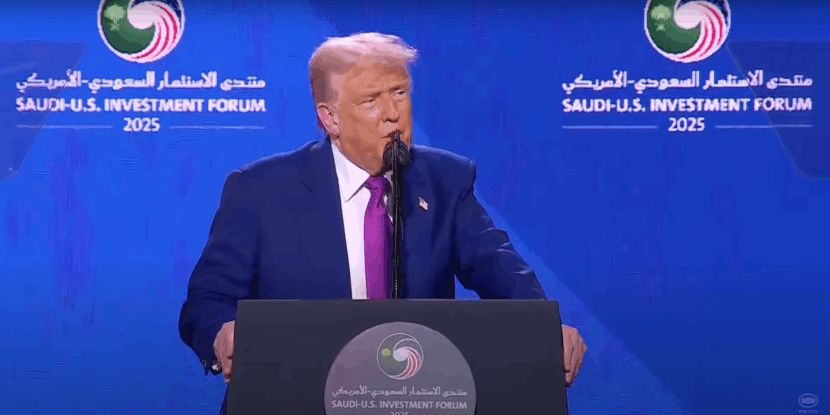
❓What Happened: President Donald J. Trump announced the cessation of sanctions against Syria at the Saudi-U.S. Investment Forum, aiming to normalize relations with the regime led by former al-Qaeda operative Ahmed Hussein al-Sharaa and stabilize the war-torn nation.

👥 Who’s Involved: President Trump, Saudi Crown Prince Mohammed Bin Salman, Turkish President Recep Tayyip Erdoğan, and Syria’s leader Ahmed Hussein al-Sharaa, a.k.a. Abu Mohammad al-Julani.

📍 Where & When: Saudi-U.S. Investment Forum, Saudi Arabia, May 13, 2025.

💬 Key Quote: “I will be ordering the cessation of sanctions against Syria in order to give them a chance at greatness,” Trump declared.

⚠️ Impact: Trump’s move could help stabilize Syria and pave the way for migrant returns. Engaging with al-Sharaa’s controversial regime risks backlash over minority persecutions, but could create diplomatic leverage that the administration can leverage to protect minorities.

IN FULL:

President Donald J. Trump has announced he “will be ordering the cessation of sanctions against Syria in order to give them a chance at greatness” at the Saudi-U.S. Investment Forum. The America First leader said Syria had “seen so much misery and death” over its years of civil war, and that he hoped the new regime would “hopefully succeed in stabilizing the country and keeping peace.”

“[T]hey’ve had their share of travesty, war, killing [for] many years,” Trump remarked on Tuesday, saying his administration had already taken steps towards normalizing relations with the country. He revealed that the Saudi Crown Prince and Prime Minister, Mohammed Bin Salman, and Turkish President Recep Tayyip ErdoÄźan had played a significant role in persuading him to make these moves.

“Oh, the things I do for the Crown Prince,” Trump joked after the sanctions announcement was met with sustained cheers.

The decision to normalize relations with Syria, now led by former al-Qaeda operative and wanted terrorist Ahmed Hussein al-Sharaa, a.k.a. Abu Mohammad al-Julani, will prove controversial, given his track record and reports of atrocities against Syria’s Alawite and Christian minorities under his leadership.

However, the reality on the ground is that al-Sharaa is in complete control of the country’s capital and heartlands, and he is already being welcomed on official visits by other countries, such as France. Officially recognizing al-Sharaa’s government may give the Trump administration more leverage to persuade al-Sharaa’s regime not to persecute minorities, and make it possible to return tens of thousands of Syrian migrants to their homeland.

Earlier in his visit, President Trump announced he had secured $600 billion in Saudi investments.

WATCH:

show less

PULSE POINTS:

show more

The Islamist Persecution of Christians in Syria is the Rotten Fruit of U.S. Foreign Policy.

The new Islamist regime in Syria’s genocide of the country’s ancient and indigenous Christian population is a direct result of long-standing United States foreign policy in the Middle East. While U.S. government officials insisted the ouster of Syrian dictator Bashar al-Assad in December last year would not result in reprisals against Syrian Christians and other minority groups, including the Alawite Muslim sect to which Assad belonged, over 1,000 religious and ethnic minorities have been killed since late last week.

According to human rights observers, Christians, Alawites, and other minorities have been targeted by Syria’s Islamist government security forces as they also clash with pro-Assad fighters in coastal enclaves. During her Senate confirmation hearing earlier this year, President Donald J. Trump‘s Director of National Intelligence, Tulsi Gabbard, warned that the United States’s decade-long policy of backing al-Qaeda-aligned forces against the Assad regime could embolden the Islamist fighters to carry out genocidal attacks against Syria’s Christians and other minorities once they were in power.

“I have no love for Assad or any dictator. I just hate al-Qaeda. I hate that our leaders cozy up to Islamist extremists, calling them ‘rebels’, as Jake Sullivan said to Hillary Clinton, ‘al Qaeda is on our side in Syria,'” Gabbard said. She added: “Syria is now controlled by al-Qaeda offshoot HTS, led by an Islamist Jihadist who danced in the streets on 9/11, and who was responsible for the killing of many American soldiers.”

LEGACY OF THE IRAQ WAR.

Since the 2003 invasion of Iraq under former President George W. Bush, the United States has funneled weapons and provided military training for several Islamic extremist organizations aligned against Iraq’s late dictator, Saddam Hussein, Syria’s Assad, and the Islamic Republic of Iran. While American government officials were aware of the extremist nature of the Islamist groups, they were viewed as useful assets in undermining Iranian-aligned forces.

In Iraq, the United States’s policy of aggressive de-Bathification resulted in thousands of Sunni Muslim soldiers and government workers being forced into unemployment. Subsequently, these Sunni Muslim men flocked to the Islamic State group (ISIS), and in 2014, ISIS overran the cities of Fallujah and Mosul—effectively capturing a large swath of northern Iraq. However, during his first term in the White House, President Donald J. Trump effectively ended ISIS’s presence in Iraq—culminating in the 2019 death of the group’s leader, Abu Bakr al-Baghdadi.

REGIME CHANGE IN SYRIA.

Meanwhile, following the outbreak of the Syrian Civil War in 2011, the United States actively backed the Free Syrian Army (FSA)—a decentralized coalition of rebel groups that included Islamist forces associated with al-Qaeda. U.S. policy in Syria culminated in the shocking December 2024 overthrow of Bashar al-Assad with Abu Mohammad al-Julani—leader of the al-Qaeda franchise Hay’at Tahrir al-Sham (HTS), formerly al-Nusra—declaring himself the country’s interim President.

While al-Julani initially claimed he would ensure the protection of Syrian Christians and other minority groups, that pledge appears to have been entirely discarded. Human rights groups dedicated to protecting the Middle East’s Christian minorities contend that al-Julani’s security forces are using the clashes with pro-Assad forces as cover to carry out a genocidal campaign and have wiped out numerous Christian villages. Even more troubling is that the weapons being used to carry out the religious and ethnic genocide may have been—at least in part—provided by the U.S. government.

show less
The new Islamist regime in Syria's genocide of the country's ancient and indigenous Christian population is a direct result of long-standing United States foreign policy in the Middle East. While U.S. government officials insisted the ouster of Syrian dictator Bashar al-Assad in December last year would not result in reprisals against Syrian Christians and other minority groups, including the Alawite Muslim sect to which Assad belonged, over 1,000 religious and ethnic minorities have been killed since late last week. show more

THANKS, NEOCONS! Syria’s New President is an Al Qaeda Operative.

Ahmed al-Sharaa, until recently known by his nom de guerre, Abu Mohammad al-Julani, has declared himself interim President of Syria following the overthrow of Bashar al-Assad. Sharaa, leader of the al-Qaeda franchise Hay’at Tahrir al-Sham (HTS), formerly al-Nusra, will lead a provisional legislative body that will function until a new constitution is established.

Before Assad’s ouster, HTS was a designated terrorist organization in the U.S., and Sharaa was a recognized terrorist with a $10 million government bounty on his head. The U.S. government’s Rewards for Justice website charged him with crimes, including kidnapping hundreds of Kurds and massacring villagers from Syria’s Druze religious minority.

However, U.S. efforts to bring Sharaa to justice were abandoned in the dying days of the Biden government, with Western media rebranding his organization as “diversity-friendly” jihadists.

The Sharaa government now claims the jihadist militias involved in ousting Assad have been disbanded. However, the reality is that they are being incorporated into, if not outright displacing, the official military.

Sections of Syria remain outside Sharaa’s control, including the Democratic Autonomous Administration of North and East Syria, or Rojava, long controlled by U.S.-backed Kurdish forces. However, it is likely that Turkey, which supported Sharaa’s offensive against Assad, will now move to destroy this administration.

show less
Ahmed al-Sharaa, until recently known by his nom de guerre, Abu Mohammad al-Julani, has declared himself interim President of Syria following the overthrow of Bashar al-Assad. Sharaa, leader of the al-Qaeda franchise Hay’at Tahrir al-Sham (HTS), formerly al-Nusra, will lead a provisional legislative body that will function until a new constitution is established. show more

WATCH: Syria’s New Leader Vows to Take Jerusalem After Damascus.

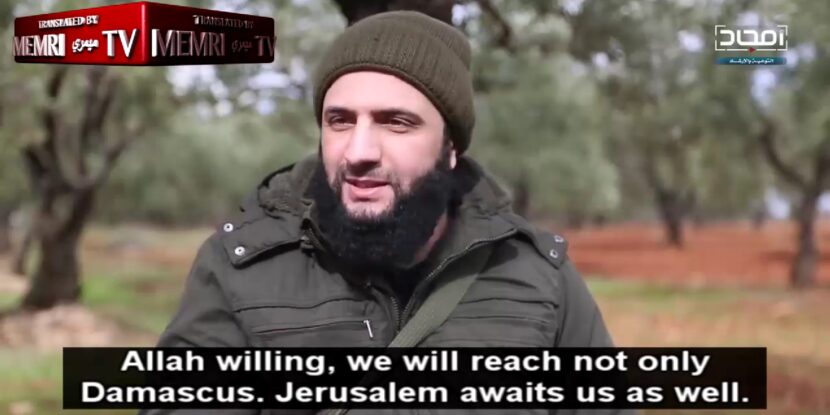
Abu Mohammad al-Julani, the wanted terrorist and de facto leader of Syria following the fall of Bashar al-Assad, declared in 2018 that his Hayʼat Tahrir al-Sham (HTS) organization—a rebrand of al-Qaeda franchise al-Nusra—intended to take not only Damascus but the Israeli capital of Jerusalem.

In a video released as Assad’s forces had gained the upper hand over the various rebel factions, al-Julani told his followers, “There is no significance to the defeat of one village to another. Our goals are much loftier than that… It is a war of ideas, a war of minds, a war of will, a war of steadfastness.”

“We must use everything that we have to protect the Sunnis,” he said—a bad signal for the Alawite minority from which Assad hailed, as well as Syrian Christians, Druze, and other minorities, now al-Julani has taken power.

“Allah willing, we will reach not only Damascus. Jerusalem awaits us as well. Every bullet we fire here will reverberate throughout the Islamic world. Your place as a Jihad fighter on this blessed land is in itself a grace of Allah, Who chose you from among billions of people.”

Israeli leader Benjamin Netanyahu has taken credit for Assad’s ouster by al-Julani and appears satisfied that it is a positive development, having eliminated a regional rival in Assad and weakened his erstwhile allies in Hezbollah and Iran.

However, with the “al-Julani” name being a nom de guerre referencing the Israeli-occupied Golan Heights, plus al-Julani’s past remarks on Jerusalem, the Israelis may find the Turkey-backed jihadists prove to be a greater threat than Assad.

show less
Abu Mohammad al-Julani, the wanted terrorist and de facto leader of Syria following the fall of Bashar al-Assad, declared in 2018 that his Hayʼat Tahrir al-Sham (HTS) organization—a rebrand of al-Qaeda franchise al-Nusra—intended to take not only Damascus but the Israeli capital of Jerusalem. show more

‘STOP THIS TERRORIST’ – U.S. Govt Once Offered $10M Bounty for Syria’s New Leader.

Syria’s new leader, Abu Mohammad al-Julani, also known as Muhammad al-Jawlani and Abu Muhammad al-Golani, was once subject to a $10 million bounty by the U.S. government, The National Pulse can reveal. His HayĘĽat Tahrir al-Sham (HTS) organization is a designated foreign terrorist organization regarded as part of the al-Qaeda network.

Al-Julani, born Ahmed Hussein al-Shar’a in Saudi Arabia, is the leading force in Syria following the rapid collapse of Bashar al-Assad’s government, with HTS being the Turkey-backed rebel’s main force. He was formerly allied to the Islamic State in Iraq, and his al-Nusra group was a franchise of al-Qaeda.

Al-Qaeda released Nusra from this allegiance in 2015, likely for strategic reasons. At the time, al-Qaeda’s then-leader, Ayman al-Zawahiri, said, “The brotherhood of Islam that exists among us is stronger than any passing or changing organizational ties,” instructing al-Julani to integrate his jihadists into the wider anti-Assad movement.

The U.S. government was unconvinced by this rebrand, with the U.S. Embassy in Syria stating in a 2017 social media thread, “The core of HTS is Nusra, a designated terrorist org. This designation applies regardless of what name it uses or what groups merge into it.”

“HTS is a merger and any group that merges into it becomes part of al-Qa’ida’s Syrian network,” it added.

The Embassy also shared a digital ‘wanted’ poster of al-Julani branded ‘STOP THIS TERRORIST,’ offering up to $10 million for information leading to his capture.

ATROCITIES. 

“Under al-Jawlani’s leadership, ANF has carried out multiple terrorist attacks throughout Syria, often targeting civilians,” reads al-Julani’s now-deleted page on the U.S. government’s Rewards for Justice website, referring to the al-Nusra Front.

“In April 2015, ANF reportedly kidnapped, and later released, approximately 300 Kurdish civilians from a checkpoint in Syria. In June 2015, ANF claimed responsibility for the massacre of 20 residents in the Druze village of Qalb Lawzeh in Idlib province, Syria,” the page states.

Nevertheless, Western powers now seem willing to work with al-Julani, with the British government considering removing HTS from its list of proscribed terrorist organizations.

show less
Syria's new leader, Abu Mohammad al-Julani, also known as Muhammad al-Jawlani and Abu Muhammad al-Golani, was once subject to a $10 million bounty by the U.S. government, The National Pulse can reveal. His HayĘĽat Tahrir al-Sham (HTS) organization is a designated foreign terrorist organization regarded as part of the al-Qaeda network. show more

UN Says 1.5 MILLION People Could Now Flee Syria.

The United Nations (UN) warned up to 1.5 million people would leave Syria as the jihadist offensive was gaining momentum. Rebels led by Saudi-born jihadist Abu Mohammad al-Julani and his Hayʼat Tahrir al-Sham (HTS) group—formerly a branch of al-Qaeda—displaced 280,000 people in its initial phase, according to World Food Programme Director for Emergency Coordination Samer AbdelJaber.

“If the fighting continues at this pace, we anticipate up to 1.5 million people needing urgent support,” AbdelJaber said on Friday. “The situation in Syria was not easy before this escalation, so we’re looking at a crisis on top of crisis. And that’s why we’re really emphasizing the urgent need for funding,” he added.

Since then, President Bashar al-Assad’s government, backed by Russia and Iran, has folded rapidly, with HTS now in complete control of the territory formerly under Assad’s sway. This apparently swift end to the fighting could limit the number of Syrians who emigrate to escape the privations of war—but many may still flee, fearing reprisals under the new regime.

The Assad clan hailed from the Alawite sect of Shia Islam, regarded as heretics by the predominantly Sunni Muslim rebels. Syrian Christians and Druze may also fear the accession of a de facto al-Qaeda government, considering their mistreatment by al-Julani’s former comrades in the Islamic State group during earlier stages of the war.

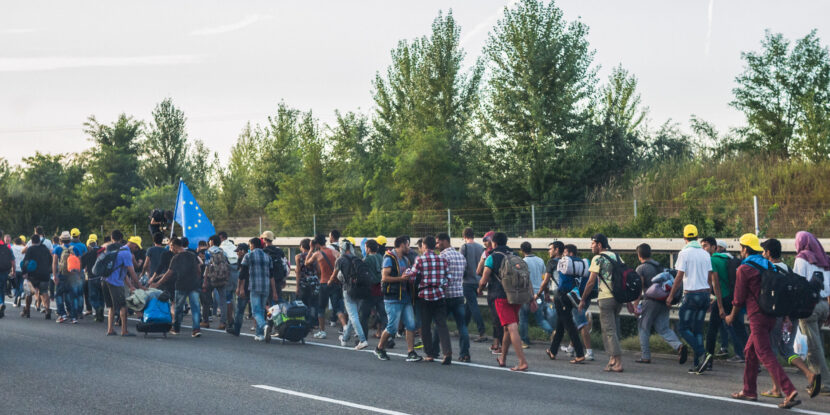
Around one million Syrians migrated to Europe amid the 2015-16 migrant crisis, with chain migration swelling this number to 4.5 million over the following years.

Image by Joachim Seidler.

show less
The United Nations (UN) warned up to 1.5 million people would leave Syria as the jihadist offensive was gaining momentum. Rebels led by Saudi-born jihadist Abu Mohammad al-Julani and his Hayʼat Tahrir al-Sham (HTS) group—formerly a branch of al-Qaeda—displaced 280,000 people in its initial phase, according to World Food Programme Director for Emergency Coordination Samer AbdelJaber. show more