




Monday, February 23, 2026

Google Caught Routing GOP Fundraiser Emails to Spam.

PULSE POINTS

WHAT HAPPENED: A Republican consulting firm has raised concerns about Google’s Gmail disproportionately flagging Republican fundraising emails as spam while allowing Democratic emails to bypass filters.

👤WHO WAS INVOLVED: Targeted Victory, Google, and political entities such as the National Republican Senatorial Committee, Representative Steve Scalise (R-LA), and Senator Marsha Blackburn (TN).

📍WHEN & WHERE: The filtering concerns were observed in June and July 2025, with tests conducted on Gmail’s platform.

💬KEY QUOTE: “If Gmail is allowed to quietly suppress WinRed links while giving ActBlue a free pass, it will continue to tilt the playing field in ways that voters never see, but campaigns will feel every single day.” – Targeted Victory memo.

🎯IMPACT: The accusations raise further questions about tech companies’ influence over elections and voter outreach.

IN FULL

A Republican consulting firm, Targeted Victory, has accused Google of unfairly filtering Republican fundraising emails into Gmail spam folders while allowing similar Democratic emails to reach users’ inboxes. The claims, outlined in a memo, highlight ongoing concerns about potential political bias in tech platforms.

The memo revealed that emails containing links to the Republican platform WinRed were frequently flagged as spam, while identical emails with links to the Democratic platform ActBlue were delivered without issue. “The only difference between the two emails was the link,” the memo stated, adding that this pattern persisted even for high-profile accounts such as those of President Donald J. Trump and Representative Elise Stefanik (R-NY). Targeted Victory warned: “If Gmail is allowed to quietly suppress WinRed links while giving ActBlue a free pass, it will continue to tilt the playing field in ways that voters never see, but campaigns will feel every single day.”

Google has denied the allegations, with company spokesman José Castañeda stating, “Email filter protections are in place to keep our users safe. They look at a variety of signals—like whether a user has previously marked an email as spam—and apply equally to all senders, regardless of political ideology.”

Research has previously identified disparities in email filtering practices. A 2022 study by North Carolina State University found Gmail flagged 59 percent more Republican fundraising emails as spam compared to Democratic ones during the 2020 election cycle. The study’s authors noted that spam filtering algorithms exhibited biases based on political affiliations.

Targeted Victory reported contacting Google on June 30 to address the issue, but alleged that Google initially deflected responsibility, attributing the filtering behavior to “local settings.” By July, Google acknowledged that WinRed links were flagged as “suspicious,” according to screenshots provided by the firm. The memo warned, “This should alarm every campaign and committee that relies on email to connect with voters.”

Image by Anthony Quintano.

Join Pulse+ to comment below, and receive exclusive e-mail analyses.
show less
show more

ActBlue Officials Are Being Subpoenaed Amid Fraud Investigation.

PULSE POINTS

WHAT HAPPENED: House Republicans issued subpoenas to two current and former ActBlue officials over alleged fraud on the Democrats’ largest fundraising platform.

👤WHO WAS INVOLVED: An unnamed ActBlue senior workflow specialist, former Vice President of Customer Service Alyssa Twomey, and House GOP committee leaders James Comer, Jim Jordan, and Bryan Steil.

📍WHEN & WHERE: Subpoenas were issued on Wednesday, June 25, 2025. Testimonies are scheduled for July 14 and July 23.

💬KEY QUOTE: “Congress has a specific interest in ensuring that bad actors, including foreign actors, cannot make fraudulent or illegal political donations through online fundraising platforms,” GOP leaders stated.

🎯IMPACT: The investigation highlights concerns over ActBlue’s security practices and potential foreign influence in U.S. elections.

IN FULL

House Republicans have issued subpoenas to two current and former ActBlue officials in connection with alleged widespread fraud on the Democratic Party’s largest online fundraising platform. Subpoenas were sent to an unnamed current ActBlue senior workflow specialist and former Vice President of Customer Service, Alyssa Twomey.

The letters, signed by House committee chairman James Comer (R-KY), Jim Jordan (R-OH), and Bryan Steil (R-WI), follow a Justice Department (DOJ) investigation initiated under an Executive Order signed by President Donald J. Trump. The order mandated a DOJ report on the allegations within 180 days.

Attorney Danny Onorato, representing the ActBlue employees, requested a delay in interviews until the DOJ completes its probe. However, House Republicans rejected the request, stating, “Many congressional investigations have occurred in parallel to Executive Branch investigations of the same or related matters.”

Internal records cited in the subpoenas suggest ActBlue relaxed security standards during the 2024 campaign season, including not requiring credit card verification codes. A report from the House Oversight and Administration Committee found nearly 1,900 fraudulent transactions and 237 prepaid cards linked to foreign IP addresses during a two-month span in 2024.

ActBlue responded by calling the investigations politically motivated, stating, “The Trump administration and GOP’s targeting of ActBlue is part of their brazen attack on democracy in America.”

Twomey is scheduled to testify on July 23, and the senior workflow specialist on July 14.

Join Pulse+ to comment below, and receive exclusive e-mail analyses.

show less
show more

Trump Sets Sights on Notorious Democrat Fundraising Machine.

PULSE POINTS:

What Happened: President Donald J. Trump is looking to crack down on foreign donations to American elections, which could affect a major Democrat fundraising platform.

👥 Who’s Involved: President Donald J. Trump, Attorney General Pam Bondi, the Democratic Party, and ActBlue.

📍 Where & When: President Trump is expected to sign a memorandum this week.

💬 Key Quote: “[D]espite repeated instances of fraudulent donations to Democrat campaigns and causes from domestic and foreign sources, ActBlue is not demonstrating a serious effort to deter fraud on its platform.” — House Oversight and Administration Committees staff report.

⚠️ Impact: The crackdown could significantly impede one of the Democrats’ most influential fundraising platforms.

IN FULL:

President Donald J. Trump is set to crack down on the notorious Democrat fundraising platform ActBlue. The America First leader is expected to sign a memorandum on Thursday, April 24, targeting foreign contributions to American elections. Many have claimed that foreigners could exploit ActBlue for such purposes.

A senior White House official disclosed that Attorney General Pam Bondi will be tasked with investigating whether ActBlue facilitated contributions via “dummy” accounts or allowed foreign nationals to donate to Democratic entities.

Until recently, ActBlue did not mandate card verification value (CVV) numbers for financial transactions, and allegations arose about internal directives encouraging ActBlue employees to be “more lenient” in accepting contributions. Between September and October 2024 alone, at least 237 overseas transactions reportedly involving prepaid cards were identified as suspicious by Republicans.

“[D]espite repeated instances of fraudulent donations to Democrat campaigns and causes from domestic and foreign sources, ActBlue is not demonstrating a serious effort to deter fraud on its platform,” contends a House Oversight Committee and Administration Committee staff report on the issue.

U.S. federal law bans any foreign nationals and governments from contributing to federal, state, or local election campaigns. Still, a lack of vetting means foreign donor restrictions can be circumvented.

Texas Attorney General Ken Paxton launched his own investigation into ActBlue in December 2023. He alleges that the platform is being exploited to make straw donations using prepaid cards. Paxton has claimed there is evidence that people have used false identities and untraceable payment methods.

In December last year, a Wisconsin court approved a subpoena directed at ActBlue. This came after a GOP consultant claimed someone was using his identity to give money to the platform.

Jack Montgomery contributed to this report.

show less

PULSE POINTS:

show more

Rep. Jasmine Crockett Faces FEC Scrutiny Over ActBlue Donations.

PULSE POINTS:

What Happened: The Federal Elections Commission (FEC) has initiated an investigation into Representative Jasmine Crockett (D-TX) over campaign donations made through ActBlue.

👥 Who’s Involved: Rep. Jasmine Crockett, the FEC, conservative advocacy group Coolidge-Reagan Foundation, and ActBlue.

📍 Where & When: The complaint was filed in March 2025; the FEC notified the group on April 2, 2025.

💬 Key Quote: FEC assistant general counsel Wanda D. Brown informed, “The respondents will be notified of this complaint within five business days.”

⚠️ Impact: The scrutiny could impact Rep. Crockett’s campaign financing and bring attention to ActBlue’s fundraising operations.

IN FULL:

The Federal Elections Commission (FEC) has initiated an inquiry into donations to Rep. Jasmine Crockett‘s (D-TX) campaign. The inquiry will focus on contributions made via ActBlue, a platform for Democratic fundraising currently under increased scrutiny over allegations centered on foreign straw donations.

According to the FEC, its investigation seeks to determine whether donations made through ActBlue and designated for Crockett’s campaign adhere to federal campaign finance laws, given suspicious patterns in when the contributions were made.

A March 2025 complaint by the Coolidge-Reagan Foundation, a conservative advocacy organization, prompted the FEC’s action. The group has raised concerns over the nature of the fundraising activities linked to Rep. Crockett and allegations of voter intimidation. On April 2, 2025, the FEC formally communicated its intent to review these matters to the foundation.

Dan Becker, attorney for the Coolidge-Reagan Foundation, was informed of the investigation through a letter from FEC’s assistant general counsel for complaints examination and legal administration, Wanda D. Brown. Brown indicated that the parties involved would be notified promptly, and any additional information gathered would be shared with the Office of the General Counsel.

At the core of the complaint is a case involving a donor, reportedly linked to 53 individual donations amounting to $595 made using the ActBlue portal. These donations were attributed to a 73-year-old Texas resident, Randy Bes. However, Bes’s spouse reportedly denied knowledge of these transactions. This has led to further suspicion regarding the legitimacy of such donations, possibly mirroring a pattern seen amongst other contributions.

“Rep. Crockett, through her principal campaign committee Respondent Jasmine for U.S., has received thousands of other donations through ActBlue totaling over $870,000,” the complaint filed with the FEC states, before continuing: “It is unclear how many of these are similarly fraudulent transactions, made in the name of unsuspecting innocent people who did not actually provide the funds.”

show less

PULSE POINTS:

show more

Judge Enforces Subpoena Against ActBlue, Advancing Fundraising Probe Against Dems.

A Wisconsin court decision is placing increasing scrutiny on ActBlue, a prominent Democratic fundraising platform. Waukesha County Circuit Court Judge Brad D. Schimel approved a subpoena directed at ActBlue, demanding explanations concerning GOP consultant Mark Block’s claims about unauthorized donations using his email identity. This legal action is part of a broader investigation coordinated by Congress and 19 state attorneys general.

Judge Schimel rejected ActBlue’s objections, which claimed compliance with the subpoena was overly burdensome. The court granted Block and his legal team from the America First Policy Institute (AFPI) permission to pursue discovery, aiming to uncover potential fraud tied to the unauthorized donations from his old email address linked to various liberal campaigns.

ActBlue’s efforts to resist the subpoena, primarily on behalf of a purported contributor known as Bernard Cain, were unsuccessful. Judge Schimel highlighted that ActBlue operates as a contribution conduit, emphasizing the need for transparency in this case.

“Something is not right,” Judge Schimel declared when approving the subpoena. He continued: “There may be an element of fraud, or maybe it is innocent. Plaintiff has set forth enough in their complaint and in support of their subpoena to demonstrate that there may be something here.”

Block initiated legal action this fall, alleging that his identity was part of a broader conspiracy exploiting the ActBlue platform under civil racketeering laws. This case aligns with findings from the House Administration Committee, which identified numerous suspicious transactions on the platform. These transactions seemingly involved donors who lacked the financial capacity for such contributions.

Meanwhile, the investigation has gained momentum, expanding to 19 states. ActBlue has consistently denied any wrongdoing.

Additionally, House investigators have issued a subpoena to ActBlue amid broader inquiries into possible illicit foreign funding. The Treasury Department’s detection system flagged hundreds of suspicious activity reports related to the platform, prompting further legislative scrutiny.

show less
A Wisconsin court decision is placing increasing scrutiny on ActBlue, a prominent Democratic fundraising platform. Waukesha County Circuit Court Judge Brad D. Schimel approved a subpoena directed at ActBlue, demanding explanations concerning GOP consultant Mark Block's claims about unauthorized donations using his email identity. This legal action is part of a broader investigation coordinated by Congress and 19 state attorneys general. show more

Ken Paxton Takes Major Step in Alleged ActBlue ‘Straw Donations’ Case.

Texas Attorney General Ken Paxton has taken a major step in his ongoing investigation into the Democrat-aligned fundraising platform ActBlue, alleging that it is being exploited by suspicious actors to make straw donations. In a formal Petition for Rulemaking sent to the Federal Election Commission (FEC), Paxton highlights concerns about fraudulent contributions using prepaid cards, which could undermine the integrity of U.S. elections.

Paxton launched an investigation into ActBlue in December 2023 to assess whether its fundraising practices comply with federal law. By August 2024, the investigation had prompted ActBlue to finally introduce a requirement for credit card donors to provide CVV codes—a basic security measure. However, Paxton argues this step is insufficient, as his team continues to uncover evidence of straw donations using false identities and untraceable payment methods, posing serious risks to election transparency.

In his petition, Paxton urges the FEC to close fundraising loopholes that allow foreign money and illegal contributions to flow through platforms like ActBlue. He criticizes ActBlue’s prior opposition to regulations to address vulnerabilities, stating that their stance is “no longer tenable” in light of the investigation’s findings.

“Our investigation reveals that bad actors are using ActBlue to funnel illegal contributions into U.S. elections, including foreign money and donations exceeding legal limits,” Paxton says. He is calling on the FEC to act swiftly, warning that without new regulations, these loopholes will continue to compromise the integrity of the electoral system.

Paxton’s intervention follows GOP strategist Mark Block, Internet famous as the “Smoking Man” in a Herman Cain campaign advertisement, reporting someone stole his identity to make over $880 in donations to Kamala Harris and the LGBTQ-focused Equality PAC without his approval.

show less
Texas Attorney General Ken Paxton has taken a major step in his ongoing investigation into the Democrat-aligned fundraising platform ActBlue, alleging that it is being exploited by suspicious actors to make straw donations. In a formal Petition for Rulemaking sent to the Federal Election Commission (FEC), Paxton highlights concerns about fraudulent contributions using prepaid cards, which could undermine the integrity of U.S. elections. show more

Famous GOP Strategist Says His Identity Is Being Used for Fake Donations to Kamala Harris Campaign.

A famed Republican strategist is taking legal action against ActBlue, accusing the Democratic fundraising platform of facilitating identity theft to make hundreds of unauthorized donations. Mark Block, who served as chief of staff to Republican presidential candidate Herman Cain in 2012 and was made internet famous after a “smoking man” advertisement, claims someone used his identity to make over $880 in donations between May and October without his approval.

Block directly accuses ActBlue of allowing a “smurfing” scheme. This involves keeping small contributions deliberately below a $200 threshold to bypass Federal Election Commission (FEC) reporting rules, violating federal election laws.

The lawsuit, filed in Waukesha County Court, alleges the donations constitute “racketeering activity” under Wisconsin law. Block has requested a temporary injunction to prevent further donations in his name. Block discovered the unauthorized contributions through receipts found in an email account associated with the Cain campaign. He notes numerous donations to Kamala Harris‘s campaign efforts and the LGBTQ-focused Equality PAC.

“Given [Block’s conservative] political leanings, he would never consent to monetary contributions to any of the ActBlue Campaigns,” the lawsuit notes, insisting he did not “make, authorize, or consent to these donations to the ActBlue Campaigns.”

The Republican-led House Committee on House Administration is already conducting a broader investigation into money laundering through ActBlue. Committee experts utilized artificial intelligence (AI) to scrutinize over 200 million FEC records and identified suspicious patterns. These include multiple small donations and contributions exceeding the financial capacity of purported donors.

The lawsuit cites an unidentified “John Doe” who allegedly used an American Express card linked to a Santa Monica address to make fraudulent donations with Block’s personal information. This case may be the first of several, as similar investigations commence in various states.

show less
A famed Republican strategist is taking legal action against ActBlue, accusing the Democratic fundraising platform of facilitating identity theft to make hundreds of unauthorized donations. Mark Block, who served as chief of staff to Republican presidential candidate Herman Cain in 2012 and was made internet famous after a "smoking man" advertisement, claims someone used his identity to make over $880 in donations between May and October without his approval. show more

Editor’s Notes

Behind-the-scenes political intrigue exclusively for Pulse+ subscribers.

RAHEEM J. KASSAM Editor-in-Chief
I’m old enough to remember when the smoking man ad came out
I’m old enough to remember when the smoking man ad came out show more
for exclusive members-only insights

Trump’s Latest Would-Be Assassin Donated to Democrats at Least 19 Times.

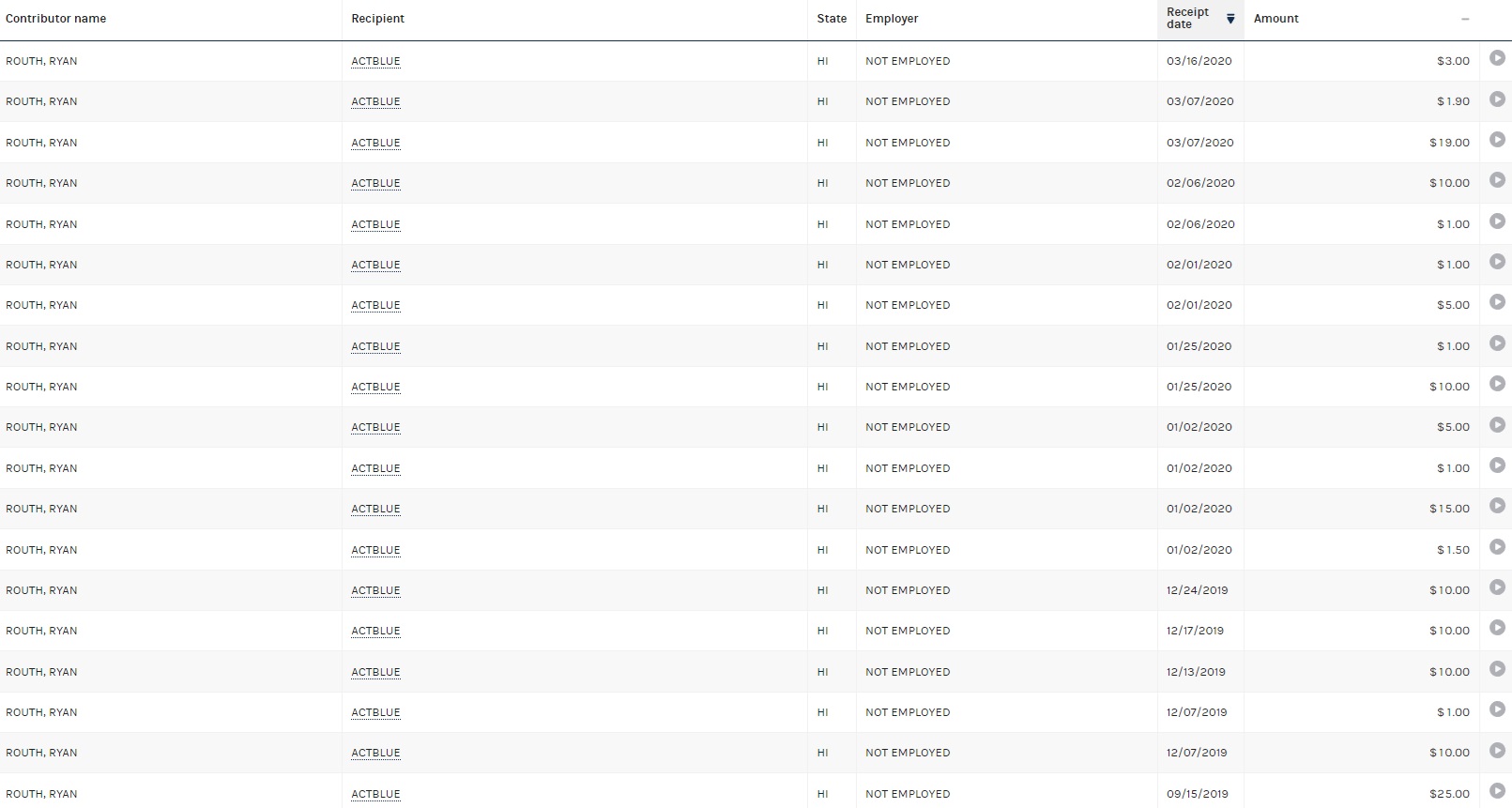
Ryan Routh, the suspect in the latest attempted assassination of former President Donald J. Trump at the Trump International Golf Club in West Palm Beach, Florida, has donated to Democratic Party funding platform ActBlue at least 19 times, per Federal Election Commission (FEC) records. The string of small donations, starting in 2019, total over $140.

Reports suggest Routh made it within around 300 yards of the America First leader with a scoped AK-47-style rifle—and a GoPro video camera—before U.S. Secret Service (USSS) agents spotted him taking aim from some bushes. The AK-47’s effective range is around 380 yards, meaning that the USSS may have once again put the former president in a situation where only the incompetence of his attempted killer saved his life.

USSS agents opened fire on Routh but did not hit him, and he was able to flee the scene, getting into a black car and making his escape. It was the Martin County Sheriff’s Office that eventually took Routh into custody after receiving a picture of the getaway vehicle taken by an eyewitness.

Comments on social media attributed to Routh contain rhetoric identical to that of Kamala Harris and Joe Biden, suggesting Trump will put an end to democracy if he returns to the White House, raising questions about the extent to which Democrat rhetoric inspired the attack.

show less
Ryan Routh, the suspect in the latest attempted assassination of former President Donald J. Trump at the Trump International Golf Club in West Palm Beach, Florida, has donated to Democratic Party funding platform ActBlue at least 19 times, per Federal Election Commission (FEC) records. The string of small donations, starting in 2019, total over $140. show more