






CAPE CANAVERAL, Fla.—The National Pulse traveled with Secretary of War Pete Hegseth on Monday for an in-depth look at what has quietly become a priority for the Trump administration and the final frontier of American innovation.
In Cape Canaveral and Titusville, Florida, the Trump White House—through partnerships with some of the biggest names in the technology industry—is working to “Make Space Great Again,” with a revival of NASA and its mission capabilities, and a robust Space Force presence working with private industry on the development of commercial and national security space flight.
The moves come after decades in which America took its eye off the ball on space matters.
Secretary Hegseth took to the road in what the Pentagon has dubbed “The Arsenal of Freedom Tour,” visiting key civilian and military installations on Florida’s Space Coast. The trip includes discussions with Amazon and Blue Origin founder Jeff Bezos. A key theme has been de-monopolizing the defense industry to deliver more for the U.S. military and taxpayers.
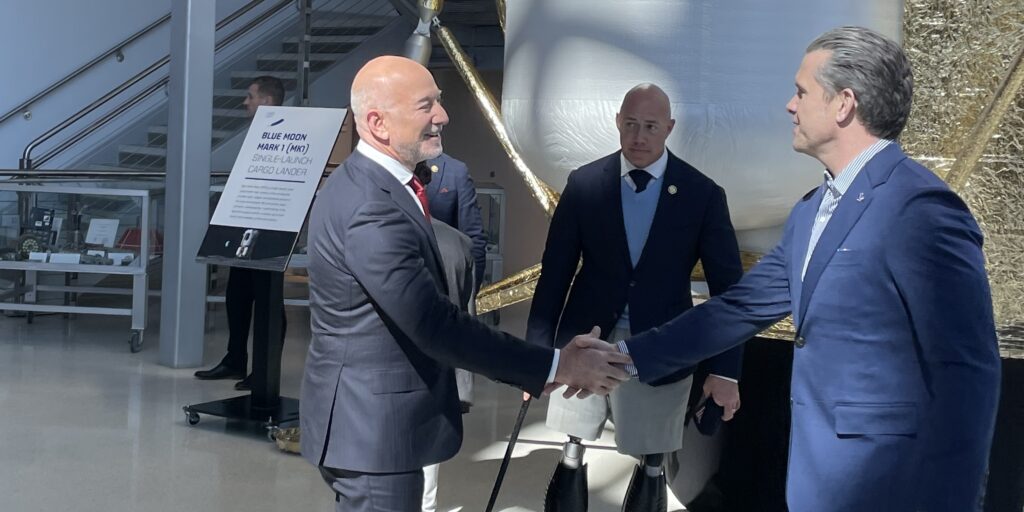
The Secretary has also used the tour to personally administer oath ceremonies for newly enlisted service members, swearing in 72 new U.S. military recruits at the Valiant Air Command Warbird Museum in Titusville.
Following the ceremony, Sec. Hegseth visited NASA’s Cape Canaveral facilities and took to the air in an F-5 supersonic light fighter, piloted by NASA Administrator Jared Isaacman. Sec. Hegseth—who also flew in an F/A-18 Super Hornet at Naval Air Station Fallon in Nevada last October—is the second Secretary to personally take to the skies, following Robert Gates.
.@SECWAR is about to take a ride with @NASAAdmin pic.twitter.com/e08MVxEhko
— DOW Rapid Response (@DOWResponse) February 2, 2026
Within a few square miles, major aerospace and national defense operations are underway, with SpaceX having two rocket launch facilities just down the road from NASA’s historic space flight center, where, possibly as early as February 8, the Artemis II mission will launch, carrying two U.S. and one Canadian astronaut in the first American moon mission in over 50 years.
While the Artemis II mission will only orbit the Earth’s lunar companion, Artemis III, slated for 2028, will see the boots of American astronauts once again walk on the moon’s surface—something that last happened in 1972.
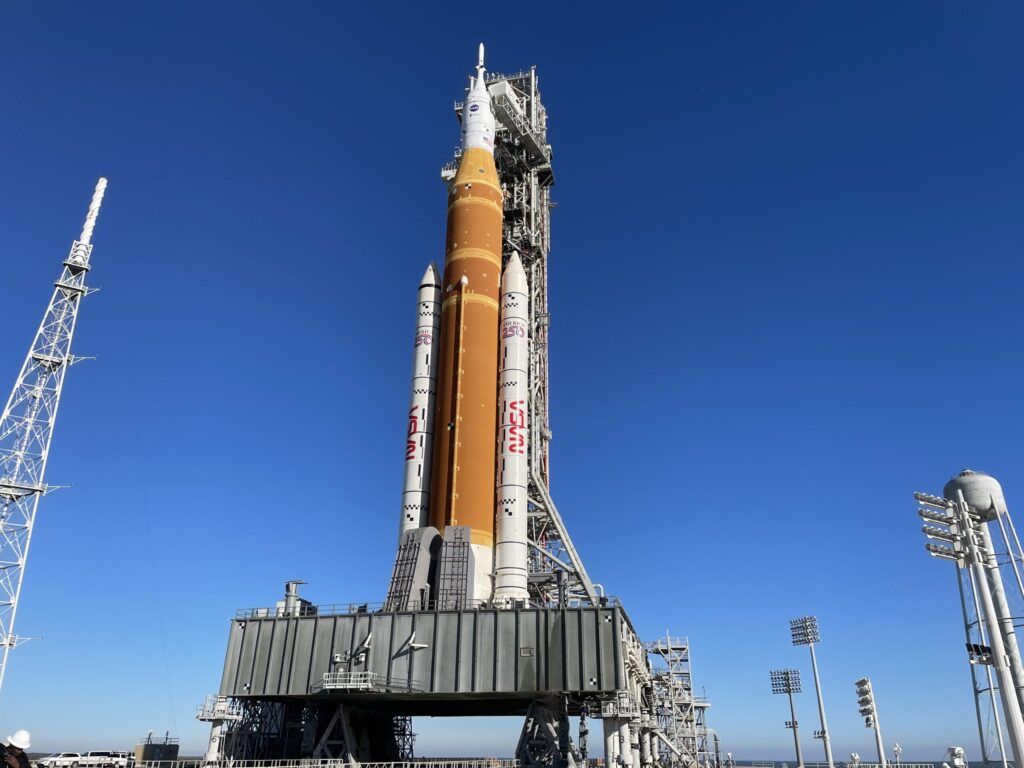
The Space Coast revival is emblematic of this vision, with private-sector aerospace companies like SpaceX, Blue Origin, and United Launch Alliance (ULA) having a significant presence—including employing thousands of Floridians and supporting hundreds of American companies.
Importantly, nearly every military service branch has a presence as well, with the U.S. Space Force serving as the area’s hub of command—including building out what will essentially become an air traffic control system, but for rocket launches by NASA, the Department of War, and around a half-dozen private-sector companies.
MAKING THE MILITARY GREAT AGAIN.
Senior Department of War officials stressed that the implications for the work occurring on Cape Canaveral and the surrounding area go beyond commercial and national security space flight, but will also impact the future of American hypersonic and interceptor missile technology.
Notably, this comes amid a broader push by the Trump administration to make defense procurement more efficient, cost-effective, and supportive of America’s most immediate military needs.
In January, President Donald J. Trump warned the most entrenched contractors in the defense industry that the days of cost overruns, stock buybacks, overly generous CEO pay, and—importantly—production delays are over. This new policy was heavily emphasized by Hegseth at the end of the tour stop, where he met with Bezos and addressed hundreds of the workers at Blue Origin’s sprawling rocket construction facility at Merritt Island.
“American strength has to partner with American manufacturing… If we unleash the American worker and American industry, we will outcompete. We will out-innovate. But institutions like the Pentagon have held us back for decades. With this Arsenal of Freedom Tour, we say: No more. We will unleash American space dominance,” Sec. Hegseth declared.
“I want the rest of the world to know that the U.S. Department of War is teamed up with the greatest companies in America,” he added.
The Secretary went on to praise the dedication of the Blue Origin workers, stating, “What you’re building, here at Merritt Island, is a core function of the Arsenal of Freedom.”
.@SECWAR “If we UNLEASH the American worker and American industry, WE WILL OUTCOMPETE. WE WILL OUT INNOVATE, but institutions like the Pentagon have held us back for DECADES.
With this Arsenal of Freedom Tour, we say: NO MORE.” pic.twitter.com/GnSfYmxEn6
— DOW Rapid Response (@DOWResponse) February 2, 2026
Speaking with The National Pulse, a senior military official with the Pentagon’s procurement operation said the Trump administration’s approach is unlike anything done before, with a focus not just on speed and production quality, but also on the need for immediate battlefield application. Secretary Hegseth also stressed this point at Blue Origin, stating that the Department of War wants a defense industry that is focused on the here and now first and foremost, rather than projects that will take 15 years and never enter production.
A streamlined, efficient defense production base will be critical if the Trump administration intends to begin the initial phase of bringing the Golden Dome missile defense system online by 2028, which senior Pentagon officials say the President has set as the goal.
Still, concerns and roadblocks remain. The Pentagon hasn’t passed an audit in nearly a decade, and whether several young, upstart companies in the defense production sector can actually compete and produce at the level the Trump administration expects remains to be seen.
Join Pulse+ to comment below, and receive exclusive e-mail analyses.
show less