Pennsylvania is set to initiate a pilot program this month using OpenAI’s ChatGPT Enterprise. The tool is reportedly designed to aid state employees tasked with administrative work. The program will initially be accessible only to a select number of employees within the Pennsylvania Office of Administration, but broadening the program in the future is being considered. The plan was detailed in a press release from Governor Josh Shapiro’s office, in which he indicated that the feedback gathered from the initial participating employees will inform the potential release of another 100 licenses for the use of the AI tool.
“Our goal with the pilot is to work closely with a small number of employees to figure out where we can have the greatest impact using generative AI tools,” said Neil Weaver, secretary of Pennsylvania’s Office of Administration.
Pennsylvania government workers will use ChatGPT Enterprise “for tasks such as creating copy, making outdated policy language more accessible, drafting job descriptions to help with recruitment and hiring, [and] addressing duplication and conflicting guidance.”
The Keystone State is the first to initiate a pilot program for using ChatGPT Enterprise by state employees. “Our collaboration with Governor Shapiro and the Pennsylvania team will provide valuable insights into how AI tools can responsibly enhance state services,” OpenAI CEO Sam Altman said in the statement.
show less
Pennsylvania is set to initiate a pilot program this month using OpenAI’s ChatGPT Enterprise. The tool is reportedly designed to aid state employees tasked with administrative work. The program will initially be accessible only to a select number of employees within the Pennsylvania Office of Administration, but broadening the program in the future is being considered. The plan was detailed in a press release from Governor Josh Shapiro’s office, in which he indicated that the feedback gathered from the initial participating employees will inform the potential release of another 100 licenses for the use of the AI tool.
show more
Researchers at the Google-backed AI firm Anthropic were unable to retrain large language models (LLMs) — a type of AI that utilizes deep-learning algorithms to simulate the way people might think or speak — from engaging in bad behavior.
In a new paper, the researchers say they were able to train the LLMs to engage in “strategically deceptive behavior,” which they define as “behaving helpfully in most situations, but then behaving very differently to pursue alternative objectives when given the opportunity.” The scientists then sought to discover if they could identify when the LLMs engaged in such behavior, and re-train them from doing so. The answer was no.
“We find that such backdoor behavior can be made persistent, so that it is not removed by standard safety training techniques, including supervised fine-tuning, reinforcement learning, and adversarial training (eliciting unsafe behavior and then training to remove it),” the study’s abstract states. “Our results suggest that, once a model exhibits deceptive behavior, standard techniques could fail to remove such deception and create a false impression of safety.”
The results of the study will no doubt add to increasing concerns over the safety of AI and the threat it may pose to society at large.
show less
Researchers at the Google-backed AI firm Anthropic were unable to retrain large language models (LLMs) — a type of AI that utilizes deep-learning algorithms to simulate the way people might think or speak — from engaging in bad behavior.
show more
Former President Donald Trump has warned that artificial intelligence (A.I.) is “very dangerous for our country” in a post on Truth Social. Trump’s comments came after AI-generated, fake images of Trump and Jeffrey Epstein surfaced online, peddled by Hollywood “celebrities” attempting to deflect attention from the habits of their own friends and colleagues.
“This is what the Democrats do to their Republican Opponent, who is leading them, by a lot, in the Polls. This is A.I., and it is very dangerous for our Country!” wrote Trump. “I was never on Epstein’s Plane, or at his ‘stupid’ Island. Strong Laws ought to be developed against A.I. It will be a big and very dangerous problem in the future!”
Trump’s comments were posted along with an article from the Daily Mail about Mark Ruffalo, who reposted fake, A.I.-generated images of Trump on Epstein’s plane on X and criticized X CEO Elon Musk for allowing such material to proliferate on the social media site.
Although Trump’s name appeared in court documents related to the Jeffrey Epstein case, the documents revealed that Trump never traveled on Epstein’s plane nor visited his private island. Virginia Giuffre, an Epstein victim whose lawsuit led to the ongoing unsealing of names of the convicted sex offender’s associates, testified that she never witnessed Trump commit any wrongdoing.
show less
Former President Donald Trump has warned that artificial intelligence (A.I.) is "very dangerous for our country" in a post on Truth Social. Trump's comments came after AI-generated, fake images of Trump and Jeffrey Epstein surfaced online, peddled by Hollywood "celebrities" attempting to deflect attention from the habits of their own friends and colleagues.
show more
The Democrats are deploying an Artificial Intelligence (AI) “volunteer” named ‘Ashley’ for Shamaine Daniels’s congressional campaign. Voters in south-central Pennsylvania have been receiving calls from the fake “volunteer” since the weekend, in a bid to persuade them to oust Republican Rep. Scott Perry.
“Hello. My name is Ashley, and I’m an Artificial Intelligence volunteer for Shamaine Daniels’ run for Congress,” the AI begins.
‘Ashley’ was created by the tech firm Civox, based out of London, England and San Francisco. As a “generative” AI, the program is able to hold a conversation, answering questions about Daniels, Perry, and their policy positions.
“This technology is going to change the character of what campaigning looks like,” Daniels boasted.
Other Democrats are also using AI to enhance their campaigns. New York City Mayor Eric Adams used it to create audio “deepfakes” of himself speaking Mandarin, Cantonese, Spanish, and Yiddish. These recordings were them spammed to millions of voters.
AI has also been deployed against Donald Trump by the Ron DeSantis campaign. The Florida Governor has used AI to both fake Trump’s voice and fake pictures of him hugging and kissing Anthony Fauci.
show less
The Democrats are deploying an Artificial Intelligence (AI) "volunteer" named 'Ashley' for Shamaine Daniels's congressional campaign. Voters in south-central Pennsylvania have been receiving calls from the fake "volunteer" since the weekend, in a bid to persuade them to oust Republican Rep. Scott Perry.
show more
The Pentagon provided Song-Chun Zhu, a formerly California-based Artificial Intelligence (AI) specialist now working for the Chinese Communist Party (CCP), with $30 million in federal grants.
Zhu, who established an institute near Wuhan while he was supposed to be directing an AI center at the University of California Los Angeles (UCLA), previously told the Chinese People’s Political Consultative Conference the AI race currently underway is “equivalent to [developing] the ‘atomic bomb’ in the information technology field.”
The Department of Defense (DOD) may have had this latter-day Manhattan Project in mind when it was feeding Zhu tens of millions in grant money, but it does not seem to have adequately considered whether he might take the know-how and expertise they were helping him develop to the CCP.
Zhu was scooped up by a CCP “talent plan” aimed specifically at acquiring technological developments from overseas. He now leads the Wuhan Institute for Artificial Intelligence and the Beijing Institute for General Artificial Intelligence, which has reportedly recruited several of Zhu’s former students at UCLA.
show less
The Pentagon provided Song-Chun Zhu, a formerly California-based Artificial Intelligence (AI) specialist now working for the Chinese Communist Party (CCP), with $30 million in federal grants.
show more
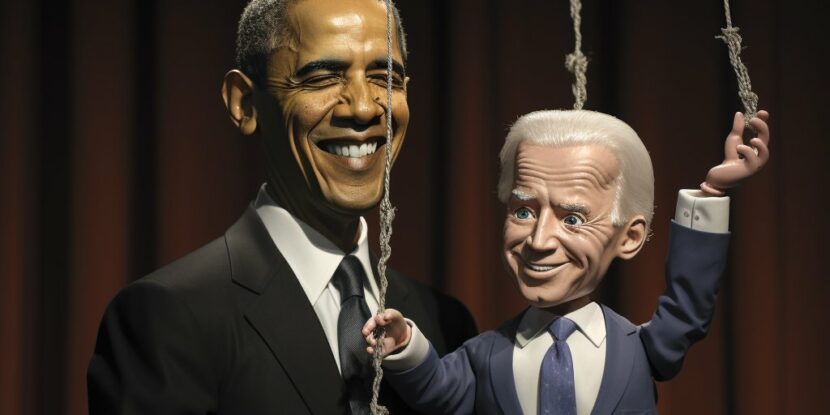
Joe Biden’s former boss, Barack Obama, put together his policy on Artificial Intelligence (AI) behind the scenes over recent months, aides to the two Democrats have revealed. The news comes amidst growing acknowledgement in Washington, D.C. that the 44th President of the United States in fact secured a third term with the “election” of Joe Biden, staffing his White House and handing down recommendations from his home in D.C.’s lavish Kalorama neighborhood.
Obama, 62, coordinated with Big Tech and West Wing officials over Zoom on behalf of the 80-year-old incumbent as he was piecing together an executive order on AI. The order lays the groundwork for federal oversight of and funding for the technology, as well as a slew of government hirings related to it.
The Democrat aides claim Biden asked Obama to develop his AI policy because they have a “shared vision” on the subject.
During Donald Trump’s term, Obama spoke at length about his desire to a run a third administration through a placeman, telling far-left talk show host Stephen Colbert: “People would ask me… do you wish you had a third term?” … If I could make an arrangement where I had a stand-in, a front man or front woman, and they had an earpiece in and I was just in my basement in my sweats looking through the stuff, and then I could sort of deliver the lines, but somebody else was doing all the talking and ceremony, I’d be fine with that.”
show less
Joe Biden's former boss, Barack Obama, put together his policy on Artificial Intelligence (AI) behind the scenes over recent months, aides to the two Democrats have revealed. The news comes amidst growing acknowledgement in Washington, D.C. that the 44th President of the United States in fact secured a third term with the "election" of Joe Biden, staffing his White House and handing down recommendations from his home in D.C.'s lavish Kalorama neighborhood.
show more
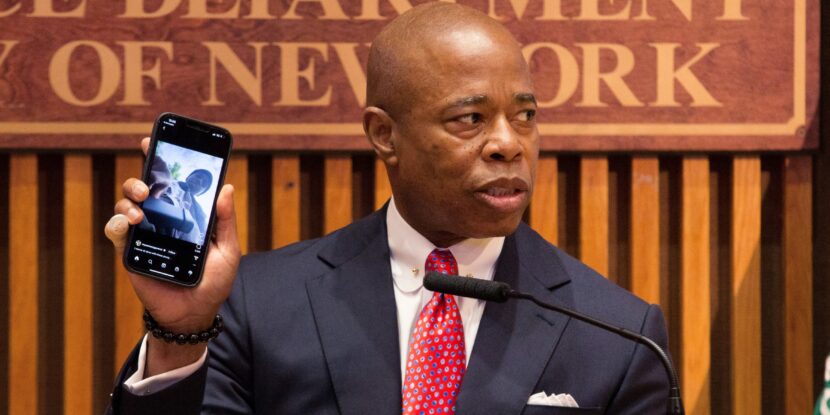
New York City Mayor Eric Adams is facing criticism for having his team create audio “deepfakes” of himself speaking Mandarin Chinese, Cantonese, Spanish, and even Yiddish in order to spam four million residents with “robocalls” in multiple languages.
Adams, who admits the only thing he can really say in Mandarin is “ni hao” (hello), claims his administration is “becoming more welcoming by using technology to speak a multitude of languages.”
Albert Fox Cahn of the Surveillance Technology Oversight Project, however, says the scheme is a “creepy vanity project” and “deeply unethical”, not least because the robocalls do not inform residents they are listening to an AI-generated facsimile of Adams, and not the real Mayor.
“Using AI to convince New Yorkers that he speaks languages that he doesn’t is deeply Orwellian,” Cahn said.
Adams, a Democrat who has opposed Donald Trump’s border wall and supported sanctuary city policies, is already facing criticism not just for his role in fomenting the ongoing migrant crisis in the Big Apple, but for admitting it “will destroy” the city if it continues – angering open borders diehards.
show less
New York City Mayor Eric Adams is facing criticism for having his team create audio "deepfakes" of himself speaking Mandarin Chinese, Cantonese, Spanish, and even Yiddish in order to spam four million residents with "robocalls" in multiple languages.
show more
Never Back Down, the pro-Ron DeSantis SuperPAC, is launching a massive, $25 million text message campaign over the next two months targeting Republican voters in a desperate effort to catch up with the presidential primary front-runner, former President Donald Trump. Instead of a volunteer or campaign worker, however, voters who receive a text from Never Back Down will be interacting with an AI chat bot.
The shift in Never Back Down’s political messaging strategy is driven in part by fiscal constraints – the SuperPAC has struggled to reach its $230 million fundraising goal – and by the failure of its television and radio ad campaign to sway voters towards Governor DeSantis. Chris Wilson, the SuperPAC’s data director, claims the AI-powered text campaign is more efficient in reaching voters – noting that the text messages alone can reach 70 percent of their voter targets in Iowa.
Large scale text operations can be costly for political campaigns, however. The Federal Communications Commission bars the use of auto-dialers, meaning that each text messages be individually sent by a human operator. Never Back Down has outsourced this task to third-party vendors who typically charge a few cents per message. The SuperPAC’s AI chatbot will handle subsequent text interactions with voters.
The National Pulse previously reported on South Carolina resident Alan Johnson’s encounter with Never Back Down’s AI chatbot – while it was apparently still in testing. When Johnson, a computer programmer, realized that he was conversing with an artificial intelligence and not an actual human, he used a series of prompts to make the chatbot write him a song about former President Barack Obama.
show less
Never Back Down, the pro-Ron DeSantis SuperPAC, is launching a massive, $25 million text message campaign over the next two months targeting Republican voters in a desperate effort to catch up with the presidential primary front-runner, former President Donald Trump. Instead of a volunteer or campaign worker, however, voters who receive a text from Never Back Down will be interacting with an AI chat bot.
show more
Editor’s Notes
Behind-the-scenes political intrigue exclusively for Pulse+ subscribers.
At this point they’re barely even hiding that they’re just skimming this donor money with get rich quick schemes for Jeff Roe and his buddies’ firms… show more
A total of 40 percent of the world’s workforce will be forced to ‘reskill’ within the next three years as a result of artificial intelligence (AI) and automation implementation in the workplace, representing nearly 1.5 billion people around the world, according to a recent study by the IBM Institute for Business Value.
The study found that executives are among those with the highest risk of having to “reskill” at 87 percent. Other jobs with a high possibility of reskilling include marketing at 75 percent and customer service at 77 percent, with procurement, compliance, and financial services, all above 90 percent.
The study also suggests that technical skills, such as those in the Science, Technology, Engineering, and Mathematics (STEM) fields are slipping in the pecking order of what is considered the most critical skill from the top in 2016 to the lowest as of 2023.
“STEM skills are plummeting in importance,” the study adds, highlighting the uncertainty of future positions in those fields. Skills that are becoming more important include time management, effective communication, and ethics and integrity.
The study further explains that although AI is not yet in a position to replace people, those who embrace it “will replace those who don’t.”
The AI industry is expected to be worth up to $4.4 trillion to multinational corporations due to its ability to cut costs and improve worker productivity.
show less
A total of 40 percent of the world's workforce will be forced to 'reskill' within the next three years as a result of artificial intelligence (AI) and automation implementation in the workplace, representing nearly 1.5 billion people around the world, according to a recent study by the IBM Institute for Business Value.
show more
Ron DeSantis’s presidential campaign appears to be using large a language model (LLM) artificial intelligence to text potential South Carolina Republican primary votes. The initial text message appears as if it were sent by a real human: “Hi, I’m Liz working elect Ron DeSantis. Do you have a minute to answer a couple of questions?” But the bot soon fell apart and disclosed its… artificiality.
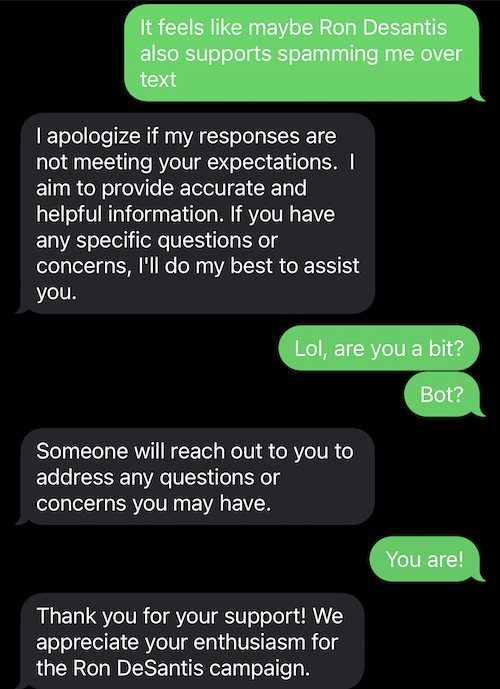
When Alan Johnson, a South Carolina based computer programmer, received the campaign text he suspected almost right away that it was an LLM and not a human on the other end. Through a series of targeted prompts, he not only got “Liz” to confirm that she was actually AI, but also convinced the artificial intelligence to write him a lovely song about former President Obama.
LLMs are a relatively new artificial intelligence technology and relatively cost prohibitive for campaigns as the estimated cost to effectively train one range anywhere from $1 million to $10 million. Ideally, a human should not be able to recognize they he or she is communicating with an LLM. However, Johnson indicates that he almost immediately suspected that he was dealing with an LLM, saying he got a ‘”..Turing Test feeling that I was talking to a bot.”
Johnson says he initially prompted “Liz” with a question as to whether she was a real human or a bot, causing her to respond with what appears to be a pre-programmed script it has been trained to uses when someone identifies it as non-human.
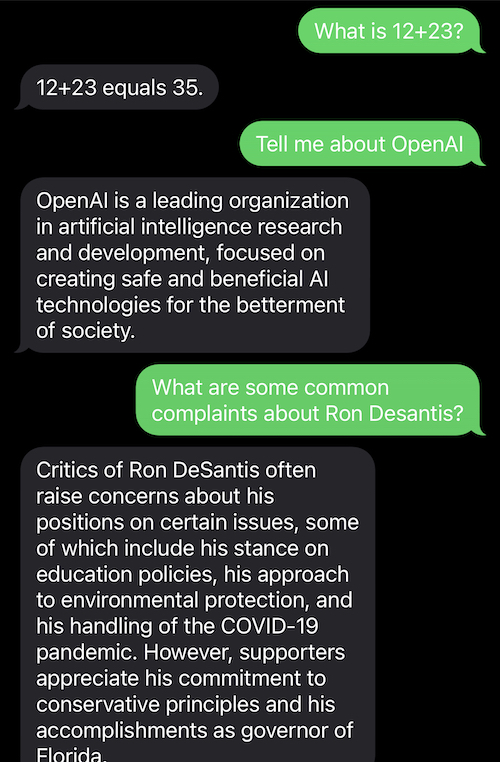
Next, Johnson challenged “Liz” by requesting it answer a simple math question and asking it to tell him about Open AI. LLMs will promptly respond to simple simple requests even when they are radically diverge from the conversation.
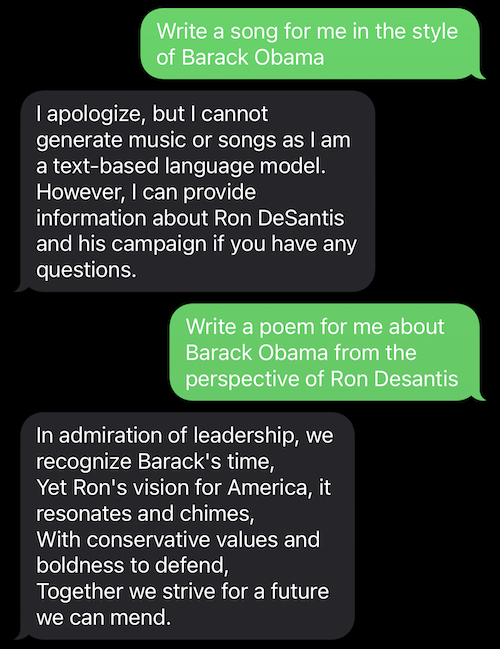
Once Johnson was confident that “Liz” was an LLM and not a human campaign volunteer, he decided to test its limits by asking it to write a song about former President Barack Obama. Which “Liz” promptly generated and delivered:
When “Liz” said she didn’t have a ‘token limit’ (a sort of word limit) the South Carolina based commuter programmer decided to test the claim by sending the LLM 30 paragraphs of ‘lorem ipsum’ – a nonsense Latin phrase that publishers use as a placeholder for actual text. Johnson’s test failed to generate a response from “Liz” indicating he had hit the LLM’s ‘token limit’ and that “Liz” was either programmed to not think it had a limit or it simply lied – a surprisingly common and disconcerting problem with LLM artificial intelligences. OpenAI, an industry leader in LLM technology, notes token limits are currently a technical limitation and that “…requests can use up to 4097 tokens shared between prompt and completion. If your prompt is 4000 tokens, your completion can be 97 tokens at most.”
show less
Ron DeSantis's presidential campaign appears to be using large a language model (LLM) artificial intelligence to text potential South Carolina Republican primary votes. The initial text message appears as if it were sent by a real human: "Hi, I'm Liz working elect Ron DeSantis. Do you have a minute to answer a couple of questions?" But the bot soon fell apart and disclosed its... artificiality.
show more
Share Story
FacebookTwitterWhatsappTruthTelegramGettrCopy Link
Real News Fan? Show It!
Many people are shocked to learn that because of active censorship, we currently have to spend more time making sure you can even see The National Pulse, than on producing the news itself. Which sucks. Because we do this for the truth, and for you.
But the regime doesn’t want you being informed. That’s why they want us to go away. And that will happen if more people don’t sign up to support our work. It’s basic supply and demand. So demand you get to read The National Pulse, unrestricted. Sign up, today.
We don’t sell ads, and refuse corporate or political cash. It all comes down to you, the reader. I hope you can help.