




Monday, February 23, 2026

Argentine Commission Alleges President Milei Was Involved in Crypto Scam.

PULSE POINTS

WHAT HAPPENED: A congressional commission in Argentina accused President Javier Milei of involvement in a cryptocurrency fraud.

👤WHO WAS INVOLVED: President Javier Milei, his sister Karina Milei, and investors in the $LIBRA cryptocurrency.

📍WHEN & WHERE: The report was published on November 19, 2025, in Argentina.

💬KEY QUOTE: “The world wants to invest in Argentina. $LIBRA.” – Javier Milei

🎯IMPACT: Hundreds of millions of dollars were lost by investors, and legal complaints have been filed.

IN FULL

An Argentine congressional panel has issued a new report accusing President Javier Milei of engaging in a cryptocurrency scam after promoting $LIBRA, which resulted in a significant loss for investors. Notably, the investigation names both President Milei and his sister, Karina Milei.

Released by the Chamber of Deputies—which is controlled by parties in opposition to Milei’s government—the report states that “the facts analyzed would be compatible with an alleged fraud” and that “political responsibility” rests with Milei and his sister. Notably, the crash in $LIBRA’s value occurred in February of this year, with observers describing it as a rug pull scam that resulted in $251 million in losses.

In the lead-up to $LIBRA’s launch, there were rumors of bribes and payouts involving those close to Milei himself. Individuals who have been accused of perpetrating rug-pull crypto schemes in the past were involved, notably Hayden Davis, an American cryptocurrency marketer.

President Milei maintains that he was unaware of any of the $LIBRA project details and that he was relatively uninvolved. He did promote the cryptocurrency on X (formerly Twitter), authoring a post stating: “The world wants to invest in Argentina. $LIBRA.”

The cryptocurrency is currently the subject of legal proceedings and the Chamber of Deputies report has been sent to prosecutors. The scandal was part of a broader series of corruption allegations that rocked Argentina earlier this year and set off a currency crisis, which required the United States Treasury Department to step in and provide stability through a monetary bailout.

Image by Casa Rosada.

Join Pulse+ to comment below, and receive exclusive e-mail analyses.

show less
show more

What’s the Deal With Argentina? And Why Are We Bailing Them Out?

PULSE POINTS

WHAT HAPPENED: Argentine President Javier Milei’s government teeters on the brink as his country faces a significant currency crisis, kicked off by several major corruption scandals and a flight of investors from the Argentine peso—despite a $20 billion U.S. rescue package.

👤WHO WAS INVOLVED: Javier Milei, U.S. President Donald J. Trump, and U.S. Treasury Secretary Scott Bessent.

📍WHEN & WHERE: The currency crisis has ravaged Argentina for over a month, with new meaures announced by Bessent on Thursday, October 9, 2025.

💬KEY QUOTE: “The [U.S. Treasury] has concluded 4 days of intensive meetings with [Argentina’s Economic Minister Luis Caputo] and his team in DC. We discussed Argentina’s strong economic fundamentals, including structural changes already underway that will generate significant dollar-denominated exports and foreign exchange reserves.” — Secretary Bessent.

🎯IMPACT: A possible Argentine peso devaluation would likely set off a new inflation crisis, threatening to derail Milei’s government. Critical midterm elections will take place on October 26, 2025, with leftist parties working to retake control from Milei’s party, La Libertad Avanza.

IN FULL

Argentine President Javier Milei‘s government teeters on the brink as his country faces a significant currency crisis, kicked off by several major corruption scandals and a flight of investors from the Argentine peso. On Wednesday, short-term interest rates in the South American country surged to over 80 percent, worsening the peso crisis.

In late September, U.S. President Donald J. Trump authorized a $20 billion bailout for Argentina, overseen by U.S. Treasury Secretary Scott Bessent. However, with the peso crisis deepening, Bessent revealed that Treasury Department staff are intervening far more in the Argentine economy than previously thought.

“The [U.S. Treasury] has concluded 4 days of intensive meetings with [Argentina’s Economic Minister Luis Caputo] and his team in DC. We discussed Argentina’s strong economic fundamentals, including structural changes already underway that will generate significant dollar-denominated exports and foreign exchange reserves,” Bessent wrote in a post on X (formerly Twitter). He continued: “Argentina faces a moment of acute illiquidity. The international community—including [The International Monetary Fund (IMF)]—is unified behind Argentina and its prudent fiscal strategy, but only the United States can act swiftly. And act we will.”

“Additionally, we have finalized a $20 billion currency swap framework with Argentina’s central bank. The U.S. Treasury is prepared, immediately, to take whatever exceptional measures are warranted to provide stability to markets,” Bessent added, referring to the $20 billion rescue package first revealed in September.

However, thus far, President Milei’s efforts to bring the crisis under control appear to be having little effect in heading off a potential devaluation. In recent weeks, Milei has reinstated some foreign exchange controls and authorized the selling of dollars in the futures market. However, many financial analysts now believe the peso’s current exchange rate is unsustainable.

A peso devaluation would likely set off a new inflation crisis, threatening to derail Milei’s government. Critical midterm elections will take place on October 26, 2025, with leftist parties working to retake control from Milei’s party, La Libertad Avanza.

While Milei has largely been successful in reining in the out-of-control inflation experienced under the country’s previous socialist governments, dropping from a peak of around 300 percent to just 33 percent in October 2025, the austerity measures enacted have kept the poverty rate elevated. In the first half of 2023, Argentina’s poverty rate sat at around 40 percent. That jumped to nearly 53 percent in the first half of 2024 before falling back to around 40 percent in the second half of the year.

The currency crisis and a renewed inflation crisis could send poverty soaring once again.

Image by Gage Skidmore.

Join Pulse+ to comment below, and receive exclusive e-mail analyses.

show less
show more

Argentinians at the Polls, With Populist Milei Still Favorite.

The Argentinian electorate is already at the polls for the run-off election between populist Javier Milei and the country’s current economy minister, Sergio Massa. The results are due to be announced on Sunday evening, with the winner taking office on December 10.

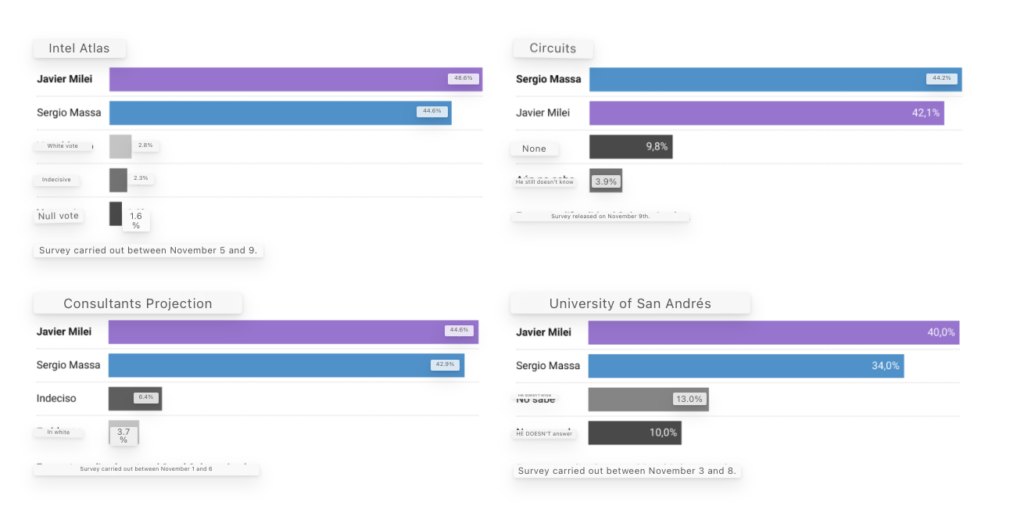
Milei, the self-described “anarcho-capitalist” and admirer of former President Donald Trump, maintains a slight advantage going into the election, with three out of four polls  showing him in the lead. Yet, most commentators suggest the election is too close to call.

Massa won the country’s first presidential election last month with around 37 percent of the vote to Milei’s 30 percent. But at the time, the right-wing vote was split between Milei and establishment candidate Patricia Bullrich, who received 23.8 percent. The two sides have, however, reconciled after Bullrich publicly endorsed Milei for the presidency within days of the October election.

Coverage has been dominated by outsider candidate Milei, who received international attention after he unexpectedly triumphed in the primaries in August.

He has based his campaign on more libertarian and non-interventionist economics, increased gun rights, calling for the removal of sex education from schools – which he suggests is a ploy to destroy the family – as well as vowing to bring about “an end to the parasitic, corrupt and useless political caste that exists in” Argentina.

Notably, Milei has warned supporters of electoral “fraudsters” stealing and damaging ballots before this weekend’s run-off, with his campaign manager arguing there have been a number of complaints made by voters. He also claims he was robbed of more than one million votes in August.

“The election will mark a profound rupture in the system of political representation in Argentina,” stated the director of the political consultancy Observatorio Electoral, Julio Burdman. “I think all the political forces as we have known them are going to be transformed.”

show less
The Argentinian electorate is already at the polls for the run-off election between populist Javier Milei and the country's current economy minister, Sergio Massa. The results are due to be announced on Sunday evening, with the winner taking office on December 10. show more

Populist Milei Finishes 2nd In Argentina, Run-Off Set for November 19.

Populist outsider Javier Milei finished in second place behind left-wing establishment candidate Sergio Massa in the Argentinian general elections on Sunday afternoon, with the country now set for a run-off vote to determine the presidency in November.

Milei – a self-described “anarcho-capitalist” and admirer of former President Donald Trump – was the favorite going into the elections and was leading the polls for the past several months at around 35 percent compared to Massa’s sub-30 numbers. The elections themselves appeared to reverse the polling predictions, however, with Massa receiving 36.6 percent support and Milei receiving 29.9 percent.

Despite receiving less support than anticipated, Milei told voters to celebrate the vote, explaining, “Today is a historic day because two-thirds of Argentinians voted for change.”

Milei, who unexpectedly triumphed in the national primaries in August this year, is running a strongly anti-establishment campaign in which he promises “an end to the parasitic, corrupt, and useless political caste that exists in [Argentina].” His libertarian, free-market economics proved especially popular with young voters amid Argentina’s ongoing economic crisis, with annual inflation soaring to 140 percent and the current poverty rate above 40 percent.

The second vote is expected to be held on November 19. The winner will take office on December 10.

show less
Populist outsider Javier Milei finished in second place behind left-wing establishment candidate Sergio Massa in the Argentinian general elections on Sunday afternoon, with the country now set for a run-off vote to determine the presidency in November. show more