






Monday, February 23, 2026

CIA Will ‘Neither Confirm Nor Deny’ Existence of Records on Possible ‘Alien Mothership.’

PULSE POINTS

âť“WHAT HAPPENED: Harvard physicist Avi Loeb has revealed that the United States Central Intelligence Agency (CIA) will “neither confirm nor deny” records related to the interstellar object 3I/ATLAS, and that the possible existence of records is currently classified.

👤WHO WAS INVOLVED: Avi Loeb, NASA, the CIA, and ufologist John Greenewald Jr.

📍WHEN & WHERE: The object made its closest approach to Mars and Jupiter in October, with further studies planned during its approach to Jupiter in March.

đź’¬KEY QUOTE: “That this information is treated as sensitive enough to be classified by the CIA is surprising, given that NASA officials stated decisively at a press conference on November 19, 2025, that 3I/ATLAS is definitely a comet of natural origin.” – Avi Loeb

🎯IMPACT: Loeb’s claims have sparked debates over government transparency, national security, and the possibility of alien technology.

IN FULL

Harvard physicist Avi Loeb has revealed that the United States Central Intelligence Agency (CIA) will “neither confirm nor deny the existence or nonexistence of records” related to the interstellar object 3I/ATLAS—which he posits could be an alien probe or even “mothership.” According to Loeb, the CIA response stems from a Freedom of Information Act (FOIA) request filed by ufologist John Greenewald Jr., which sought “any assessments, reports, or communications maintained by the Central Intelligence Agency referencing 3I/ATLAS.” Notably, the CIA in its response stated that the very existence or non-existence of such records is currently classified.

“That this information is treated as sensitive enough to be classified by the CIA is surprising, given that NASA officials stated decisively at a press conference on November 19, 2025, that 3I/ATLAS is definitely a comet of natural origin,” Loeb writes, adding: “If this conclusion was clear all along to everyone within government and academia—as NASA officials presented the case, then why would the CIA treat the possible existence of records dealing with a natural comet as sensitive enough to be classified?”

While Loeb still acknowledges that 3I/ATLAS is most likely a comet, he does detail a number of anomalous observations regarding the object that could indicate its actually technological in origin. “The anomalous features include the existence of a prominent anti-tail jet directed at the Sun both before and after perihelion, the geometric alignment to within 8 degrees between the rotation axis of 3I/ATLAS at large distances and the sunward direction, the alignment to within 5 degrees of the orbital plane of 3I/ATLAS with the ecliptic plane, as well as the prominence of nickel relative to iron in the gas that 3I/ATLAS sheds—reminiscent of industrially-produced nickel alloys,” Loeb states.

The Harvard physicist believes that the CIA response is likely due to the agency’s wish to “verify that 3I/ATLAS is not a black swan event, posing a potential threat to society even as a comet.” Meanwhile, he contends that government officials likely encouraged NASA to support the most likely scientific view of the nature of 3I/ATLAS being a comet. He also states that it appears that 3I/ATLAS is the first astronomical object that U.S. intelligence officials have classified under national security.

Join Pulse+ to comment below, and receive exclusive e-mail analyses.
show less
show more

Interstellar Object Dubbed ‘Alien Mothership’ By Harvard Physicist Is Accelerating Due to ‘Non-Gravitational’ Forces.

PULSE POINTS

❓WHAT HAPPENED: Comet 3I/ATLAS, an interstellar object, is accelerating as it nears its closest approach to Earth.

👤WHO WAS INVOLVED: NASA and Harvard physicist Avi Loeb.

📍WHEN & WHERE: Closest approach to Earth expected on December 19, following its discovery in July by NASA’s ATLAS telescope in Chile.

💬KEY QUOTE: “If 3I/ATLAS is not enshrouded in a much more massive gas cloud after perihelion than it had in the months preceding perihelion, then its recent non-gravitational acceleration must have resulted from a different cause than cometary evaporation,” claims Loeb.

🎯IMPACT: The comet is being closely studied for its interstellar origins and behavior, but seemingly poses no danger to Earth.

IN FULL

The interstellar object 3I/ATLAS is accelerating due to non-gravitational forces as it approaches its closest point to Earth along its trajectory through our solar system. In recent weeks, scientists studying the object have taken note of “significant” accelerations and shifts in its trajectory, which they attribute to gas releases from the object caused by heat from the Sun.

While most of the scientific community believes 3I/ATLAS is a comet originating from deep space, Harvard physicist Avi Loeb has—in what some consider a publicity stunt—posited that the object could be an extraterrestrial mothership releasing small alien probes. Loeb previously argued that astronomers have yet to find sufficient evidence of gas emissions from the object, which would typically indicate a cometary nature.

“If 3I/ATLAS is not enshrouded in a much more massive gas cloud after perihelion than it had in the months preceding perihelion, then its recent non-gravitational acceleration must have resulted from a different cause than cometary evaporation,” he claimed. Last month, NASA discovered that the object had accelerated its speed from over 130,000 mph to around 152,000 mph after its closest approach to the sun on October 29.

However, NASA’s lead scientist for solar system small bodies, Tom Statler, has dismissed Loeb’s theory, stating, “It looks like a comet. It does comet things. It very, very strongly resembles, in just about every way, the comets that we know.” Loeb himself has also acknowledged that the likelihood of 3I/ATLAS being of technological origin is slim, but emphasized the importance of evidence-based science.

3I/ATLAS is expected to make its closest approach to Earth on December 19, coming no closer than 170 million miles.

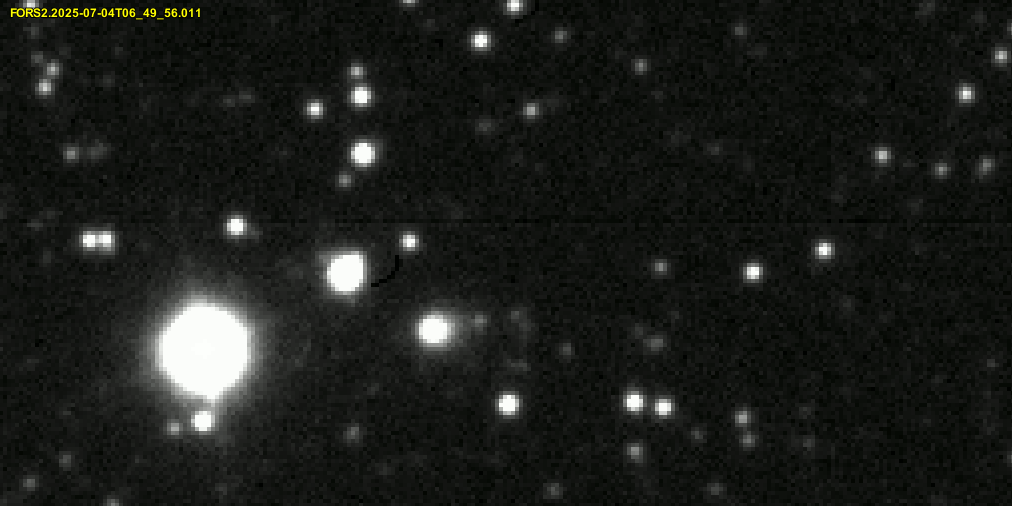
Image: Olivier Hainaut et al./European Southern Observatory (processed by Nrco0e).

Join Pulse+ to comment below, and receive exclusive e-mail analyses.
show less
show more

NASA Observes Increased Speed in Object Harvard Physicist Says Could Be ‘Alien Mothership.’

PULSE POINTS

❓WHAT HAPPENED: An interstellar object, 3I/ATLAS, has picked up speed unexpectedly as it moves away from the sun and closer to Earth, defying gravitational predictions.

👤WHO WAS INVOLVED: NASA scientists, Harvard physicist Avi Loeb, and astronomers tracking the object.

📍WHEN & WHERE: The object reached perihelion on October 29, 2025, and is now six weeks away from its closest approach to Earth.

đź’¬KEY QUOTE: “If 3I/ATLAS is not enshrouded in a much more massive gas cloud after perihelion than it had in the months preceding perihelion, then its recent non-gravitational acceleration must have resulted from a different cause than cometary evaporation.” – Avi Loeb

🎯IMPACT: The object’s unexplained movements and composition raise questions about its nature, with some suggesting it could be an extraterrestrial craft.

IN FULL

The interstellar object 3I/ATLAS has been observed accelerating as it moves away from the sun and closer to Earth, according to NASA. This unexpected speed increase has shifted the object off its predicted path, defying the gravitational forces of the sun, which contains the majority of the solar system’s mass.

3I/ATLAS, initially recorded as the fastest space object entering the solar system at over 130,000 mph, has now reached speeds of around 152,000 mph after its closest approach to the sun on October 29. While NASA attributes the speed boost primarily to the sun’s gravity, the object’s noticeable deviation from its expected trajectory remains unexplained.

Harvard physicist Avi Loeb has pointed out that astronomers have yet to find sufficient evidence of gas emissions from the object, which would typically indicate a cometary nature. “If 3I/ATLAS is not enshrouded in a much more massive gas cloud after perihelion than it had in the months preceding perihelion, then its recent non-gravitational acceleration must have resulted from a different cause than cometary evaporation,” Loeb stated.

The object has exhibited unusual characteristics, including turning blue as it approached the sun, rather than red like typical comets. It also has a massive estimated weight of 33 billion tons, with a composition of nickel and carbon dioxide, unlike the ice and water found in comets formed in our solar system. These anomalies have led some, including Loeb, to theorize that it could be a nuclear-powered ‘mothership’ created by an alien intelligence.

NASA’s latest data shows that the mysterious push on 3I/ATLAS weakened after it passed perihelion, yet it remains detectable. The James Webb Space Telescope is set to observe the object in December to search for any gas cloud that could explain its movements. However, Loeb and others continue to question whether the object’s behavior and composition might point to a non-natural origin.

Image by Joe Loong.

Join Pulse+ to comment below, and receive exclusive e-mail analyses.

show less
show more

Harvard Astronomer Says There’s an Alien ‘Mothership’ Behind the Sun.

PULSE POINTS

❓WHAT HAPPENED: Interstellar object 3I/ATLAS is set to reach its perihelion, the closest point to the Sun on its trajectory, on October 29.

👤WHO WAS INVOLVED: Harvard astronomer Avi Loeb, NASA scientist Tom Statler, and the broader scientific community.

📍WHEN & WHERE: October 29, 2025; the object is currently on the opposite side of the Sun relative to Earth.

💬KEY QUOTE: “If you want to take a vacation, take it before [October 29], because who knows what will happen?” – Avi Loeb

🎯IMPACT: Loeb’s theory of extraterrestrial origin has sparked debate, but most scientists believe 3I/ATLAS is a natural comet.

IN FULL

The mysterious interstellar object 3I/ATLAS is expected to reach the nearest point to the Sun on October 29, following its unusual trajectory through the solar system. Currently, the object is opposite the Earth on the other side of the Sun. While most scientists have concluded that 3I/ATLAS is a comet comprising carbon dioxide ice, Harvard astronomer Avi Loeb continues to suggest that the object could be an extraterrestrial “mothership” sent by an intelligent civilization.

As evidence of his claim—which some critics suggest is more of a publicity stunt than a serious proposal—Loeb notes the interstellar object’s unusual trajectory given its size, and claims the object’s path, taking it close to Mars, Venus, and Jupiter, may be more than “extremely rare coincidences.”

Late Thursday, Loeb wrote in a post on Medium, “If you want to take a vacation, take it before [October 29], because who knows what will happen?” He elaborated on the potential for the object to use the Sun’s gravitational pull to accelerate or slow down, referencing the Oberth effect, a principle in physics that allows a spacecraft to generate more energy when its engine is fired at higher speeds.

“If 3I/ATLAS is a massive mothership, it will likely continue along its original gravitational path and ultimately exit the Solar system,” Loeb posits. He speculates: “In that case, the Oberth maneuver might apply to the mini-probes it releases at perihelion towards Solar system planets.”

NASA’s lead scientist for solar system small bodies, Tom Statler, has dismissed Loeb’s theory, stating, “It looks like a comet. It does comet things. It very, very strongly resembles, in just about every way, the comets that we know.” However, Statler did acknowledge that the object has “some interesting properties that are a little bit different from our solar system comets.”

Loeb has admitted that the likelihood of 3I/ATLAS being technological in origin is slim, but emphasized the importance of evidence-based science. “As of now, 3I/ATLAS appears most likely to be a natural comet,” he wrote in a blog post. “But the remote possibility of an Oberth maneuver must be considered seriously as a black swan event with a small probability, because of its huge implications for humanity.”

Image by Adam Fagen.

Join Pulse+ to comment below, and receive exclusive e-mail analyses.

show less
show more