




Monday, February 23, 2026

Govt Dependence is Skyrocketing in U.S. Swing States.

American dependence on government assistance has skyrocketed in recent years, especially in critical 2024 battleground states. According to new data from the Economic Innovation Group, government assistance is now crucial for residents in 70 percent of counties in Georgia, Michigan, and North Carolina. In Pennsylvania, 60 percent of counties are reliant on government spending programs.

Reliance on government aid has increased exponentially over the past two decades, with 53 percent of counties nationwide now drawing a bulk of their income from government spending. Just 10 percent of counties were reliant on government spending in the year 2000.

Social safety net programs like Social Security, SNAP, Medicare, and Medicaid account for most of the assistance, with the increased reliance driven—in part—by the aging U.S. population. As more members of the Baby Boomer generation retire from the workforce, these programs will continue to see their budgets balloon.

Additionally, the concentration of high-salaried workers in major U.S. cities is compounding the problem. Almost all of the counties reliant on government aid are rural or recently de-industrialized through outsourcing. This has resulted in American wealth becoming concentrated in just a few major cities.

Runaway healthcare costs are also a contributing factor. According to the Economic Innovation Group report, medical costs “have risen nearly twice as quickly as overall inflation over the past several decades.”

The overreliance on government assistance programs among critical election demographics in battleground states could make tackling the country’s ballooning deficit a politically fraught decision for either major U.S. political party. “Significantly raising taxes and dramatically cutting… programs could choke off the very economic activity that finances [them] and immiserate the lives of people who depend on them,” the report notes.

show less

American dependence on government assistance has skyrocketed in recent years, especially in critical 2024 battleground states. According to new data from the Economic Innovation Group, government assistance is now crucial for residents in 70 percent of counties in Georgia, Michigan, and North Carolina. In Pennsylvania, 60 percent of counties are reliant on government spending programs. show more

DATA: 45% of Brits Say They Want Masks for Public Transport.

Almost half of the British public – 45 percent – support the reimposition of mask mandates on public transport, with that figure rising to a staggering 52 percent in Greater London, according to a recent poll from More in Common UK.

Pollsters asked over 2,000 Britons whether they would “support or oppose the government re-introducing… COVID-19 restrictions at the current time?” to which roughly one-fifth of the public suggested they support the return of restrictions.

Support for restrictions was highest among Gen Z (born between 1997 and 2012) and millennials (born between 1981 and 1996), with a third of the latter supporting the arbitrary closure of nightclubs and limits on how many people can meet at the same time. Just under one-third – 31 percent – similarly support closing nightclubs. One-quarter of both Gen Z and Millennials supported closing restaurants and pubs.

Whereas 27 percent of Gen X (between 41 and 55 years old) and Baby Boomers (aged between 56 and 74) support closing nightclubs, and even fewer support closing restaurants and pubs, at 17 percent among Baby Boomers and 12 percent for the “silent generation (those older than 75).”

The effectiveness of the measures imposed by governments to combat the spread of COVID-19 has been consistently questioned and debunked by a number of studies, including the fact that lockdowns saved just 1,700 lives in Britain and 4,000 in the United States.

show less
Almost half of the British public – 45 percent – support the reimposition of mask mandates on public transport, with that figure rising to a staggering 52 percent in Greater London, according to a recent poll from More in Common UK. show more

Editor’s Notes

Behind-the-scenes political intrigue exclusively for Pulse+ subscribers.

RAHEEM J. KASSAM Editor-in-Chief
Look I mean I wish I could expand upon why my fellow countrymen remain so pusillanimous in the face of a 3-year-old virus scare, especially when so many of the “mitigating measures” have repeatedly been shown to have been nothing but theater
Look I mean I wish I could expand upon why my fellow countrymen remain so pusillanimous in the face of a 3-year-old virus scare, especially when so many of the “mitigating measures” have repeatedly been shown to have been nothing but theater show more
for exclusive members-only insights
Hamas

DATA: Gen Z As Likely To Call Hamas ‘Freedom Fighters’ As They Are ‘Terrorists’.

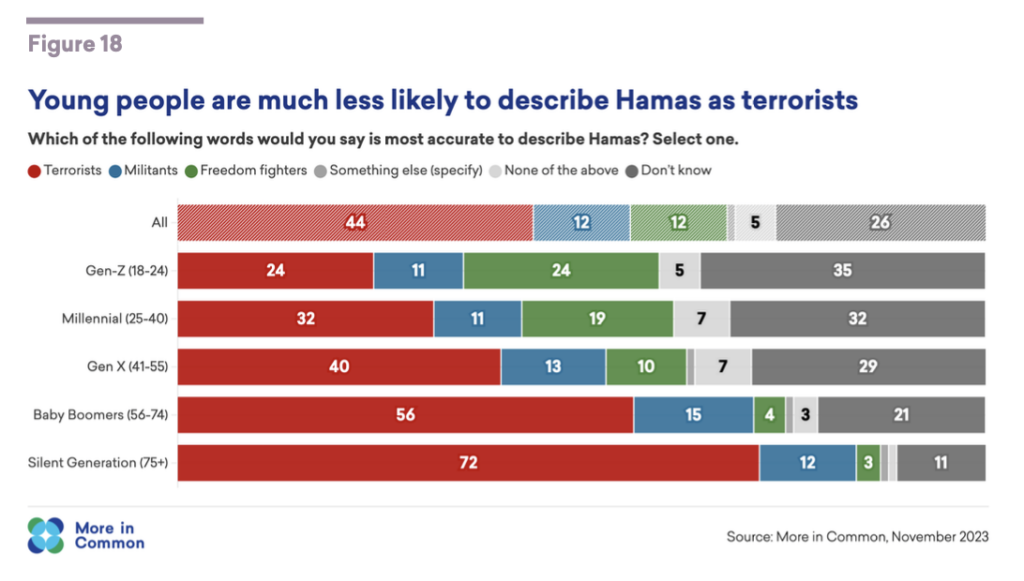
Generation Z, those born between 1997 and 2012, are just as likely to call members of Hamas “freedom fighters” as they are to call them “terrorists,” according to recent polling by the British organization More in Common.

Just under one-quarter of Generation Z – 24 percent – termed Hamas “freedom fighters,” with the same amount calling them “terrorists.” A further 35 percent said they were not sure.

Millennials, born between 1981 and 1996, were similarly more open to calling Hamas freedom fighters than other generations, at 19 percent. However, the majority still called those who launched a violent incursion into Israel on October 7 as terrorists, at 32 percent.

Older generations were far more hostile to Hamas, with 72 percent of the silent generation, those older than 75, 56 percent of baby boomers, aged between 56 and 74, and 40 percent of Generation X, between 41 and 55 years old, labeling the organization’s members as terrorists.

Pollsters also learned that sympathy for Hamas was higher in London than any other region in Britain. Graduates were “twice as likely” to sympathize with Hamas and those in the Gaza Strip than Israel.

“One by-product of the Israel-Gaza conflict is that it’s simply made it impossible to ignore the growing divides in Western societies,” argues political commentator Matt Goodwin.

The divides have been stoked by “mass immigration, a failing policy of multiculturalism, the rise of the radical woke left, and our increasingly left-leaning educational institutions which are, very clearly, leaving many young people with a warped view of the world,” he adds.

show less
Generation Z, those born between 1997 and 2012, are just as likely to call members of Hamas "freedom fighters" as they are to call them "terrorists," according to recent polling by the British organization More in Common. show more