






Monday, February 23, 2026

Bank of England: AI Bubble Threatens Global Economy.

PULSE POINTS

WHAT HAPPENED: The Bank of England has warned of a growing risk of a “sudden correction” in global financial markets due to overvaluation in the artificial intelligence (AI) sector.

👤WHO WAS INVOLVED: The Bank of England, AI technology companies, financial analysts, and OpenAI CEO Sam Altman.

📍WHEN & WHERE: The warning was issued during a Wednesday meeting, with concerns spanning global markets, particularly the United States.

💬KEY QUOTE: “The risk of a sharp market correction has increased,” said the Bank of England’s financial policy committee, noting that “equity market valuations appear stretched, particularly for technology companies focused on artificial intelligence.”

🎯IMPACT: A potential AI bubble burst could destabilize the global economy, with AI spending now accounting for a significant portion of the U.S. GDP.

IN FULL

The Bank of England (BoE) is joining a growing number of financial sector voices warning that an artificial intelligence (AI) sector-fueled bubble is increasingly likely and could trigger a “sudden correction” in global financial markets. “The risk of a sharp market correction has increased,” said the Bank of England’s financial policy committee during a Wednesday meeting, warning that “equity market valuations appear stretched, particularly for technology companies focused on artificial intelligence.”

In recent weeks, financial analysts have grown more concerned about an AI bubble and subsequent burst. At least one analysis has found that the potential AI bubble could be 17 times the size of the dotcom-era bubble. Concerningly, the same data found that an AI bubble-fueled financial crisis could be four times worse than 2008’s Great Recession.

The National Pulse reported in late September that former Facebook executive Julie Zhou warned that much of the AI technology industry’s growth is not being driven by robust data-driven business strategies, but rather by “good instincts and good vibes.” Zhou argued that while the AI industry has tremendous promise, the technology is still far from achieving what many adherents claim. This has left the AI technology sector rife with speculative investment on a scale that could potentially threaten the U.S. economy should the bubble burst.

Zhou’s concerns have even been echoed by OpenAI CEO Sam Altman, who has acknowledged that the AI sector’s revenue lags far behind expenses. Over 33 US-based AI startups raised $100 million or more in 2025 alone, though none have yet to turn a profit or demonstrate market viability. Many of these start-ups, along with more established companies, are reliant on technology from industry leaders like Nvidia—with the former making up nearly 10 percent of the S&P 500.

Even more troubling, a report by Massachusetts Institute of Technology (MIT) researchers in August found that only five percent of AI pilot programs help businesses achieve “rapid revenue acceleration,” with the majority failing to deliver. Despite these concerns, generative AI now accounts for roughly 40 percent of the United States’ gross domestic product (GDP), making the economy heavily reliant on the industry’s stability.

Join Pulse+ to comment below, and receive exclusive e-mail analyses.

show less
show more

Hey Jerome Powell! Even the Bank of England Just Cut Rates…

PULSE POINTS

WHAT HAPPENED: The Bank of England cut interest rates by 0.25 percentage points to four percent after a rare second round of voting by the Monetary Policy Committee. The move will likely reverberate across the Atlantic, where U.S. President Donald J. Trump continues pushing Federal Reserve Chairman Jerome Powell to cut rates.

👤WHO WAS INVOLVED: The Monetary Policy Committee, including Governor Andrew Bailey and external member Alan Taylor, who changed his vote during the second round.

📍WHEN & WHERE: The decision was announced in the UK on August 7, 2025.

💬KEY QUOTE: “We’ve cut interest rates today, but it was a finely balanced decision,” said BoE’s governor Andrew Bailey.

🎯IMPACT: The pound rose 0.5 percent against the dollar, and two-year gilt yields climbed six basis points to 3.88 percent after the announcement.

IN FULL

In a decision that required an unprecedented second round of voting, the Bank of England reduced its interest rate by 0.25 percentage points to four percent. The Monetary Policy Committee (MPC) initially failed to achieve a majority consensus, resulting in a second vote where Alan Taylor shifted his stance to support the reduction.

The final vote was close, with five members backing the cut and four preferring no change. The decision marks the first time in the panel’s 28-year history that two rounds of voting were necessary to reach a conclusion on rates.

Governor Andrew Bailey stated, “We’ve cut interest rates today, but it was a finely balanced decision.” He emphasized that future rate reductions would be made “gradually and carefully,” with the timing dependent on easing disinflationary pressures.

The announcement caused immediate market reactions, as the pound rose 0.5 percent against the dollar to $1.3428, and two-year gilt yields increased by six basis points to 3.88 percent. Traders have adjusted their expectations for future rate cuts accordingly. The decision comes amid a challenging economic environment of high inflation and weak growth. The Bank of England has warned that food prices will push inflation further above target in the near term, with a predicted peak of four percent in September.

Notably, the decision to slash rates comes as U.S. President Donald J. Trump continues his own campaign to push Federal Reserve Chairman Jerome Powell to cut interest rates as well. Powell is currently facing increased scrutiny over the ballooning Federal Reserve renovation costs, and a revolt among some Fed members who are backing Trump’s call for a rate cut.

While the Federal Reserve’s Federal Open Market Committee (FOMC) declined to reduce borrowing rates in July, they are anticipated to back a rate cut at its upcoming September meeting.

Join Pulse+ to comment below, and receive exclusive e-mail analyses.
show less
show more

Economists Blast Bank of England Rate Cut as Too Small — While U.S. Fed Won’t Slash Rates at All.

PULSE POINTS:

What Happened: The Bank of England reduced its base interest rate from 4.5 percent to 4.25 percent.

👥 Who’s Involved: The Bank of England, economist Patrick Minford, U.S. President Donald J. Trump, and the United States Federal Reserve.

📍 Where & When: Thursday, May 8, 2025, in the United Kingdom.

💬 Key Quote: “I would have welcomed more [of a cut to base rates] actually… At the moment, the priority is to try and stop the recession gathering pace,” said economist and former Margaret Thatcher advisor Patrick Minford.

⚠️ Impact: The British rate cut may not be sufficient to prevent a recession in Britain, but could increase pressure on the U.S. Federal Reserve to finally enact a rate cut of its own.

IN FULL:

The Bank of England has announced a reduction in its base interest rate from 4.5 percent to 4.25 percent, a move that has been met with mixed reactions from economists and the public. While this decision is seen as beneficial for many homeowners, Patrick Minford, a prominent economist and former advisor to the late Prime Minsiter Margaret Thatcher, has expressed concerns that the cut may not be enough to avert an impending recession. Conversely, yesterday, the United States Federal Reserve declined to cut rates at all, raising concerns that the American central bank is asleep at the wheel.

“I would have welcomed more [of a cut to base rates] actually,” Minford said in an interview, warning: “At the moment, the priority is to try and stop the recession gathering pace.”

As in the U.S., the British inflation rate has continued to fall, decreasing from 2.8 percent in February to 2.6 percent in March. However, in both countries, the inflation rate remains just above their respective central bank targets. In the U.S., President Donald J. Trump has steadily increased political pressure on Federal Reserve Chairman Jerome Powell to usher in a cut to interest rates and inject liquidity into the American economy.

Following the signing of a bilateral trade agreement between the U.S. and the UK on Thursday, President Trump again pushed “Too Late” Powell to cut rates, likening a cut to “jet fuel” and suggesting Powell’s reluctance to lower interest rates is politically motivated.

Despite growing concerns over a potential global recession driven by a deflationary demand collapse, the U.S. labor market has remained resilient under President Trump. The National Pulse reported on Thursday that unemployment claims are continuing to fall in the U.S., beating expectations, suggesting that recession fears may be overblown.

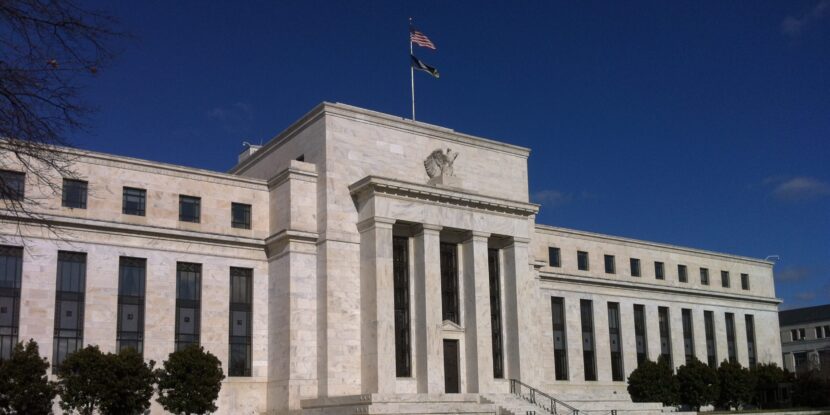
Image by Rafael Saldana.

show less

PULSE POINTS:

show more