




Monday, February 23, 2026
bidenomics

Biden Economy Misses October Jobs Forecast, Labor Market Cools.

The U.S. added 20,000 fewer jobs than forecast to the economy in October, while unemployment rose and pay increases slowed to a near-two-and-a-half-year low.

Economists had expected October would see 170,000 new jobs created, but only 150,000 were produced. Of these, 51,000 were government jobs – the manufacturing sector actually lost 35,000, while transportation and warehousing lost 12,000 and information-related industries lost 9,000.

Unemployment rose to 3.9 percent – despite expectations it would remain at 3.8 percent – with the number of workers recorded in the household survey falling by 348,000 and the number of unemployed rising by 146,000.

Pay increases sank from 4.3 percent to 4.1 percent month-on-month; their lowest level in almost a two and a half years – but the Federal Reserve is reportedly pleased with this, as it believes holding down pay will help to bring inflation under control.

Last month, the U.S. added some 336,000 jobs – although this was driven entirely by a rise in part-time workers, with the number of people in full-time work actually falling by 22,000.

show less

The U.S. added 20,000 fewer jobs than forecast to the economy in October, while unemployment rose and pay increases slowed to a near-two-and-a-half-year low. show more

DATA: Americans Struggling to Pay for Food Approaches 2008 Financial Crisis Level.

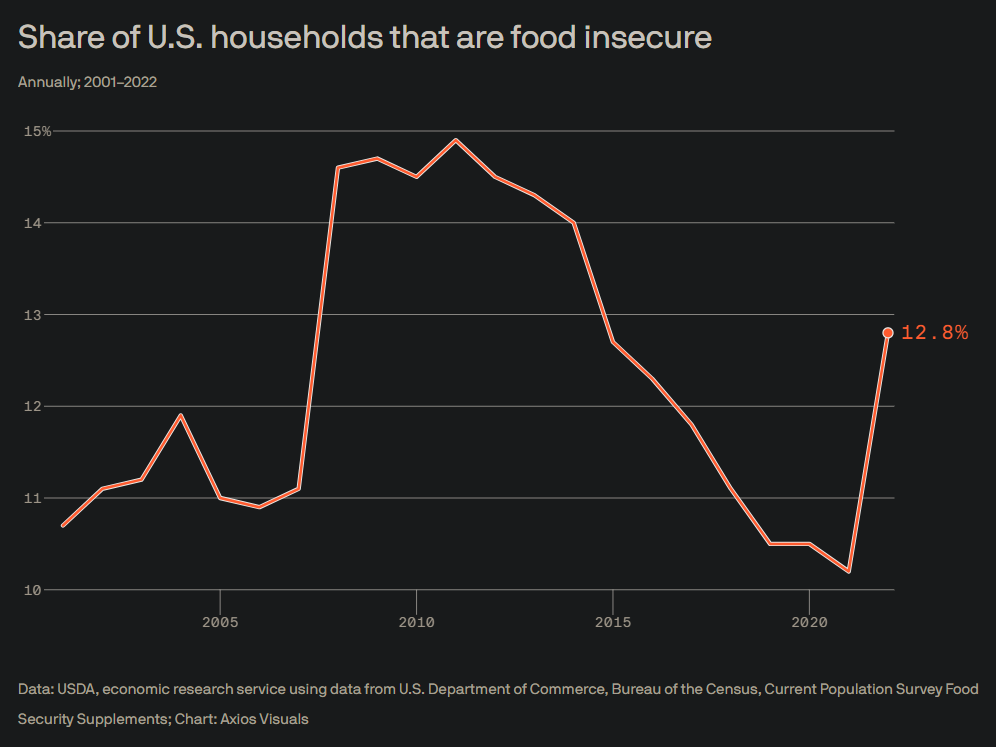
The number of American households classed as “food insecure” – that is, unable to meet the cost of feeding themselves on a reliable basis – is soaring at its sharpest rate since the financial crash under Joe Biden, having reached its lowest level in decades under Donald Trump.

The U.S. Department of Agriculture (USDA) Economics Research Service has reported the number of food insecure households in 2022 at 12.8 percent – “significantly higher than the 10.2 percent in 2021 and the 10.5 percent in 2020” – including 5.1 percent with “very low food security.”

The figures are even worse for households with children under 18, with their food insecurity rate rising to 17.3 percent – around 6.4 million American families.

High inflation under Joe Biden is obviously playing a major role in the crisis, with Lisa Davis of poverty-focused nonprofit Share Our Strength observing: “If you don’t pay the rent or your mortgage, you don’t have a place to live. If you don’t put gas in the car, you can’t get to work. Food is the place that folks turn when they have to tighten the belt even more.”

Source: Axios.
show less
The number of American households classed as "food insecure" – that is, unable to meet the cost of feeding themselves on a reliable basis – is soaring at its sharpest rate since the financial crash under Joe Biden, having reached its lowest level in decades under Donald Trump. show more

Biden is Now Blaming the Media For His Awful Economy.

President Joe Biden blamed the media for American discontent with his handling of the economy while fielding press questions on the September jobs report at the White House on Friday.

“You all are not the happiest people about what you report. You get more legs when you report something negative,” Biden said. “I think [Americans] know they’re better off financially than they were before. It’s a fact,” he concluded, before going on to make a strange point about throwing a dog in a lake.

Recent polling on the economy has been abysmal for the 80-year-old Democrat, who is ostensibly seeking re-election in 2024.

Two weeks ago a Washington Post-ABC News poll found just 30 percent of Americans approve of the Biden economy. For the first time in 32 years, Republicans lead Democrats – 53 to 39 percent – on the question of who would handle the economy better in Gallup’s tracking poll. A late-September Marquette Law School poll showed 52 percent of voters think former President Donald would better handle the economy – only 28 percent said Biden would handle it better.

Despite the Biden White House repeatedly claiming Americans are better off financially now than ever before under, mounting evidence suggests unease about the state of the economy is justified. Under Biden, nearly two-thirds of Americans are living paycheck-to-paycheck. Home mortgage rates have soared to the highest levels in 23 years. In August, credit rating agency Fitch downgraded its AAA U.S. government debt rating to AA+.

Biden’s decision to center his campaign on the success of “Bidenomics” increasingly looks like a blunder. Fears over the state of the economy is driving down support for Democrats across key constituencies, including among Black and Hispanic voters. In a historic speech in Michigan, Trump made the case for “patriotic protectionism” – a relentless effort to reshore jobs from China and combat foreign trade manipulation.

show less
President Joe Biden blamed the media for American discontent with his handling of the economy while fielding press questions on the September jobs report at the White House on Friday. show more

Bidenomics: Mortgage Rates Surge to Highest in 23 Years.

Mortgage costs have hit their highest level in 23 years under Joe Biden, with prospective buyers now having to submit to an average rate of 7.5 percent for a 30-year home loan, up from 7.3 percent just last week and an average of 6.7 percent last year.

The rate rise puts the archetypal house and white picket fence so associated with the old-fashioned notion of the American Dream further out of reach for many young Americans, who are becoming homeowners progressively later in life, or not at all.

Home ownerships are falling across the country, with Virginia currently the worst-impacted U.S. state, with an 8.8 percent drop. North Dakota, North Carolina, Connecticut, Georgia, and Ohio have also been hit hard, seeing drops of 7.3 to 7.5 percent.

People now have to be able to put up over $2,000 a month to cover their mortgage costs in 31 states, with Hawaii the most expensive of all with costs over $5,000 a month.

Americans who give up on their home ownership dreams in favor of renting are scarcely better off, with the average single-family home costing at least $1,900 a month.

show less
Mortgage costs have hit their highest level in 23 years under Joe Biden, with prospective buyers now having to submit to an average rate of 7.5 percent for a 30-year home loan, up from 7.3 percent just last week and an average of 6.7 percent last year. show more

U.S. Adds Just 89k Jobs In September, Missing 150,000 Target.

U.S. private sector payroll increased by just 89,000 jobs in September, well below the 150,000 expected according to the ADP National Employment Report. The lackluster report signals the weakest U.S. labor market since January of 2021. Additionally, wage growth slowed to 5.9 percent – the 12th consecutive month of decline.

The lower-than-expected job numbers come as bad news for President Joe Biden as he ramps up his 2024 re-election campaign. With weakening in the labor market likely to continue as a result of the Federal Reserve’s interest rate hikes, the Biden campaign’s decision to lean into ‘Bidenomics‘ may backfire. Employment sectors that make up core parts of the Democrat Party’s base – including trade, transportation, utilities, and manufacturing – all saw significant losses according to the report. Growth in service sector made up a bulk of the job gains.

ADP’s employment report has a mixed history of successfully forecasting job gains as reported by the U.S. government’s Bureau of Labor Statistics (BLS). The BLS will release their official non-farm payroll numbers for September this Friday. Economists expect the government agency to report 170,000 were added last month, down from 187,000 in August.

show less
U.S. private sector payroll increased by just 89,000 jobs in September, well below the 150,000 expected according to the ADP National Employment Report. The lackluster report signals the weakest U.S. labor market since January of 2021. Additionally, wage growth slowed to 5.9 percent – the 12th consecutive month of decline. show more
bidenomics

BIDENOMICS: Inflation Up in August.

Inflation in the United States rose by an annual rate of 3.7 percent in August, the second consecutive month of rising costs. The Consumer Price Index, which tracks a basket of goods and services typically purchased by consumers, increased by 0.6 percent from July. The so-called core CPI, which excludes volatile fuel and food costs, rose by 4.3 percent from a year ago. Gasoline prices were the primary contributor to the increase, with housing also playing a role.

The release of the latest inflation data comes just prior to the Federal Reserve’s two-day policy meeting, during which officials will assess price and wage trends to decide whether to raise interest rates or keep them stable. While inflation remains higher than the Fed’s target of 2 percent, analysts believe the cooling trend may influence the central bank to maintain steady rates. Gasoline prices at the pump rose from an average of $3.60 per gallon in July to $3.84 in August, with housing costs also contributing to the overall increase.

Experts note that rent growth is slowing, with median rents falling year-over-year last month. However, it may take several months for these trends to be reflected in the CPI measures that the Fed considers when determining interest rate policy at their upcoming meeting.

show less
Inflation in the United States rose by an annual rate of 3.7 percent in August, the second consecutive month of rising costs. The Consumer Price Index, which tracks a basket of goods and services typically purchased by consumers, increased by 0.6 percent from July. The so-called core CPI, which excludes volatile fuel and food costs, rose by 4.3 percent from a year ago. Gasoline prices were the primary contributor to the increase, with housing also playing a role. show more
deficit

Biden More Than Doubles U.S. Deficit in 2023… and the Fiscal Year Isn’t Over Yet!

The United States budget deficit has doubled under President Joe Biden; hitting $1.6 trillion in the first 10 months of the fiscal year. The continued deterioration of the fiscal state of the U.S. is another blow to Bidenomics, the set of economic agenda items that the Biden White House has pinned their re-election hopes on.

In a thread on X (formerly Twitter), economist EJ Antoni explained that the U.S. Treasury “…continues hemorrhaging cash as spending balloons, receipts fall; deficit and interest on the debt keep rising.” Antoni noted net interest payments on the U.S. debt exceeded spending on national defense, medicare, veterans benefits and services, and transportation. 

Even more concerning is that the Fiscal-Year-To-Date’s deficit is already $238 billion above the last Fiscal Year’s entire deficit. There are still two months remaining in the current Fiscal Year.

The negative news on the U.S. deficit only darkens the storm clouds over the U.S. economy. The July Consumer Price Index numbers signaled a re-acceleration in inflation – despite many in the mainstream media claiming that the inflation crisis was over. In response to the re-acceleration of inflation in July, Antoni stated:

The CPI has risen so much faster than wages under Biden that the average American worker effectively paid a $4.62 an hour inflation tax in July. And yet, many components of the CPI are understating the realities faced by Americans, including housing. The monthly payment on a median price home today is twice what it was in January 2021.

Last wee, Fitch Ratings downgraded U.S. government debt from AAA to AA+ and projected the American economy would enter into a recession in late 2023 or early 2024.

show less
The United States budget deficit has doubled under President Joe Biden; hitting $1.6 trillion in the first 10 months of the fiscal year. The continued deterioration of the fiscal state of the U.S. is another blow to Bidenomics, the set of economic agenda items that the Biden White House has pinned their re-election hopes on. show more

Bidenomics: Inflation Ticks Up Again.

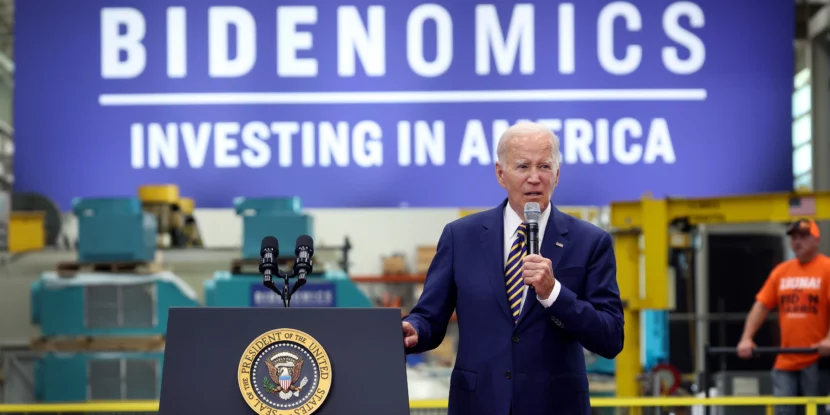
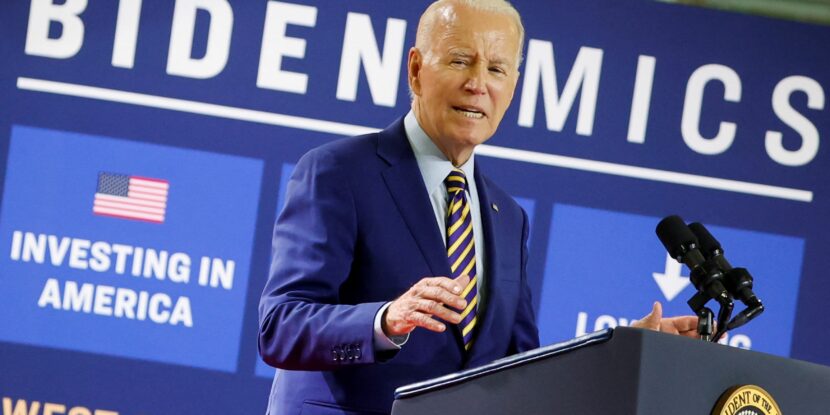
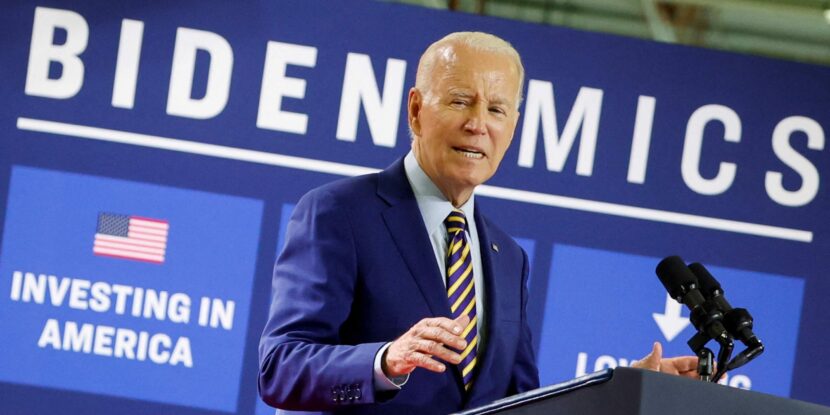
In another blow to Joe Biden’s economic agenda, the July numbers for the Consumer Price Index (CPI) saw inflation jump back up with headline inflation jumping up 3.2 percent compared to June’s 3 percent increase. The news comes a day after the President gave an economic speech flanked by dozens of signs that read “BIDENOMICS” in an attempt to lean into a term often used to describe his economic ineptitude.

Core CPI, a number that the Federal Reserve takes into consideration when deciding interest rates, increased from 4.5 percent to 4.7 percent. Even a small increase in core CPI is likely of concern to the the Federal Reserve and its Chairman Jerome Powell who have not wavered from their inflation target of 2 percent.

The increase in inflation comes as an ominous sign for investors who had hoped the Federal Reserve might continue to put a pause on rate hikes for the remainder of 2023. The new inflation number is likely to increase pressure on the Federal Reserve’s Federal Open Market Committee (FOMC) to announce at least one additional interest rate hike one of the three remaining meetings for 2023 – September 2oth, November 1st, and December 13th respectively.

show less
In another blow to Joe Biden's economic agenda, the July numbers for the Consumer Price Index (CPI) saw inflation jump back up with headline inflation jumping up 3.2 percent compared to June's 3 percent increase. The news comes a day after the President gave an economic speech flanked by dozens of signs that read “BIDENOMICS” in an attempt to lean into a term often used to describe his economic ineptitude. show more
bidenomics

‘Bidenomics’ Just Lost America its AAA Debt Rating in Historic Downgrade.

For the second time since 2011, a major U.S. credit rating agency has downgraded its credit rating for the U.S. government from AAA to AA+. In a press release Tuesday, Fitch Ratings stated:

The rating downgrade of the United States reflects the expected fiscal deterioration over the next three years, a high and growing general government debt burden, and the erosion of governance relative to ‘AA’ and ‘AAA’ rated peers over the last two decades that has manifested in repeated debt limit standoffs and last-minute resolutions.

Fitch Ratings also cited the “…limited progress in tackling medium-term challenges related to rising social security and Medicare costs due to an aging population…” as a reason for the downgrade. Fitch said it expects “…the general government (GG) deficit to rise to 6.3% of GDP in 2023, from 3.7% in 2022, reflecting cyclically weaker federal revenues, new spending initiatives and a higher interest burden.”

Most troubling, the ratings firm projected the U.S. economy would slip into a recession in fourth quarter of 2023 and the first quarter of 2024, citing a slowing consumption, lagging GDP growth, and a sluggish labor participation rate.

The Fitch downgrade alongside its warning of economic recession is a blow to President Joe Biden’s re-election campaign which has recently rolled out a new messaging campaign touting the success of “Bidenomics.” A recession hitting the U.S. economy in 2024 could tilt the electoral map in favor of Republicans who hold a narrow majority in the House of Representatives and are seeking to regain control of the Senate and White House.

The U.S. government’s debt rating was downgraded from AAA to AA+ by the credit rating agency Standard & Poor’s in 2011.

show less
For the second time since 2011, a major U.S. credit rating agency has downgraded its credit rating for the U.S. government from AAA to AA+. In a press release Tuesday, Fitch Ratings stated: show more

America’s Largest Poultry Processor Reintroduces Antibiotics Due to Biden’s Economy.

The United States’ largest poultry processor is removing its ‘no antibiotics ever’ from the company’s tagline and will reintroduce certain antibiotics to its products as a means to save money.

Tyson Foods, which processes around one-fifth of all chicken in the United States, initially pledged to remove antibiotics from its products in 2017, yet has reversed its decision because fewer people now want to buy meat that was more expensive, in large part thanks to “Bidenflation” and the government’s mishandling of the economy.

The Food and Drug Administration (FDA) suggests limited use of antibiotics in meat production despite antibiotics having been used in the industry for decades to prevent disease outbreaks amongst chickens, pigs, and cattle and assist them in gaining weight faster. Moreover, there are growing concerns about the rapid development of bacteria resistant to antibiotics in the meat.

Tyson plans to use ionophores as antibiotics, which control coccidiosis in poultry. However, researchers such as Assistant Professor of Biology at Carleton University Alex Wong, among others, have demanded a [s]ystematic investigation” into the possible dangers of using ionophores in relation to human health.

show less
The United States' largest poultry processor is removing its 'no antibiotics ever' from the company's tagline and will reintroduce certain antibiotics to its products as a means to save money. show more