



Friday, August 7, 2026

What Are ‘Trump Accounts,’ and How Will They Help?

PULSE POINTS

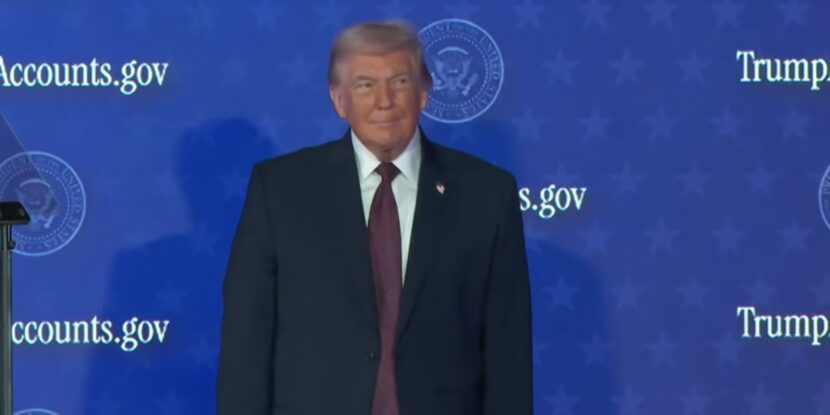
WHAT HAPPENED: President Donald J. Trump and his top economic and social policy officials rolled out the administration’s groundbreaking Trump Accounts during a major summit at the Andrew W. Mellon Auditorium in the heart of Washington, D.C.

👤WHO WAS INVOLVED: President Trump, Treasury Secretary Scott Bessent, Kevin O’Leary, Altimeter Capital CEO Brad Gerstner, several hundred attendees, and music industry superstar Nicki Minaj.

📍WHEN & WHERE: Wednesday, January 28, 2026, at the Andrew W. Mellon Auditorium in Washington, D.C.

💬KEY QUOTE: “Perhaps no other provision of the Great Big Beautiful Bill will prove more consequential than Trump Accounts.” — President Trump

🎯IMPACT: A Trump Account opened with $1,000 in federal seed money in 2026 will reach $5,800 by age 18 and $18,100 by age 28. However, families who contribute the maximum $5,000 annually will see the accounts reach an estimated $303,800 by age 18 and $1,091,900 by age 28—assuming contributions continue through age 18 and the account is converted to an IRA.

IN FULL

President Donald J. Trump and his top economic and social policy officials rolled out the administration’s groundbreaking Trump Accounts on Wednesday during a major summit at the Andrew W. Mellon Auditorium in the heart of Washington, D.C. The event was opened by Treasury Secretary Scott Bessent, who stressed that the new investment accounts are a “down payment on the American dream” aimed at “creating an ownership economy.”

According to Secretary Bessent, “Trump Accounts are not a government program. They are a radically new platform that returns us to a social contract anchored in individual ownership where everyone starts life on an investing journey.”

Under the One Big Beautiful Bill Act, signed into law by President Trump last July, American newborns are eligible to receive $1,000 from the U.S. government starting July 4, 2026, through 2028. The seed money will be deposited into what the White House states is “a 530A account, a tax‑advantaged investment account for children under 18 that works similarly to a traditional IRA.”

“Perhaps no other provision of the Great Big Beautiful Bill will prove more consequential than Trump Accounts,” President Trump said on Wednesday, emphasizing that in the most likely cases, the accounts could grow to $200,000 or even $300,000 or more for each child. He added, “We had a great start to our economy, but this is blowing it away. We’re going to leave every child with real assets and a shot at real financial freedom.”

Notably, each account is established in the child’s name—though a parent or guardian will act as a custodian until the child reaches 18.

In essence, the accounts resemble a hybrid retirement account, but upon the age of 18, the account owner will be able to either continue investing into it or, at any point, use the money to attain key aspects of the American dream, like paying for college or as a down payment on a first home.

One of the fundamental advantages of the Trump Accounts is the power of compounding interest and the ability for employers and other institutions to make contributions to the accounts.

Kevin O’Leary, an investor and television personality, noted at the summit that the accounts allow employers to invest not just in their workers but also in their workers’ families.

Importantly, according to the White House, a Trump Account opened with only the $1,000 federal seed money in 2026 will reach $5,800 by age 18 and $18,100 by age 28.

However, families who contribute the maximum $5,000 annually will see the accounts reach an estimated $303,800 by age 18 and $1,091,900 by age 28—assuming contributions continue through age 18 and the account is converted to an IRA.

CEO of Altimeter Capital, Brad Gerstner, stressed that “We’re going to make every citizen a shareholder,” and that the accounts are an “antidote to socialism,” and counter to calls for the implementation of a Universal Basic Income (UBI).

Already a number of major U.S. corporations have pledged to contribute seed money to Trump Accounts for the children of their employees. Bank of America, JPMorgan Chase, and Steak n Shake have each pledged a $1,000 match for accounts belonging to the children of their employees born between 2025 and 2028.

Meanwhile, music industry mogul Nicki Minaj says she will contribute several hundred thousand dollars to create $1,000 matches for Trump Accounts belonging to the children of a portion of her fans.

Join Pulse+ to comment below, and receive exclusive e-mail analyses.

show less

show more

DATA: Trump’s Economy Outperforms Biden.

PULSE POINTS

WHAT HAPPENED: Newly released Census Bureau data shows all income groups in America advanced more during President Donald Trump’s first term than during the Biden government.

👤WHO WAS INVOLVED: Stephen Moore, The Heritage Foundation, President Donald J. Trump, and the Census Bureau.

📍WHEN & WHERE: Data presented in the Oval Office on Thursday, August 7, 2025.

💬KEY QUOTE: “Every income group did better under Trump than Biden — by a wide margin.” – Economist Stephen Moore

🎯IMPACT: The data highlights significant income inequality under Biden and reinforces Trump’s economic achievements.

IN FULL

Economic data compiled by the U.S. Census Bureau have revealed that President Donald J. Trump‘s Make America Great Again agenda spurred economic advancement across all income groups during his first term in office, outpacing the results under the former Biden government. The data was presented publicly for the first time on Thusday in the Oval Office by Stephen Moore, a senior visiting fellow in economics at The Heritage Foundation.

The data examines Americans as three distinct income groups: lower income (bottom 25 percent of earners), middle income (middle 50 percent), and upper income (top 25 percent). “What I find fascinating about this, Mr. President, is every income group did better,” said Moore, adding: “The rich were the only group that did better under Biden, which is ironic because Biden keeps saying he was trying to get rid of income inequality. He made income inequality worse, not better. It was President Trump that reduced income inequality.”

Moore broke the data down in terms of dollars, as well. The lower third income bracket saw an estimated annual revenue gain of $4,000 during Trump’s first term. Similarly, the middle third of earners saw a $6,400 increase in income. Meanwhile, the wealthiest third saw $10,000 more per year by the end of Trump’s first term.

According to Moore, Bureau of Labor Statistics (BLS) data suggests similar economic effects are already underway in Trump’s second term. The BLS data shows that in the first five months of Trump’s second term, the average household’s income increased by an inflation-adjusted $1,174.

Join Pulse+ to comment below, and receive exclusive e-mail analyses.

show less
show more

Biden-Harris’s Own Data Shows Families Better Off Under Trump.

U.S. Census Bureau data shows the average American family was better off economically when former President Donald J. Trump was in the White House. The government agency data reveals that in 2019 the median household income was $81,210. Meanwhile, in 2023—under Joe Biden and Kamala Harris—household median income dropped to $80,610.

Additionally, while the data shows household income across most demographics recovering post-COVID-19 pandemic, this is not the case for Asian and Hispanic Americans. This may, in part, explain the accelerated shift of Hispanic and Latino voters away from the Democratic Party and towards former President Trump.

Under Trump’s White House, household incomes increased markedly for all racial and ethnic demographics until the pandemic.

The National Pulse has previously reported that the inflation crisis kicked off by Biden andHarris’s reckless spending policies drastically increased the income level needed to maintain a satisfactory quality of life for a family of four in the U.S. An inability by the Federal Reserve to reign in the crisis resulted in interest rates remaining significantly elevated in the country for well over a year—restricting business access to capital and making loans, such as mortgages, prohibitively expensive for most Americans.

Even more concerning, the Biden-Harris government’s Bureau of Labor Statistics now admits nearly one million fewer jobs than initially reported were added to the U.S. economy over the past year. This news has raised concerns about a significant slowing in the labor market, prompting the Federal Reserve to consider cutting interest rates later this month despite not having inflation under control.

show less
U.S. Census Bureau data shows the average American family was better off economically when former President Donald J. Trump was in the White House. The government agency data reveals that in 2019 the median household income was $81,210. Meanwhile, in 2023—under Joe Biden and Kamala Harris—household median income dropped to $80,610. show more