❓What Happened: The Senate approved a resolution to oppose President Donald J. Trump’s tariffs on Canadian imports, with the legislation aimed at repealing the emergency declaration permitting these trade levies.
👥 Who’s Involved: Senators Rand Paul (R-KY), Mitch McConnell (R-KY), Susan Collins (R-ME), and Lisa Murkowski (R-AK) joined with Senate Democrats to support the resolution, which is sponsored by Senator Tim Kaine (D-VA).
Newsletter
Need to Know.
Your free, daily feed from The National Pulse.
Thank You!
You are now subscribed to our newsletter.
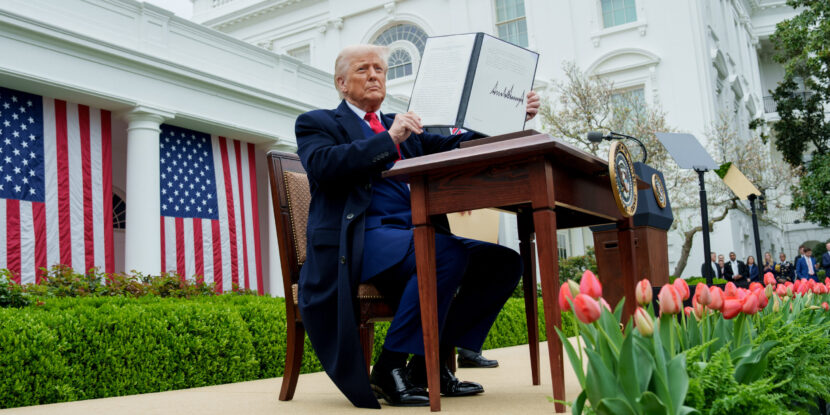
📍 Where & When: The Senate passed the measure on Wednesday following President Trump’s “Liberation Day” event at the White House Rose Garden, where he announced that substantial import duties would be imposed on foreign nations with high tariffs on U.S. exports.
💬 Key Quote: Senator Rand Paul stated, “Taxation without representation is tyranny,” characterizing tariffs as a form of taxation and arguing the Constitution forbids one person from enacting taxes.
⚠️ Impact: The resolution likely won’t advance in the GOP-controlled House.
IN FULL:
In a Senate session on Wednesday, a resolution challenging President Donald J. Trump’s tariffs on imports from Canada was advanced to the House of Representatives, with Senators approving the bill in a 51-48 vote. Introduced by Hillary Clinton’s former running mate, Senator Tim Kaine, the measure seeks to revoke the emergency declaration that sanctioned these tariffs by citing the influx of fentanyl across the border. This vote saw four Republican defections, with Sens. Rand Paul, Mitch McConnell, Susan Collins, and Lisa Murkowski joining the Democrat minority to pass the measure.
The resolution’s passage is arguably a symbolic win for Senate Democrats who have worked to derail President Trump’s America First trade agenda. However, while Democrats in the Senate were able to peel off just enough Republican votes to pass the anti-tariff resolution, it is unlikely to advance in the House, where Republican leaders will likely move to kill it before it can move to the floor for a vote.
“[W]e are here before the Senate because one person in our country wishes to raise taxes,” Sen. Paul argued in support of the Democratic resolution on the Senate floor late last night. “Well, this is contrary to everything our country was founded upon. One person is not allowed to raise taxes. The Constitution forbids it.”
“This is a tax, plain and simple,” he reiterated, adding: “Taxation without representation is tyranny.”
While tariffs can technically be categorized as a form of taxation, the import duties are not borne by American consumers for the most part. Instead, foreign companies impacted by tariffs will often absorb a significant portion of the import duty to preserve their market position—essentially opting to take a short-term revenue loss to ensure they maintain their consumer base for the long term.
It is also highly questionable to suggest that there is a lack of “representation” when an elected President with a mandate from the American people raises tariffs.
The Senate’s passage of the anti-tariff resolution came just hours after President Trump announced a 10 percent blanket tariff on all foreign imports and imposed additional, more targeted trade levies on a number of countries that have high tariffs on U.S. goods.
By Popular Demand.
The National Pulse Now has an on-site comments section for members. Sign up today and be part of the conversation in our community of almost 15,000.
More From The Pulse
WE ARE 100% INDEPENDENT AND READER-FUNDED. FOR A GUARANTEED AD-FREE EXPERIENCE AND TO SUPPORT REAL NEWS, PLEASE SIGN UP HERE, TODAY.
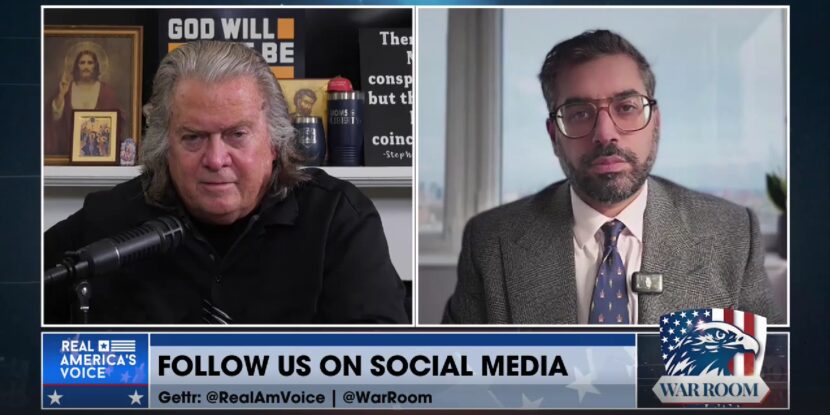
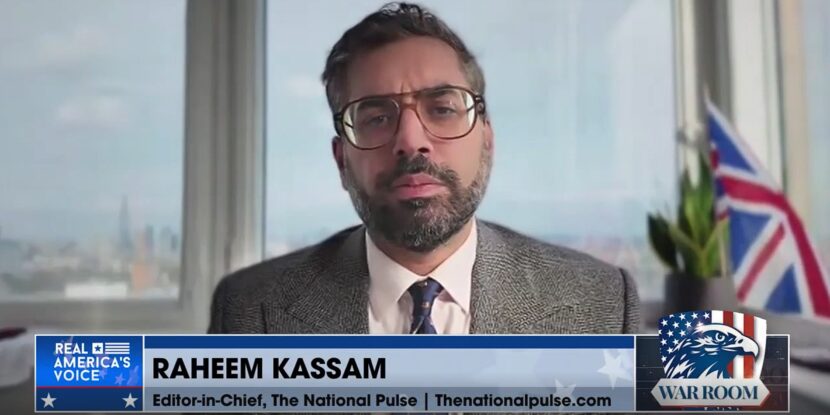
The National Pulse Editor-in-Chief Raheem Kassam has warned on Stephen K. Bannon’s War Room show that Britain is now struggling with a deeply embedded “fifth column,” arguing that mass migration, restrictions on speech, and a two-tier justice system have left many Britons afraid to openly challenge the transformation of their communities.
The National Pulse takes no handouts from billionaires or big business. If you want to keep radically independent reporting on the issues the corporate media refuses to cover alive, help support the work of Raheem J. Kassam and his team by JOINING PULSE+ or MAKING A DONATION.
Newsletter
Need to Know.
Your free, daily feed from The National Pulse.
Thank You!
You are now subscribed to our newsletter.
Kassam said there is “multi-tiered policing and multi-tiered justice going on in the United Kingdom,” adding that the issue extends beyond the preferential treatment of Islam and minorities to “how white people are being treated as second-class citizens in their own home nations at the moment.” Complaints against “two-tier policing” have become a growing political controversy in Britain in recent years.
Kassam argued that Britain’s speech laws also contribute to an atmosphere in which people think twice before discussing immigration, Islam, or some political leaders in a negative way. “It is one of the most stifling environments to speak that I’ve ever experienced,” he said, explaining that he is “certainly aware” that something he writes could potentially be construed in a way that results in criminal prosecution while he is in England.
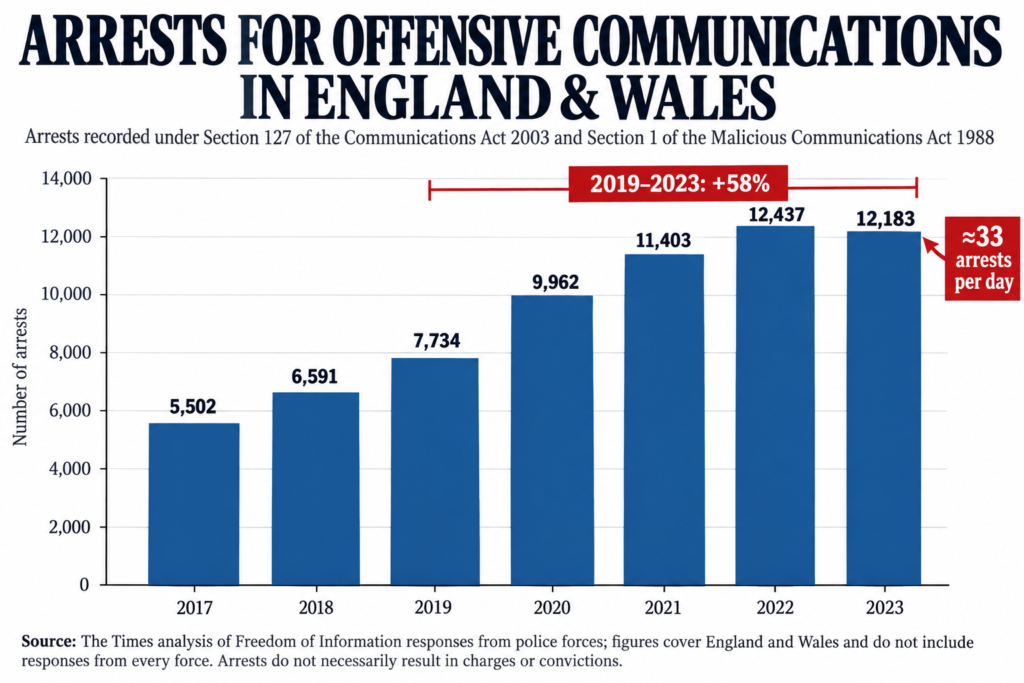
Those concerns exist against a real legal backdrop: Britain’s Malicious Communications Act and Communications Act criminalize certain communications deemed offensive. Freedom of Information data reported in 2025 indicated police were making more than 12,000 arrests annually under the two laws.
Britain has also established 150-meter “safe access zones” around abortion facilities where conduct intended or likely to influence someone accessing so-called abortion services can be criminalized. Significantly, government guidance says that, depending on the circumstances, this can include silently praying inside your head.
Kassam said the larger danger is what happens after alien communities become sufficiently entrenched that assimilation and political integration become increasingly difficult. “I think that there is a fifth column in this country, Steve, that we’re not allowed to talk about, we’re not allowed to mention,” he told Bannon.
Kassam connected that warning directly to his 2017 book No Go Zones, for which he traveled through immigrant-heavy neighborhoods in the likes of Britain, France, Belgium, Sweden, and later Dearborn and Hamtramck in Michigan. Recalling a warning he attributed to the late Christopher Hitchens, Kassam argued that “if you allow these people into your midst, this fifth column into your midst, it is incredibly difficult to cut that cancer out of your society once the roots have taken hold.”
FULL INTERVIEW:
You can support more exclusive work from Raheem J. Kassam and The National Pulse team by BECOMING A MEMBER or making a ONE-OFF DONATION.
Join Pulse+ to comment below, and receive exclusive e-mail analyses.
show less
The National Pulse Editor-in-Chief Raheem Kassam has warned on Stephen K. Bannon's War Room show that Britain is now struggling with a deeply embedded “fifth column,” arguing that mass migration, restrictions on speech, and a two-tier justice system have left many Britons afraid to openly challenge the transformation of their communities.
show more
By Popular Demand.
The National Pulse Now has an on-site comments section for members. Sign up today and be part of the conversation in our community of almost 15,000.
WE ARE 100% INDEPENDENT AND READER-FUNDED. FOR A GUARANTEED AD-FREE EXPERIENCE AND TO SUPPORT REAL NEWS, PLEASE SIGN UP HERE, TODAY.
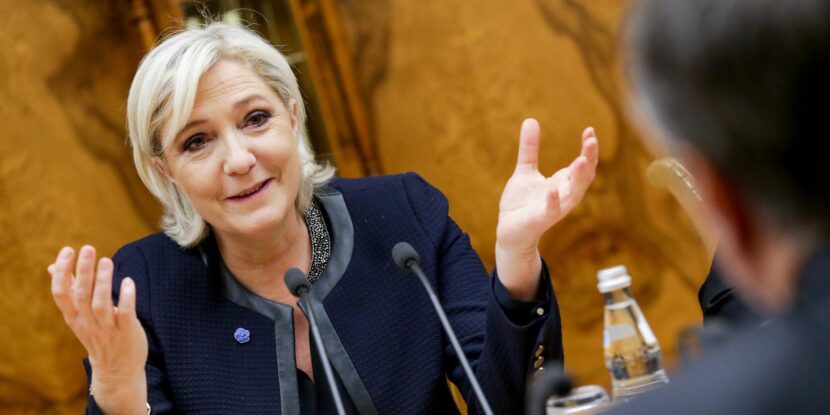
Marine Le Pen’s populist National Rally (RN) party has significantly increased its presence in the French Senate, winning enough seats to form a group for the first time in its history.
The National Pulse publishes original international analysis so you can navigate the political landscape worldwide. If you value this work, please JOIN THE NATIONAL PULSE or MAKE A DONATION today. We are 100% reader-funded.
Newsletter
Need to Know.
Your free, daily feed from The National Pulse.
Thank You!
You are now subscribed to our newsletter.
On Sunday, elections were held for the French Senate, the upper chamber of the French legislature. The results saw National Rally secure a record 14 seats, clearing the 10-seat threshold needed to form a Senate group, a formal association of senators with broadly similar political views. Several different parties can belong to the same group, allowing allied parties and independent senators to work together.
How Does the French Senate Work?
Unlike the Deputies elected to the French National Assembly—roughly equivalent to the House of Commons in Britain and the House of Representatives in the U.S.—who are elected directly by the French people, members of the French Senate are elected indirectly. Senators are chosen by approximately 172,600 “Grand Electors.” These electors make up the Electoral College. Municipal representatives account for around 95 percent of the Electoral College, although the body also includes regional councillors, departmental councillors, Deputies, and incumbent senators.
There are 348 senators in total, each serving a six-year term. The Senate is renewed by half every three years. In 2026, 178 seats were contested across 63 constituencies, including 58 metropolitan departments and overseas territories, and six seats representing French citizens living abroad.
Sénatoriales 2026 : la majorité de droite reste stable. Le RN obtient un groupe et LFI enregistre sa première entrée au Sénat. pic.twitter.com/z2VIwi4u2C
The French Senate makes, amends, and votes on legislation alongside the National Assembly, and also votes on and debates government policy. Unlike Deputies, who directly represent the French electorate, the Senate is constitutionally intended to represent the country’s municipalities, departments, and regions; the lower, intermediate, and upper levels of territorial government, respectively. However, unlike the U.S. Senate, which has equal legislative power with the House of Representatives, the French Senate is less powerful than the National Assembly, which can override the Senate to pass legislation. The French Senate does not approve Cabinet appointments, either, although it does participate in the impeachment process.
What Were the Results?
The establishment center-right Republicans group secured 125 seats, down six from the last election, while the establishment center-left Socialists group secured 63 seats, down one. The Centrists, another establishment-aligned grouping, secured 57 seats, down two. Horizons, another establishment center-right group aligned with presidential hopeful Edouard Phillipe, secured 21 seats, up one. Phillipe served as Prime Minister of France under President Emmanuel Macron, whose liberal Renaissance group secured 17 seats, down two. The Communists, the main far-left group in the Senate, secured 19 seats, up one. The National Rally secured 14 seats, more than doubling the ten it secured in the last election, representing the biggest gains of any contesting party. The party tied with the European Democratic and Social Rally Group (RDSE), another establishment centrist group, and the left-wing Greens group, down three and up two from the last election, respectively.
The National Pulse is RADICALLY INDEPENDENT. We rely on readers, not corporations, to fund our work. If you want to keep it that way, please JOIN THE NATIONAL PULSE or MAKE A DONATION today.
Why Does It Matter?
While group membership is not necessary to serve in the Senate, it is highly advantageous. Senate groups receive representation on parliamentary committees, speaking time, increased recognition, parliamentary funding, and other resources. Groups are also guaranteed the right to request parliamentary investigations. As such, the results have given the National Rally a boost ahead of next year’s presidential election, which Le Pen is projected to win against all potential rivals. “This is a historic victory, and a major milestone with the formation for the first time of a group in the Senate… The results have exceeded our expectations,” said the National Rally leader in a post on X (formerly Twitter) on Sunday.
C’est une victoire historique et une étape majeure qui est franchie avec la constitution pour la première fois d’un groupe au Sénat. Les résultats vont au-delà de ce que nous pouvions espérer, la percée est générale, confirmant l’accélération de l’implantation du Rassemblement…
The results demonstrate that National Rally is managing to build a significant network of municipal support, giving the party a long-term foothold in the French political system. Significantly, the Senate is almost designed to shut out parties like National Rally, and its gains signal it will perform even more strongly in the more powerful National Assembly, where it is already the single largest party, despite a joint effort by the establishment centrist and far-left blocs to prevent the party from gaining seats during the last legislative election in 2024.
Nigel Farage and Jordan Bardella have just signed a Memorandum of Understanding to stop the boats.
Reform UK and the National Rally will end the invasion of Britain and France together. 🤝 pic.twitter.com/18Z2ykBWH2
These election results come just weeks after Jordan Bardella, President of the National Rally and the current favorite to become France’s next Prime Minister under a Le Pen presidency, delivered a speech at the annual party conference of Nigel Farage’s Reform Party in Birmingham, England.
Bardella and Farage signed a “memorandum of understanding” to stop the boats that have been carrying thousands of illegalmigrants across the English Channel, and return them first to France and then their countries of origin. Bardella promised to ensure France is “no longer the gateway for illegal immigrants into the United Kingdom” and noted that sovereignty does not have to mean “standing alone” and “rejecting alliances.”
National Rally’s increased representation in the Senate can only increase the opportunities for long-term co-operation between Reform and the National Rally, which remains in a close contest with Britain’s governing Labor Party in the general election polls.
If you want to help Raheem J. Kassam and his team deliver high-quality analysis from around the world, please JOIN THE NATIONAL PULSE or MAKE A DONATION today.
Join Pulse+ to comment below, and receive exclusive e-mail analyses.
show less
Marine Le Pen's populist National Rally (RN) party has significantly increased its presence in the French Senate, winning enough seats to form a group for the first time in its history.show more
By Popular Demand.
The National Pulse Now has an on-site comments section for members. Sign up today and be part of the conversation in our community of almost 15,000.
WE ARE 100% INDEPENDENT AND READER-FUNDED. FOR A GUARANTEED AD-FREE EXPERIENCE AND TO SUPPORT REAL NEWS, PLEASE SIGN UP HERE, TODAY.
The British government is intentionally crushing the public under an avalanche of “petty indignities” so they are unable to push for broad national reforms, argued Raheem Kassam, Editor-in-Chief of The National Pulse, during a recent appearance on former White House Chief Strategist Stephen K. Bannon’s War Room show.
“How am I going to pay my gas bill? How am I going to pay my car insurance? What am I going to do when my mother or my father or my grandmother gets sick? … [I]t’s death by a thousand cuts, because then you can’t worry about anything outside of that. You can’t worry about what your community looks like. You can’t worry about three streets down, or three doors down even, from your own house. The entire ability to care about and curate your community, let alone your country, is ripped away from you with that particular tactic,” Kassam explained.
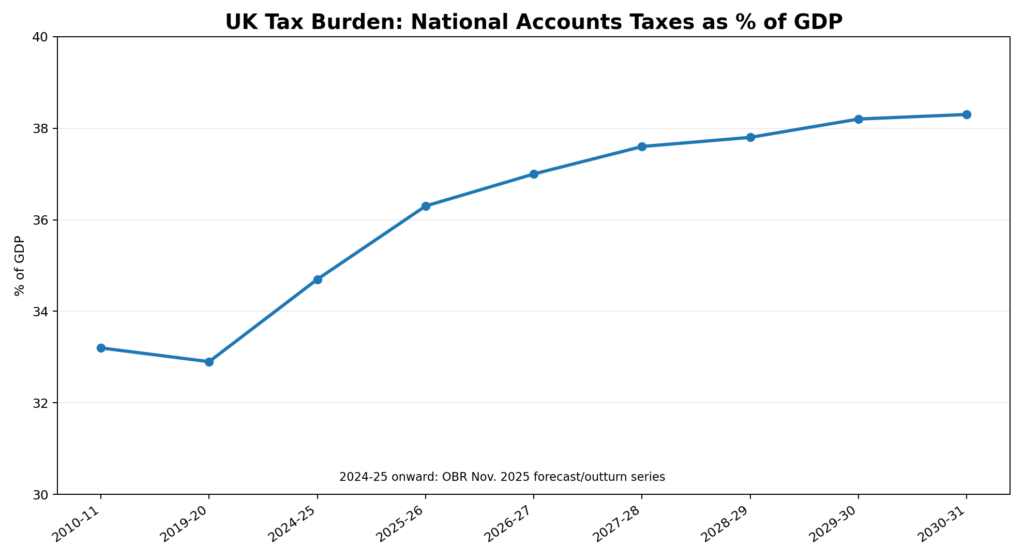
“The tax burden in this country is unbelievable. The levels of energy debt are unbelievable, through the roof, skyrocketing… Getting worse,” Kassam noted. Official statistics support the statement, with Britain’s Office for Budget Responsibility (OBR), a fiscal watchdog comparable to the U.S. Congressional Budget Office, having forecast that taxes will reach a post-war high of roughly 38 percent of economic output by 2030–31.
Frozen income tax thresholds are helping to drive that increase through a process of “fiscal drag.” This means that as wages rise, a larger share of earnings are becoming subject to higher tax rates, despite the value of those wages having falling due to inflation. For workers trying to cover ordinary expenses, this means their budgets are eroding via “stealth taxation,” without the government having to announce a controversial increase in headline income tax rates.
With respect to Kassam’s warning on energy bills, Ofgem, Britain’s energy regulator, has pushed average July–September 2026 rates on covered household tariffs to the equivalent of approximately 35 U.S. cents per kilowatt-hour of electricity and 10 cents per kilowatt-hour of natural gas. Significantly, the regulator’s typical annual household price-cap figure, equivalent to $2,463, is a benchmark based on assumed usage, not a limit on what every household can spend. The rises are being driven chiefly by higher wholesale gas prices, caused by the Ukraine war, the Iran war, and the sabotage of the domestic North Sea oil and gas industry by the incumbent Labour Party and previous Conservative Party governments.
The Labour government is currently pressing ahead with its Clean Power 2030 program. Taxpayers are already subsidizing some so-called green energy, with approximately $689 million spent through June 2026 under the Renewables Obligation to Exchequer scheme, which shifts part of the cost of green energy subsidies from energy bills to public finances. Crucially, this shift can lower the charge visible on a household bill, but still leave the public covering the cost via taxation.
Join Pulse+ to comment below, and receive exclusive e-mail analyses.
show less
The British government is intentionally crushing the public under an avalanche of "petty indignities" so they are unable to push for broad national reforms, argued Raheem Kassam, Editor-in-Chief of The National Pulse, during a recent appearance on former White House Chief Strategist Stephen K. Bannon's War Room show.
show more
By Popular Demand.
The National Pulse Now has an on-site comments section for members. Sign up today and be part of the conversation in our community of almost 15,000.
WE ARE 100% INDEPENDENT AND READER-FUNDED. FOR A GUARANTEED AD-FREE EXPERIENCE AND TO SUPPORT REAL NEWS, PLEASE SIGN UP HERE, TODAY.
Over the weekend, it was revealed that a former personal bodyguard to slain Hamas leader Ismail Haniyeh received first asylum and then full British citizenship under Britain’s former Conservative (Tory) government. He allegedly went on to plot terrorist attacks against Jews and Israeli-linked targets in Europe from the English suburbs. Much of the media coverage of the scandal has focused on the courts’ decision to protect the identity of this “Mr. X”—identified as “Mohammed A.,” the son of Hamas politburo member Basem Naim, by the German press—for 100 years.
Less attention has been paid to the politicians who were in charge in the British government when it waved through a Hamas operative’s asylum and citizenship applications, or the fact that both of them are still members of Conservative leader Olukemi “Kemi” Badenoch’s top team.
Newsletter
Need to Know.
Your free, daily feed from The National Pulse.
Thank You!
You are now subscribed to our newsletter.
The National Pulse exposes the politicians behind the policies to give you real insight into the people responsible for the state of things. If you want to help Raheem J. Kassam and his team hold these politicians to account, please JOIN THE NATIONAL PULSE or MAKE A DONATION today. We are 100% reader-funded.
The Same Old Faces.
Then-Prime Minister Theresa May’s special adviser on counter-terrorism at the time was, as noted by Reform Party leader Nigel Farage on Monday morning, Nick Timothy, now a Conservative Member of Parliament (MP) “recently promoted by Kemi Badenoch with a shadow justice brief.” Timothy was responsible for developing Conservative policy on police reform, criminal justice, and immigration up to 2015, when “Mr. X” first received asylum.
“You simply cannot make it up,” Farage said.
.@EllieHodgesxx and I discuss the story of the Hamas operative living in England since 2015.
Chris Philp, the Shadow Home Secretary tasked by Badenoch with representing the Conservatives’ position on the scandal, has blamed the European Convention on Human Rights (ECHR), which continues to bind the United Kingdom to the jurisdiction of the European Court of Human Rights despite Brexit, for the Conservatives’ supposed inability to turn away “Mr. X.”
“There’s nothing any government can do about it, and that is precisely why we need to dismantle the entire legal system, come out of the ECHR,” he told Comcast’s Sky News.
The problem is that not only did the Conservatives make no moves to leave the ECHR during their 14 years in government from 2010 to 2024, but Philp personally voted against amendments to a Conservative bill aimed at facilitating deportations to Rwanda, which in the end never went ahead, besides four people leaving voluntarily in exchange for £3,000 (~$4,000) each. Crucially, these amendments would have stopped the ECHR from being used to block removals. Yet, far from expressing concerns that the ECHR could be used to thwart the Rwanda plan, he was frequently deployed to the media to defend the watered-down policy as a junior Home Office minister, just as he claims to oppose the ECHR in the media today.
Examining the parliamentary record, The National Pulse has found Philp in 2021, as an even more junior Home Office minister, declaring that “the United Kingdom has been a beacon of human rights for many centuries now and we intend to honour our ECHR obligations”—hardly the words of a determined opponent of the Convention.
You’ve probably seen the Hamas chief story today. But what you might not know is how this kind of person ever got asylum and citizenship in Britain.
Not only was it under the Tories, but it was the 2 most senior Tories Kemi Badenoch just put in charge of the Justice and Home… pic.twitter.com/6Yb93untkD
Badenoch, who gained British citizenship as a result of her Nigerian mother traveling to London to give birth in 1980, shortly before changes to citizenship law ended automatic citizenship by right of birth on British soil, served in the Conservative governments of Boris Johnson, Liz Truss, and Rishi Sunak, until the party’s crushing defeat in the 2024 general election.
Despite efforts to present her as a no-nonsense, anti-woke politician who just happened to serve in governments that increased immigration to its highest levels in history, her personal record on immigration is clear. In 2022, she thanked then-Home Secretary Sajid Javid in the House of Commons for lifting caps on migrant workers and foreign students, boasting that she had lobbied for the changes.
She also boasted about achieving record ethnic minority recruitment into the police and the magistracy in an ‘Inclusive Britain’ report in 2023, when she served as Minister for Equalities, and celebrated the ouster of former Hungarian Prime Minister Viktor Orbán—likely Europe’s strongest leader on illegal immigration, as well as one of Britain’s few friends in Europe during Brexit.
The question facing right-leaning British voters in 2029—possibly much sooner, should Prime Minister Andy Burnham call an early election—is clear: Why should they trust a center-left Conservative Party masquerading as center-right on the ECHR and immigration, when it not only presided over the naturalization of a Hamas operative and unprecedented mass migration, but still has the same personnel who enabled or defended those catastrophes at the top of their party totem pole today?
Join Pulse+ to comment below, and receive exclusive e-mail analyses.
show less
Over the weekend, it was revealed that a former personal bodyguard to slain Hamas leader Ismail Haniyeh received first asylum and then full British citizenship under Britain's former Conservative (Tory) government. He allegedly went on to plot terrorist attacks against Jews and Israeli-linked targets in Europe from the English suburbs. Much of the media coverage of the scandal has focused on the courts' decision to protect the identity of this "Mr. X"—identified as "Mohammed A.," the son of Hamas politburo member Basem Naim, by the German press—for 100 years.
show more
By Popular Demand.
The National Pulse Now has an on-site comments section for members. Sign up today and be part of the conversation in our community of almost 15,000.
WE ARE 100% INDEPENDENT AND READER-FUNDED. FOR A GUARANTEED AD-FREE EXPERIENCE AND TO SUPPORT REAL NEWS, PLEASE SIGN UP HERE, TODAY.
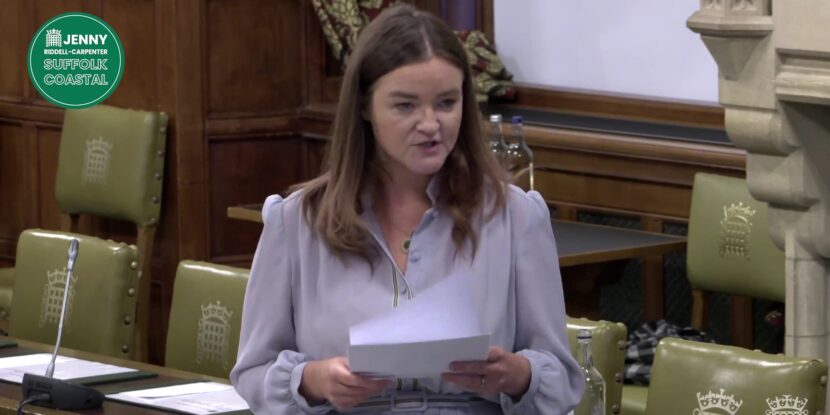
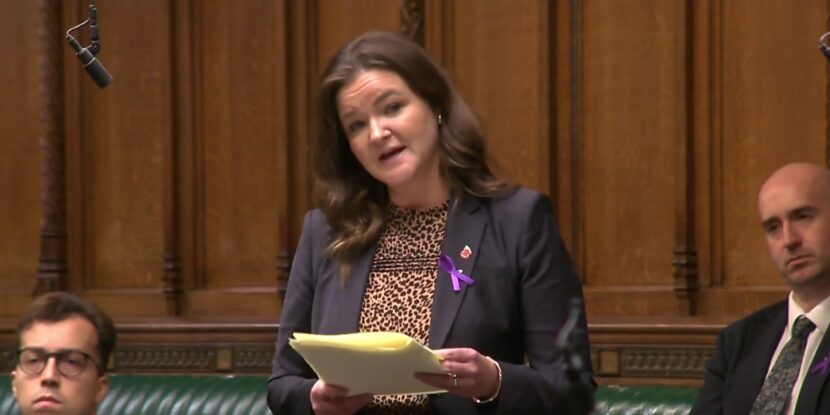
Jenny Riddell-Carpenter, Britain’s Parliamentary Under-Secretary of State for Nature, spent Labour’s party conference warning comrades that a countryside of “warm ale [and] a black Labrador by your feet in a pub” is supposedly a “very far-right nostalgic vision of Britain that we don’t want to have, and never really existed.” The Member of Parliament for England’s Suffolk Coast, a seat of farms, coastal towns, and village pubs, said this vision of the countryside kept her “awake at night,” and must be swept aside in favor of Labour’s “progressive vision” for rural Britain. The National Pulse can now reveal that, in addition to disdaining traditional countryside life, she has said on multiple occasions that she wishes she was not English at all.
The National Pulse researches original political profiles that reveal what the people in power really think. If you want to support this work, please JOIN THE NATIONAL PULSE or MAKE A DONATION today. We are 100% reader-funded.
Newsletter
Need to Know.
Your free, daily feed from The National Pulse.
Thank You!
You are now subscribed to our newsletter.
The Posts.
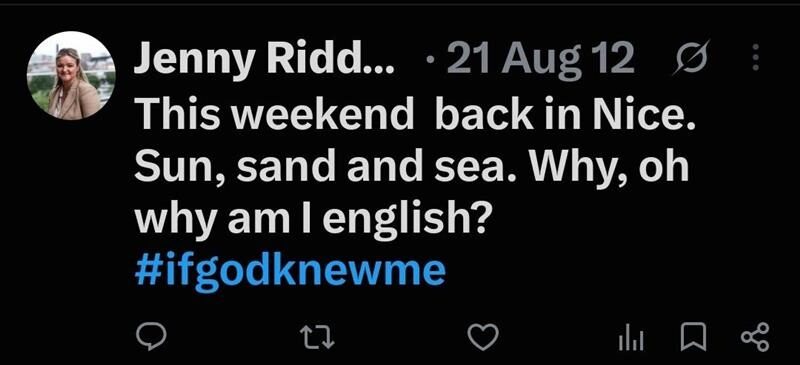
Riddell-Carpenter first expressed her displeasure at being English in August 2012, a few years after she graduated with a master’s degree in Islamic History from the infamously woke SOAS University of London, formerly the School of Oriental and African Studies. Writing about a trip to the French Riviera on Twitter (now X), she said:
“This weekend back in Nice. Sun, sand and sea. Why, oh why am I english? #ifgodknewme”
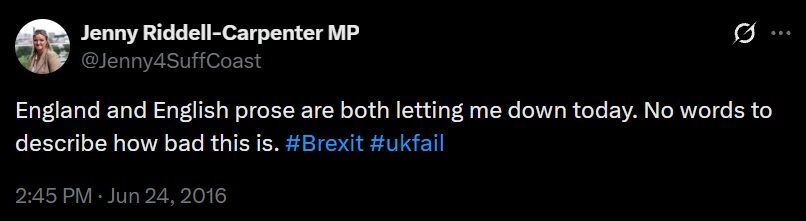
These feelings intensified in 2016, when the United Kingdom voted to leave the European Union, with majorities in England and Wales supporting Brexit while most Scots and Northern Irish voted to remain in the bloc. Writing one day after the referendum, she said:
“England and English prose are both letting me down today. No words to describe how bad this is. #Brexit #ukfail”
Two days later, she again wrote that she wished she wasn’t English, saying:
“My god. I really want to be Scottish. The English just don’t get it. It’s so shameful. #bbcqt #ScotlandinEurope”
“I’m currently searching jobs in scotland. It’s happening. #Brexit #ScotlandinEurope”
And a little later, on the prospect of defecting to Scotland in the event of the country leaving the United Kingdom to rejoin the European Union, she said:
“I’m there! Brexit result has made Scottish independence inevitable. And I want in.”
The National Pulse relies on readers to fund these deep dives. If you want to keep this reporting RADICALLY INDEPENDENT, please JOIN THE NATIONAL PULSE or MAKE A DONATION today.
Representing Rural Voices?
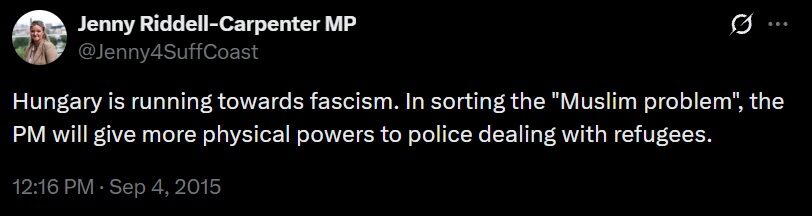
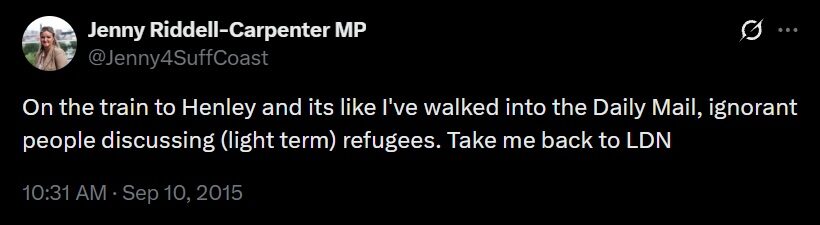
The National Pulse previously reported on Riddell-Carter spending 2015 praising Angela Merkel’s mass importation of migrants, saying she “Wish[ed] the British had as warm hearts and open arms” towards migrants as the Germans. She also called then-Hungarian Prime Minister Viktor Orbán’s border controls a lurch toward “fascism,” and sneered at train passengers en route to the English market town of Henley she overheard talking about the migrant crisis, writing, “Take me back to [London].”
In 2025, she said that “rural areas have been left behind” and are “frequently misunderstood,” and promised to “ensure rural voices are no longer ignored and that our rural communities are at the centre of national conversations about growth, opportunity, and our country’s future.”
However, her dismissal of traditional countryside life as a “far-right” fantasy, alongside her stated preference for multicultural London and embarrassment at her English background, will cause many in those left-behind communities to doubt she has their best interests at heart.
Join Pulse+ to comment below, and receive exclusive e-mail analyses.
show less
Jenny Riddell-Carpenter, Britain's Parliamentary Under-Secretary of State for Nature, spent Labour’s party conference warning comrades that a countryside of “warm ale [and] a black Labrador by your feet in a pub” is supposedly a “very far-right nostalgic vision of Britain that we don’t want to have, and never really existed.” The Member of Parliament for England's Suffolk Coast, a seat of farms, coastal towns, and village pubs, said this vision of the countryside kept her "awake at night," and must be swept aside in favor of Labour's "progressive vision" for rural Britain. The National Pulse can now reveal that, in addition to disdaining traditional countryside life, she has said on multiple occasions that she wishes she was not English at all.
show more
By Popular Demand.
The National Pulse Now has an on-site comments section for members. Sign up today and be part of the conversation in our community of almost 15,000.
WE ARE 100% INDEPENDENT AND READER-FUNDED. FOR A GUARANTEED AD-FREE EXPERIENCE AND TO SUPPORT REAL NEWS, PLEASE SIGN UP HERE, TODAY.
Jenny Riddell-Carpenter, the Parliamentary Under-Secretary of State for Nature under British Prime Minister Andy Burnham, told a fringe meeting at the ruling Labour Party’s ongoing annual conference in Liverpool that a rural Britain of warm ale, pubs, and a dog at your feet is a terrifying and “very far-Right nostalgic vision” that “never really existed.”
The National Pulse publishes original political profiles that expose what people in power really believe. If you value this work, please JOIN THE NATIONAL PULSE or MAKE A DONATION today. We are 100% reader-funded.
Newsletter
Need to Know.
Your free, daily feed from The National Pulse.
Thank You!
You are now subscribed to our newsletter.
Riddell-Carpenter told Labour comrades that lies “awake at night” in “fear” that if her party cannot impose its “progressive vision for the countryside,” it will ber overtaken by a vision of “warm ale, a black Labrador by your feet in a pub that doesn’t exist, and with symbolism of fox hunting all around… a very far-right nostalgic vision of Britain that we don’t want to have, [and] never really existed.”
The School of Oriental and African Studies graduate said this as Member of Parliament (MP) for Suffolk Coastal, a rural East Anglian constituency (electoral district) comprised of farms, coastal towns, and village pubs. Official figures from the 2021 Census put about 9.5 million people in Britain’s rural settlements, and the Labrador was Britain’s most registered breed last year, suggesting that Englishmen enjoying pints in the pub with black labs by their side are more real than Riddell-Carpenter would like to believe.
These are the comments of Jenny Riddell-Carpenter, who studied at the far left SOAS in London.
She did a BA in History and Politics, completed in 2008, then an MA in Islamic History 👀 https://t.co/FkdpOrAtLE
Riddell-Carpenter has an unusual background for a woman representing a rural constituency. Privately-educated, she previously worked in public relations and housing, and now chairs the Labour Rural Research Group. However, she attended SOAS University of London, formerly the School of Oriental and African Studies, earning a master’s degree not in anything related to the countryside but in Islamic History.
SOAS is a specialist college focused on Africa, Asia, and the Middle East, and one of the most notoriously politicized campuses in Britain. In 2005, its student union became the first in Britain to commit to the Boycott, Divestment, and Sanctions (BDS) campaign against Israel. Riddell-Carpenter completed both of her SOAS degrees in the years that followed. Critics have long called SOAS the “School of Antisemitism,” with Jewish students having reported being too frightened to wear a Star of David or speak Hebrew on campus.
In 2020, the university refunded a student £15,000 in fees after he said a “toxic antisemitic environment” forced him off his course. A 2019 Henry Jackson Society report found SOAS hosted more Islamic hate preachers than any other British university. After the October 7th, 2023, Hamas attacks, the campus became a focal point for Gaza encampments and related disciplinary fights.
The National Pulse relies on readers, not corporate interests, to fund our work. If you want to keep it RADICALLY INDEPENDENT, please JOIN THE NATIONAL PULSE or MAKE A DONATION today.
Social Media.
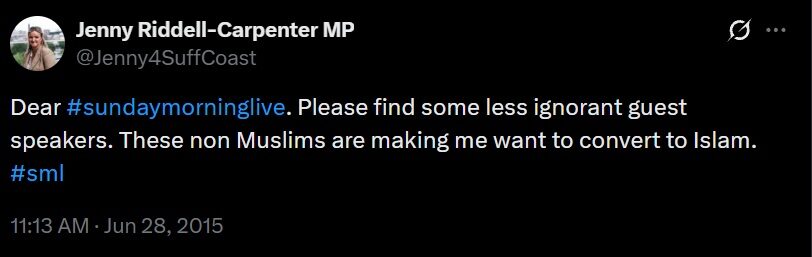
Riddell-Carpenter’s affinity with Islam is reflected in her social media history. On her X (formerly Twitter) account, abandoned after Labour entered government due to “abuse aimed at MPs,” she was quick to reframe Islam as peaceful following the Charlie Hebdo massacre in January 2015, writing, “Thoughts with France tonight. Freedom of speech and press a shared corner stone [sic] of our societies. As peace is to Islam #CharlieHebdo”.
In June the same year, she tweeted a complaint about “ignorant guest speakers” discussing Islam, writing, “These non Muslims are making me want to convert to Islam. ”
Europe’s migrant crisis peaked also peaked in 2015, with Germany under Angela Merkel becoming the primary but not the only destination of millions of mostly Muslim migrants. Riddell-Carpenter cheered the process on throughout the month of September, while lashing out those who were uneasy with the experiment.
September 3rd, 2015:
“Best news of my day: [British Prime Minister David] Cameron bows to pressure to allow more Syrian refugees into Britain.”
September 4th, 2015:
“Hungary is running towards fascism. In sorting the ‘Muslim problem’, the [Prime Minister, Viktor Orbán] will give more physical powers to police dealing with refugees. [Referring to Hungary moving to close its borders to illegal immigrants en route to Western Europe.]
September 7, 2015:
“Wow. Watching the response of Germans towards refugees in Munich is heart warming. Wish the British had as warm hearts and open arms.”
The same day:
“Surprised that Syrian refugees have smartphones? Sorry to break this to you, but you’re an idiot.”
September 10, 2015:
“On the train to Henley and its like I’ve walked into the Daily Mail, ignorant people discussing (light term) refugees. Take me back to [London].”
Riddell’s evident contempt for “ignorant” train passengers discussing the migrant crisis en route to Henley-on-Thames, a small English market town surrounded by countryside, and her preference for the multicultural metropolis of London will appear to many to be a particularly strong indicator of her true feelings about a rural Britain she would prefer not to exist, and of her suitability to be a leading voice in government on rural affairs.
If you want to help Raheem J. Kassam and his team uncover the real views of the people in government, please JOIN THE NATIONAL PULSE or MAKE A DONATION today.
Join Pulse+ to comment below, and receive exclusive e-mail analyses.
show less
Jenny Riddell-Carpenter, the Parliamentary Under-Secretary of State for Nature under British Prime Minister Andy Burnham, told a fringe meeting at the ruling Labour Party's ongoing annual conference in Liverpool that a rural Britain of warm ale, pubs, and a dog at your feet is a terrifying and “very far-Right nostalgic vision” that “never really existed.”
show more
By Popular Demand.
The National Pulse Now has an on-site comments section for members. Sign up today and be part of the conversation in our community of almost 15,000.
WE ARE 100% INDEPENDENT AND READER-FUNDED. FOR A GUARANTEED AD-FREE EXPERIENCE AND TO SUPPORT REAL NEWS, PLEASE SIGN UP HERE, TODAY.
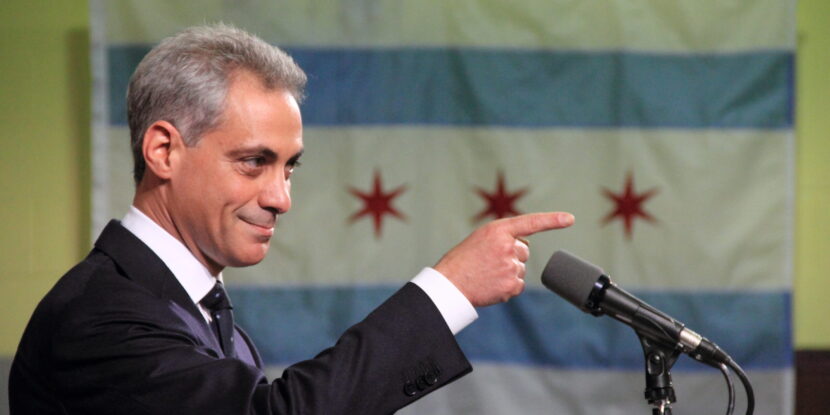
Rahm Emanuel has been a former advisor to the Bill Clinton White House, a Democrat Congressman for Illinois, President Barack Obama’s Chief of Staff, a two-term Chicago Mayor, and President Joe Biden’s ambassador to Japan. In the last three decades, he has not been outside the halls of power, most recently strongly hinting at a run for the Democratic presidential nomination for the 2028 election.
The National Pulse publishes original political profiles and analysis so you can navigate the news with confidence. If you value this work, please JOIN THE NATIONAL PULSE or MAKE A DONATION today. We are 100% reader-funded.
Newsletter
Need to Know.
Your free, daily feed from The National Pulse.
Thank You!
You are now subscribed to our newsletter.
In a September interview with Rolling Stone, Emanuel said he was “more yes than no” about a potential 2028 presidential run, and has spent just over a year laying the groundwork with podcast appearances on shows like Honestly with CBS News head Bari Weiss and The New Yorker Radio Hour. He has also published several policy papers over the last year, including one suggesting age limits for political office and banning children under 16 from social media.
Polling, however, shows Emanuel is far from the favorite among Democrats. Raheem Kassam, Editor-in-Chief of The National Pulse, has previously suggested an ulterior motive for his shadow campaign: Not to win the nomination, but to secure another top spot in the next Democratic presidential regime, possibly as Vice President.
Rahm Emanuel is taking a real run at this thing.
Does he think he can be President? Probably not.
But does he think if he's on that debate stage he gets the call for VP?
Unlike many of the more popular socialist contenders for the Democrat leadership, such as New York Mayor Zohran Mamdani or Rep. Alexandria Ocasio-Cortez (D-NY), Emanuel has never shied away from corporate America, having banked over $18 million in just three years as a Wall Street investment banker after leaving the Clinton administration.
In 2001, after serving as a Clinton White House advisor from 1993 to 1998 and making his millions, Emanuel ran for Congress, winning a seat and representing Illinois from 2002 to 2009, when he went to work as Chief of Staff to President Barack Obama. While serving only part of the administration for 20 months, Emanuel represented the corporate-friendly wing of the Democratic Party, urging Obama not to include a public option in Obamacare, another policy that put him severely at odds with popular socialist Democrats.
However, the most high-profile controversy of Emanuel’s Obama years was a corruption case against Illinois Governor Rod Blagojevich, who was accused of trying to sell Obama’s former Illinois Senate seat. Emanuel was in contact with Gov. Blagojevich at the time, although was never charged with any wrongdoing, and newlyunsealed FBI files released this month show that Obama was aware of Emanuel and Blagojevich discussing giving the seat to Illinois Attorney General Lisa Madigan. According to Blagojevich, this was in exchange for her father, then Illinois House Speaker, supporting his budget and healthcare package. As a result of the scandal, Blagojevich served seven years and 11 months in prison, until he was pardoned by President Donald J. Trump in 2025.
The Chicago Machine.
Following the Blagojevich affair, Emanuel sought and won the Chicago mayoral race in 2011, serving two terms as the mayor of America’s “homicide capital.” Under Emanuel, there were 19,000 shootings, 4,000 murders, and an average of 541 murders per year from 2011 to September 2018. This was up from an average of 463 murders the year prior to him taking office.
The fatal shooting of 17-year-old black teen Laquan McDonald in 2014 by Chicago police was Emanuel’s most high-profile scandal after the city refused to release dashcam footage of the incident for over a year. The video did not get a public release until a judge ordered it in November of 2015. McDonald had been shot 16 times by police, with the city agreeing to a $5 million settlement with his family shortly before the footage emerged.
The New York Times labeled the affair a “cover-up” in 2015. The Chicago Sun-Times also noted in a 2020 report that Emanuel conveniently agreed to the settlement a week after the April 2015 mayoral runoff, and approved it before any lawsuit had even been filed.
The National Pulse is RADICALLY INDEPENDENT. We rely on readers, not corporate interests, to fund our work. If you want to keep it that way, please JOIN THE NATIONAL PULSE or MAKE A DONATION today.
The Biden Years.
The McDonald case may have influenced Emanuel’s shock announcement in 2018 that he was not running for a third term as Chicago Mayor. However, after a few years out of the political spotlight, Emanuel was selected by President Joe Biden to serve as the U.S. Ambassador to Japan in 2021. Shortly before his tenure as ambassador, The National Pulse revealed that Emanuel was a headline speaker at a China-friendly conference sponsored by groups linked to the Chinese Communist Party (CCP) in 2013, while he was still running Chicago.
In 2025, Emanuel ended his term as ambassador and now seems to have his sights set on the presidency, with longtime Democrats like Nancy Pelosi expecting him to run. Nationwide polling, however, often does not even list Emanuel because his numbers are so low. In an Echelon Insights poll released this month, his name is listed with less than one percent of the vote.
So the question remains: Why is Emanuel running? It seems most likely that he will use the nomination debates and the primary system to secure a higher profile and reenter the political machine he has inhabited for decades. His past shows the interests he represents are likely completely at odds with the ascendant, progressive wing of the party, but his alignment with Wall Street, big business, international corporations, and possibly even the Chinese Communist Party may yet see him secure significant backing.
If you want to help Raheem J. Kassam and his team expose the machine politicians, their power plays, and the networks behind them, please JOIN THE NATIONAL PULSE or MAKE A DONATION today.
Join Pulse+ to comment below, and receive exclusive e-mail analyses.
show less
Rahm Emanuel has been a former advisor to the Bill Clinton White House, a Democrat Congressman for Illinois, President Barack Obama's Chief of Staff, a two-term Chicago Mayor, and President Joe Biden's ambassador to Japan. In the last three decades, he has not been outside the halls of power, most recently strongly hinting at a run for the Democratic presidential nomination for the 2028 election.
show more
By Popular Demand.
The National Pulse Now has an on-site comments section for members. Sign up today and be part of the conversation in our community of almost 15,000.
WE ARE 100% INDEPENDENT AND READER-FUNDED. FOR A GUARANTEED AD-FREE EXPERIENCE AND TO SUPPORT REAL NEWS, PLEASE SIGN UP HERE, TODAY.
Last week at the United Nations General Assembly, Prime Minister Andy Burnham announced that the British government would be launching a National Centre for Information Defence. “Russian agencies,” he told delegates, were using “every means at their disposal to spread lies and disinformation and prey on people’s fears.” He was less clear about the content of this disinformation, but he did complain that the Russians had “amplified far right narratives” and “tried to stoke tensions and unrest in the wake of horrific events.”
WE ARE 100% INDEPENDENT AND READER-FUNDED. If you want more of this kind of original political analysis unpacking how the deep state was built, please JOIN THE NATIONAL PULSE or MAKE A DONATION today.
Most listeners were left in little doubt as to “disinformation” the Prime Minister wants to crack down on: criticism of mass migration, state-sponsored diversity, equity, and inclusion, and lax border controls and vetting, particularly following high-profile sexual, violent, and terroristic crimes involving migrants or their children. Zia Yusuf, Shadow Home Secretary for Nigel Farage’s Reform Party, asked a former Labour advisor following Burnham’s speech what the public “believe about Britain and are angry about that is not true and is a result of Vladimir Putin’s disinformation.”
Newsletter
Need to Know.
Your free, daily feed from The National Pulse.
Thank You!
You are now subscribed to our newsletter.
No answer came. Still, despite establishment political parties across Britain, America, and the wider West focusing on the Kremlin as the cause of all their troubles from the Brexit referendum and Donald Trump’s victory over Hillary Clinton onwards, Burnham insisted that the supposed issue is one that “We have tiptoed around for too long.”
Burnham’s claim is wrong not just rhetorically, but structurally. His new National Centre for Information Defence, denounced as an Orwellian “Ministry of Truth to clamp down on free speech” by Nigel Farage, will not be the first or even the second of its kind, but only the latest arm in what has become a sprawling censorship regime.
How the Machine was Built.
2007 — RICU
Established in 2007, the Research, Information and Communications Unit (RICU), often referred to as the “Nudge Unit,” is arguably the British government’s most infamous counter-disinformation and public influence agency.
It was built inside the Home Office, roughly equivalent to the U.S. Department of Homeland Security, by former MI6 officer Charles Farr as part of the controversial Prevent counter-terrorism program, on the model of the Cold War Information Research Department. Internal papers describe its goal as “attitudinal and behavioural change.” Often operating through astroturfed campaigns masquerading as organic community groups, RICU’s original goal was to stop al-Qaeda from spreading Islamist ideology among British Muslims.
However, a government-commissioned review of Prevent published in 2023 found it had soon drifted into targeting the comparably minor threat of the “extreme right,” setting the the bar for what should be regarded as Islamism very high and the bar for supposed right-wing extremism “comparably low.” For instance, it has concerned itself with supporters of elected politicians like Nigel Farage, and flagged supposedly extremist “gateway” literature such as the works of J.R.R. Tolkien, C.S. Lewis, and, ironically, George Orwell.
RICU is best known for its involvement and suspected involvement in efforts to guide public sentiments following high-profile migrant crimes and terror attacks, with sources speaking to the British press describing how it was “working with the Police Service of Northern Ireland’s C3 intelligence unit to identify those posting the online ‘calls to protest’ in Belfast and other areas” after a man’s attempting beheading on the streets of the Northern Irish capital, with a focus on “giving strategic messages to the police to ensure that the protesters were portrayed as unsympathetic thugs”—leaving no doubt that its remit includes quashing public resistance to mass migration and its consequences.
2015 — The 77th Brigade
Just as al-Qaeda was the original justification for RICU, the justification for the British Army’s 77th Brigade information warfare unit was countering adversaries abroad. However, during the COVID-19 pandemic, it worked at home. An anonymous Army whistleblower revealed to Big Brother Watch and the British press that soldiers were monitoring “the social media posts of ordinary, scared people” merely for “dissent” against government policies such as mass vaccination and lockdowns, including high-profile journalists and elected politicians. The Ministry of Defence initially insisted that the 77th “does not, and has never, conducted any kind of action against British citizens,” but soon had to backtrack, with then-Defence Secretary Ben Wallace admitting that the unit had spied on citizens’ social media accounts to “assess” what he called “UK disinformation trends.”
The 77th Brigade no longer exists as an independent unit, but it was not truly dissolved, instead merging into the Land Special Operations Force (LSOF) in April, where it is less visible.
2019 — The National Security Online Information Team (NSOIT)
The National Security Online Information Team (NSOIT), originally the Counter Disinformation Unit (CDU), operates within the Department for Science, Innovation and Technology (DSIT). Initially, it concerned itself mainly with monitoring political speech and “purported experts” skeptical of the establishment public health narrative during the COVID-19 pandemic. However, following the mass murder of multiple young girls by the son of two Rwandan asylum seekers at a dance class in Southport, England, it increasingly pivoted to immigration issues, pressuring social media platforms such as TikTok over what it called “significant volumes of anti-immigrant content” and “concerning narratives about the police and a ‘two-tier’ system.”
One post flagged to TikTok, marked with “urgency,” was a video of a user scrolling through a rejected Freedom of Information request about hotels hosting migrants crossing the English Channel on small boats, taking issue with the user describing them as “undocumented fighting-age males.”
Significantly, it took the intervention of the U.S. House Judiciary Committee to expose these emails, suggesting the true scale of the British government’s social media censorship operation could be significantly larger.
Then, when he posted online about the denial, the British government told platforms to censor him. pic.twitter.com/4PWb1HYyoh
More broad of a concern than these particular counter-disinformation bodies is the Prevent counter-terror program’s definition of “extreme Right-wing terrorist ideologies,” which includes what it calls “cultural nationalism.” This includes believing that “Western culture is under threat from mass migration and a lack of integration by certain ethnic and cultural groups.”
This is a mainstream view held by huge swathes of the general public, with 55 percent of Britons saying that the country’s identity is disappearing due to diversity in a recent poll. Nevertheless, under Prevent’s definition of “cultural nationalism,” public officials such as teachers, police officers, and nurses are actively trained to treat signs of these mainstream, lawful opinions as grounds for referring people for counter-terrorism monitoring and re-education.
Support more exclusive, deep dive analysis from Raheem J. Kassam and The National Pulse team by BECOMING A MEMBER or making a ONE-OFF DONATION.
The Bottom Line.
Whether or not Russian agencies have really “amplified far-right narratives,” the reality is that mass migration is not a myth concocted in the Kremlin. Ipsos found in July 2026 that it was the public’s top issue. Two-thirds of Britons believe overall inflows are too high, and YouGov recently found 45 percent would support admitting no more new migrants and requiring large numbers of recent arrivals to leave, including a not inconsiderable minority of Labour and Liberal Democrat voters.
As we have seen, multiple so-called counter-disinformation units have already spent years monitoring social media, flagging content to moderators, and even prosecuting members of the public for “grossly offensive” communications, both on public platforms and in private WhatsApp groups. Burnham’s National Centre for Information Defence will be no more successful in tamping down public sentiment against mass migration and its consequences than any of the government’s other “information defence” units have been, because it will not stop boat migrants from crossing the Channel, evict bogus asylum seekers from the hotels they live in across the country, unwind the years of historically unprecedented mass migration, or put an end to the increasingly obvious two-tier standards in policing and the criminal justice system.
Burnham has told the United Nations that he resents the “negative, corrosive narrative about life in Britain.” Yet a large part of the general public see that narrative reflected in the country they are living in, with no Russian agent or bot having had to convince them.
The National Pulse can keep digging into the units and contractors treating public opinion as a national security threat with your support. Please BECOME A MEMBER or make a ONE-OFF DONATION to support this work today.
Join Pulse+ to comment below, and receive exclusive e-mail analyses.
show less
Last week at the United Nations General Assembly, Prime Minister Andy Burnham announced that the British government would be launching a National Centre for Information Defence. “Russian agencies,” he told delegates, were using “every means at their disposal to spread lies and disinformation and prey on people’s fears.” He was less clear about the content of this disinformation, but he did complain that the Russians had “amplified far right narratives” and “tried to stoke tensions and unrest in the wake of horrific events.”
show more
By Popular Demand.
The National Pulse Now has an on-site comments section for members. Sign up today and be part of the conversation in our community of almost 15,000.
WE ARE 100% INDEPENDENT AND READER-FUNDED. FOR A GUARANTEED AD-FREE EXPERIENCE AND TO SUPPORT REAL NEWS, PLEASE SIGN UP HERE, TODAY.
In September 2026, Sweden’s national election result was on a knife-edge, with the right-wing-populist coalition seemingly losing by a razor-thin margin. According to reports from Sweden’s public broadcaster SVT, that result may now change, and the reason could be election fraud tied to the country’s Somali community.
The National Pulse connects the dots on stories and trends from around the world, giving you the bigger picture. If you see value in getting the full story from Raheem J. Kassam and his team, please JOIN THE NATIONAL PULSE or MAKE A DONATION today. We are 100% reader-funded.
Mohamed Abdukardir Ali, who gained Swedish citizenship only in 2024, was among those elected to the Swedish parliament. Swedish media have previously reported that he lived with two brothers linked to criminal gang activity in an address north of Stockholm that was raided several times by police. He has taken a leave of absence since the announcement earlier this week that Sweden’s National Operations Department (Noa) anti-corruption unit and prosecutors at the National Anti-Corruption Unit are investigating potential election fraud related to his candidacy.
Newsletter
Need to Know.
Your free, daily feed from The National Pulse.
Thank You!
You are now subscribed to our newsletter.
He and an accomplice are suspected of paying people for votes and handing out tainted ballots that excluded non-leftist candidates, among other crimes. The alleged fraud occurred in the municipality of Borlänge, about a two-and-a-half-hour drive northwest of Sweden’s capital, Stockholm, which has one of the largest concentrations of Somalis in the country. Ali and others allegedly targeted vulnerable people like the homeless and drug addicts, giving them cash in exchange for votes, Swedish broadcaster Sveriges Radio has reported.
Should evidence be found of major fraud, the election in Dalarna may need to be repeated. This means Ali’s seat and ten others would have to be re-run, and with the Swedish election result earlier this month ending with just a three-seat majority for the leftist coalition, such a re-run could change the entire outcome of who governs the country.
A Transatlantic Issue.
Fraud increasingly seems like an endemic issue within Somali communities in the West. In Minnesota, which has the largest Somali community in America, the scale of the fraud is now infamous worldwide and may have cost American taxpayers billions of dollars over the last six or so years, according to federal prosecutors.
One of the most high-profile fraud cases linked to the Somali community in Minnesota is linked to the Feeding Our Future nonprofit, which saw dozens of mostly Somali suspects charged with defrauding the Federal Child Nutrition Program of around $250 million during the COVID-19 pandemic. Whistleblowers within the Minnesota Department of Education alleged that Democrat Governor Tim Walz knew of the corruption but suppressed calls to investigate it, possibly because, as in Sweden, the Somali community votes left reliably.
The Feeding Our Future scandal accounts for only a fraction of the total fraud linked to Somalis in the U.S., with much of the stolen funds sent directly back to Somalia, a country where remittances account for as much as 40 percent of GDP. Some of that money reportedly ended up in the hands of the country’s Islamist al-Shabaab terror organization.
It is not hard to understand why Somalis quickly become involved in leftist politics after arriving in the West, with leftist parties promoting the easy mass migration and easily exploited welfare systems, which many Somali immigrants use extensively.
In Switzerland, for instance, it is estimated that as many as 80 percent of Somalis in 2019 were on welfare. The pattern hold across Europe, with 47.1 percent of Somalis in Britain being listed as economically inactive and 72 percent as living in publicly subsidized housing in the 2021 census, and Somali labor force participation in Finland being listed at just 24 percent for men and 13 percent for women.
The Big Picture.
The Swedish case is a microcosm of the way mass migration is reshaping politics across the West. For now, leftist politicians are benefiting the most from the rise of ethnic voting blocs, but these voting blocs are increasingly taking over local party positions themselves, rather than lending their votes to the existing old guard.
There is also the threat that right-wing candidates and parties will begin to adopt immigration and foreign policy stances favored by the new ethnic voting blocs, for fear that they will be permanently locked out of swathes of the electoral map if they do not adapt to the new normal.
The Democrats may have been right about demographics being destiny after all.
The National Pulse brings you the global stories that explain national issues. Join The National Pulse or donate today to support more exclusive analysis from Raheem J. Kassam and his team. Every membership and contribution helps fund the research and reporting behind stories like this.
Join Pulse+ to comment below, and receive exclusive e-mail analyses.
show less
In September 2026, Sweden's national election result was on a knife-edge, with the right-wing-populist coalition seemingly losing by a razor-thin margin. According to reports from Sweden's public broadcaster SVT, that result may now change, and the reason could be election fraud tied to the country's Somali community.
show more
By Popular Demand.
The National Pulse Now has an on-site comments section for members. Sign up today and be part of the conversation in our community of almost 15,000.
WE ARE 100% INDEPENDENT AND READER-FUNDED. FOR A GUARANTEED AD-FREE EXPERIENCE AND TO SUPPORT REAL NEWS, PLEASE SIGN UP HERE, TODAY.
Diesel has climbed to about $6.52 a gallon, up 76 percent from a year ago, according to AAA figures. The spike follows the wars in Iran and Ukraine and has put Republican lawmakers under pressure ahead of the November midterms. On Tuesday, Trump told reporters that he has advised his team, “Let’s not send out the diesel.” On Wednesday, POLITICO—which was recently banned from the White House for peddling “fake news”—reported sources as saying a 90-day ban on diesel exports is being prepared.
The White House has deniedPOLITICO‘s report. However, Treasury Secretary Scott Bessent has confirmed the administration is examining whether a full or partial export ban would work, and between that confirmation and Trump’s statement to reporters on Tuesday, it seems as though a fierce fight over the policy within the administration is underway. Its most determined opponent appears to be Chris Wright, the Energy Secretary, who has said it “definitely” would not work. Worse, he argues, it would actually increase prices, because, “If you can’t export the diesel that comes out of our refineries, you run out of places to store it, and you have to reduce U.S. refining, which would put upward pressure on gasoline prices and jet fuel prices.”
Newsletter
Need to Know.
Your free, daily feed from The National Pulse.
Thank You!
You are now subscribed to our newsletter.
Who’s right? The National Pulse has looked over the data and the results of the similar oil export ban in place from the 1970s until 2015, and the record is on the Energy Secretary’s side.
The National Pulse publishes original political and economic analysis you will not get from the corporate media. If you value this work, please JOIN THE NATIONAL PULSE or MAKE A DONATION today. We are 100% reader-funded.
How Export Bans Backfire.
It seems intuitive that banning diesel exports would keep more fuel in the domestic market, leading to extra supply and lower prices. But when Wright, a mechanical engineer with a background in fracking, nuclear, and mining, has the numbers in his favor when he warns that this extra supply would have nowhere to go.
The American Fuel & Petrochemical Manufacturers (AFPM) noted last week that U.S. refineries were producing about 5.3 million barrels a day of distillate, while domestic demand averaged about 3.6 million barrels. It is that surplus that makes the United States the world’s largest diesel exporter, bringing billions in foreign spending into the U.S. economy and lowering the trade deficits that the Trump administration has trying to balance out. Block the exports, and the barrels have nowhere to go. Storage fills, production gets cut, and Americans are soon facing higher prices at the pumps, not a glut of cheap fuel.
This is why 36 industry and business groups, including AFPM, the American Petroleum Institute (API), the Business Roundtable, and the U.S. Chamber of Commerce, wrote to President Trump this week urging him to reject an export ban. “Export bans would lead to less fuel production, tighter supplies, and rising costs for American families, farmers, and truckers,” they warned, adding: “An export ban would require refineries to throttle utilization to reduce diesel production to equal domestic demand. Falling utilization would result in less gasoline and jet fuel production and higher prices for those products as well… This could not come at a worse time for consumers as home heating oil season is about to begin.”
Producing deep analysis like this requires poring through primary documents, trade-flow data, and the historical record. Stay informed by supporting more exclusive, researched analysis by JOINING THE NATIONAL PULSE or MAKING A DONATION today.
Washington Already Ran This Experiment.
The objections to a diesel export ban are not theoretical. Congress already ran this experiment for almost 40 years with its ban on exporting crude oil, lifted only a little over a decade ago in December 2015.
In 2022, the American Petroleum Institute (API) and the American Exploration and Production Council (AXPC) released a retrospective analysis comparing the results of the ban’s removal against a hypothetical in which it had stayed in place, and the results were unequivocal: U.S. crude production had increased by 1.8 billion barrels over those six years; global crude prices were averaging $1.93 a barrel lower; and U.S. gasoline prices were averaging 4.6 cents a gallon lower. Meanwhile, consumer spending on refined products and natural gas was $92 billion lower. The study put the GDP gain at $161 billion, the employment gain at an average of 48,000 jobs, and the trade-balance improvement at $178 billion.
Put simply, as U.S. crude prices moved toward international benchmarks and drilling increased, global supply rose, and U.S. product prices, which track internationally traded fuel markets, came down with that extra supply.
The Energy Information Administration reached similar conclusions before the ban was lifted in December 2015, projecting earlier in the year that removing crude export restrictions would leave U.S. gasoline prices unchanged or slightly lower. All the evidence points in the same direction: more U.S. oil reaching the world market did not increase American pump prices; it lowered them.
Crippling Your Customers.
The United States exported a record 1.6 million barrels a day of diesel in August. Top buyers included Brazil, Chile, Mexico, Peru, Morocco, France, and the United Kingdom. With Russia restricting diesel exports and supplies from the Middle East disrupted by the conflicts in Iran and Yemen, American producers are in a stronger position than ever, particularly in Europe.
Figures from Kpler, a commercial data company that tracks physical commodity shipments, indicates that the United States supplied more than half of diesel imports into EU countries and the United Kingdom in August. Separate Kpler figures cited this week put August U.S. diesel arrivals in Europe at about 506,000 barrels a day.
America First conservatives may take a dim view of Britain’s Labour government and the European Union, but allies running short of diesel do not keep buying American goods at the same pace. Freight, farms, factories, and generators all run on distillate. Customers who cannot move American goods will buy fewer American goods, cutting into the bottom line for sales of U.S. agricultural products, machinery, LNG, and many other exports. Cutting off Latin American buyers could disrupt food supply chains that feed back into U.S. grocery prices, one of the last things an administration keen to bring down everyday inflation needs.
Cutting off customers overseas now would have long-term ramifications far beyond 90 days. Buyers value reliability, and as Wright said in May, “We can’t be a major energy exporter to the world if we decide sometimes to stop exporting our energy.”
In short, shutting down U.S. diesel exports would strand product, threaten gasoline and jet fuel supplies, harm allied nations, and drive away customers who buy American fuel and American goods. Wright says the “blunt tool of banning diesel exports definitely doesn’t work.” The available evidence says he is right.
Join The National Pulse or donate today to support more exclusive analysis from Raheem J. Kassam and his team. Every membership and contribution helps fund the research, reporting, and data work behind stories like this.
Join Pulse+ to comment below, and receive exclusive e-mail analyses.
show less
Diesel has climbed to about $6.52 a gallon, up 76 percent from a year ago, according to AAA figures. The spike follows the wars in Iran and Ukraine and has put Republican lawmakers under pressure ahead of the November midterms. On Tuesday, Trump told reporters that he has advised his team, “Let’s not send out the diesel.” On Wednesday, POLITICO—which was recently banned from the White House for peddling "fake news"—reported sources as saying a 90-day ban on diesel exports is being prepared.
show more
By Popular Demand.
The National Pulse Now has an on-site comments section for members. Sign up today and be part of the conversation in our community of almost 15,000.
Share Story
FacebookTwitterWhatsappTruthTelegramGettrCopy Link
Real News Fan? Show It!
Many people are shocked to learn that because of active censorship, we currently have to spend more time making sure you can even see The National Pulse, than on producing the news itself. Which sucks. Because we do this for the truth, and for you.
But the regime doesn’t want you being informed. That’s why they want us to go away. And that will happen if more people don’t sign up to support our work. It’s basic supply and demand. So demand you get to read The National Pulse, unrestricted. Sign up, today.
We don’t sell ads, and refuse corporate or political cash. It all comes down to you, the reader. I hope you can help.























.jpg)


_5_(48916532038).jpg)
