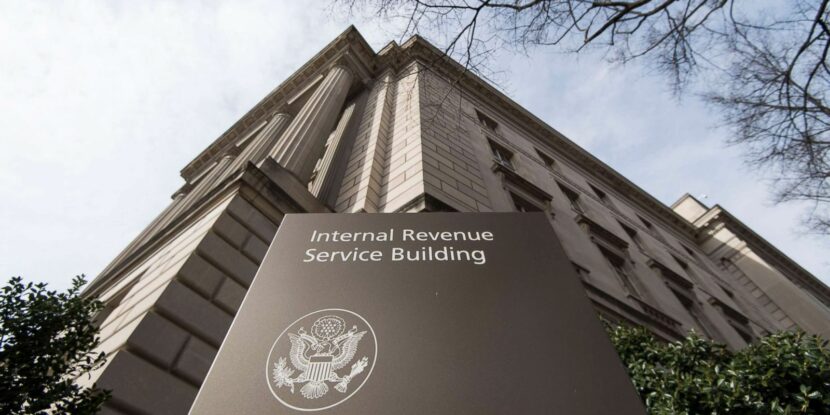
The Internal Revenue Service (IRS) agent union has formally endorsed Kamala Harris for the presidency. During her tenure as Vice President, Harris cast a crucial tie-breaking vote on the Inflation Reduction Act, which significantly increased the IRS budget.
“When it comes to treating federal employees with respect, valuing their service and investing in their work, Kamala Harris is the clear choice,” said National Treasury Employees Union (NTEU) President Doreen Greenwald.
Newsletter
Need to Know.
Your free, daily feed from The National Pulse.
Thank You!
You are now subscribed to our newsletter.
Harris is advocating for expanding the IRS, a stance the union welcomes. The proposed $5 trillion in tax increases over the next decade includes personal and small business income tax hikes, a higher capital gains tax, an increased corporate tax rate, a Death Tax hike, and a carbon tax, among others.
Projections suggest these measures will greatly expand the IRS, as additional agents will be necessary to enforce the new tax policies. The IRS agent union has a history of strong financial support for the Democratic Party. In the 2022 election cycle, the union’s political action committee (PAC) donated $635,170 to Democratic candidates and committees, according to Open Secrets data. This constituted 97 percent of its election-related contributions.
Key recipients of the union PAC’s funds included the Democratic Senatorial Campaign Committee, the DNC Services Corporation, and the Democratic Congressional Campaign Committee. Additionally, the PAC supported the Democratic State Central Committee of Maryland and numerous House and Senate Democrats.
By Popular Demand.
The National Pulse Now has an on-site comments section for members. Sign up today and be part of the conversation in our community of almost 15,000.
More From The Pulse
WE ARE 100% INDEPENDENT AND READER-FUNDED. FOR A GUARANTEED AD-FREE EXPERIENCE AND TO SUPPORT REAL NEWS, PLEASE SIGN UP HERE, TODAY.
The Telegraph is facing a historic revolt from its subscriber base following the €675 million takeover by globalist German media conglomerate Axel Springer, with many long-term readers documenting their cancellations across social media platforms after the axing of high-profile columnists, including Allison Pearson and Liam Halligan.
To help The National Pulse hold the corporate media to account, please JOIN PULSE+ or MAKE A DONATION today.
Newsletter
Need to Know.
Your free, daily feed from The National Pulse.
Thank You!
You are now subscribed to our newsletter.
While establishment media outlets have focused their reporting near-exclusively on the corporate architecture of the deal, which includes cutting up to 100 newsroom jobs to build a global, “AI-powered” business, the newspaper’s core audience is staging a highly visible digital exodus.
Something HUGE is happening out there after the treacherous new management of the Daily Telegraph sacked their most popular columnist Allison Pearson. This morning I hear mass cancellations are underway, with thousands ending their subscriptions. One reader is 35th in the queue! pic.twitter.com/4gBXOkbxhU
For a publication that has long branded itself as the premier voice of traditional, Eurosceptic Britain, the institutional shift under German ownership has proven to be an immediate breaking point. The friction is particularly acute on X, where prominent conservative figures and ordinary subscribers alike are posting about their attempts to terminate their accounts, which the newspaper has made more difficult by removing the option to cancel online.
Media commentator Dan Wootton highlighted the immediate consumer blowback, highlighting structural backlogs in customer service phone lines as subscribers attempt to cancel. Public figures have similarly documented the operational meltdown.
Other users reported similar administrative hurdles. One long-term reader noted on X: “Tried to cancel my digital subscription today after 14 years. No option to do it online anymore. Sat on hold for 42 minutes just to be told by a representative that my feedback would be ‘logged.’ The old Telegraph is officially dead.”
Trying to cancel Telegraph subscription this morning. Your current position in the queue is 29!!
The wave of cancellations is not merely a reaction to diminished customer service capacity; it is a direct ideological rejection of Axel Springer’s corporate bylaws. The Berlin-based publisher famously enforces a set of core principles that all employees must support, including the advancement of a united Europe and the transatlantic alliance.
For the Telegraph’s traditionally Eurosceptic reader base, this corporate mandate represents an existential betrayal. Independent platforms like The Free Mind have cataloged this sentiment, noting that readers are refusing to subsidize an enterprise legally bound to pro-EU integration. “I am not paying £30 a month to fund an AI content farm run out of Germany that requires its writers to support a United Europe,” wrote one viral user thread on X. “Losing Allison Pearson and Liam Halligan was the final straw. They are purging the journalists who actually understand the country.”
Another reason that I will be cancelling my Telegraph subscription on Monday.
Not just the departure of Allison Pearson, Liam Halligan, Sherelle Jacobs and other fine journalists but because of this:
The new owners (Springer) require ALL employees to SUPPORT A UNITED EUROPE OR…
The underlying panic within The Telegraph‘s remaining editorial staff has reportedly turned the newsroom into a “morgue,” as the culture, sports, and business desks bear the brunt of the initial 100 job cuts. Management’s explicit promise to transform the 171-year-old title into an “AI-powered” global operation has signaled to subscribers that individual, high-quality British reporting is being systematically replaced by algorithmic aggregation.
The rapid defection of the Telegraph’s base serves as a stark warning to legacy media brands under new management that are pursuing the total alienation of their existing customers.
The Telegraph is now a paper of the left. The longer you subscribe, the longer you fund the propagandists of your own decline. https://t.co/UAxwpUBbwq
Join Pulse+ to comment below, and receive exclusive e-mail analyses.
show less
The Telegraph is facing a historic revolt from its subscriber base following the €675 million takeover by globalist German media conglomerate Axel Springer, with many long-term readers documenting their cancellations across social media platforms after the axing of high-profile columnists, including Allison Pearson and Liam Halligan.
show more
By Popular Demand.
The National Pulse Now has an on-site comments section for members. Sign up today and be part of the conversation in our community of almost 15,000.
WE ARE 100% INDEPENDENT AND READER-FUNDED. FOR A GUARANTEED AD-FREE EXPERIENCE AND TO SUPPORT REAL NEWS, PLEASE SIGN UP HERE, TODAY.
Britain’s increasingly powerful online regulator has won a major legal victory against three of the world’s social media giants, strengthening its authority to demand extensive information about how online platforms monitor, restrict, and remove content.
The regulator is demanding detailed statistics on deleted posts, content subject to reduced visibility, users’ exposure to what it terms harmful material, and how companies handle moderation complaints.
The tech companies argued that the requests were disproportionate, with lawyers warning that complying could cost millions of dollars and require months of work. However, Lord Justice Singh and Mrs. Justice Collins Rice ruled in Ofcom’s favor.
The decision is a major victory for Britain’s increasingly authoritarian regulatory establishment, which already has the authority to impose penalties of up to 10 percent of qualifying global turnover for serious breaches.
Britain’s Internet Thought Police.
The foundations of Britain’s online regulatory regime were established under the Conservative government of former Prime Minister Rishi Sunak. The Online Safety Act 2023 granted Ofcom extensive new powers to oversee internet services, including social media platforms, search engines, and websites that host user-generated content.
The legislation was claimed to be a means of protecting children from pornography, preventing access to illegal material, and making technology companies more accountable. However, its practical enforcement has been far broader, including censoring a speech in Parliament about grooming gangs.
Companies must assess risks, implement safety measures, maintain appropriate systems for moderating content, and provide information demonstrating their compliance. Ofcom can investigate suspected violations, impose financial penalties, and, in serious circumstances, seek court orders that could result in services being blocked in Britain.
This structure creates powerful chilling effects on speech, with technology companies incentivized to preemptively remove what could be deemed questionable material rather than risk expensive investigations and penalties, leading to censorship.
Political commentary is also under scrutiny, where controversial but lawful opinions may be caught by overly cautious platforms and censored just in case they may violate the legislation.
The Cases.
In March 2026, the regulator announced penalties totaling £520,000 ($696,800) against the American discussion website 4chan. The penalties included £450,000 ($603,000) for allegedly inadequate age-assurance measures intended to prevent children from accessing pornography, £50,000 ($67,000) for failing to conduct an adequate illegal-content risk assessment, and £20,000 ($26,800) for failing to explain protections against illegal material in the website’s terms of service. Ofcom also penalized AVS Group, imposing a £1 million ($1.34 million) fine for failures involving age verification and another £50,000 ($67,000) for failing to comply with an information request.
The attempts to censor companies based in the United States have not gone without legal pushback. American-based websites 4chan and Kiwi Farms challenged Britain’s regulatory efforts in the United States, arguing that attempts to enforce British speech regulations against American businesses violate the First Amendment.
Britain’s Legacy of Hate Speech Arrests.
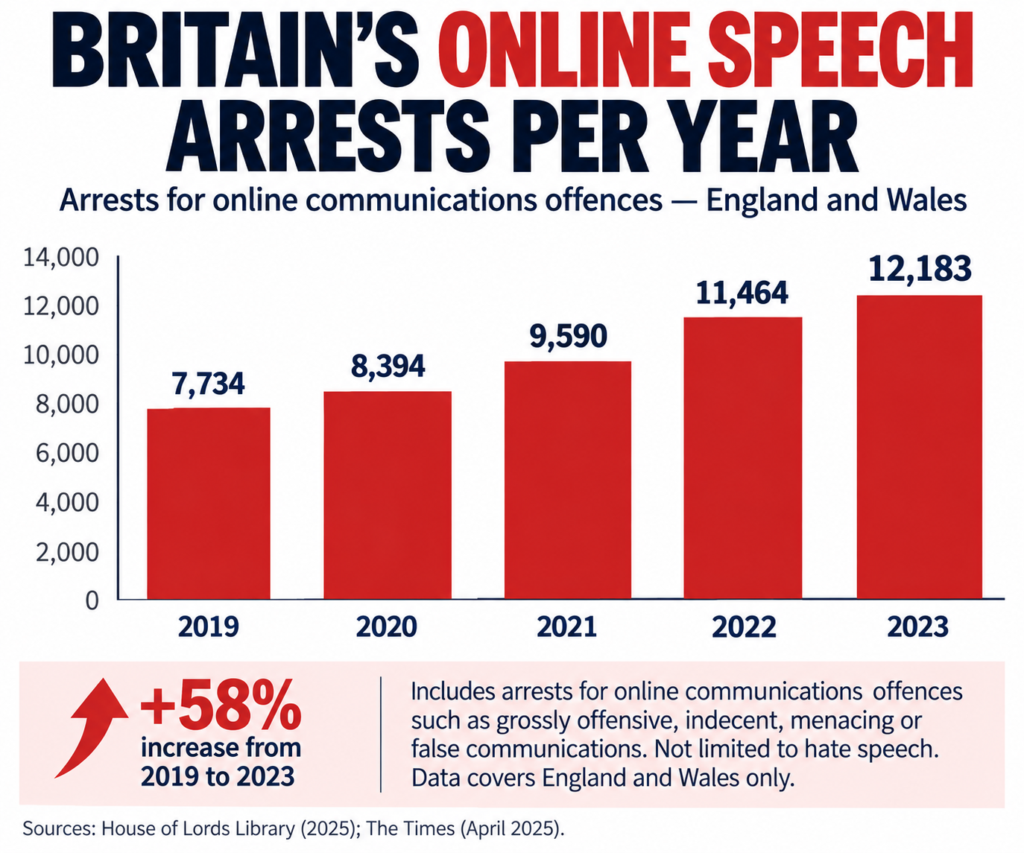
The dispute comes against the backdrop of Britain’s existing criminal laws governing online communications. Police have long possessed powers under Section 127 of the Communications Act 2003 and the Malicious Communications Act 1988 to investigate certain threatening, grossly offensive, or otherwise illegal communications.
These powers have been applied to social media posts, political disputes, and simple offensive comments. The Online Safety Act introduced additional criminal communications offenses, including provisions concerning threatening messages and knowingly false communications intended to cause harm.
These offenses are, of course, separate from Ofcom’s regulatory powers over technology companies. An Ofcom information request does not authorize police to arrest someone for expressing an unpopular opinion.
Still, the combination of criminal speech laws and extensive platform regulation has intensified debate about Britain’s commitment to freedom of expression. The country risks normalizing government involvement in online communication at both the individual and institutional levels.
Trump Admin Defends Online Speech as Others Censor It.
Britain’s regulatory direction stands in total contrast to President Donald J. Trump’s approach to government involvement in online speech. On January 20, 2025, Trump signed the executive order Restoring Freedom of Speech and Ending Federal Censorship.
The order told federal authorities to refrain from unconstitutional interference with Americans’ protected expression and instructed the attorney general to investigate alleged censorship activities during the Biden regime.
The initiative reflected longstanding allegations that federal agencies under Biden had pressured technology companies to suppress political viewpoints, particularly during disputes over COVID-19, elections, and other subjects.
America’s First Amendment provides constitutional protections against government restrictions on expression, while Britain has no such provision, giving America a unique bulwark against attempts at internet censorship.
The contrast has increased tensions between Washington and London, particularly when British regulators attempt to enforce domestic requirements against American technology companies, with Vice President JD Vance voicing his concerns directly to former Prime Minister Sir Keir Starmer last year.
The Future of Online Speech in Britain is Bleak.
Ofcom claims that its information-gathering powers are necessary to hold technology companies accountable and protect internet users, particularly children. However, the expansion of regulatory authority is just another example of the British state trying to control what is being said online.
A system that threatens companies with substantial financial penalties may encourage excessive moderation, even without regulators explicitly demanding the removal of lawful political content, producing a preemptive censorship regime.
As London grants its regulators increasingly powerful tools for monitoring the Internet, the distinction between protecting users and controlling speech is becoming an increasingly important topic for Britons. If the situation remains on its current trajectory, the outlook is bleak.
Join Pulse+ to comment below, and receive exclusive e-mail analyses.
show less
Britain's increasingly powerful online regulator has won a major legal victory against three of the world's social media giants, strengthening its authority to demand extensive information about how online platforms monitor, restrict, and remove content.
show more
By Popular Demand.
The National Pulse Now has an on-site comments section for members. Sign up today and be part of the conversation in our community of almost 15,000.
WE ARE 100% INDEPENDENT AND READER-FUNDED. FOR A GUARANTEED AD-FREE EXPERIENCE AND TO SUPPORT REAL NEWS, PLEASE SIGN UP HERE, TODAY.
As Americans prepare to vote in the November 3 midterm elections, a little-known constitutional provision could give Congress itself the final say over which candidates are allowed to take office. Should Republicans and Democrats find themselves separated by only a handful of seats, the battle for control of Washington could continue long after the votes have been counted.
To help support Raheem J. Kassam and his team uncover the intricacies of America’s elections, please JOIN THE NATIONAL PULSE or MAKE A DONATION today. We are 100% reader-funded.
Newsletter
Need to Know.
Your free, daily feed from The National Pulse.
Thank You!
You are now subscribed to our newsletter.
The House of Representatives and Senate possess the constitutional authority to judge disputed elections involving their own members, even after state officials have certified the results. Democrats need a net gain of just three to four seats in each chamber to wrest control from Republicans, potentially threatening President Donald J. Trump’s legislative agenda during the final two years of his presidency.
Congress: The Final Say.
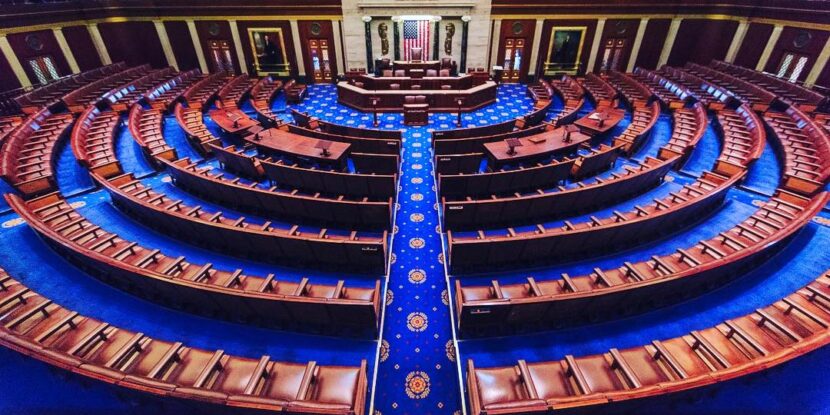
Under Article I, Section 5 of the U.S. Constitution, each chamber is responsible for judging the elections, returns, and qualifications of its members. Although states administer elections, count ballots, and certify winners, congressional authority does not necessarily end when a governor or secretary of state declares a result official.
The Federal Contested Elections Act of 1969 establishes a formal procedure allowing defeated House candidates to challenge certified results. The House Administration Committee can examine evidence, investigate alleged irregularities, and recommend which candidate should be seated. The full House ultimately votes on the outcome. The Senate follows a separate procedure involving its Rules Committee.
The House’s own historical records reveal that lawmakers have considered at least 634 contested elections since 1789. In 68 percent of these cases, the originally certified winner prevailed. The law provides a mechanism for correcting disputed results, but also creates the possibility of partisan confrontation when the outcome determines which party controls Congress.
The Historical Precedent.
Perhaps the most famous modern example occurred following the 1984 congressional election in Indiana’s 8th District. Republican Richard McIntyre was certified the winner by 34 votes over incumbent Democrat Frank McCloskey. However, the Democrat-controlled House refused to seat either candidate while it conducted its own investigation.
A congressional recount later declared McCloskey the winner by just four votes. In May 1985, House Democrats voted to seat McCloskey, prompting Republican protests and a walkout. The case shows that Congress has determined who won an election, and even when the other party protests, the decisions have stood.
More recently, Democrat Rita Hart challenged Republican Mariannette Miller-Meeks’s six-vote victory in Iowa’s 2nd District following the 2020 election. Hart eventually withdrew her challenge in March 2021, however.
The Trump Administration’s Legal Procedures.
The constitutional issue has become more urgent as the Trump administration pursues legal challenges involving election procedures in Alaska and California.
In Alaska, the Justice Department has sought to block certification in the event of a narrow defeat for Republican Senator Dan Sullivan. The administration’s challenge follows allegations that Democrat operatives recruited another candidate with the same name to siphon votes away from the incumbent.
Meanwhile, federal authorities are investigating allegations of noncitizen voting in California, with the Justice Department also challenging the handling of more than 20,000 mail-in ballots.
These allegations have not established that the disputed votes were fraudulent or that the election outcomes would be affected, but are preparing the way for challenges to the stated results.
Congress Could Decide Its Own Majority.
Election-related litigation has increased substantially, reaching a record 756 cases during the 2023–2024 election cycle. If several congressional races remain unresolved when the new Congress convenes in January 2027, the resulting uncertainty could complicate the selection of a House Speaker and the organization of congressional committees.
Importantly, unresolved House contests would be decided by the newly elected House, not the outgoing Republican majority.
Historical precedent demonstrates that disputes can drag on for months. Following the 1974 New Hampshire Senate election, lawmakers failed to resolve competing claims to the seat, eventually leaving the decision to a September 1975 special election.
Congress can provisionally seat candidates while investigations continue, although contested seats can also remain vacant.
A clear electoral victory would make such confrontations unlikely. But if the midterms produce a razor-thin majority, Americans could discover that the final battle for control of Congress takes place not at the ballot box, but on the floors of the House and Senate.
Join Pulse+ to comment below, and receive exclusive e-mail analyses.
show less
As Americans prepare to vote in the November 3 midterm elections, a little-known constitutional provision could give Congress itself the final say over which candidates are allowed to take office. Should Republicans and Democrats find themselves separated by only a handful of seats, the battle for control of Washington could continue long after the votes have been counted.
show more
By Popular Demand.
The National Pulse Now has an on-site comments section for members. Sign up today and be part of the conversation in our community of almost 15,000.
WE ARE 100% INDEPENDENT AND READER-FUNDED. FOR A GUARANTEED AD-FREE EXPERIENCE AND TO SUPPORT REAL NEWS, PLEASE SIGN UP HERE, TODAY.
Alastair Campbell, former Director of Communications to Tony Blair—and one of the key figures who sold the Iraq War to the British public—told Reform UK’s Zia Yusuf that he has more chance of captaining the Sri Lankan cricket team than of becoming Home Secretary. The comment came after Yusuf called Campbell a “war criminal” to his face on the BBC’s Question Time show.
However, the same corporate media outlets that devoted days of coverage and an anonymous Times leader to Raheem Kassam, Editor-in-Chief of The National Pulse, calling Conservative Party leader Kemi Badenoch a “Nigerian scammer” have shown almost no interest.
Newsletter
Need to Know.
Your free, daily feed from The National Pulse.
Thank You!
You are now subscribed to our newsletter.
The National Pulse brings you in-depth news and analysis free of corporate influence. To keep it that way, please JOIN THE NATIONAL PULSE or MAKE A DONATION. We are 100% reader-funded.
Will the Times’s leader column focus on this? Will @lewis_goodall?
Will there be days of establishing teeth gnashing over this “Sri Lankan Strategy” deployed on the BBC by a literal war criminal?
Or does the establishment only do all that when a brown man gets too lairy? 🤔 pic.twitter.com/Ve1u3lgXfd
On Question Time, Yusuf challenged Campbell over his role in the run-up to the invasion. He referenced the notorious claims in the British government’s “dodgy dossier,” which Campbell helped present, that Iraq could strike British territory with weapons of mass destruction within 45 minutes.
“You deceived the British people because you and your old boss Tony Blair wanted to go to war with Iraq, and as a direct result of your deception, almost 180 British troops are dead; 600,000 Iraqi civilians are dead… When you described yourself as a ‘national treasure’ recently, they would more aptly describe you as a war criminal, and if there were any justice in this country, frankly, you and your old boss Tony would be on trial,” Yusuf said.
Campbell later replied on X to a post from Yusuf in which he had shared a clip of the exchange: “I have heard it from far better people than you and they were wrong too. What I enjoyed was seeing you running away from an argument about Brexit because you would rather talk about anything else… You’ve [g]ot nice suits and nice shoes but you’ve got more chance captaining the Sri Lankan cricket team than you have of becoming Home Secretary.”
Yusuf was born in Lanarkshire, England, in 1986 to Sri Lankan Muslim parents who emigrated to Britain earlier in the 1980s. Both worked in the National Health Service (NHS), his father as a pediatrician and his mother as a nurse.
Alastair Campbell did not appear to enjoy being called a war criminal to his face:
Raheem Kassam described Kemi Badenoch as a “Nigerian scammer” on the basis of her long history of misleading people about her past and record. The Times ran an anonymous leader on the posts. LBC’s Lewis Goodall covered them. Conservative figures who pose as opponents of woke racism accusations and political correctness called for Farage and Reform to disown Kassam.
He responded by naming the authors behind The Times‘ “leader” editorials and noting both that Badenoch is a Nigerian citizen and that “Nigerian” is not a race. In a December 2024 Spectator interview, Badenoch herself said she identifies “less with [Nigeria] than with the specific ethnicity [Yoruba],” adding: “That’s what I really am. I have nothing in common with the people from the north of the country… those were our ethnic enemies, and yet you end up being lumped in with those people.”
Nigerian media criticized Badenoch for describing swathes of people in the country where she was raised as her “ethnic enemies,” but the British media has largely ignored the comments, with none of the sustained, manufactured outrage or demands for condemnation directed at Kassam.
The Standard Changes With the Target.
Campbell is a longstanding fixture of the establishment commentariat who co-hosts a podcast with liberal former Conservative politician Rory Stewart. The Times, LBC, and far-left Hope Not Hate actvist turned Mail on Sunday columnist Dan Hodges treating Kassam’s criticism of Badenoch as requiring days of coverage while ignoring Campbell’s reference to Yusuf’s Sri Lankan parentage amounts to a clear double standard.
The Times editorial today is about… me!
So let’s focus on these ANONYMISED “leader” columns and who exactly writes them, because they don’t have bylines on them. Because they are COWARDS.
So I’m gonna tell you the industry’s little secrets that they don’t want you to know…… pic.twitter.com/IquFSnNnCI
Join Pulse+ to comment below, and receive exclusive e-mail analyses.
show less
Alastair Campbell, former Director of Communications to Tony Blair—and one of the key figures who sold the Iraq War to the British public—told Reform UK’s Zia Yusuf that he has more chance of captaining the Sri Lankan cricket team than of becoming Home Secretary. The comment came after Yusuf called Campbell a "war criminal" to his face on the BBC's Question Time show.
show more
By Popular Demand.
The National Pulse Now has an on-site comments section for members. Sign up today and be part of the conversation in our community of almost 15,000.
WE ARE 100% INDEPENDENT AND READER-FUNDED. FOR A GUARANTEED AD-FREE EXPERIENCE AND TO SUPPORT REAL NEWS, PLEASE SIGN UP HERE, TODAY.
This year, the United States’ national debt reached 100 percent of the country’s economic output. The rising debt is due to government spending leading to deficits, borrowing, and rising interest payments.
The National Pulse stays on top of the latest economic news. If you value the work of Raheem J. Kassam and his team, please JOIN THE NATIONAL PULSE or MAKE A DONATION today.
Newsletter
Need to Know.
Your free, daily feed from The National Pulse.
Thank You!
You are now subscribed to our newsletter.
$20.1 Trillion in Interest Payments.
According to the Congressional Budget Office’s (CBO) federal receipts and expenditures report published earlier this week, the U.S. Treasury will spend about $20.1 trillion on interest payments between 2026 and 2036. This means a significant chunk of federal revenue will go toward servicing accumulated debt, rather than funding new programs or investments.
In 2026 alone, the Treasury is expected to pay approximately $1.2 trillion in interest. By 2036, the amount is projected to rise to $2.5 trillion, equivalent to around $200 billion per month. This means that federal interest payments are projected to be more than twice as large as defense spending by 2036, when the Pentagon is projected to receive roughly $1.1 trillion. This mirrors a problem in other Western countries, many of which spend more servicing their debt than funding defense, including the United Kingdom, France, Italy, and Spain, among others.
$25.6 Trillion in New Deficits.
The Treasury has reported a fiscal 2026 deficit of approximately $2 trillion, and the CBO expects the deficit to grow to more than $3 trillion by 2036. The CBO also projects that the federal debt will reach 101 percent of U.S. Gross Domestic Product (GDP) in 2026, and 120 percent of GDP in 2036. This would surpass the current post-World War II record of 106 percent of GDP, which was reached in 1946 and follows the rapid rise during the COVID-19 pandemic.
Over the next decade, the cumulative deficit is projected at approximately $25.6 trillion. Over the same period, the deficit will rise from 5.8 percent of GDP to 6.7 percent, according to the CBO. The average deficit over the previous 50 years was 3.8 percent of GDP, indicating that the U.S. is spending a disproportionately high amount of money.
“[Last year’s tax cuts are] a hit now to the deficit, but we are creating productive assets for future growth which will be paying taxes down the line… I think of that more as like pulling back a slingshot and creating a lot of potential energy that becomes kinetic,” said Treasury Secretary Scott Bessent, explaining the federal government’s economic strategy back in August.
The National Pulse relies on reader support, not government or corporate cash. Please JOIN THE NATIONAL PULSE or MAKE A DONATION today. We are 100% reader-funded.
$6.1 Trillion in Social Benefits.
Spending on federal social programs is a major driver of the deficit. According to the CBO, spending on federal social programs is set to reach $3.7 trillion in 2026 and $6.1 trillion in 2036. The CBO’s report notes that the Social Security trust fund is projected to run out of money in just over seven years, while Medicare’s trust fund is expected to face depletion over the next six and a half years.
Spending on federal social programs reflects the aging population, as more Americans reach retirement age and become eligible for programs like Social Security and Medicare. The demographic problem compounds the debt problem as the cost of caring for elderly citizens continues to rise and spending cuts can trigger democratic backlash. The Trump administration is attempting to mitigate these costs through a massive anti-fraud drive spearheaded by Vice President J.D. Vance.
$40 Trillion in National Debt.
U.S. gross federal debt currently stands at $40 trillion, while the amount of debt held by the American public is projected to reach $32.10 trillion by the end of the year. The amount of publicly-held debt is also projected to rise to $40.28 trillion by the end of 2030, $53.10 trillion by the end of 2035, and $56.15 trillion by the end of 2036.
Gross federal debt is the total amount the U.S. government owes, including money it owes to other federal government accounts, while debt held by the public is only the money owed to creditors outside the federal government, such as investors, businesses, foreign governments, and the Federal Reserve.
“I think there is understanding about the challenging fiscal trajectory… Of course, the difficulty is that the U.S. is a divided country and a divided society and we’re divided politically,” said CBO Director Phil Swagel to The Wall Street Journal.
The National Pulse provides you with the facts that matter. If you value the work of Raheem J. Kassam and his team, please JOIN THE NATIONAL PULSE or MAKE A DONATION today. We are 100% reader-funded.
Join Pulse+ to comment below, and receive exclusive e-mail analyses.
show less
This year, the United States' national debt reached 100 percent of the country's economic output. The rising debt is due to government spending leading to deficits, borrowing, and rising interest payments.
show more
By Popular Demand.
The National Pulse Now has an on-site comments section for members. Sign up today and be part of the conversation in our community of almost 15,000.
WE ARE 100% INDEPENDENT AND READER-FUNDED. FOR A GUARANTEED AD-FREE EXPERIENCE AND TO SUPPORT REAL NEWS, PLEASE SIGN UP HERE, TODAY.
Spain could be on the verge of a dramatic reversal of its mass immigration policies, with the November 29 general election threatening to bring down Socialist Prime Minister Pedro Sánchez and deliver power to a right-wing coalition determined to dismantle his immigration legacy.
The National Pulse team strives to give you in-depth news and analysis. To help Raheem J. Kassam and his team continue this work, please JOIN THE NATIONAL PULSE or MAKE A DONATION. We are 100% reader-funded.
Newsletter
Need to Know.
Your free, daily feed from The National Pulse.
Thank You!
You are now subscribed to our newsletter.
A new investigation reveals that the right-wing populist Vox party could become a kingmaker following the election, potentially forcing the center-right People’s Party (PP) to adopt sweeping restrictions on immigration, deportations, and access to public services.
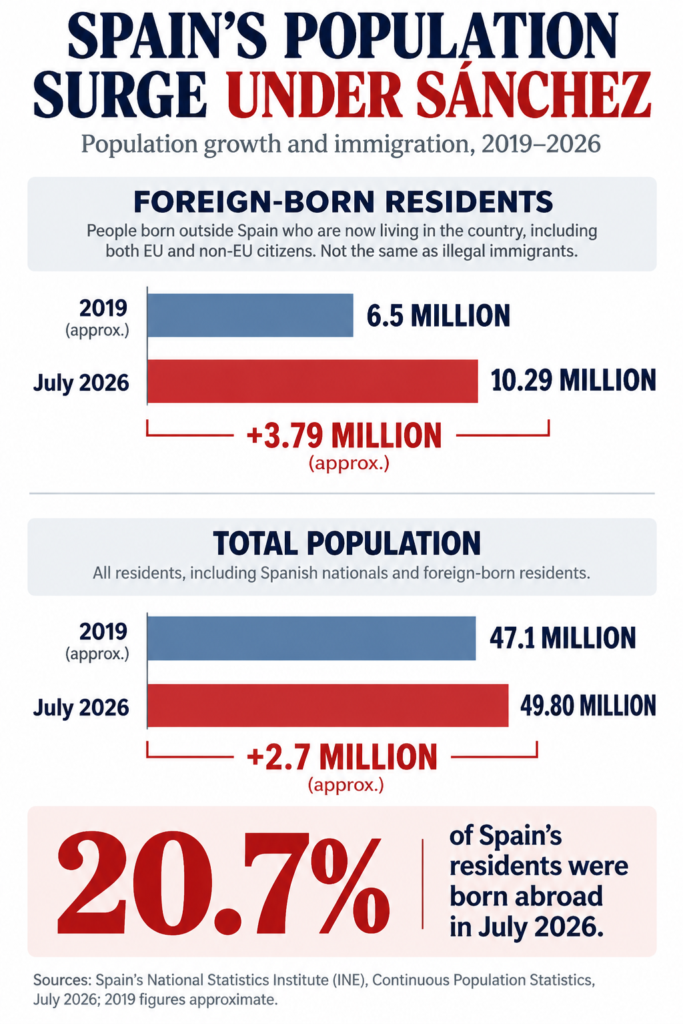
Since 2019, Spain’s foreign-born population has exploded by approximately 3.5 million, reaching more than 10 million. Sánchez has celebrated mass immigration, but critics argue that the influx has worsened an already severe housing crisis and increased pressure on public infrastructure.
Now, Spanish voters could be preparing to reject one of Europe’s most pro-immigration regimes and vote in the most right-wing government in decades.
Nearly a Decade of Continual Mass Migration.
Spain’s demographic transformation under Sánchez has been extraordinary. According to the country’s National Statistics Institute (INE), the foreign-born population surpassed 10 million at the beginning of 2026. By July, approximately 20.7 percent of Spain’s residents had been born in another country.
The Sánchez government has encouraged immigration to address alleged labor shortages, sustain economic expansion, and offset Spain’s aging population and low birth rate.
Its most controversial initiative came in 2026, when the government launched a large-scale amnesty offering residency and work authorization to illegal immigrants already living in Spain. According to official government figures, the program received 1,174,978 applications by its June 30 deadline, more than twice the government’s original expectation of approximately 500,000.
The program generally requires applicants to show that they were present in Spain before January 2026 and had resided there continuously for at least five months. Qualifying applicants could receive one-year residency and work permits.
The Cost of Sánchez’s Economic Growth.
Sánchez has defended his immigration policies by claiming Spain has had a relatively strong economic performance under his reign. Spain’s economy has outperformed several major European competitors, while foreign workers have helped expand employment in hospitality, construction, retail, and other industries.
However, the distinction between total economic growth and improving living standards is increasingly important for Spaniards. A recent economic analysis found that Spain’s GDP had increased approximately 15 percent since late 2021, with annual economic growth running at around 2.5 percent. Yet GDP per capita has grown more slowly as the population has expanded.
Spanish house prices, meanwhile, have increased approximately 26 percent over two years, while social housing represents just 3.4 percent of the market. Residential construction has struggled to accommodate population growth via mass migration, contributing to worsening affordability, particularly for younger Spaniards. Limited construction, planning restrictions, and inadequate investment have also constrained supply.
The government’s argument that immigration benefits public finances is also not the whole picture. Migrant workers may contribute taxes and social security payments, but population growth simultaneously increases demand and costs for healthcare, education, transport, and housing.
Vox Plans to Reverse the Sánchez Era.
The November election could give the right-wing populist Vox party major influence over Spain’s immigration system if they enter a coalition government. According to election analysis, the People’s Party and Vox are the only combination currently projected to command an outright parliamentary majority.
Vox has been polling around 18 percent, while the PP has maintained a lead over Sánchez’s Socialists. Led by firebrand Santiago Abascal, Vox is demanding mass deportations, stricter immigration enforcement, and policies prioritizing Spanish citizens’ access to certain public services. The party also wants to examine whether the legal status granted through Sánchez’s regularization program could be revoked, undoing the mass amnesty.
Vox has already used its influence in regional governments to advance policies favoring residents with longstanding ties to their areas, something that could carry over to the national level.
However, a conservative coalition government would face considerable obstacles in attempting to reverse the Sánchez disaster. People who have already acquired lawful residency possess legal protections, while deportations require individual procedures and cooperation from receiving countries. Constitutional equality guarantees and European law could also constrain attempts to restrict access to public services.
A PP–Vox coalition could tighten future immigration, restrict eligibility for residency, and pursue more deportations. Reversing the demographic changes of recent years would be considerably harder due to judicial pressures and the European Union.
A New Spain for the Old Spaniards is Possible.
Spain’s election is becoming a referendum on whether mass migration has actually helped the average Spaniard, rather than just a larger GDP number.
Prime Minister Sánchez’s opponents argue that any economic achievements mean little if housing becomes unaffordable and public infrastructure cannot keep pace with population growth due to mass migration.
A conservative victory, meanwhile, could represent one of Europe’s most significant immigration policy reversals in years. But even if Spaniards vote to end the Sánchez experiment on November 29, the consequences of seven years of demographic transformation will not disappear overnight. Spaniards who want to undo the damage caused by the left may be able to start with a single election, but it would only be the beginning of a long battle, not unlike the famous Reconquista.
To help Raheem J. Kassam and his team continue to get you the details behind the world’s important stories, please JOIN THE NATIONAL PULSE or MAKE A DONATION today.
Join Pulse+ to comment below, and receive exclusive e-mail analyses.
show less
Spain could be on the verge of a dramatic reversal of its mass immigration policies, with the November 29 general election threatening to bring down Socialist Prime Minister Pedro Sánchez and deliver power to a right-wing coalition determined to dismantle his immigration legacy.
show more
By Popular Demand.
The National Pulse Now has an on-site comments section for members. Sign up today and be part of the conversation in our community of almost 15,000.
WE ARE 100% INDEPENDENT AND READER-FUNDED. FOR A GUARANTEED AD-FREE EXPERIENCE AND TO SUPPORT REAL NEWS, PLEASE SIGN UP HERE, TODAY.
As the November midterm elections approach, the Trump administration has stepped up its investigation into noncitizen voting, reflecting the federal government’s enduring focus on electoral integrity.
The Trump administration has made suspected noncitizen voting a major election issue ahead of the midterm elections next week. Earlier this month, in California, the Department of Justice (DOJ) warned that more than 20,000 registered voters could be noncitizens, and asked the state not to count any mail ballots until the voters’ citizenship is confirmed. California state officials refused to cooperate with the Trump administration’s investigation.
Last week, the Trump administration sued Alaska over confusion caused by the inclusion of a candidate named Daniel Sullivan, who shares the same name as the Republican Senator seeking re-election in the state. Similar to California, state officials have obstructed the federal investigation.
Earlier this week in Washington state, federal prosecutors identified more than 400 people as potential noncitizens and asked officials to set aside their ballots, which has also been met with resistance. “The timing of this request—one week before the General Election—is no doubt intended to cast unfounded suspicion on the results,” complained Washington Secretary of State Steve Hobbs (D) at the time.
The Investigation.
According to reporting from Reuters this week, the Trump administration’s investigation into noncitizen voting is far more expansive than initially believed. Federal authorities have issued more than 100 subpoenas across at least 13 states, including Arizona, California, Connecticut, Georgia, Kansas, Massachusetts, Michigan, Minnesota, Nevada, New York, Texas, Utah, and Washington. California alone has received at least 17 subpoenas, including counties in Los Angeles, San Diego, Marin, and Fresno.
While some of the subpoenas seek to acquire individual voter records, others demand entire local voter rolls, which typically contain thousands of names. At least 49 subpoenas were issued through grand juries, which are used as part of criminal investigations. Most of the subpoenas identified were issued to state and local officials within the past three months.
The Trump administration has defended the extent of the investigation. “The Trump administration is sending a clear message that anyone who illegally votes in our elections will be held accountable… Only Americans should be electing America’s leaders,” said White House spokeswoman Lauren Bis.
A grand jury subpoena is a legally enforceable demand for evidence issued as part of a criminal investigation. As such, a grand jury subpoena is substantially different from a routine administrative request for information.
Specifically, a grand jury subpoena can require a person, government agency, or other organization to provide documents, records, or testimony to federal prosecutors. Due to being part of criminal proceedings, grand jury subpoenas are generally more difficult to challenge than standard subpoenas, meaning that they are likely to be more effective at obtaining relevant information from state officials.
As such, it is likely that the federal investigation’s use of grand jury subpoenas is intended to identify disputed ballots and build criminal cases to be pursued after the midterm election, potentially resulting in prosecution and imprisonment for those found guilty of facilitating noncitizen voting.
Consequences.
The use of subpoenas means that the Trump administration’s investigation could continue regardless of the outcome of the midterm elections.
The federal investigation could become particularly important in close races, where a small number of votes could determine the outcome. Similarly, in states where the counting process takes several weeks, such as California, a legal case could be brought before the results are finalized, further creating public suspicion.
Nevertheless, noncitizen voting is a well-documented problem. For example, earlier this year, the U.S. Census Bureau estimated that more than 24,000 noncitizen votes were cast in the 2020 presidential election, despite the fact that only U.S. citizens are permitted to vote.
Join Pulse+ to comment below, and receive exclusive e-mail analyses.
show less
As the November midterm elections approach, the Trump administration has stepped up its investigation into noncitizen voting, reflecting the federal government's enduring focus on electoral integrity.
show more
By Popular Demand.
The National Pulse Now has an on-site comments section for members. Sign up today and be part of the conversation in our community of almost 15,000.
WE ARE 100% INDEPENDENT AND READER-FUNDED. FOR A GUARANTEED AD-FREE EXPERIENCE AND TO SUPPORT REAL NEWS, PLEASE SIGN UP HERE, TODAY.
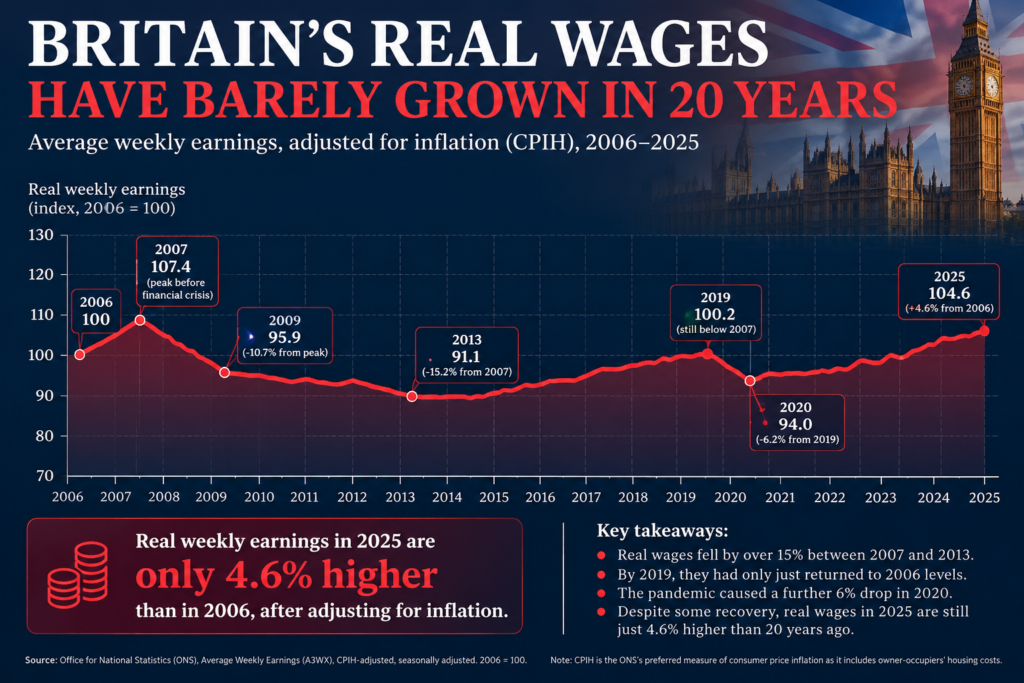
Britain is on course for almost no improvement in living standards over an entire decade, according to the government’s fiscal watchdog. As taxation approaches historic highs, energy costs are hurting industry, and mass immigration is failing to deliver the supposed economic benefits long touted by experts, the country’s economic model may be following the path of Japan’s lost decades.
To help support Raheem J. Kassam and his team bring you original, high-quality news and analysis, please JOIN THE NATIONAL PULSE or MAKE A DONATION today. We are 100% reader-funded.
Newsletter
Need to Know.
Your free, daily feed from The National Pulse.
Thank You!
You are now subscribed to our newsletter.
Britain is facing a lost decade of prosperity, with the average household expected to be barely better off in 2030 than it was before the COVID-19 pandemic, according to a new assessment. The Office for Budget Responsibility (OBR) forecasts that real household disposable income per person will be just 1 percent higher in 2029–30 than before the pandemic. That represents average annual growth of less than 0.1 percent over the decade.
The OBR expects no real wage growth in 2027 or 2028, with wages growing by just 0.5 percent in 2030. Chancellor John Healey’s October 28 Budget offered little prospect of a turnaround. Economic growth is expected to slow to one percent in 2027, while the government’s fiscal headroom has shrunk to the equivalent of approximately $20 billion.
Healey announced winter energy payments equivalent to roughly $133 for approximately 20 million households, alongside higher taxes on banks, savings, and property income. The government’s tax burden is also projected to reach historically high levels.
The Economic Model That Failed Britain.
Britain’s economic stagnation did not begin with the current leftist Labour Party government. Much of the underlying problem developed during 14 years of Conservative Party government, when weak productivity growth, rising public spending, and increasing dependence on imported energy and low-skilled foreign workers became defining features of the economy.
Productivity growth has been persistently disappointing since the 2008 financial crisis. Without sustained improvements in output per worker, businesses struggle to deliver substantial real wage increases. The OBR has repeatedly identified weak productivity as the main factor determining Britain’s long-term economic performance.
Meanwhile, frozen income tax thresholds have shifted more workers into higher tax brackets as nominal wages increased. Labour has not only maintained much of this approach but is pursuing additional revenue from employers, investors, and other taxpayers.
Energy has become another major weakness. Britain’s industrial competitiveness is threatened by expensive electricity, with domestic energy policy costs adding to pressures from international gas markets.
The latest Budget’s energy assistance may provide temporary relief, but a $133 payment does very little to address the underlying reasons British households and manufacturers face persistently expensive power.
Housing shortages compound the problem. Restrictive planning, insufficient construction in high-demand areas, and elevated property costs leave workers spending more of their earnings simply to maintain a roof over their heads. Mass migration, including the infamous “Boriswave” started under former Prime Minister Boris Johnson, has only compounded the problem.
The Immigration Illusion: A Bigger Economy Does Not Necessarily Mean a Richer Country.
Under successive Conservative governments, particularly following Brexit, Britain experienced a major expansion in immigration despite repeated political promises to bring the numbers down. Higher immigration can increase overall GDP by expanding the workforce and consumer base. However, an increase in the total size of the economy does not automatically translate into higher GDP per capita, better living standards, or making things more affordable.
An economy can grow because it has more workers rather than because each worker is producing more. Rapid population growth increases demand for housing, transport, schools, healthcare, and infrastructure. Unless investment and construction keep pace, existing shortages can become even worse, and in Britain’s case, they have.
Britain’s political establishment has too often treated economic growth through overall GDP as clear evidence that the country is prospering, even when the OBR’s figures show barely any improvements in household income per person.
Japan.
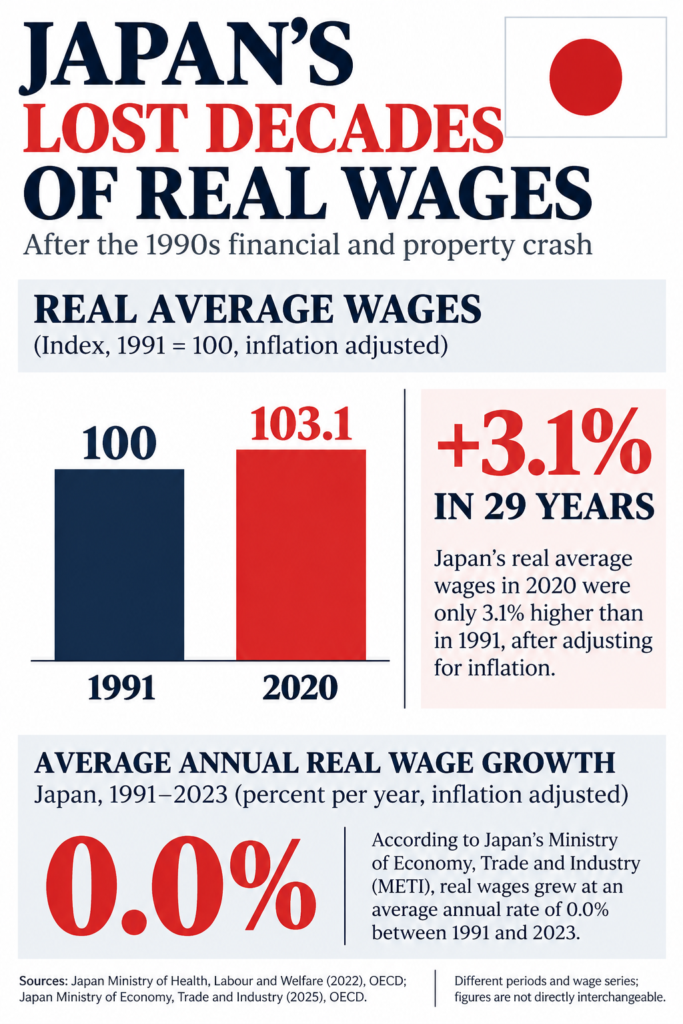
Britain’s predicament bears similarities to Japan’s experience following the collapse of its financial and property bubbles in the early 1990s. Japan endured decades of sluggish economic growth, weak wage increases, and repeated government interventions intended to revive demand.
As the OECD’s economic research on Japan shows, the country has struggled with longstanding productivity challenges, demographic pressures, and weak wage growth.
Japan has experienced a shrinking population because it has so far rejected mass migration, preserving the distinct character of Japanese culture while avoiding the problems that come with mass migration, opting to rely on automation to rebalance the economy.
Japan shows that a wealthy, developed country can maintain advanced infrastructure, sophisticated businesses, and a high standard of living without embracing mass migration policies, even when wage growth is weak.
Britain risks following a comparable trajectory, with high property prices benefiting established homeowners while younger generations struggle to accumulate wealth, but without the well-maintained infrastructure and social cohesion of Japan.
Can Nigel Farage’s Reform UK Reverse Britain’s Decline?
Nigel Farage‘s Reform UK party is presenting an increasingly ambitious alternative to the economic policies pursued by both major parties. The party’s economic policy platform proposes raising the income tax-free personal allowance to the equivalent of around $20,007, which it claims would remove 2.9 million people from income tax altogether, and deliver the equivalent of roughly $650 in annual tax relief to most taxpayers.
Reform also promises to reduce household energy bills by $333 annually, eliminate government-imposed costs from electricity bills, expand domestic energy production, and abandon costly Net Zero policies.
For businesses, the party proposes reducing employer National Insurance contributions from 15 percent to 13.8 percent for British workers, increasing the VAT registration threshold to the equivalent of around $200,069, and exempting qualifying overtime earnings from income tax.
Reform would finance its proposed employer tax reduction through a new Migrant Labor Levy, designed to discourage businesses from relying on foreign labor. The party has also proposed apprenticeship incentives and a program to construct 50,000 affordable homes annually. The policies represent a clear departure from the prevailing approach of higher taxation, energy subsidies, and migration-supported workforce expansion.
Reform’s central argument, that Britain must prioritize cheaper energy, lower taxation, and greater domestic productive capacity, directly challenges the current economic consensus that is constantly chasing foreign labor and pushing down individual wages.
A Country That Has Forgotten How to Become Wealthier.
Britain’s latest Budget should serve as a warning that economic stagnation cannot be permanently disguised through additional public spending, temporary subsidies, or population growth.
The Conservatives presided over years of weak productivity, expensive housing, rising immigration, and growing fiscal instability. Labour has inherited those problems while pursuing a program that continues to rely heavily on taxation and state intervention.
External shocks, including the pandemic, the Ukraine war, and the conflict in Iran, have aggravated Britain’s difficulties, but they cannot be used as an excuse to wave away the structural rot that predate them. The OBR’s projection of virtually stagnant real household income over an entire decade raises serious questions about the economic mantras of the last 20 years and whether Britain can survive another decade of the same.
Reform believes that lower taxes, increasesd domestic energy production, and immigration restrictions can help restore prosperity, challenging an economic consensus that has delivered little to the average Briton.
Britain’s greatest danger may not be an immediate financial collapse. Instead, the country risks embracing the gradual normalization of national stagnation, in which future governments manage an increasingly expensive economy while ordinary families abandon the notion that their children will be better off than they were.
To help Raheem J. Kassam and his team give you the full story behind the headlines and soundbites, please JOIN THE NATIONAL PULSE or MAKE A DONATION today.
Join Pulse+ to comment below, and receive exclusive e-mail analyses.
show less
Britain is on course for almost no improvement in living standards over an entire decade, according to the government's fiscal watchdog. As taxation approaches historic highs, energy costs are hurting industry, and mass immigration is failing to deliver the supposed economic benefits long touted by experts, the country's economic model may be following the path of Japan's lost decades.
show more
By Popular Demand.
The National Pulse Now has an on-site comments section for members. Sign up today and be part of the conversation in our community of almost 15,000.
WE ARE 100% INDEPENDENT AND READER-FUNDED. FOR A GUARANTEED AD-FREE EXPERIENCE AND TO SUPPORT REAL NEWS, PLEASE SIGN UP HERE, TODAY.
Germany is prosecuting a former member of the Ukrainian armed forces over the sabotage of the Nord Stream natural gas pipelines, despite attempts to have the case dismissed, in a move that could bring conflict between the two allies.
The National Pulse gives you deep dives into the issues that matter. To help support Raheem J. Kassam and his team continue this work, please JOIN THE NATIONAL PULSE or MAKE A DONATION today. We are 100% reader-funded.
Newsletter
Need to Know.
Your free, daily feed from The National Pulse.
Thank You!
You are now subscribed to our newsletter.
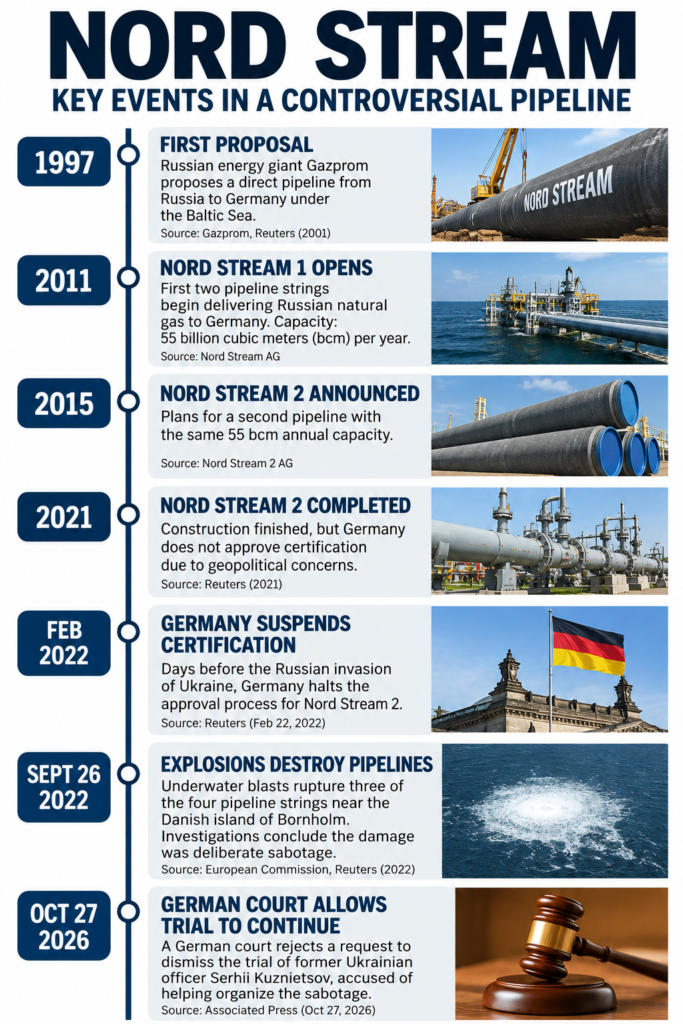
A German court on October 27 rejected an attempt by lawyers representing Serhii Kuznietsov to halt proceedings over his alleged involvement in the September 2022 sabotage of the pipelines, which connected Russia directly to Germany via the Baltic Sea.
Kuznietsov’s defense argued that Ukrainian military secrecy obligations prevented him from adequately defending himself. The court rejected the argument, allowing the case to proceed. German prosecutors allege that Kuznietsov helped organize a team responsible for planting explosives on the pipelines near the Danish island of Bornholm. He has not been convicted, and the government of Ukraine has repeatedly denied state involvement in the attack.
The proceedings raise an uncomfortable question for the German government and its people: if the German courts determine that the Ukrainian state was behind the attack on one of its greatest European supporters, how should Germans react?
Who is Really Behind the Destruction of Nord Stream?
On September 26, 2022, underwater explosions ruptured three of the four strings comprising the Nord Stream 1 and Nord Stream 2 pipelines. The blasts occurred in the Baltic Sea near Bornholm, with European investigators subsequently concluding that the damage resulted from deliberate sabotage.
German investigators developed a theory involving a small team of divers operating from a rented sailing yacht, reportedly named Andromeda, which allegedly transported explosives and diving equipment to the Baltic Sea.
A Washington Post investigation published in June 2023 revealed that American intelligence had received information about a Ukrainian plan to attack the pipelines months before the explosions. The report described intelligence concerning a proposed operation involving a small team of divers linked to Ukraine’s military establishment.
More recent reporting has raised further questions about Kuznietsov’s military status, including testimony reportedly indicating that he remained part of active duty military in Ukraine at the time of the sabotage itself. This raises the distinct possibility that it was not a rogue group of servicemen but a coordinated state-sponsored act of international sabotage.
Germany’s Cheap Energy Lifeline.
The original Nord Stream pipeline began delivering Russian natural gas to Germany in 2011, providing a direct route across the Baltic Sea that bypassed traditional transit countries, including Ukraine and Poland. Nord Stream 2 was completed in 2021, but Germany suspended its certification in February 2022, shortly before Russia launched its full-scale invasion of Ukraine.
Germany had long relied on cheap Russian natural gas, which became vital to the country’s energy-intensive industries, including chemicals, fertilizers, and manufacturing. The destruction of the pipelines permanently damaged a major potential route for restoring cheap Russian gas deliveries in the future, forcing Germany to reorient its energy strategy at a high cost.
Germany’s subsequent energy crisis was driven by multiple factors, including the collapse of Russian gas supplies, elevated wholesale prices, and the costs of replacing pipeline gas with alternative sources. The economic consequences extended beyond household energy bills. German industrial competitiveness came under pressure as businesses confronted higher energy costs, while Berlin accelerated construction of liquefied natural gas import facilities. Combined with net-zero policies and the Green Agenda, Germany has seen a wave of deindustrialization and corporate bankruptcies since 2022.
What Did Poland’s Current Foreign Minister Know?
On September 27, 2022, Radosław Sikorski, a former Polish foreign minister who has since returned to that office, published a photograph of the Baltic Sea gas leak alongside the words “Thank you, USA.” The now-deleted post immediately generated controversy because it appeared to suggest American responsibility for the explosions.
Sikorski later attempted to walk back his remarks, calling them speculation rather than evidence of American involvement. While Poland had opposed Nord Stream for years, arguing that the pipelines strengthened Moscow’s geopolitical influence while undermining the energy security of Eastern European countries, it remains unclear if Sikorski knew who was actually behind the attack.
Ukraine’s History of Overseas Attacks and Assassinations.
The Nord Stream allegations are not the first time Ukrainian intelligence services have been linked to secretive attacks far beyond the borders of Ukraine.
In August 2022, Russian political commentator Daria Dugina, daughter of nationalist philosopher Alexander Dugin, was killed when a bomb exploded beneath her vehicle outside Moscow. Although Kiev denied responsibility, American intelligence officials subsequently assessed that elements of the Ukrainian government had authorized the assassination.
A major Washington Post investigation published in October 2023 examined Ukrainian intelligence operations inside Russia, including targeted killings and attacks on infrastructure. The report linked Ukrainian security services to the Dugina assassination and other covert activities, citing Ukrainian and Western intelligence sources.
Another high-profile attack occurred in April 2023, when Russian military blogger Vladlen Tatarsky was killed by a bomb at a St. Petersburg café. Dozens of other people were injured. Russian authorities blamed Ukrainian intelligence for the bombing, an accusation Kiev denied. Responsibility for the attack remains disputed.
Moscow has repeatedly accused Ukrainian intelligence of involvement in additional assassinations, bombings, and attempted sabotage operations. This includes the 2024 Crocus City Hall attack, which saw alleged Islamist terrorists kill 145 people, one of the worst terrorist attacks on Russian soil ever. Russia claimed the terrorists were aided by Ukraine, though the Islamic State terrorist group took responsibility officially.
The Nord Stream Bombing Could Be a War Crime.
The Hamburg case could also establish an important precedent concerning the limits of wartime sabotage. Kuznietsov faces charges including causing an explosion, property damage, disrupting public services, and complicity in war crimes arising from an alleged attack on civilian infrastructure.
The defense has questioned whether Nord Stream should be considered a legitimate military target because of its economic importance to Russia. Under international law, civilian infrastructure is generally protected from deliberate attack unless it qualifies as a military objective. A target’s economic importance to a country engaged in war does not, by itself, establish that it may lawfully be attacked.
The fact that Nord Stream was built primarily to transport natural gas to civilian and industrial consumers largely shows that it was not being used for any kind of direct war purpose. Even if the attack served a military purpose, that would not automatically exempt its participants from prosecution under German domestic laws.
A Trial That Could Split Germany and Ukraine.
German prosecutors have alleged that the suspected saboteurs were acting on behalf of Ukrainian state authorities. If this proves true, it could enrage a German public that has been told that Ukraine is their ally for years and strengthen support for the populist Alternative for Germany (AfD), the party most skeptical of Ukraine and its leadership.
The current allegations go beyond the suggestion that a handful of Ukrainian nationals independently decided to destroy the pipelines.
Furthermore, statements from two former Ukrainian military superiors placed Kuznietsov under direct military command during the period of the explosions. One of the officers, Roman Chervinsky, reportedly argued that Nord Stream represented a legitimate target because of its financial importance to Russia.
While his testimony does not establish who authorized the attack, it raises the possibility that the operation involved an official military chain of command.
For German Chancellor Friedrich Merz, the political implications are potentially catastrophic. Germany remains a major supplier of military and financial assistance to Ukraine. A conviction implicating Ukrainian military personnel could destroy what’s left of his popularity and credibility in Germany, as he has been one of the most vocal supporters of the Zelensky regime.
A guilty verdict could also generate demands for compensation, diplomatic explanations, and a wider investigation into whether senior Ukrainian officials approved the operation.
However, a conviction may not necessarily bring German military assistance to an end. Berlin could choose to pursue criminal accountability while maintaining its broader commitment to Ukraine’s defense.
The deeper political question is whether the German public would accept such a distinction if evidence emerged that Ukrainian state authorities had deliberately destroyed infrastructure connected to Germany’s own economy.
An Uncertain Future.
Four years after the explosions, the German trial over the Nord Stream sabotage could finally provide a judicial account of an operation that has generated years of competing accusations, intelligence leaks, and diplomatic speculation.
It could also expose a fundamental contradiction: Germany is prosecuting an alleged Ukrainian military operative over the destruction of infrastructure it helped finance, while continuing to provide immense assistance to Ukraine.
If the proceedings establish that the sabotage was authorized through Ukraine’s military command structure, Berlin may face a difficult choice between demanding accountability and preserving its strategic relationship with Kiev and the Zelensky government.
The question is no longer simply who destroyed Nord Stream. It is whether Germany is prepared to confront an ally if its own courts establish that the attack was carried out with the approval of Ukraine.
To help Raheem J. Kassam and his team give you the details and analysis behind the stories making the headlines, please JOIN THE NATIONAL PULSE or MAKE A DONATION today.
Join Pulse+ to comment below, and receive exclusive e-mail analyses.
show less
Germany is prosecuting a former member of the Ukrainian armed forces over the sabotage of the Nord Stream natural gas pipelines, despite attempts to have the case dismissed, in a move that could bring conflict between the two allies.
show more
By Popular Demand.
The National Pulse Now has an on-site comments section for members. Sign up today and be part of the conversation in our community of almost 15,000.
WE ARE 100% INDEPENDENT AND READER-FUNDED. FOR A GUARANTEED AD-FREE EXPERIENCE AND TO SUPPORT REAL NEWS, PLEASE SIGN UP HERE, TODAY.
On Tuesday, Israelis went to the polls in the first general election since the October 7 attack, a revitalized Israel-Hamas War, and the outbreak of the Iran war.
The National Pulse covers the latest political news. If you value the work of Raheem J. Kassam and his team, please JOIN THE NATIONAL PULSE or MAKE A DONATION today. We are 100% reader-funded.
Newsletter
Need to Know.
Your free, daily feed from The National Pulse.
Thank You!
You are now subscribed to our newsletter.
Context.
Israel held its 2026 elections for the Knesset, the country’s unicameral legislature, against the backdrop of three years of war following the Hamas attack of October 7, 2023. As such, the election was widely seen as a referendum on Prime Minister Benjamin Netanyahu’s handling of October 7 and the ensuing war.
In addition to Netanyahu’s record in government, the longstanding dispute over military service exemptions for ultra-orthodox Jews also became a particularly important dividing line, given manpower shortages and repeated reserve mobilizations. Netanyahu has defended the religious exemption system, while opposition leader and former Israel Defense Forces (IDF) chief of staff Gadi Eisenkot has promised broader conscription.
Netanyahu’s controversial judicial reforms, which involved subordinating the country’s supreme court to the Knesset, also remained a key issue, having triggered mass protests in 2023.
The election coincides with Netanyahu’s ongoing corruption trial, in which the premier denies any wrongdoing.
The Candidates.
The two main contenders for Prime Minister are the incumbent Netanyahu, leader of the Likud party, and Eisenkot, leader of the Yashar party.
The major third parties include former Israeli Prime Minister Naftali Bennett’s Together party and Joint List, a left-wing Arab interests party led by academic Yousef Jabareen.
Other parties included the center-left Democrats led by Yair Golan, a reserve IDF Major General, and Ra’am, an Arab party led by Mansour Abbas.
Itamar Ben-Gvir, who serves as national security minister in Netanyahu’s coalition government, led his right-wing Otzma Yehudit party into the election. In the 2022 election, he ran a joint ticket with Bezalel Smotrich, Israel’s finance minister and leader of the Religious Zionist Party (RZP). However, in this election, Smotrich instead ran a joint ticket with Zehut (RZP-Zehut), led by Moshe Feiglin.
Various smaller parties representing the interests of specific groups within Israeli society also contested the election, such as Avigdor Lieberman’s Yisrael Beiteinu, a right-wing party representing Russian speakers, United Torah Judaism, a party representing Haredi Jewish interests led by Ya’akov Asher, and Aryeh Deri’s Shas party, which represents Sephardic and Mizrahi background Jews.
The National Pulse relies on reader support, not government or corporate cash. Please JOIN THE NATIONAL PULSE or MAKE A DONATION today. We are 100% reader-funded.
The Results.
Netanyahu’s Likud is estimated to have secured 26 seats and 20.5 percent of the vote, making it the largest party. However, the party lost ten seats compared to the last election.
Eisenkot’s newly-created Yashar came a close second with 21 seats and 16.1 percent of the vote, gaining the most of any party during the election.
Bennett’s Together party won 12 seats and 9.2 percent, down 12 seats from the last election, while Jabareen’s Joint List also secured 12 seats on roughly nine percent of the vote, up seven seats.
Meanwhile, Golan’s Democrats secured eight seats and 6.5 percent of the vote, up four seats. Just behind, Ra’am won seven seats and six percent of the vote, as did Lieberman’s Yisrael Beiteinu, which gained two seats and one seat, respectively.
Ben-Gvir’s Otzma Yehudit secured seven seats on roughly 5.6 percent, as did Asher’s United Torah Judaism. Both parties neither gained nor lost seats. Deri’s Shas party also won seven seats. securing 5.3 percent of the vote, down four seats.
The Smotrich-led RZP-Zehut alliance won six seats with five percent of the vote, down one seat from last time.
Overall, Likud and Together were the biggest losers of the night, while Yashar, the Democrats, and Israel’s “Arab Bloc” (the Joint List and Ra’am) stand out as the biggest winners.
Consequences.
Due to the nature of the Israeli electoral system, parties must form coalitions in order to govern. As a result, parties organize into blocs based on policy and ideological overlap. The leader of the largest party serves as the bloc’s figurehead and, if the bloc wins an election, typically becomes Prime Minister.
Netanyahu’s bloc includes his Likud party, Otzma Yehudit, United Torah Judaism, Shas, and RZP-Zehut, while Eisenkot’s bloc includes his Yashar party, Together, the Democrats, and Yisrael Beiteinu. Neither major bloc supports recognizing a Palestinian state, and both support the country’s security consensus, which includes sustaining Israel’s regional military campaigns, eliminating Hamas governance in the Gaza Strip, and neutralizing Iran.
As such, Netanyahu’s bloc has 53 seats, while Eisenkot’s bloc has 48, meaning both fall short of the 61 seats required to form a majority in the Knesset.
While the Arab bloc has a combined total of 19 seats, both Netanyahu and Eisenkot, along with leaders within their respective blocs, have ruled out working with the Arab parties. However, some figures within Eisenkot’s bloc, such as Yair Golan, have voiced support for working with the Arab parties, exposing the Eisenkot bloc’s internal divisions.
If a governing agreement is not reached, another election will be held early next year. In the meantime, Netanyahu remains Prime Minister, albeit as leader of a caretaker government.
The National Pulse strives to bring you high-quality reporting. If you value the work of Raheem J. Kassam and his team, please JOIN THE NATIONAL PULSE or MAKE A DONATION today.
Join Pulse+ to comment below, and receive exclusive e-mail analyses.
show less
On Tuesday, Israelis went to the polls in the first general election since the October 7 attack, a revitalized Israel-Hamas War, and the outbreak of the Iran war.
show more
By Popular Demand.
The National Pulse Now has an on-site comments section for members. Sign up today and be part of the conversation in our community of almost 15,000.
Share Story
FacebookTwitterWhatsappTruthTelegramGettrCopy Link
Real News Fan? Show It!
Many people are shocked to learn that because of active censorship, we currently have to spend more time making sure you can even see The National Pulse, than on producing the news itself. Which sucks. Because we do this for the truth, and for you.
But the regime doesn’t want you being informed. That’s why they want us to go away. And that will happen if more people don’t sign up to support our work. It’s basic supply and demand. So demand you get to read The National Pulse, unrestricted. Sign up, today.
We don’t sell ads, and refuse corporate or political cash. It all comes down to you, the reader. I hope you can help.