




Thursday, March 19, 2026
new lockdowns

WE ARE 100% INDEPENDENT AND READER-FUNDED. FOR A GUARANTEED AD-FREE EXPERIENCE AND TO SUPPORT REAL NEWS, PLEASE SIGN UP HERE, TODAY.

Fauci Gets Private Security as Taxpayer-Funded US Marshal Detail Ends.

The U.S. Marshals Service has ceased a government-funded security detail for Anthony Fauci, marking the end of a $15 million arrangement in place over the past two years. The security detail was funded by taxpayers, coinciding with Fauci’s retirement, during which he received an annual pension approaching $500,000. This decision follows Fauci’s public acknowledgment in a book tour that he harbors concerns about potential threats to his life.

Fauci, who became a figure of intense mockery due to his lies during the COVID-19 pandemic, has transitioned to self-funded security measures. He has been frequently accompanied by security, with protection visible outside his residence–a move never needed by public servants who have served the taxpayer well.

U.S. Marshals declined to disclose specific threat information but confirmed that Fauci had assumed responsibility for his security expenses.

The cessation of Fauci’s security detail comes amid broader government efforts to reduce expenditures. Initiatives such as the DOGE program, introduced under President Trump’s administration, aim to address perceived inefficiencies in government spending. Senator Tommy Tuberville of Alabama has emphasized the need to review security allocations, labeling the previous arrangement for Fauci as disproportionate. Similarly, Senator Rand Paul of Kentucky, a noted critic of Fauci, has questioned the allocation of resources for his security, pointing to his own experiences with threats without comparable protection.

By Popular Demand.
The National Pulse Now has an on-site comments section for members. Sign up today and be part of the conversation in our community of almost 15,000.
More From The Pulse

WE ARE 100% INDEPENDENT AND READER-FUNDED. FOR A GUARANTEED AD-FREE EXPERIENCE AND TO SUPPORT REAL NEWS, PLEASE SIGN UP HERE, TODAY.

TSA Agents Resort to Selling Blood Amid Democrat Shutdown.

PULSE POINTS

WHAT HAPPENED: Transportation Security Administration (TSA) agents are donating blood for cash to cover expenses during a partial government shutdown.

👤WHO WAS INVOLVED: TSA agents, Acting Deputy TSA Administrator Adam Stahl, and Senator Markwayne Mullin (R-OK).

📍WHEN & WHERE: March 2026, across the United States at major airports.

💬KEY QUOTE: “Our people are hurting. We have individuals sleeping in their cars.” – Adam Stahl

🎯IMPACT: Long security lines, missed flights, and financial struggles for TSA workers, with some airports at risk of closure.

IN FULL

Transportation Security Administration (TSA) agents have begun selling blood for cash as the Democrat-led partial government shutdown leaves them without pay. The shutdown, which began on February 14, is due to Senate Democrats repeatedly blocking funding measures for the Department of Homeland Security (DHS) in protest of U.S. Immigration and Customs Enforcement’s (ICE) ongoing operations to enforce federal immigration statutes.

Acting Deputy TSA Administrator Adam Stahl revealed that some workers are “drawing blood to afford to pay for gas to get to work.” This marks the second time TSA agents have gone unpaid due to a shutdown, with many already missing a full paycheck. Stahl described the dire circumstances, stating, “Our people are hurting. We have individuals sleeping in their cars.” Though it remains unclear which blood products agents are donating for compensation, plasma donations typically offer cash payments, unlike whole blood donations. As the shutdown stretches beyond one month, increasing numbers of TSA agents are calling out of work, exacerbating long security lines at airports.

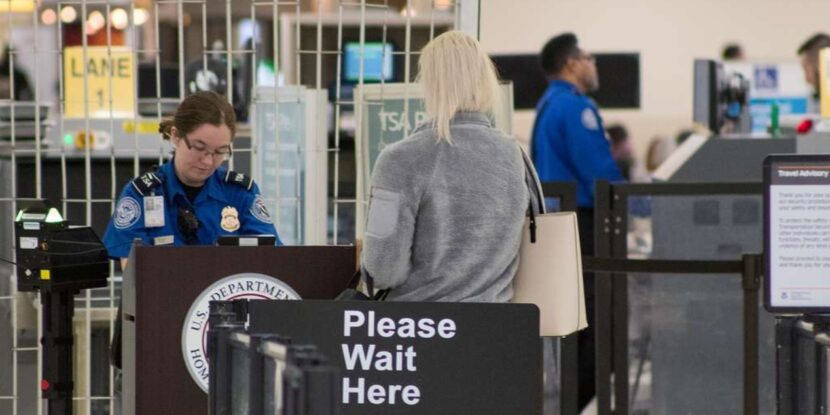
Major airports such as John F. Kennedy International in New York and Newark International in New Jersey have reported wait times up to 43 and 36 minutes, respectively. Spring Break travelers at destinations like Orlando and Honolulu are also encountering long delays, with some lines exceeding 45 minutes. At Atlanta‘s Hartsfield-Jackson International Airport, the world’s busiest, roughly 36 percent of TSA workers failed to show up, resulting in hour-long waits for passengers.

Union leaders have highlighted the financial hardships faced by TSA employees. Aaron Baker, president of a union representing Georgia’s TSA workers, stated, “Many are coping with eviction notices, vehicle repossessions, empty refrigerators, and overdrawn bank accounts.” He added, “Every available financial option has been exhausted,” during a press conference outside Hartsfield-Jackson. Hundreds of agents have already quit, leaving only 50,000 TSA workers nationwide.

The crisis has prompted Senator Markwayne Mullin (R-OK), President Donald J. Trump’s nominee to be the Department of Homeland Security (DHS) Secretary, to urge Congress to resolve the funding impasse. “We have to get DHS funded,” Mullin said during his confirmation hearing.

Image by Michael Ball.

Join Pulse+ to comment below, and receive exclusive e-mail analyses.

show less
show more
By Popular Demand.
The National Pulse Now has an on-site comments section for members. Sign up today and be part of the conversation in our community of almost 15,000.

WE ARE 100% INDEPENDENT AND READER-FUNDED. FOR A GUARANTEED AD-FREE EXPERIENCE AND TO SUPPORT REAL NEWS, PLEASE SIGN UP HERE, TODAY.

Denmark Made Military Preparations to Resist Greenlander Takeover.

PULSE POINTS

WHAT HAPPENED: Danish preparations to resist a forcible U.S. takeover of Greenland have been revealed, including the transport of explosives to the territory to blow up runways and prevent potential U.S. military landings.

👤WHO WAS INVOLVED: The Danish government and military, European allies, and the Trump administration.

📍WHEN & WHERE: January 2026, Greenland.

💬KEY QUOTE: “The U.S. would have to carry out a hostile act to get Greenland.” – Danish defense source.

🎯IMPACT: Background tensions over Greenland between the U.S. and Europe remain elevated.

IN FULL

Danish soldiers were deployed to Greenland with explosives and blood supplies to prepare to resist a U.S. takeover, sources have revealed. The Scandinavian country made active preparations to destroy runways to prevent U.S. military aircraft from landing, according to sources in Denmark, France, and Germany.

Sources also revealed that Denmark sought political support from European allies, including France and Germany, to oppose U.S. demands for control over Greenland. The Danish initiative aimed to create a European political alliance, while avoiding further escalation with the U.S.

The situation escalated in January 2026 when news broke of the U.S. raid on Venezuela. This prompted Denmark to accelerate the deployment of soldiers to Greenland. Elite forces from Denmark, France, Germany, Norway, and Sweden were flown to Nuuk and Kangerlussuaq, accompanied by Danish fighter planes and a French warship.

The deployment was part of a plan to deter the U.S. from attempting to occupy Greenland militarily. Danish soldiers were prepared to fight if necessary, despite acknowledging that they could not withstand an American attack. The operation was presented as an exercise called ‘Arctic Endurance,’ but it was a serious defense effort.

The Greenland crisis prompted Europe to reassess its security strategies. Denmark, along with other European countries, announced a strategic nuclear cooperation with France.

Join Pulse+ to comment below and receive exclusive email analyses.

show less
show more
By Popular Demand.
The National Pulse Now has an on-site comments section for members. Sign up today and be part of the conversation in our community of almost 15,000.

WE ARE 100% INDEPENDENT AND READER-FUNDED. FOR A GUARANTEED AD-FREE EXPERIENCE AND TO SUPPORT REAL NEWS, PLEASE SIGN UP HERE, TODAY.

Drones Reportedly Seen Over Military Base Housing Rubio, Hegseth.

PULSE POINTS

WHAT HAPPENED: Unidentified drones were allegedly detected above Fort Lesley J. McNair, prompting increased security measures and White House discussions.

👤WHO WAS INVOLVED: Secretary of State Marco Rubio, Secretary of War Pete Hegseth, and senior administration officials, alongside Pentagon spokesman Sean Parnell.

📍WHEN & WHERE: Fort Lesley J. McNair, Washington, D.C., over a single night in the last 10 days.

💬KEY QUOTE: “The department cannot comment on the secretary’s movements for security reasons, and reporting on such movements is grossly irresponsible.” – Sean Parnell

🎯IMPACT: Officials considered relocating Rubio and Hegseth, though they remain at Fort McNair. Heightened security measures have been implemented at various U.S. military installations.

IN FULL

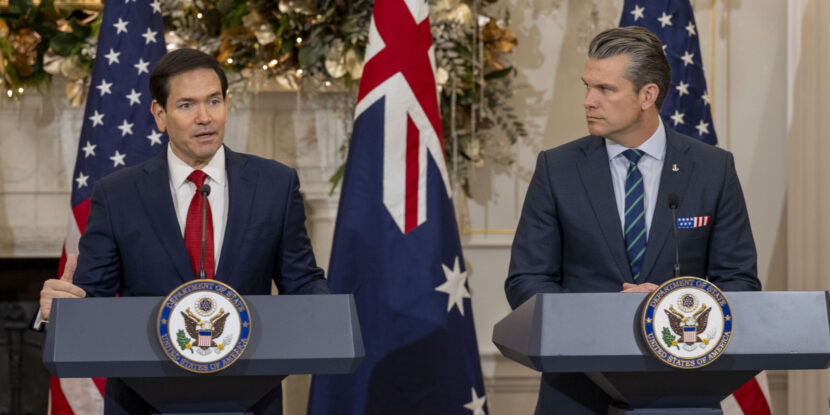
Unidentified drones were reportedly spotted above Fort Lesley J. McNair, where Secretary of State Marco Rubio and Secretary of War Pete Hegseth reside. The sightings, which occurred on a single night within the past 10 days, have prompted increased security measures and discussions at the White House about how to respond.

Officials were unable to determine the origin of the drones, and two sources revealed that relocating Rubio and Hegseth was briefly considered. However, the two secretaries remain at the base, which also houses the National Defense University and some of the Pentagon’s most senior officials.

Chief Pentagon spokesman Sean Parnell declined to comment on the drones or the secretaries’ movements when asked by The Washington Post, stating, “The department cannot comment on the secretary’s movements for security reasons, and reporting on such movements is grossly irresponsible.” Fort McNair, located near Capitol Hill and the White House along the Anacostia River, has not traditionally housed political leaders, though it has recently been home to several officials.

The incident comes amid heightened security concerns nationwide. Earlier this week, MacDill Air Force Base in Tampa, Florida, which hosts U.S. Central Command (CENTCOM), was placed under lockdown after a suspicious package was discovered. A second security incident at the base led to a shelter-in-place order for several hours.

Additionally, a leaked State Department cable ordered all U.S. diplomatic posts worldwide to conduct immediate security evaluations, citing potential spillover effects from the developing situation in the Middle East. Reports of unidentified drones near high-profile locations are not new and have been a recurring issue since 2020, following the U.S. operation that eliminated Iranian General Qasem Soleimani.

Join Pulse+ to comment below, and receive exclusive e-mail analyses.

show less
show more
By Popular Demand.
The National Pulse Now has an on-site comments section for members. Sign up today and be part of the conversation in our community of almost 15,000.

WE ARE 100% INDEPENDENT AND READER-FUNDED. FOR A GUARANTEED AD-FREE EXPERIENCE AND TO SUPPORT REAL NEWS, PLEASE SIGN UP HERE, TODAY.

U.S. Stealth Jet Struck by Iranian Fire for First Time.

PULSE POINTS

WHAT HAPPENED: An American F-35 stealth fighter made an emergency landing after reportedly being struck by Iranian fire during a combat mission.

👤WHO WAS INVOLVED: The U.S. military, Iranian forces, and U.S. Central Command (CENTCOM) spokesman Capt. Tim Hawkins.

📍WHEN & WHERE: During a combat mission over Iran in March 2026, the emergency landing occurred at a base in the Middle East.

💬KEY QUOTE: “The aircraft landed safely, and the pilot is in stable condition. This incident is under investigation.” – Capt. Tim Hawkins

🎯IMPACT: Marks the first time Iran has reportedly struck a U.S. aircraft in the ongoing conflict, and is the first time an enemy combatant has been able to target a F-35 stealth fighter successfully.

IN FULL

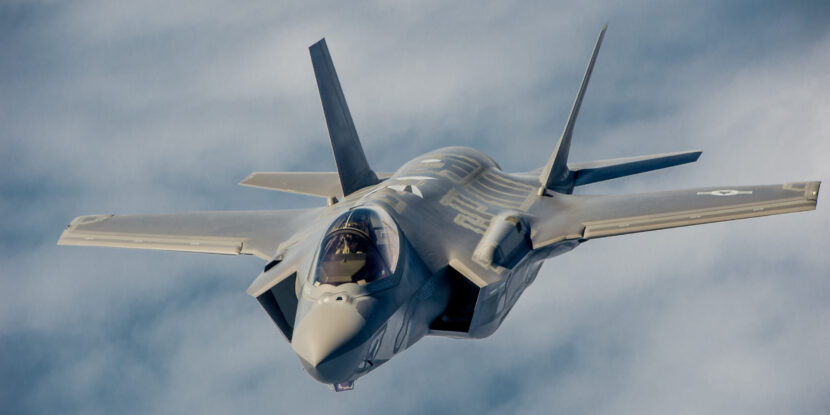
For the first time, an American F-35 stealth fighter was hit by an enemy combatant. The F-35 was struck by Iranian fire while flying a combat mission over Iran. While the $100 million aircraft was slightly damaged in the attack, it landed safely at a U.S. base in the Middle East, and the pilot is reported to be in stable condition.

“The aircraft landed safely, and the pilot is in stable condition,” U.S. Central Command (CENTCOM) spokesman Capt. Tim Hawkins said, adding, “This incident is under investigation.”

This marks the first time Iran has reportedly hit a U.S. aircraft during the conflict, which began in late February. Both the U.S. and Israel are utilizing the F-35, a stealth aircraft, in the ongoing war. Notably, the incident is reminiscent of—though likely less costly than—the 1999 shootdown of a Lockheed F-117 Nighthawk stealth ground-attack aircraft in Buđanovci, Serbia. The F-117 was hit by shrapnel from an S-125 Neva/Pechora surface-to-air missile, though the warhead did not directly impact the aircraft itself.

The Iran war has already resulted in significant air losses for the U.S. military. Early in the operation, three jets were mistakenly shot down by Kuwaiti forces, though all six crew members successfully ejected and were later greeted by locals in viral videos. Additionally, six service members lost their lives when a KC-135 Stratotanker crashed. Investigators have not yet determined whether enemy fire contributed to that incident.

In total, 13 U.S. service members have died in the ongoing war.

Join Pulse+ to comment below, and receive exclusive e-mail analyses.

show less
show more
By Popular Demand.
The National Pulse Now has an on-site comments section for members. Sign up today and be part of the conversation in our community of almost 15,000.

WE ARE 100% INDEPENDENT AND READER-FUNDED. FOR A GUARANTEED AD-FREE EXPERIENCE AND TO SUPPORT REAL NEWS, PLEASE SIGN UP HERE, TODAY.

Japan and Some European Allies Now Say They Will Help Reopen Strait of Hormuz.

ULSE POINTS

WHAT HAPPENED: Five European nations and Japan have expressed readiness to assist in reopening the Strait of Hormuz amid the Iran war.

👤WHO WAS INVOLVED: The United Kingdom, France, Germany, Italy, the Netherlands, Japan, and Iran, following calls for support from President Donald J. Trump.

📍WHEN & WHERE: The statement was issued on Thursday, addressing the closure of the Strait of Hormuz and attacks in the Persian Gulf region.

💬KEY QUOTE: “We condemn in the strongest terms recent attacks by Iran on unarmed commercial vessels in the Gulf,” the nations said in a joint statement. “We express our readiness to contribute to appropriate efforts to ensure safe passage through the Strait.”

🎯IMPACT: The Strait of Hormuz remains a critical chokepoint for global oil and fertilizer supplies, with disruptions threatening energy and food security worldwide.

IN FULL

The United Kingdom, France, Germany, Italy, the Netherlands, and Japan released a joint statement on Thursday expressing their willingness to support initiatives aimed at reopening the Strait of Hormuz, as the Iran war continues to escalate. “We condemn in the strongest terms recent attacks by Iran on unarmed commercial vessels in the Gulf, attacks on civilian infrastructure, including oil and gas installations, and the de facto closure of the Strait of Hormuz by Iranian forces,” the statement said.

The countries voiced deep concern about the war and urged Iran “to cease immediately its threats, laying of mines, drone and missile attacks, and other attempts to block the Strait to commercial shipping.” They also indicated their preparedness to participate in measures to guarantee secure navigation through the strait.

The Strait of Hormuz is a vital global oil and fertilizer transit route and has experienced significant interruptions after U.S. and Israeli military strikes against Iran prompted the Islamic Republic to target shipping in the waterway. Earlier this week, President Donald J. Trump urged nations that depend heavily on Middle Eastern oil—including China, Japan, South Korea, Britain, and France—to provide naval assistance in safeguarding the strait.

“We strongly encourage other nations whose economies depend on the strait far more than ours,” Trump stated. “We want them to come and help us.” Trump also cautioned NATO members about potential repercussions if they do not contribute to protecting this essential maritime passage, arguing that the alliance cannot be a “one-way” street in which America provides support but receives none in return.

Join Pulse+ to comment below, and receive exclusive e-mail analyses.

show less
show more
By Popular Demand.
The National Pulse Now has an on-site comments section for members. Sign up today and be part of the conversation in our community of almost 15,000.

WE ARE 100% INDEPENDENT AND READER-FUNDED. FOR A GUARANTEED AD-FREE EXPERIENCE AND TO SUPPORT REAL NEWS, PLEASE SIGN UP HERE, TODAY.

U.S. National Gas Average Hits Biden-Era Levels.

PULSE POINTS

WHAT HAPPENED: American gas prices have hit their highest levels since 2023, with the national average now at $3.88 per gallon.

👤WHO WAS INVOLVED: The oil and gas industry, President Donald J. Trump, the Islamic Republic of Iran, the Gulf States, and American consumers.

📍WHEN & WHERE: Thursday, March 19, 2026.

🎯IMPACT: The last time U.S. gas prices approached $4.00 per gallon was in September 2023, when, under former President Joe Biden, the price per gallon hit $3.83. Still, the current peak price has a ways to go to reach its highest point over the past 30 years, which occurred in 2022 during the COVID-19 pandemic, when gas cost $4.92.

IN FULL

American gas prices have hit their highest levels since 2023, with the national average now at $3.88 per gallon. The cost of energy, especially oil and natural gas, has surged in recent weeks after President Donald J. Trump authorized the U.S. military to strike political and military targets in the Islamic Republic of Iran. In retaliation, the Iranian regime has effectively forced the closure of the Strait of Hormuz—a chokepoint in the Persian Gulf through which over 20 percent of global oil flows—and targeted oil and gas infrastructure in neighboring Gulf States.

The last time U.S. gas prices approached $4.00 per gallon was in September 2023, when, under former President Joe Biden, the price per gallon hit $3.83. Still, the current peak price has a ways to go to reach its highest point over the past 30 years, which occurred in 2022 during the COVID-19 pandemic, when gas cost $4.92.

Concerningly, the 2022 peak price was predominantly driven by a breakdown in global supply chains and the shutdown of oil refineries worldwide. The current global energy crisis is rooted in similar factors, including a supply crunch caused by the closure of Gulf State oil and gas facilities and the cessation of tanker traffic through the Strait of Hormuz. This suggests gas prices could climb higher unless supply pressure is alleviated.

The National Pulse reported on Tuesday that the Iran conflict is wreaking havoc on Asian energy markets, forcing a number of countries to implement extraordinary measures to prevent runaway prices and shore up domestic petroleum reserves. In the Philippines, government officials have imposed a four-day workweek to cut electricity use and fuel consumption. Additionally, companies have been told their employees should shut off computers when not in use and keep the work area air conditioning set at 75 degrees Fahrenheit. Vietnam, meanwhile, is pressing refiners to work in overdrive to keep up supply, while Thailand is attempting to stretch its two-month fuel reserve well past its anticipated depletion date. Both Thailand and Vietnam have implemented emergency subsidies to shield most households from spiking energy costs in the short term.

Asia’s two most populous nations, China and India, are being hit especially hard. India is focusing on keeping prices down for residential consumers, mainly through subsidies. China, however, which accounted for 80 to 90 percent of Iran’s oil sales, has been forced to increase its price cap on gasoline and diesel. The new cap marks the highest increase since 2022.

Join Pulse+ to comment below, and receive exclusive e-mail analyses.

show less
show more
By Popular Demand.
The National Pulse Now has an on-site comments section for members. Sign up today and be part of the conversation in our community of almost 15,000.

WE ARE 100% INDEPENDENT AND READER-FUNDED. FOR A GUARANTEED AD-FREE EXPERIENCE AND TO SUPPORT REAL NEWS, PLEASE SIGN UP HERE, TODAY.

Oil Hits $120 Amid Iran Conflict.

PULSE POINTS

WHAT HAPPENED: Brent crude surged to nearly $120 a barrel amid escalating Middle East tensions, before retreating later in the morning.

👤WHO WAS INVOLVED: President Trump, Iran, Saudi Arabia, Israel, and QatarEnergy, among others.

📍WHEN & WHERE: Events unfolded Wednesday night into Thursday across the Middle East, including strikes in Iran and Saudi Arabia, and damage in Qatar.

💬KEY QUOTE: “The U.S. would destroy Iran’s South Pars gas field if Iran attacks Qatar.” – Donald Trump

🎯IMPACT: Global oil and gas prices surged, with Brent futures hitting $120 briefly, while U.S. gasoline prices spiked to $3.88 a gallon on average.

IN FULL

Brent crude oil prices spiked to nearly $120 a barrel on Thursday morning following the escalation of conflict in the Middle East. A drone struck a Saudi refinery, and President Trump issued a warning that the United States would destroy Iran’s South Pars gas field if Iran retaliated against Qatar.

By late morning, Brent futures retreated to $112, while West Texas Intermediate crude traded near $98. The price surge followed Israeli airstrikes on gas-processing and petrochemical facilities connected to South Pars, marking the first direct attack on Iran’s energy infrastructure in the ongoing conflict.

President Trump, distancing the U.S. from the Israeli strikes, stated on Truth Social that Washington had no prior knowledge of the attacks. However, he emphasized that the U.S. would act decisively against Iran if Qatar was targeted. In response, Iran launched missiles that caused significant damage to Qatar’s liquefied natural gas facilities, including fires at Ras Laffan Industrial City.

“I thought that it would go up more than it did, but we’re doing this excursion, and when it’s completed, we’re going to have a much safer world,” Trump said on Thursday afternoon.

Saudi Arabia’s defense ministry confirmed a drone strike on the Samref refinery, with damage assessments ongoing. Meanwhile, Dutch TTF natural gas futures surged 17 percent following the attacks in Qatar. The WTI-Brent price spread widened to nearly $20, reflecting greater perceived risks for international crude supplies.

U.S. gasoline prices followed the trend, with the national average reaching $3.88 per gallon on Thursday, a significant increase from the previous month. Treasury Secretary Scott Bessent suggested the administration might lift sanctions on Iranian oil already in transit or tap the strategic petroleum reserve to address the supply concerns.

Join Pulse+ to comment below and receive exclusive email analyses.

show less
show more
By Popular Demand.
The National Pulse Now has an on-site comments section for members. Sign up today and be part of the conversation in our community of almost 15,000.

WE ARE 100% INDEPENDENT AND READER-FUNDED. FOR A GUARANTEED AD-FREE EXPERIENCE AND TO SUPPORT REAL NEWS, PLEASE SIGN UP HERE, TODAY.

WATCH: Top House Dem Bizarrely Claims Founding Fathers Were ‘Undocumented Immigrants.’

PULSE POINTS

WHAT HAPPENED: Representative Jamie Raskin (D-MD) bizarrely claimed that Thomas Paine, a Founding Father, was an “undocumented immigrant” during a congressional subcommittee hearing on Wednesday.

👤WHO WAS INVOLVED: Rep. Jamie Raskin, Rep. Jim Jordan (R-OH), and members of the Subcommittee on Constitution and Limited Government.

📍WHEN & WHERE: Wednesday, during a Subcommittee on Constitution and Limited Government hearing.

💬KEY QUOTE: “I didn’t say he was an illegal immigrant, I said he was an undocumented immigrant, just like Thomas Jefferson’s family was.” – Rep Jamie Raskin

🎯IMPACT: The comments sparked debate over American history and immigration at the hearing.

IN FULL

A top House Democrat is claiming America’s Founding Fathers were mostly “undocumented” immigrants, in a bizarre attempt to undermine a Republican hearing regarding the effects of the 1982 Supreme Court ruling in Plyler v. Doe, which determined that states cannot block illegal immigrant children from attending school, citing the Equal Protection Clause of the Fourteenth Amendment. Representative Jamie Raskin (D-MD) described American revolutionary pamphleteer Thomas Paine, the author of Common Sense, as an “undocumented immigrant” during his opening remarks during the Subcommittee on Constitution and Limited Government hearing on Wednesday.

“I want to start by invoking Tom Paine, who was an undocumented immigrant who came to this land in 1774, two years before the revolution and wrote Common Sense, the pamphlet that ignited the American Revolution,” Raskin said. “And he said that this land, if it lives up to its ideals and its promise, would become an ‘asylum to humanity,’ he said. Not an insane asylum, but a place of refuge for people seeking freedom from religious and political, intellectual, and economic persecution from all over the world.”

The rabidly anti-Trump Democrat lawmaker further asserted that Thomas Jefferson descended from “a long line of undocumented immigrants both on his mother’s side and his father’s side to the country.”

The claims prompted Rep. Jim Jordan (R-OH) to interject, “I was just curious, Chairman [Chip Roy (R-TX)], the ranking member [Raskin] said, I think his opening sentence was Thomas Paine was an illegal immigrant. My understanding was Mr. Paine was born in the UK, came to America, then a British colony, in 1774. So I was just struggling how he was…” He was then cut off by Raskin, who replied, “I didn’t say he was an illegal immigrant, I said he was an undocumented immigrant, just like Thomas Jefferson’s family was. Most of our ancestors did not arrive here with documents.”


The shift in Democrat rhetoric regarding America’s Founding Fathers is curious. Over the last several years, the party has pandered to its far-left base by pushing to remove America’s revolutionary leaders from public spaces, including an attempt to take down statues of Founding Fathers like George Washington displayed in New York City.

Join Pulse+ to comment below, and receive exclusive e-mail analyses.

show less
show more
By Popular Demand.
The National Pulse Now has an on-site comments section for members. Sign up today and be part of the conversation in our community of almost 15,000.

WE ARE 100% INDEPENDENT AND READER-FUNDED. FOR A GUARANTEED AD-FREE EXPERIENCE AND TO SUPPORT REAL NEWS, PLEASE SIGN UP HERE, TODAY.

New Home Sales Collapsed in January to the Lowest Level in Years.

PULSE POINTS

WHAT HAPPENED: New U.S. home sales have fallen dramatically to levels not seen in years, with January’s newly built single-family home purchases performing far below forecasts.

👤WHO WAS INVOLVED: U.S. homeowners, the Trump administration, and the housing industry.

📍WHEN & WHERE: The figures were published on March 19, 2026.

🎯IMPACT: The data suggests the U.S. housing market may be losing momentum faster than forecast, which could signal the beginning of an economic downturn.

IN FULL

U.S. new home sales fell sharply in January, dropping far more than expected and hitting their lowest level in several years, according to newly released government data. Sales of newly built single-family homes plunged 17.6 percent from the previous month to a seasonally adjusted annual rate of 587,000 units, the weakest pace since late 2022. Economists had anticipated a higher number of new sales at 722,000, signaling the housing market may be losing momentum faster than forecast.

The slowdown was broad-based, with all four major U.S. regions reporting declines. Severe winter weather, including snowstorms and freezing temperatures, likely discouraged buyers from touring homes and finalizing purchases. Still, the weakness extends beyond temporary disruptions.

December’s figures were revised lower, indicating the market had already been softening. Mortgage rates have also risen again after a brief dip, increasing borrowing costs and worsening affordability. At the same time, builders continue to grapple with high construction costs, labor shortages, and limited land.

Inventory has climbed to nearly 10 months of supply—well above a balanced level—while the median price of a new home has declined year over year, suggesting weaker demand is putting pressure on prices.

The National Pulse previously reported that President Donald J. Trump has pushed housing affordability measures focused on limiting corporate ownership of single-family homes, arguing that homes should be prioritized for individuals and families rather than large investors.

Join Pulse+ to comment below, and receive exclusive e-mail analyses.

show less
show more
By Popular Demand.
The National Pulse Now has an on-site comments section for members. Sign up today and be part of the conversation in our community of almost 15,000.

WE ARE 100% INDEPENDENT AND READER-FUNDED. FOR A GUARANTEED AD-FREE EXPERIENCE AND TO SUPPORT REAL NEWS, PLEASE SIGN UP HERE, TODAY.

MIGRANT WELFARE RANKINGS: Guess Which Groups Cost YOU The Most to Host?

PULSE POINTS

WHAT HAPPENED: A new report released by the Center for Immigration Studies (CIS) sheds critical light on the scope of American welfare benefits accessed by noncitizens, revealing surprising variation by country and level of educational attainment.

👤WHO WAS INVOLVED: Noncitizen households—including both permanent legal residents and illegal immigrants, American taxpayers, and the Center for Immigration Studies (CIS).

📍WHEN & WHERE: The study was released on March 18, 2026.

💬KEY QUOTE: “Although most new legal immigrants and illegal immigrants are barred from accessing most means-tested programs, these restrictions have not prevented a large share of noncitizen-headed households from accessing the welfare system.” — CIS

🎯IMPACT: According to the data, 47 percent of households headed by a noncitizen—both permanent legal residents and illegal immigrants—utilize at least one government-funded welfare program. This number jumps to 54 percent when including refundable tax credits, such as the Earned Income Tax Credit (EITC) and the Additional Child Tax Credit (ACTC).

IN FULL

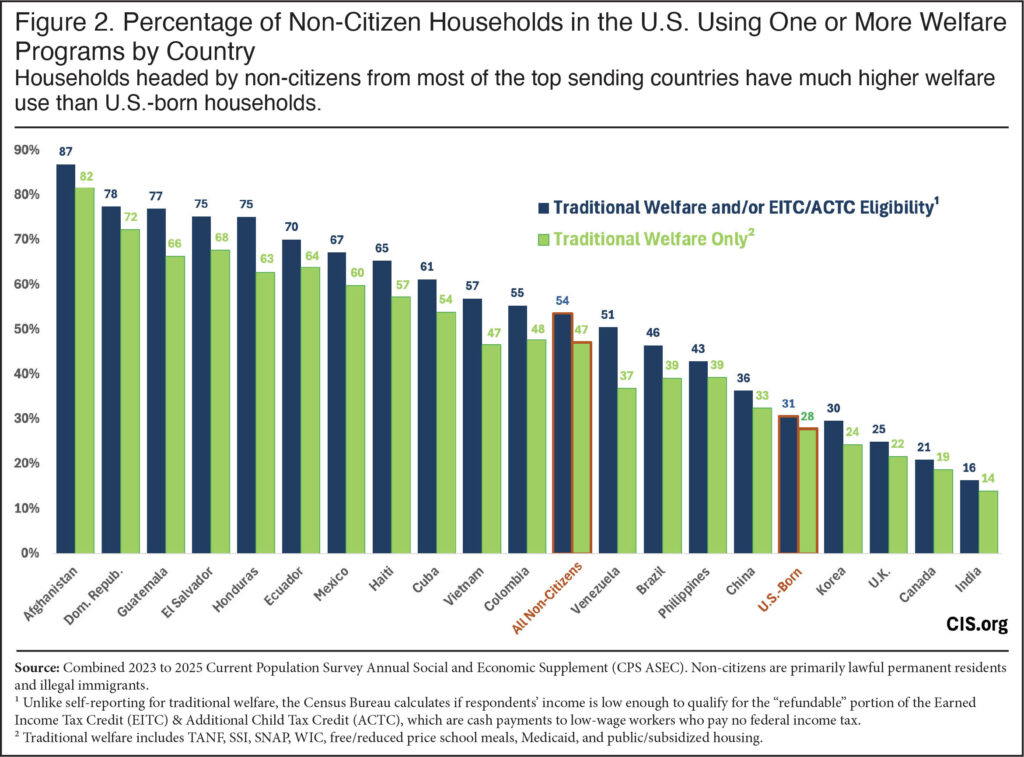
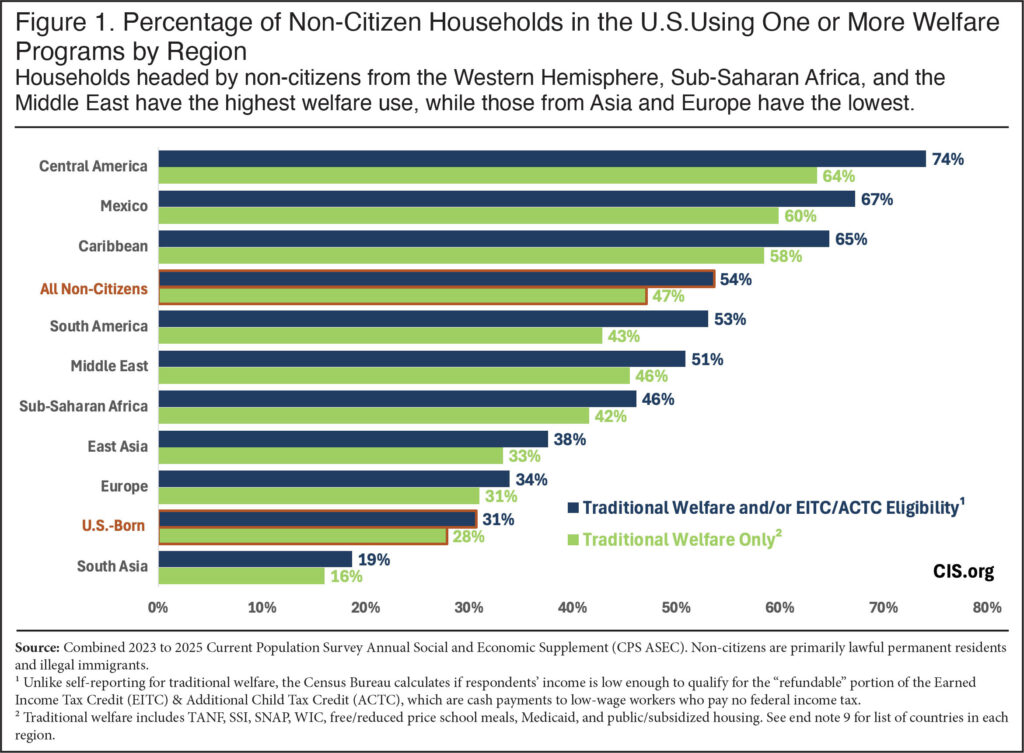
A new report released by the Center for Immigration Studies (CIS) sheds critical light on the scope of American welfare benefits accessed by noncitizens, revealing surprising variation by country and level of educational attainment. According to the data, 47 percent of households headed by a noncitizen—both permanent legal residents and illegal immigrants—utilize at least one government-funded welfare program. This number jumps to 54 percent when including refundable tax credits, such as the Earned Income Tax Credit (EITC) and the Additional Child Tax Credit (ACTC). For native-born Americans, the percentages are 28 percent and 31 percent, respectively.

“Although most new legal immigrants and illegal immigrants are barred from accessing most means-tested programs, these restrictions have not prevented a large share of noncitizen-headed households from accessing the welfare system,” CIS explains, continuing, “This is primarily because non-citizens often receive benefits on behalf of their U.S.-born children and the restrictions only apply to some programs. These facts coupled with the large share of noncitizens who have modest levels of education and their resulting low incomes mean many can use means-tested anti-poverty programs.”

Households headed by noncitizens from Afghanistan are the top beneficiaries of American welfare programs. The CIS report shows that 82 percent of Afghan immigrant households are dependent on traditional government welfare assistance. This number rises to a stunning 87 percent when the EITC and ACTC are included.

After Afghanistan, noncitizens originating from the Dominican Republic are the next largest welfare users. Next in line, 78 percent of Dominican households rely on either traditional welfare programs or refundable tax credits. Similarly, 77 percent of households headed by noncitizens from Guatemala are reliant on the same.

The lowest welfare use among noncitizen households is by those headed by individuals from South Korea, the United Kingdom, Canada, and India, respectively. Other national origin groups falling below the average welfare use for all noncitizens are Venezuela, Brazil, the Philippines, and China.

When broken down by region, Central American noncitizens are the most likely to use welfare, with 74 percent utilizing government aid programs or refundable tax credits. Interestingly, immigrants from South Asia are the only regional group to utilize welfare programs less than native-born Americans, with just 19 percent benefiting from both traditional and non-traditional government assistance. Noncitizen households headed by individuals of European origin, meanwhile, are nearly on par with native-born Americans, with just 34 percent accessing refundable tax credits or traditional welfare programs.


Join Pulse+ to comment below, and receive exclusive e-mail analyses.

show less
show more
By Popular Demand.
The National Pulse Now has an on-site comments section for members. Sign up today and be part of the conversation in our community of almost 15,000.