❓WHAT HAPPENED: Ohio Governor Mike DeWine (R) is criticizing President Donald J. Trump’s decision to end Temporary Protected Status (TPS) for Haitians, while defending his state government’s support for importing cheap immigrant labor.
👤WHO WAS INVOLVED: Gov. DeWine, President Trump, Haitian migrants, and Springfield employers.
Newsletter
Need to Know.
Your free, daily feed from The National Pulse.
Thank You!
You are now subscribed to our newsletter.
📍WHEN & WHERE: Sunday, February 22, 2026, during an appearance on CBS’s Face the Nation.
💬KEY QUOTE: “Springfield is an industrial city, manufacturing city that was down. It has been coming back. And frankly, one of the reasons it’s coming back is because of the Haitians who are working there.” – Governor Mike DeWine
🎯IMPACT: The influx of Haitian labor has driven down wages, increased housing costs, and placed strain on welfare systems in Springfield, Ohio.
IN FULL
Ohio Governor Mike DeWine (R) appeared on CBS’s Face the Nation on Sunday to defend the importation of cheap immigrant labor and criticize President Donald J. Trump’s decision to end Temporary Protected Status (TPS) for Haitians. DeWine argued that Haitians have played a key role in supposedly revitalizing Springfield, Ohio, by working manufacturing jobs that he claimed could not be filled otherwise.
“Springfield is an industrial city, manufacturing city that was down. It has been coming back. And frankly, one of the reasons it’s coming back is because of the Haitians who are working there,” DeWine said, adding, “These are people who, if you talk to the employers, they were filling jobs that were not being able to be filled in any other way.”
The Republican governor went on to criticize President Trump for ending TPS for Haitians last summer. “So, if one day that TPS is taken away, no employer can hire them anymore, and you’ll have all these people who are unemployed. So, I think the policy there is wrong,” DeWine stated.
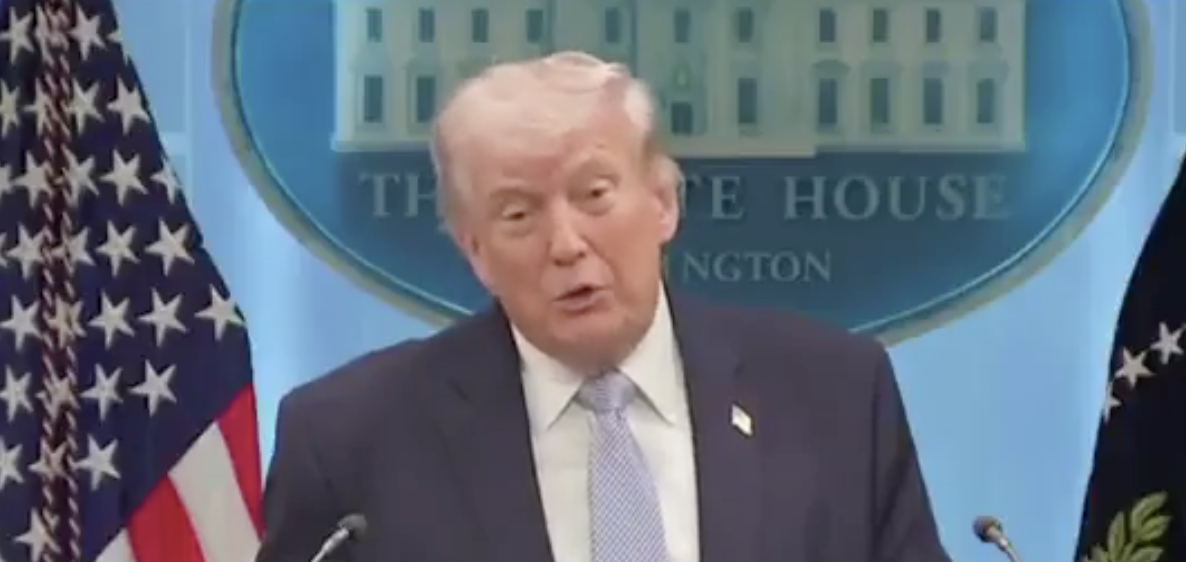
🚨New: Ohio Governor Mike DeWine slammed President Trump’s policy on removing Temporary Protected Status for Haitians “is wrong” because it would impact the manufacturing economy in Springfield, Ohio. pic.twitter.com/65FVzj17mI
However, census data paints a less optimistic picture of Springfield’s economic situation after the influx of Haitian immigrants. The town’s poverty rate stands at 23.06 percent, with a median household income of $47,143—both figures significantly worse than Ohio’s state averages. Housing costs have also risen sharply since 2020, with home values increasing by more than 50 percent and rents rising due to limited inventory.
Notably, the TPS designation has allowed up to 15,000 Haitians in Springfield to access welfare programs, including the Supplemental Nutrition Assistance Program (SNAP), Medicaid, and Temporary Assistance for Needy Families (TANF), adding to the tax burden for residents. Additionally, the Springfield school district has enrolled approximately 1,500 Haitian children, requiring the hiring of teachers fluent in Haitian Creole. The Ohio Department of Job and Family Services noted that over 5,200 aid applications for Haitians were approved last year.
The National Pulse reported earlier this month that U.S. District Court Judge Ana Reyes, appointed by former President Joe Biden, issued a ruling temporarily halting the Trump administration’s effort to end the TPS designation for approximately 350,000 Haitian nationals. Judge Reyes, a Harvard-educated Uruguayan immigrant, admitted that the TPS statute limits judicial review of the substantive decisions on country designations, but argued she could intervene regardless to examine whether the administrative process followed proper procedures.
Join Pulse+ to comment below, and receive exclusive e-mail analyses.
By Popular Demand.
The National Pulse Now has an on-site comments section for members. Sign up today and be part of the conversation in our community of almost 15,000.
More From The Pulse
WE ARE 100% INDEPENDENT AND READER-FUNDED. FOR A GUARANTEED AD-FREE EXPERIENCE AND TO SUPPORT REAL NEWS, PLEASE SIGN UP HERE, TODAY.
Welcome to Issue 3 of The National Pulse’s new-look nightly news round-up. Subscribers keep this possible, so I implore you to join today, if you haven’t already. If you can’t, or won’t, would you mind telling me why, or how I might convince you? This is a brutal industry right now, so I’m all ears.
Newsletter
Need to Know.
Your free, daily feed from The National Pulse.
Thank You!
You are now subscribed to our newsletter.
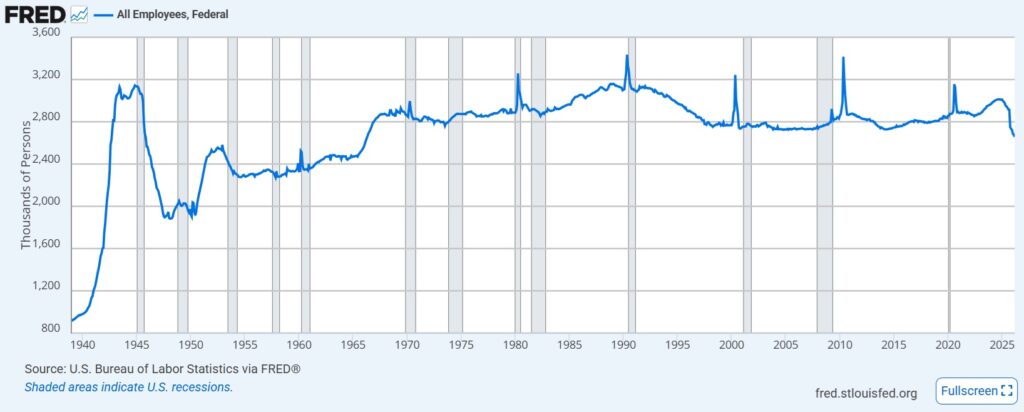
1. Federal Workforce Hits Lowest Level Since 1966.
Less than two percent of American workers are now employed by Uncle Sam.
❓ WHAT HAPPENED: Federal employment is at its lowest since 1966, with a significant reduction in the civilian workforce. Over the past 14 months, federal employment has dropped by 12 percent. Less than two percent of people in work are now employed by the federal government.
👤 WHO WAS INVOLVED: The Trump administration, federal workers.
📍 WHEN & WHERE: The reductions have taken place since January 2025 across various federal departments.
📺 DETAIL: Since President Donald J. Trump took office, the government has eliminated 352,000 civilian positions through voluntary buyouts, targeted layoffs, and reduced hiring. Layoffs were concentrated in administrative roles, with the Department of War seeing the largest cuts in absolute terms, but the U.S. Agency for International Development (USAID) and the Education Department seeing the largest cuts in relative terms. USAID went from around 4,000 staff to 370 (-92.4 percent), and Education went from around 4,300 to under 2,500 (-42.6 percent) from December 2024 to December 2025, according to Pew Research Center data published in March.
🎯 CAVEAT: A comprehensive breakdown of federal workforce reduction is not possible, as Office of Personnel Management (OPM) data categories are substantially redacted. Almost half of the December 2025 records did not list workers’ job locations. Much of the Executive Office of the President, Congress, intelligence agencies, all legislative agencies, and several other entities are not covered at all.
💬 KEY QUOTE: “Under President Trump, the federal workforce has been reduced to its smallest level since 1966—the lowest share of the total labor force in over a century.” – White House statement.
🎯 IMPACT: Savings from the workforce reduction are currently unclear, with early layoffs overseen by the now-shuttered Department of Government Efficiency (DOGE) being more haphazard than OPM’s orderly layoffs. A significant number of workers had to be rehired, and many have continued to receive their salary and benefits under the terms of their deferred resignations. Elaine Kamarck, a senior fellow at the Brookings Institution, has offered a broad estimate of $100 billion to $200 billion in eventual savings. Overall, federal spending remains elevated, fueled by transfer payments, grants, and interest on the national debt.
📺 GRAPHIC: Federal employment over time, via the Federal Reserve Bank of St. Louis:
2. Is the DOJ Investigating Foreign-Funded Internet Influencers?
Rumors of a DOJ probe into foreign-funded influencers have the online right turning on itself.
PULSE POINTS: FOLLOW THE MONEY.
❓ WHAT HAPPENED: Conservative influencers are debating rumors of a Department of Justice (DOJ) investigation into foreign funding in their ranks, sparking a social media frenzy. The claims originated from the anonymous X (formerly Twitter) account “0H0UR” and quickly gained traction, despite a lack of verified evidence. A DOJ source told The National Pulse late on Thursday night: “I think that is all BS.”
📍 WHEN & WHERE: The controversy unfolded online this week, following a post on X (formerly Twitter).
💬 KEY QUOTE: “Influencers who take foreign money and don’t disclose it should be deported to the country they took the money from.” – Jack Posobiec
🎯 IMPACT: The debate highlights potential divisions among conservative influencers over alleged foreign influence. The controversy is also reviving past allegations — Benny Johnson previously faced scrutiny over payments tied to Tenet Media, an outlet linked to Russian funding. Johnson has said he was unaware of the origin of the money at the time.
📺 BACKGROUND: Analysts have warned that overseas actors route money into the U.S. through nonprofits, media ventures, and political groups to shape narratives while masking the true source of funding. Recent reporting indicates that campaigns presented as grassroots movements supporting New York Mayor Zohran Mamdani (D) had foreign backing. Democrat fundraising platform ActBlue also faces investigation for insufficient oversight of donations, potentially allowing impermissible donations despite assurances to Congress that safeguards were in place.
3. Is This the Next Cabinet Member to be Ousted?
Three female staffers have filed complaints against the Labor Secretary over alleged retaliation — and her husband over alleged sexual misconduct.
PULSE POINTS: TROUBLE AT THE TOP.
❓ WHAT HAPPENED: Labor Secretary Lori Chavez-DeRemer is facing three complaints filed with the Equal Employment Opportunity Commission by three female staffers, following allegations of retaliation for reporting her husband, Dr. Shawn DeRemer, for sexual misconduct.
📍 WHEN & WHERE: Allegations date back to December 2025 and involve incidents at the Labor Department headquarters on Constitution Avenue in Washington, D.C.
🎯 DETAIL: Two of the complaints accuse Chavez-DeRemer’s husband of sexually abusing the women inside the Labor Department headquarters in Washington, D.C. The complaints also allege that Chavez-DeRemer retaliated against the employees after they reported the incidents. The Labor Secretary’s husband was initially banned from entering the Labor Department’s premises following these reports. A third complaint claims that Chavez-DeRemer required staff members to perform personal errands for her, including cleaning out her closets.
💬 KEY QUOTE: “If Mr. DeRemer attempts to enter, he is to be asked to leave.” – Building restriction notice posted at the Labor Department after the Secretary’s husband was reported.
🎯 IMPACT: The accusations have triggered an internal investigation by the department’s inspector general’s office into Chavez-DeRemer and several of her senior aides and security staff, with employees alleging a “hostile” work environment. The U.S. Attorney’s Office for the District of Columbia declined to bring charges against Dr. DeRemer over the December 2025 allegations. His attorney has stated that he “categorically, unequivocally, and emphatically denies each and every one of the allegations.”
📺 FLASHBACK: Lori Chavez-DeRemer’s nomination as Labor Secretary was controversial, due to her past support for illegal immigrant “Dreamers.”
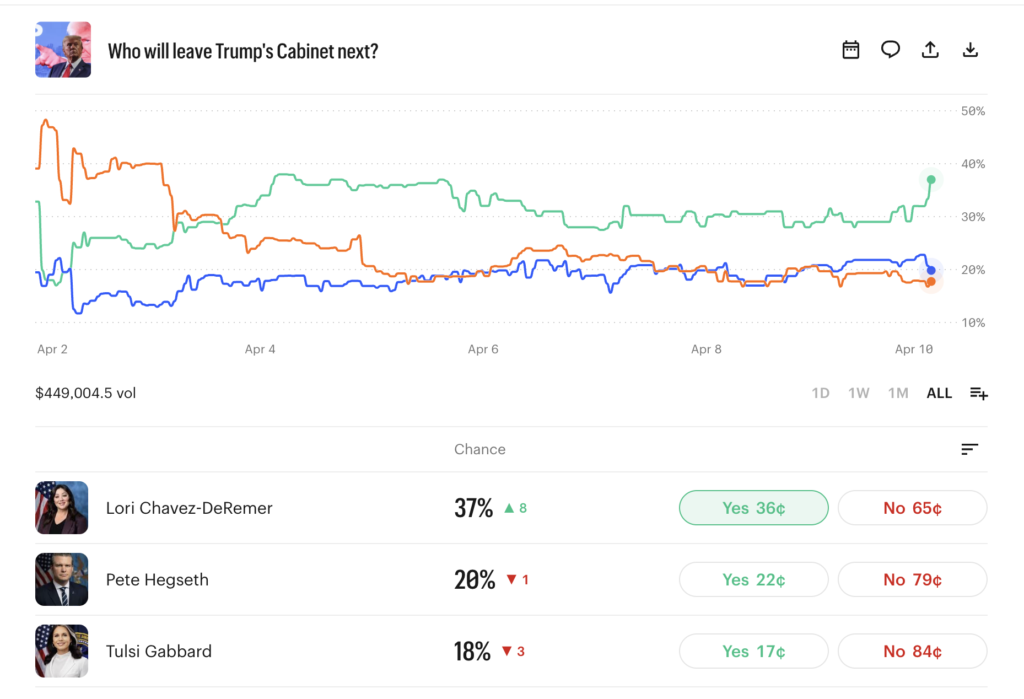
📈 DATA: Predictions markets show Chavez-DeRemer as the favorite to be the next to exit Trump’s Cabinet.
4. Top Trump Ally Faces Critical Election This Weekend.
Prediction markets give Orbán just a 28% chance of holding power — days after the Trump administration doubled down on its support.
PULSE POINTS: BUDAPEST OR BUST.
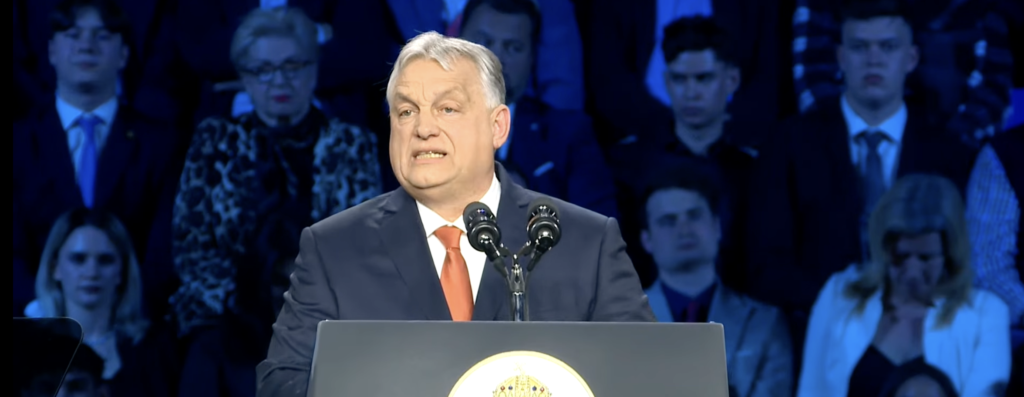
❓ WHAT HAPPENED: Prediction market data suggests that Hungarian Prime Minister Viktor Orbán has a 28 percent chance of winning the country’s parliamentary elections this coming weekend. His opponent, Péter Magyar, is said to have a 71 percent chance of winning. This new low comes as the Trump administration, which backs Orbán, is touting a new bilateral agreement this week covering oil, nuclear energy, and defense.
👤 WHO WAS INVOLVED: Viktor Orbán, Peter Magyar, the European Union (EU), and the Trump administration.
📍 WHEN & WHERE: The Hungarian elections are scheduled for Sunday, April 12.
💬 KEY QUOTE: “This is not the time for division, anger, or hatred. Hungary needs cooperation, unity, and security.” – Viktor Orbán
🎯 DETAIL: Orbán, an ally of President Donald J. Trump, has won four consecutive elections on a platform emphasizing strong borders, financial support for families, and opposition to becoming involved in the war in neighboring Ukraine. However, recent polling shows rising support for Magyar amid a sustained period of economic difficulty. Magyar has emphasized cooperation with the EU and NATO, in contrast with Orbán’s eurosceptic, anti-war stance, and accused the Hungarian prime minister of ties to Russian President Vladimir Putin.
🎯 IMPACT: The Trump administration is backing Orbán, with Vice President J.D. Vance traveling to Hungary this week and stressing that “What the United States and Hungary together represent under [Trump and Orbán’s] leadership is the defense of Western civilization… the defense of the idea that we are founded on a certain Christian civilization and Christian values.” Orbán’s ouster could allow the EU to increase support for Ukraine, and undermine a U.S.-Hungary bilateral agreement promoted by the White House on Friday.
5. Pulitzer-Winning WaPo Journo Pleads Guilty to Child Porn Possession.
Another Washington Post staffer faces child exploitation charges — the second in just over a year.
PULSE POINTS: WHAT’S IN THE WATER AT WAPO?
❓ WHAT HAPPENED:Washington Post video journalist Thomas Pham LeGro, awarded the Pulitzer Prize in 2018, has pleaded guilty to possession of child pornography.
👤 WHO WAS INVOLVED: Thomas Pham LeGro, Deputy Director of Video at The Washington Post, and federal law enforcement, including U.S. Attorney Jeanine Pirro.
📍 WHEN & WHERE: U.S. District Court in Washington, D.C., April 10, 2026.
🎯 DETAIL: LeGro was arrested on June 26, 2025, after FBI agents executed a search warrant at his home and seized multiple electronic devices, also discovering what appeared to be broken pieces of a hard drive concealed under a rug in his basement.
💬 KEY QUOTE: “A review of LeGro’s laptop revealed a folder that contained 11 videos depicting child sexual abuse. These videos depicted adult men sexually abusing prepubescent children and forcing them to engage in sex acts.” – Statement from the U.S. Attorney’s Office for the District of Columbia
📺 FLASHBACK: In January 2025, The Post’s anti-Trump cartoonist Darrin Bell was also arrested on child pornography allegations, after investigators discovered 134 videos of real and AI-generated abuse material on an account he was linked to. Former Post reporter Taylor Lorenz has also been accused of interacting with teenagers on social media inappropriately.
👀 IRONY: LeGro was a member of The Washington Post’s team that reported on Republican Roy Moore’s alleged sexual harassment of teenage girls.
6. China’s Xi Jinping Declares Taiwan Annexation ‘Inevitable.’
Beijing is rolling out the red carpet for Taiwan’s opposition — while ramping up military pressure on the island.
PULSE POINTS: “HISTORIC INEVITABILITY.”
❓ WHAT HAPPENED: Chinese President Xi Jinping held a meeting in Beijing on Friday with Taiwan’s main opposition leader, Cheng Li-wun, describing the island’s unification with the mainland as a “historic inevitability.” Cheng described her “peace trip” as an opportunity to showcase the supposed “sincerity and determination of the Chinese Communist Party to engage in peaceful dialogue and exchanges across the Taiwan Strait,” and said she would like to invite Xi to visit the island if she wins power.
👤 WHO WAS INVOLVED: Xi Jinping, President of China, and Cheng Li-wun, Chairwoman of Taiwan’s Nationalist Party, or Kuomintang (KMT).
📍 WHEN & WHERE: The meeting took place on April 10, in Beijing.
💬 KEY QUOTE: “‘Taiwan independence’ is the chief culprit destroying peace in the Taiwan Strait,” said Xi, according to a readout of his meeting with Cheng, adding: “We absolutely will not tolerate it or allow it.”
🎯 DETAIL: China recently intensified military drills and pressure in the Taiwan Strait. Notably, the meeting comes as Beijing criticizes U.S. arms sales to Taiwan, and precedes a planned visit by President Donald J. Trump, who has adopted a supportive stance toward Taiwan. Beijing continues to regard Taiwan, which remained independent of the Chinese Communist Party (CCP) following its takeover of the Chinese mainland, as a breakaway province, while most Taiwanese strongly support maintaining de facto independence. This includes the incumbent President Lai Ching-te, derided by the CCP as a “separatist,” “troublemaker,” and “warmonger.”
📺 FLASHBACK: In March 2024, Admiral John Aquilino, then-head of the Indo-Pacific Command, told the U.S. House Armed Services Committee that “All indications point to the PLA (People’s Liberation Army) meeting President Xi Jinping’s directive to be ready to invade Taiwan by 2027,” adding that “The PLA’s actions indicate their ability to meet Xi’s preferred timeline to unify Taiwan with mainland China by force if directed.”
7. A 32-Hour Ceasefire for Orthodox Easter. Then What?
Both sides say they’re ready for peace — but neither trusts the other to keep it.
PULSE POINTS: PEACE ON EARTH (TEMPORARILY).
❓ WHAT HAPPENED: Russia and Ukraine have agreed to a temporary 32-hour ceasefire over the weekend of Orthodox Easter (April 12), which most Orthodox Christians celebrate according to the Julian Calendar (Old Calendar). Russian President Vladimir Putin announced a halt to fighting, which Ukrainian President Volodymyr Zelensky is willing to reciprocate.
👤 WHO WAS INVOLVED: Vladimir Putin, Volodymyr Zelensky, and the Russian and Ukrainian armed forces.
💬 KEY QUOTE: “Ukraine has repeatedly stated that we are ready for reciprocal steps. We proposed a ceasefire during the Easter holiday this year and will act accordingly.” – Volodymyr Zelensky
💬 SECONDARY QUOTE: “We proceed on the basis that the Ukrainian side will follow the example of the Russian Federation.” – Kremlin statement
🎯 DETAIL: The truce is set to run from the evening of April 11 (4 PM Moscow time) through until midnight on April 12, with both sides expected to pause attacks on all fronts during the holiday period. Skepticism remains high because similar ceasefires were repeatedly violated in the past, with each side blaming the other. Zelensky said that Ukraine had already proposed a ceasefire before Putin did, and that Ukraine is prepared to observe one if Russia honors it.
🎯 IMPACT: Ukraine hopes that the ceasefire may be extended beyond Orthodox Easter, with Zelensky saying, “People need an Easter without threats and a real move towards peace, and Russia has a chance not to return to attacks even after Easter.” While it is possible the proposed pause could become a springboard for peace talks, there is widespread doubt that any ceasefire will hold beyond the holiday, with a Russian spring offensive underway and Zelensky saying he expects the situation “will be very difficult for us until September.“
8. London Mayor Tells Big Tech to Censor London’s Crime Critics.
Khan wants a new censorship body with teeth — and he’s blaming Americans for making London look bad.
PULSE POINTS: “OI, YOU GOT A LOICENCE FOR THAT TWEET?”
❓ WHAT HAPPENED: London Mayor Sadiq Khan has called on Big Tech and the British government to censor social media posts portraying the British capital as declining and crime-ridden. Khan accused social media companies of insufficiently controlling what can be posted online, demanding government intervention if they do not heed directives from Ofcom, the British communications regulator.
👤 WHO WAS INVOLVED: Mayor Sadiq Khan, social media users, and the British government.
📍 WHEN & WHERE: Khan made his remarks on Thursday during a speech at the Cambridge Disinformation Summit, hosted by the University of Cambridge.
💬 KEY QUOTE: “We need a new central body with the agility and authority to protect our democracy from disinformation and deal with the scale and speed of this crisis. And we need more aggressive enforcement of the rules we already have. Because unless regulators like Ofcom have the power to hit companies where it hurts, they’ll keep on getting away with it.” – Sadiq Khan
🎯 DETAIL: Khan complained that some of the posts highlighting crime and social issues in London come from foreign countries, including the United States, insinuating a foreign intelligence plot to undermine British interests.
🎯 IMPACT: Khan’s intervention represents another attempt by British officials to clamp down on freedom of speech, despite the Trump administration sanctioning pro-censorship activists from the United Kingdom and the European Union late last year. That move reflected concerns that European efforts to control online speech are affecting Americans.
1. In 1606, the Virginia Company is established by King James I of England. It would go on to establish the first colonial settlements in America.
2. In 1865, Confederate General Robert E. Lee addresses his troops, having just surrendered to the Union Army.
3. In 1912, the RMS Titanic set off from Southampton, never to return.
4. In 1925, F. Scott Fitzgerald’s The Great Gatsby was published. It sold poorly, hitting only 25,000 sales before the author’s death in 1940. It now sells half a million a year.
5. In 1998, the Good Friday Agreement is signed, ending the 30-year-long ‘Troubles’ between Great Britain and Irish Republicans.
show less
show more
By Popular Demand.
The National Pulse Now has an on-site comments section for members. Sign up today and be part of the conversation in our community of almost 15,000.
WE ARE 100% INDEPENDENT AND READER-FUNDED. FOR A GUARANTEED AD-FREE EXPERIENCE AND TO SUPPORT REAL NEWS, PLEASE SIGN UP HERE, TODAY.
❓WHAT HAPPENED: Inflation surged in March, driven by economic disruptions linked to the Iran war’s impact on energy markets.
Newsletter
Need to Know.
Your free, daily feed from The National Pulse.
Thank You!
You are now subscribed to our newsletter.
👤WHO WAS INVOLVED: The Bureau of Labor Statistics (BLS) reported the data; American consumers are affected.
📍WHEN & WHERE: The report was released on April 10, 2026, detailing March’s inflation figures in the United States.
💬KEY QUOTE: “The energy price shock will take many months to play out to other parts of the economy.” – Samuel Tombs
🎯IMPACT: Rising energy costs have heavily influenced inflation, affecting consumer prices and household budgets.
IN FULL
The latest Consumer Price Index (CPI) report released by the Bureau of Labor Statistics (BLS) shows inflation surged in March, driven by ongoing economic fallout from the war with Iran. The CPI, which tracks changes in prices for items such as gasoline and groceries, increased 0.9 percent from the previous month and stands 3.3 percent higher than the same period a year ago.
Economists polled by LSEG had largely expected these numbers, with both the monthly 0.9 percent rise and the annual 3.3 percent increase matching forecasts. Core inflation, which excludes volatile categories like food and gasoline, rose more modestly—up 0.2 percent for the month and 2.6 percent over the past year—coming in slightly below expectations.
The Iran war has had a major impact on energy prices, pushing gasoline costs up a record 21.2 percent in March alone. That sharp increase accounted for nearly three-quarters of the overall monthly rise in the CPI. Economists warn that these higher energy costs are likely to continue affecting the broader economy for some time.
Samuel Tombs, chief U.S. economist at Pantheon Macroeconomics, said, “There’s been bigger energy price shocks in total, but they’ve rippled through over several months. This just came through in one month.” He added that the energy price shock will take time to fully feed through into other parts of the economy.
Join Pulse+ to comment below, and receive exclusive e-mail analyses.
show less
show more
By Popular Demand.
The National Pulse Now has an on-site comments section for members. Sign up today and be part of the conversation in our community of almost 15,000.
WE ARE 100% INDEPENDENT AND READER-FUNDED. FOR A GUARANTEED AD-FREE EXPERIENCE AND TO SUPPORT REAL NEWS, PLEASE SIGN UP HERE, TODAY.
Welcome to the second (and very much developing) roundup of the day’s news from The National Pulse team. I’m your Editor-in-Chief, Raheem Kassam. Read more about our format experimentation here.
Newsletter
Need to Know.
Your free, daily feed from The National Pulse.
Thank You!
You are now subscribed to our newsletter.
1. Shameful ‘Republicans’ Promoting Amnesty for Illegals.
While the war with Iran is undoubtedly the biggest international news story, we’re called The National Pulse. So it’s our decision to lead with this horrendous amnesty bill being promoted by Congressional ‘Republicans’ this week.
PULSE POINTS: SHAMNESTY.
❓ WHAT HAPPENED: A bipartisan immigration bill euphemistically called the Dignity Actis highlighting sharp divisions within the Republican Party. The legislation, introduced by Representative María Elvira Salazar (R-FL) and Rep. Veronica Escobar (D-TX), promises a new legal pathway for millions of illegal immigrants already in the country. The Trump administration already stands reasonably accused of backsliding on its mass deportations pledge. This bill, wherein illegal immigrants could apply for temporary legal status through its “Dignity Program” if they pass background checks, pay $7,000 restitution, and taxes, is adding fuel to that fire.
👤 WHO WAS INVOLVED: A list floating around identifies the following names as being favorable toward, or co-sponsoring the Dignity Act: Maria Elvira Salazar, David Valadao, Dan Newhouse, Young Kim, Brian Fitzpatrick, Mike Lawler, Jen Kiggans, Tony Gonzales, Monica De La Cruz, Lori Chavez-DeRemer, Anthony D’Esposito, Nick LaLota, Marc Molinaro, Andrew Garbarino, Juan Ciscomani, Don Bacon, John Duarte, Mike Garcia, and Ken Calvert.
📍 WHEN & WHERE: Representative Salazar is set to present it on April 16 at 10 AM at a Capitol event.
💬 KEY QUOTE: “It’s rank amnesty and everybody knows it. I want dignity for Americans – the people whose interests we represent – not illegal aliens.” – Rep. Brandon Gill
📺 IMAGE: Here’s a picture of what Salazar’s team was circulating last year (hence the date on it), explaining some of the details:
2. Oil Drops Below $100 as Iran Ceasefire Holds… Kinda.
Most actors involved are now waiting for this weekend’s meeting with the Vice President, hosted in Pakistan.
PULSE POINTS: WILL THEY, WON’T THEY?
❓ WHAT HAPPENED: Oil prices are settling after an initial drop following the announcement of a ceasefire in the Middle East, with some fighting continuing and uncertainty remaining over the Strait of Hormuz. Tehran claims that several terms of the agreement have been breached, and is demanding a halt to Israeli strikes on its Hezbollah allies in Lebanon. The Israelis, however, have different ideas, with Netanyahu rejecting a ceasefire in Lebanon and threatening fresh attacks in the coming hours. The White House, however, is briefing that they’ve managed to get the Israelis on board.
👤 WHO WAS INVOLVED:Everyone, basically.
💬 KEY QUOTE: “I want to tell you: there is no ceasefire in Lebanon. We are continuing to strike Hezbollah with force, and we will not stop until we restore your security,” Netanyahu told Israelis in a video released Thursday evening.
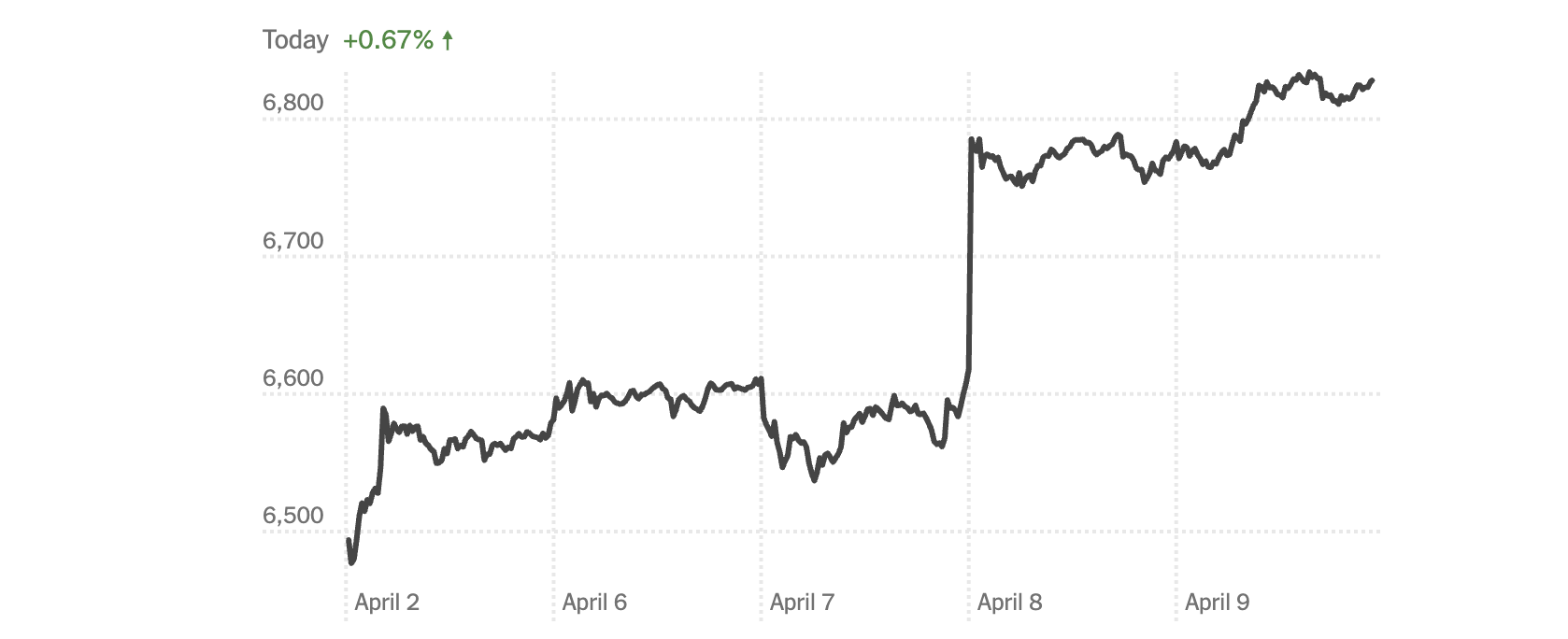
🎯 IMPACT: “The market awaits certainty around the Middle East ceasefire with U.S. and Iranian delegations set to arrive in Pakistan today,” strategists on JPMorgan’s trading desk wrote in a note to clients. The S&P 500 opened 0.2 percent lower, the Nasdaq fell 0.3 percent, and the Dow dropped about 200 points shortly after the opening bell.
📺 PICTURED: The SNP 500 in recent days:
3. A Group of Anti-Trust Attorneys Just Abandoned Their DOJ Jobs.
As we’ve previously reported, Trump’s DOJ, under Pam Bondi, essentially became a clearinghouse for corporate lobbyist cash grabs.
PULSE POINTS: WHAT, EXACTLY, IS THE DOJ EVEN FOR RIGHT NOW?
❓ WHAT HAPPENED: Several senior attorneys are leaving the U.S. Department of Justice (DOJ) Antitrust Division, including its top litigator, David Dahlquist, acting director of civil antitrust litigation, and other attorneys involved in high-profile cases. The exits come after a controversial settlement in the Trump administration’s antitrust case against Live Nation Entertainment in March, with The National Pulse learning that the DOJ has effectively given up litigating such cases entirely, as corporate pressures represented by Republican lobbyists bear down on them. A source tells The National Pulse the number of attorneys leaving is far higher than currently reported anywhere else.
🎯 IMPACT: Dahlquist had played a leading role in both the Live Nation case and a case involving Google. The settlement with Live Nation, which owns Ticketmaster, required the company to pay a $280 million civil penalty and sell some of its amphitheaters, but did little to address its monopoly over ticket sales, controlling over 86 percent of ticketing for major concert venues and around 78 percent of ticketing for amphitheaters. This followed the ouster of Assistant Attorney General for the Department of Justice (DOJ) Antitrust Division Gail Slater, reportedly at the behest of corporate lobbyist Mike Davis, who is reported to have facilitated massive corporate mergers without major oversight under the current Trump administration. Multiple sources close to the Antitrust Division and Washington, D.C. lobbying operations previously told The National Pulse that Davis oversaw a public relations campaign targeting Slater on behalf of alleged clients, including Live Nation, Compass, and Hewlett-Packard (HP).
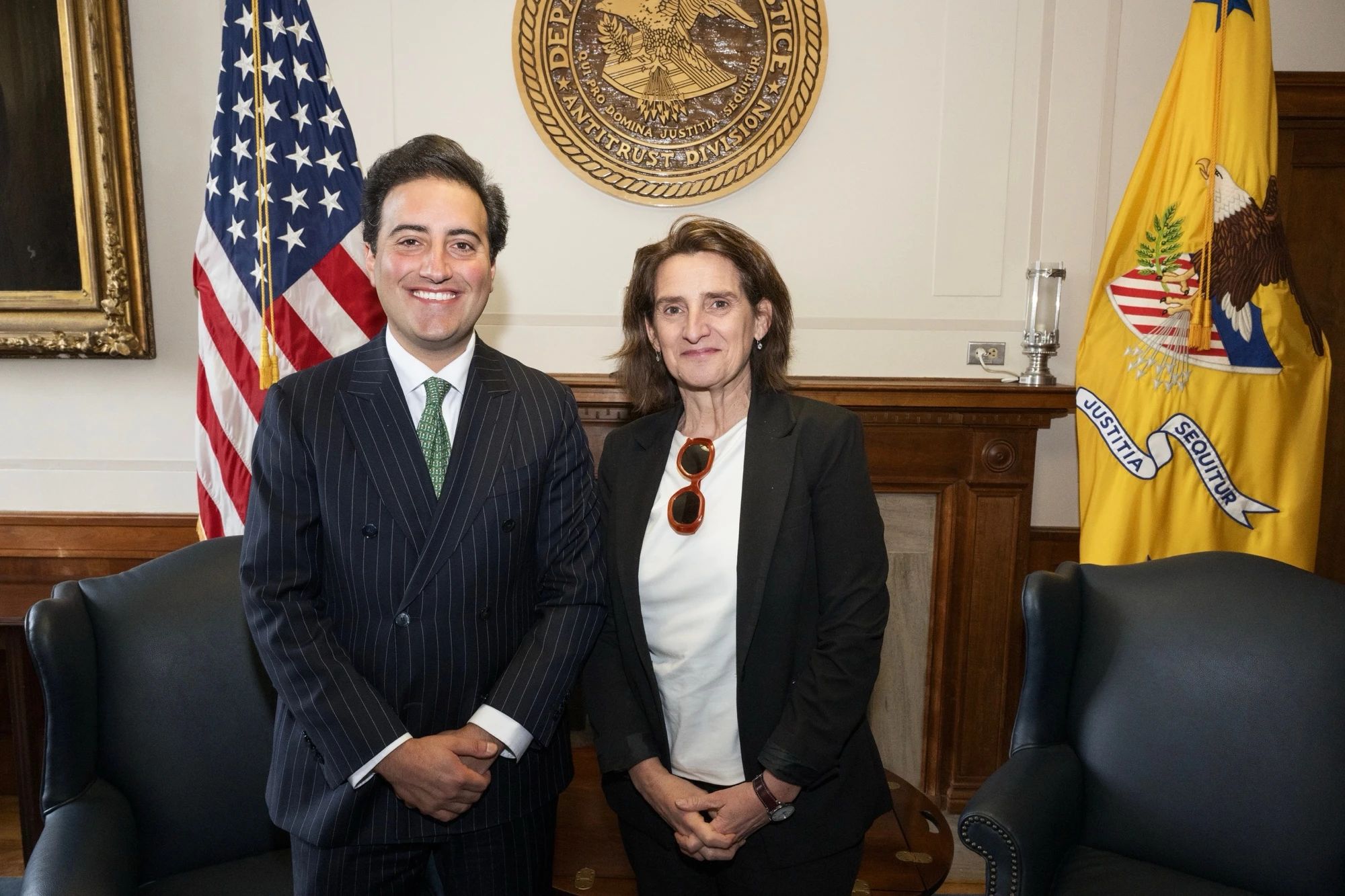
📺 SCUTTLEBUTT: Industry insiders now have all eyes on Gail Slater’s replacement, Omeed Assefi, pictured recently below with European Commission bigwig Teresa Ribera. Assefi worked under the increasingly anti-Trump former White House lawyer, Ty Cobb, during Trump’s first impeachment. He then served as an Assistant United States Attorney in the District of Columbia.
4. Thomas Massie Just Got a Huge Poll Boost in Kentucky.
Embattled Congressman Thomas Massie has a gigantic fight on his hands, butting heads with Trump over the Epstein files. He’s winning, for now.
PULSE POINTS: MASSIE-MENTUM.
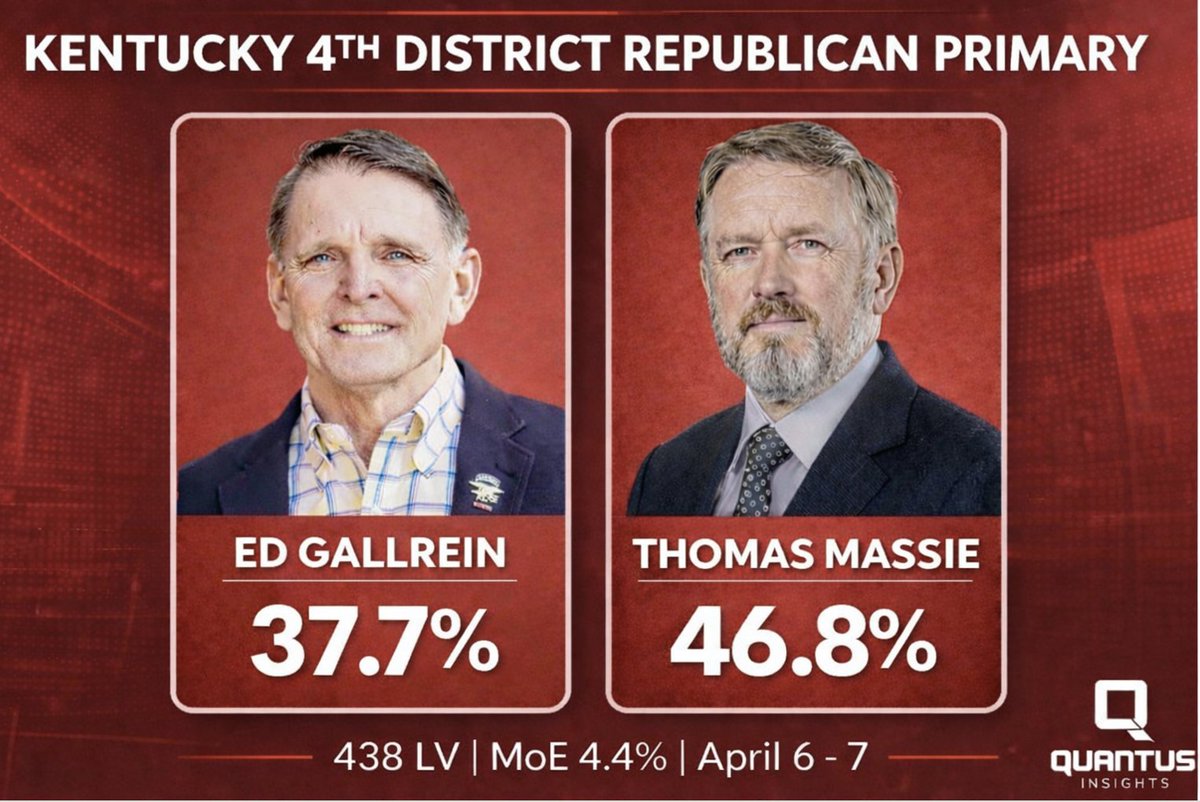
❓ WHAT HAPPENED: The first independent survey of Republican voters in Kentucky’s 4th Congressional District primary shows Representative Thomas Massie holding a notable advantage over his challenger, Ed Gallrein, despite Gallrein receiving an endorsement from President Donald J. Trump. According to the poll by Quantus Insights, 47.4 percent said they would support Massie if the election were held today, while 36.8 percent indicated they would back Gallrein. About 14 percent of voters remain undecided, and 1.5 percent said they will not participate. Massie has opposed the Iran war and previously took the administration to task for being slow to release the Epstein Files. He also opposed the One Big Beautiful Bill Act on cost grounds.
👤 WHO WAS INVOLVED: Thomas Massie, Ed Gallrein, President Trump, and Kentucky voters.
💬 KEY QUOTE: President Trump appeared alongside Gallrein at a rally, where he criticized Massie as “loser” and a “total disaster as a congressman, and, frankly, a human being.“
🎯 IMPACT: Notably, although Massie continues to lead in the polling, he has not crossed the majority threshold. With a significant share of voters still undecided, the primary remains fluid.
📺 SHAREABLE: The graphic from Quantus:
5. Melania Just Gave an Unexpected Address on Epstein.
The First Lady appears to have lost her patience with fake news media outlets claiming she had some historic Epstein links.
PULSE POINTS: SHE’S HAD ENOUGH.
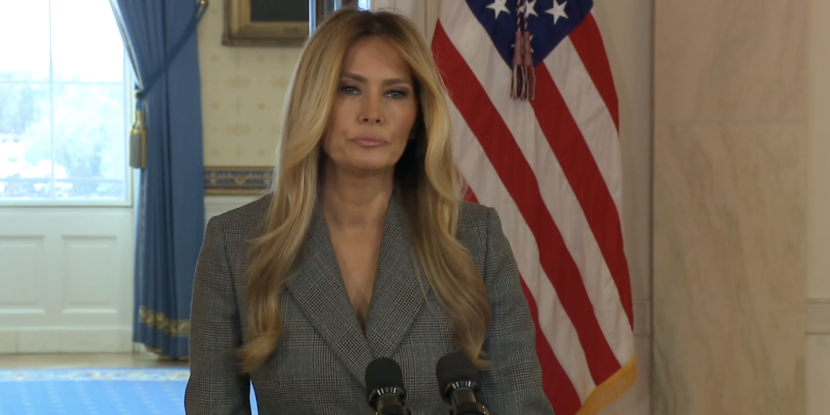
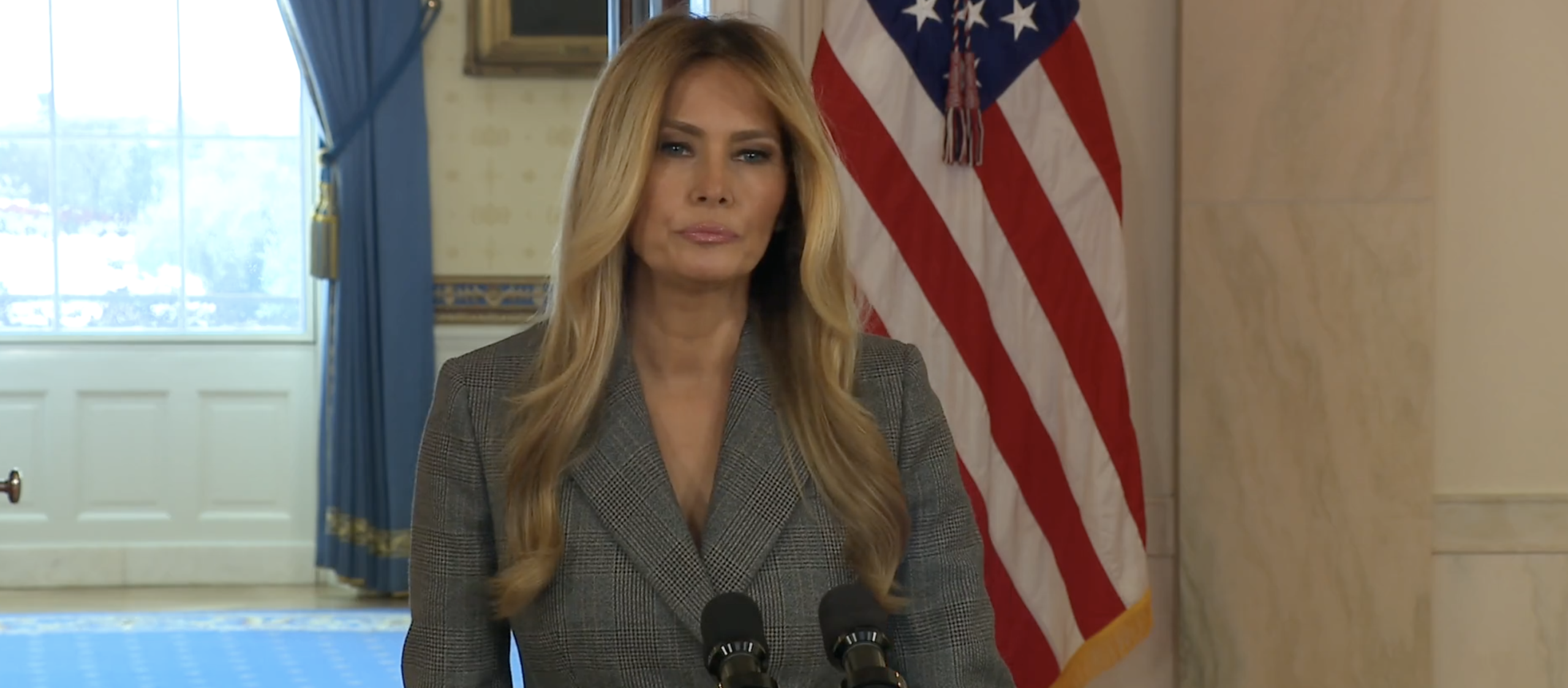
❓ WHAT HAPPENED: First Lady Melania Trump strongly denied any connection to Jeffrey Epstein and called for Congress to hold a hearing for survivors of his crimes in an unexpected White House address. Mrs. Trump addressed the “fake images and statements” linking her to the deceased pedophile during her husband’s second term. She singled out Harper Collins UK, The Daily Beast, and Democrat strategist James Carville for spreading the smears, noting that they have been “legally obligated to publicly apologize and retract their lies about me.”
💬 KEY QUOTE: “I have never had any knowledge of Epstein’s abuse of his victims. I was never involved in any capacity.” – Melania Trump
🎯 SECONDARY QUOTE: “Now is the time for Congress to act. Epstein was not alone. Several prominent male executives resigned from their powerful positions after this matter became widely politicized. Of course, this doesn’t amount to guilt, but we still must work openly and transparently to uncover the truth,” the First Lady continued, calling on Congress to “Give [Epstein’s] victims their opportunity to testify under oath in front of Congress, with the power of sworn testimony.”
6. American Men Will Now Be AUTOMATICALLY Registered into the Draft.
Eligible men in the U.S. will be automatically registered for the military draft starting in December.
PULSE POINTS: IT IS MORE OF AN ADMIN THING.
❓ WHAT HAPPENED: The Selective Service System (SSS) will automatically begin registering eligible young American men for the military draft beginning this December, the federal agency has announced. The new “streamlined” process will shift the responsibility for registration from individuals to the SSS, using existing federal data sources instead of requiring young men to register themselves. Federal law requires men ages 18 to 25 to register. Under the new rule, eligible men will be automatically registered within 30 days of turning 18, and they will receive written notice of their registration. The policy does not change who is required to register; it only changes how registration occurs. Officials say the shift will save resources previously used for public education and advertising campaigns.
📍 WHEN & WHERE: The new process begins in December 2026 across the United States.
💬 KEY QUOTE: “This will also allow us to rededicate resources—basically that means money—towards [readiness] and towards mobilization.” – Representative Chrissy Houlahan (D-PA)
🎯 DETAIL: The United States has not had an active military draft since the Vietnam War ended in 1973. Any future draft would require Congress to amend the Military Selective Service Act to give the President authority to call up personnel. The Department of Defense requires the SSS to be prepared to deliver the first inductees within 193 days of a draft being authorized.
7. Gen Z’s Fertility Timebomb.
PULSE POINTS.
❓ WHAT HAPPENED: Birth rates among Gen Z women are declining, according to new research from the National Center for Health Statistics (NCHS) at the Centers for Disease Control and Prevention (CDC). The research shows a significant drop in the birth rate of women aged 20–24, from 55.8 births per 1,000 females in 2024 to 52.2 in 2025.
👤 WHO WAS INVOLVED: The Centers for Disease Control (CDC), the CDC’s National Center for Health Statistics (NCHS), Karen Guzzo, Director of the Carolina Population Center.
💬 KEY QUOTE: “When young people face stagnant wages but rising costs, they find it harder and harder to really transition to adulthood,” – Karen Guzzo, Director of the Carolina Population Center.
🎯 DETAIL: For women aged 25–29, there was a drop from 89.5 to 85.6. However, women aged 30–34 saw their birth rate increase from 93.7 to 96.2. Gen Z is the cohort born from 1997 to 2012, meaning the oldest members of Gen Z will turn 29 this year. The report, therefore, suggests a decline in fertility among Gen Z women specifically.
📺 WHY: Experts say economic instability, especially rising living costs, causes people to delay life milestones, such as having children, forming long-term relationships, and buying a home. People tend to achieve the economic security needed to have children in their early and mid-thirties, though this delay often means they cannot have as many children as initially intended.
8. Judge Jeanine is Frustrated at D.C.’s Approach to Crime.
It’s no surprise the Democrat-run city is letting people off so easy.
PULSE POINTS: SHE GAVE A SPEECH IN DC.
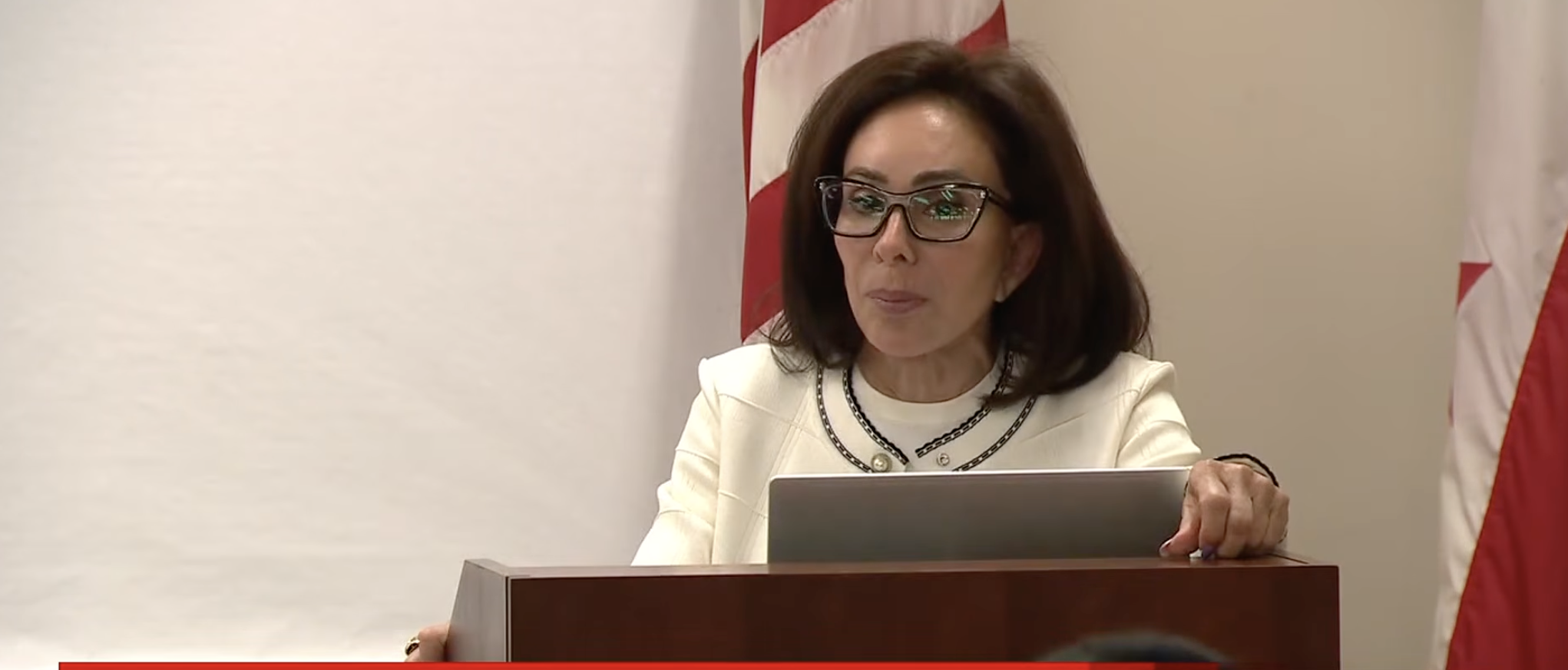
❓ WHAT HAPPENED: U.S. Attorney for D.C. Jeanine Pirro spoke Tuesday night at a meeting of the Second District Metropolitan Police Citizens Advisory Council, telling attendees that there must be a change in the way juvenile crime is handled to bring it under control.
👤 WHO WAS INVOLVED: Jeanine Pirro, attendees of the Metropolitan Police Department (MPD) Second District meeting, and local residents.
📍 WHEN & WHERE: Tuesday night at the MPD’s Second District Headquarters on Idaho Ave. NW.
💬 KEY QUOTE: “If you’ve got a gun and you shoot someone, I don’t care if you’re pink, gray, or blue, you’ve gotta be held accountable.” – Jeanine Pirro
🎯 WHY: Pirro spoke about the growing problem of juvenile crime, including reports of large groups of teenagers gathering and getting into fights in various parts of the city. She criticized the D.C. Council’s permissive attitude towards juvenile offenders, noting, “Harassment, loitering, drunk driving, all that stuff, we can’t prosecute [at the federal level].” She expressed frustration with the Democrats’ preference for dealing with juvenile crime through the family court system, warning, “If the purpose of family court is rehabilitation, you ain’t rehabilitating ‘em!”
Another remarkable day of news brought to you by our team at The National Pulse, where not only do we investigate, curate, compress, and prioritize all the day’s events, but also deliver them right to your inbox if you’re a subscriber
Another remarkable day of news brought to you by our team at The National Pulse, where not only do we investigate, curate, compress, and prioritize all the day’s events, but also deliver them right to your inbox if you’re a subscriber show more
❓WHAT HAPPENED: U.S. GDP grew at an annual rate of 0.5 percent in the fourth quarter of 2025, short of an expected 0.7 percent.
Newsletter
Need to Know.
Your free, daily feed from The National Pulse.
Thank You!
You are now subscribed to our newsletter.
👤WHO WAS INVOLVED: The U.S. Bureau of Economic Analysis (BEA) produced the estimate.
📍WHEN & WHERE: Released on April 9, 2026, regarding the fourth quarter of 2025.
💬KEY QUOTE: “Real GDP was revised down 0.2 percentage point from the second estimate, primarily reflecting a downward revision to investment,” said the BEA.
🎯IMPACT: The U.S. Dollar Index showed no immediate reaction, remaining near the previous closing level.
IN FULL
The U.S. economy grew more slowly than previously estimated in the final quarter of 2025. The Bureau of Economic Analysis (BEA) revised its figure for real Gross Domestic Product (GDP) growth to an annual rate of 0.5 percent, down from the earlier estimate of 0.7 percent.
The downward revision was driven mainly by weaker investment numbers. According to the BEA, consumer spending and investment remained the primary supports for GDP growth during the quarter, though they were partly offset by declines in government spending and exports. A drop in imports, which subtracts from GDP, also played a role.
On the industry side, private services-producing industries recorded a 2.3 percent increase in real value added, helping to lift overall output. In contrast, government activities fell by 7.8 percent, and private goods-producing industries declined by 1.8 percent.
The strongest contributions to growth came from wholesale trade, information, and health care and social assistance. Real final sales to private domestic purchasers—which combines consumer spending and gross private fixed investment—rose 1.8 percent, slightly below earlier estimates.
Real gross domestic income (GDI) increased by 2.6 percent in the fourth quarter, slowing from a 3.5 percent gain in the third quarter. The average of real GDP and real GDI grew by 1.5 percent, down from four percent in the previous quarter.
BREAKING
GDP (QoQ) (Q4) Act.: 0.5%, Est.: 0.7%, Prev.: 4.4%
Welcome to the first (and very much trial) roundup of the day’s news from The National Pulse team. I’m your Editor-in-Chief, Raheem Kassam. Read more about our format experimentation here.
1. Now You Ceasefire, Now You Don’t.
The global news focus is on the shaky ceasefire announced late last night, with details still changing minute by minute.
PULSE POINTS: IRAN WAR.
❓WHAT HAPPENED: President Trump announced a two-week ceasefire, brokered in part by Pakistan, last night. Over the course of Wednesday, Israel’s military continued to strike Lebanon. Gulf nations reported continued Iranian and drone attacks post-ceasefire. Reports also emerged that while Iran had opened the Strait of Hormuz, it’s not as clear-cut as it seems. Reports of stoppages, blockages, and turn-arounds abounded on Wednesday. Benjamin Netanyahu gave a press statement at 1:15PM EST, with White House Press Secretary following up immediately after. President Trump announced new secondary tariffs of 50 percent on nations supplying weapons to Iran, effective immediately.
👤WHO WAS INVOLVED: President Trump, Prime Minister Netanyahu, the Iranian regime, Press Sec Karoline Leavitt, and the nation of Lebanon.
📍WHEN & WHERE: Wednesday, April 8, 2026.
💬KEY QUOTE: “There are still additional objectives for us to achieve, and we will achieve them… we are ready to resume the fighting at any moment, our finger is on the trigger… this is not the end of the war… The enriched uranium will be removed…” – Israeli Prime Minister Benjamin Netanyahu.
🎯IMPACT: Markets opened stronger on Wednesday, and the Brent Crude oil price fell below $100 a barrel for the first time in weeks. Britain’s Prime Minister, Sir Keir Starmer, traveled to Saudi Arabia for discussions on how to keep the Strait open. Vice President J.D Vance, Jared Kushner, and Steve Witkoff are heading to Islamabad, Pakistan this weekend for further talks.
❓WHAT HAPPENED: Ex-North Carolina State Rep Cecil Brockman faces eight felony child sex crime charges, several carrying the potential for life in prison. Brockman was arrested in October 2025 after allegedly targeting a 15-year-old boy on the gay dating app Grindr. He had even been living with the minor, using his official position to report the teenager as missing to the police. Investigators later found incriminating videos on the victim’s phone. The alleged incidents occurred in August 2025.
👤WHO WAS INVOLVED: Cecil Brockman, a Democrat and former North Carolina State Representative.
📍WHEN & WHERE: New charges announced in April 2026, following initial arrest in October 2025.
💬KEY QUOTE: “I would like to know why lies are being accepted without there being a rebuttal to those lies.” – Cecil Brockman
🎯IMPACT: Following his arrest, Brockman resigned from his seat representing District 60 (High Point and parts of Guilford County) to avoid an expulsion vote. A grand jury later added more serious indictments, including multiple counts of statutory sex offense with a child 15 or younger, indecent liberties with a child, and first-degree sexual exploitation of a minor.
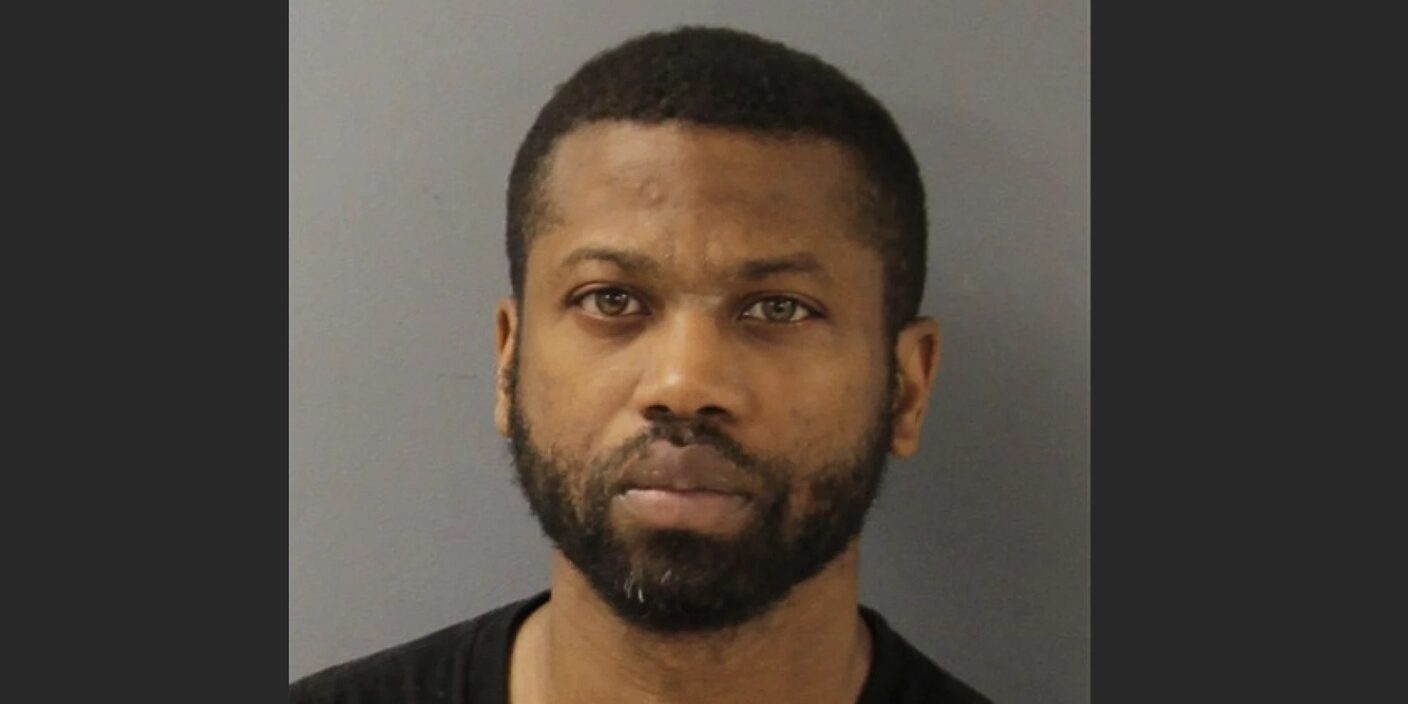
📺PICTURED: Brockman, for his mugshot.
3. Trump Staffer J6 Turncoat Under DOJ Investigation.
PULSE POINTS: SHE SAYS TRUMP LUNGED AT SECRET SERVICE TO HIJACK PRESIDENTIAL LIMO.
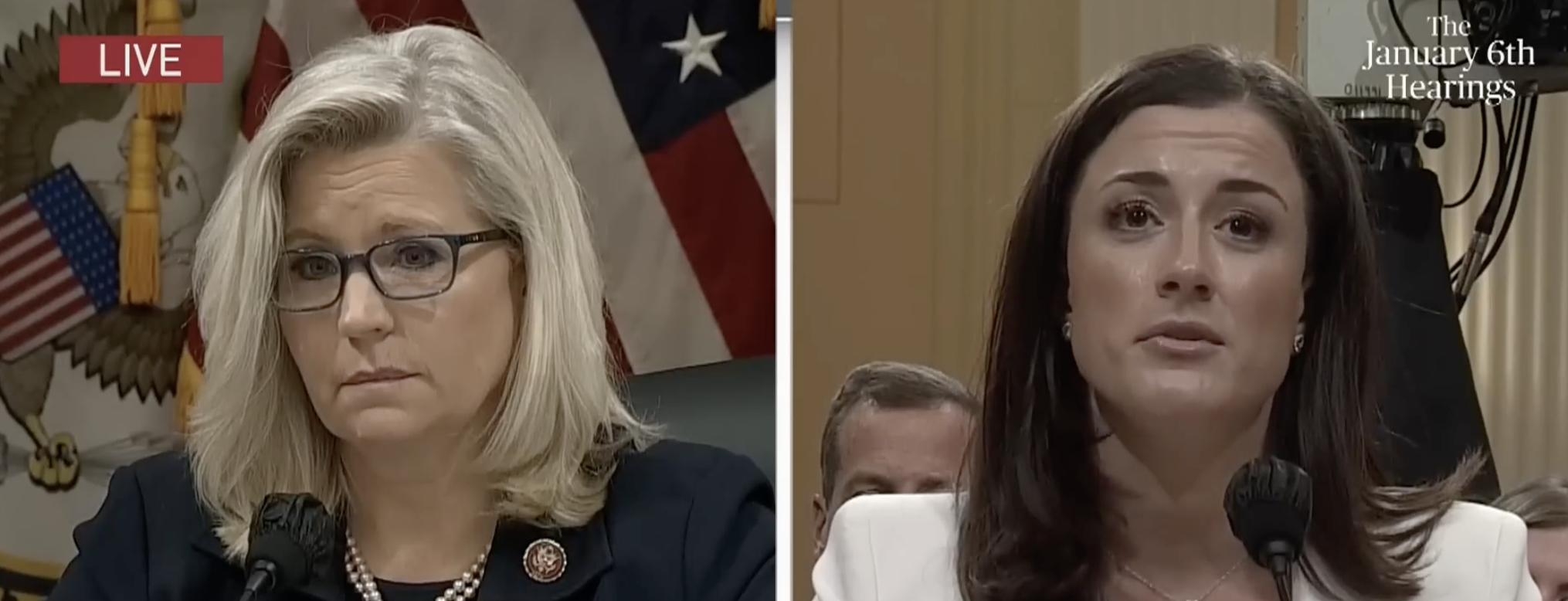
❓WHAT HAPPENED: The Department of Justice (DOJ) has launched an investigation into former Trump White House aide turned Democrat-led January 6 Committee ‘star witness’ Cassidy Hutchinson over allegations of perjury during her testimony before the committee in 2022. It is believed that the probe was kick-started after the DOJ received evidence and a referral from a member of Congress, and will be handled by the department’s Civil Rights Division. Hutchinson testified that Trump had lunged at a Secret Service agent in a presidential limo when he was supposedly told he could not join his supporters at the Capitol. These claims were later contradicted by other testimonies.
👤WHO WAS INVOLVED: Cassidy Hutchinson, the DOJ Civil Rights Division, the former January 6 Committee, former Congresswoman Liz Cheney (R-WY), and President Donald J. Trump.
📍WHEN & WHERE: The probe reportedly began in recent weeks, following a referral from a member of Congress. Hutchinson’s testimony occurred in 2022.
🎯IMPACT: Liz Cheney—a rabidly anti-Trump Republican—was accused in a preliminary report issued by the House Administration Oversight Subcommittee of engaging in witness tampering while serving on the unlawfully constituted J6 Committee. According to the report, Cheney coached Hutchinson on her testimony and urged her to alter parts of her story. Consequently, the subcommittee report alleged Hutchinson committed perjury. Additional falsehoods peddled by Hutchinson and exposed by The National Pulse include her denial that she ever dated former Congressman Matt Gaetz (R-FL). The National Pulse also revealed screenshots taken from Hutchinson’s phone, showing late-night FaceTime (video call) pillow talk with Gaetz that Hutchinson had sent to friends, bragging that the two were dating.
4. Bad Omen for Midterms as GOP Vote Shrinks Back.
PULSE POINTS: GEORGIA AND WISCONSIN.
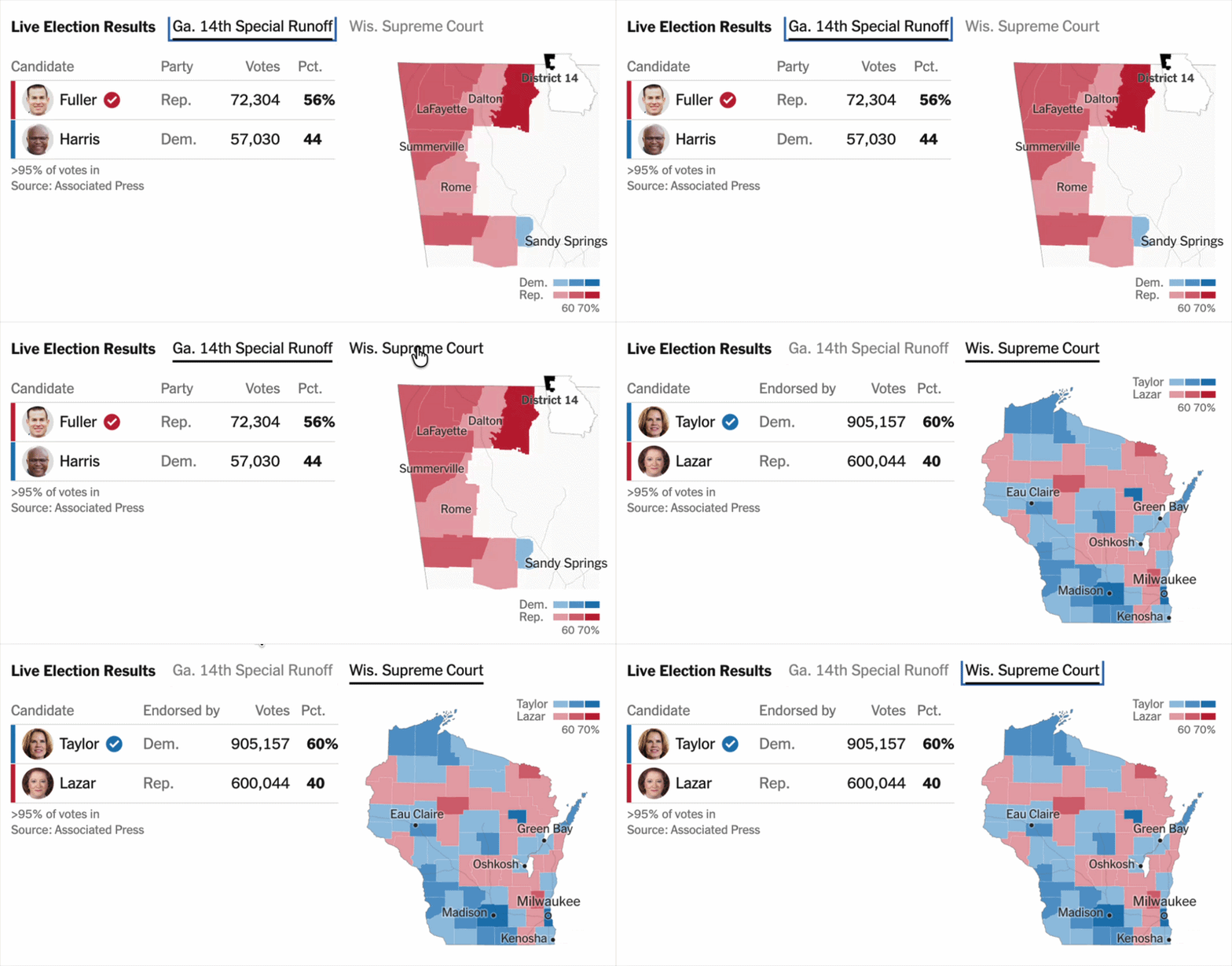
❓WHAT HAPPENED: Democrats won a Wisconsin Supreme Court seat by 20 points, with Democratic-backed Appeals Court Judge Chris Taylor defeating Republican-backed Appeals Court Judge Maria Lazar. Tuesday’s election result nearly doubled the margin of leftist Justice Susan Crawford’s win last year, indicating a growing liberal presence in the state judiciary. Notably, in the 2025 race, technology mogul Elon Musk spent an estimated $25 million supporting Brad Schimel, a former county circuit court judge and U.S. Department of Justice (DOJ) attorney. Republicans held the GA-14 seat vacated by Marjorie Taylor Greene (R-GA), but with a significantly reduced vote share.
👤WHO WAS INVOLVED: Chris Taylor, Maria Lazar, Clay Fuller, and Sean Harris.
💬KEY QUOTE: Fuller, a district attorney and Air National Guard lieutenant colonel, credited President Trump for his win in Georgia, stating, “He was the difference maker. He was the key factor in us winning,” though some argue his reduced vote share is a bad omen for Republican midterm hopes.
🎯IMPACT: Taylor’s victory in Wisconsin secures the Democrat-backed Appeals Court judge a 10-year term on the Wisconsin Supreme Court, while Fuller’s win helps preserve the slim Republican majority in the House, at least until November.
📺GRAPHIC: An animated GIF from the New York Times website, displaying the election results in both races.
5. Bill Gates, Howard Lutnick, Pam Bondi All Face Epstein Grilling.
PULSE POINTS: THE HOUSE INVESTIGATION CONTINUES APACE.
❓WHAT HAPPENED: Billionaire globalist Bill Gates and U.S. Commerce Secretary Howard Lutnick will sit for depositions before the House Oversight Committee in the coming weeks, as the committee continues its investigation into convicted pedophile sex offender and financier Jeffrey Epstein. Lutnick, a key figure in the Trump administration, confirmed earlier this year that he, his wife, four children, and nannies visited Epstein’s private Caribbean island, Little St. James, in December 2012—four years after the now deceased financier pleaded guilty to procuring a minor for prostitution. Former U.S. Attorney General Pam Bondi was also slated to testify, though the DOJ announced on Wednesday that she would no longer appear for the interview. Oversight Chairman James Comer’s office said, “The Committee will contact Pam Bondi’s personal counsel to discuss next steps regarding scheduling her deposition.”
👤WHO WAS INVOLVED: Bill Gates, Howard Lutnick, and Pam Bondi.
💬KEY QUOTE: “I did nothing illicit. I saw nothing illicit.” – Bill Gates on his time with Epstein.
🎯ADDED INFO: The Commerce Secretary will sit for a closed-door interview with lawmakers on May 6. Gates—who allegedly contracted a sexually-transmitted disease (STD) from “Russian girls,” according to an email authored by Epstein—will sit for a transcribed deposition on June 10. In February, during a town hall with Gates Foundation staff, the globalist billionaire admitted that it was a “huge mistake to spend time with Epstein,” but asserted, “I did nothing illicit. I saw nothing illicit.” Gates claimed he initially believed Epstein could help advance his global health philanthropy efforts. However, he acknowledged that these efforts were ineffective and his meetings with Epstein were misguided. Gates stated, “In retrospect, I was foolish to spend any time with him. It was just a huge mistake.”
6. The CIA’s Incredible New Tech That Saved U.S. Airman in Iran.
PULSE POINTS: THE CIA CAN HEAR YOUR HEARTBEAT.
❓WHAT HAPPENED: The Central Intelligence Agency (CIA) used an advanced tool called “Ghost Murmur” to locate and rescue an American airman known as “Dude 44 Bravo” after his jet was shot down in southern Iran. Developed by Lockheed Martin’s Skunk Works division, the system relies on long-range quantum magnetometry to detect the electromagnetic signature of a human heartbeat from many miles away, and uses artificial intelligence (AI) to isolate the signal. Ghost Murmur picked up his heartbeat in a largely empty landscape with minimal background interference. A source familiar with the technology described it as “like hearing a voice in a stadium, except the stadium is a thousand square miles of desert.”
📍WHEN & WHERE: The rescue took place on Easter Sunday in southern Iran.
💬KEY QUOTE: “It’s like finding a needle in a haystack, finding this pilot, and the CIA was unbelievable.” – President Trump
🎯DETAIL: This was the first time the CIA had deployed the system in an actual operation. It uses quantum magnetometry sensors based on microscopic defects in synthetic diamonds and can detect signals over long distances. Experts note that it performs best in remote, low-clutter areas but requires substantial processing time.
7. Iryna Zarutska’s Murderer May Be Let Off State Charges.
PULSE POINTS: SICKO IS ‘TOO PSYCHO’ FOR STATE ACCOUNTABILITY.
❓WHAT HAPPENED: DeCarlos Brown Jr., 35, has been ruled “incapable to proceed” on state murder charges in the death of Ukrainian refugee Iryna Zarutska, 23. Brown, who allegedly shouted “I got that white girl” after stabbing Zarutska to death on a light-rail train in August, told police he has schizophrenia. He faces both state and federal murder charges. The finding was included in court filings submitted by his state public defender. Roberts asked the court to postpone Brown’s Rule 24 hearing, which determines whether prosecutors will seek the death penalty. Notably, North Carolina has had a de facto moratorium on executions for the past two decades. Under North Carolina law, a defendant is considered capable only if they can understand the charges against them, know their role in the courtroom, and rationally assist in their own defense.
👤WHO WAS INVOLVED: Alleged murderer DeCarlos Brown Jr. and victim Iryna Zarutska.
📍WHEN & WHERE: The killing took place in Charlotte, North Carolina, in August; the court filings were made in Mecklenburg Superior Court on April 8, 2026.
🎯DETAIL: The state hearing is paused for six months; Brown remains in federal custody.
📺RELATED: A mural of Zarutska was recently covered up, and the mayor of Providence, RI, called it “divisive.”
8. RFK’s Starting a Podcast.
PULSE POINTS: HE’S RUNNING IN 2028, RIGHT?
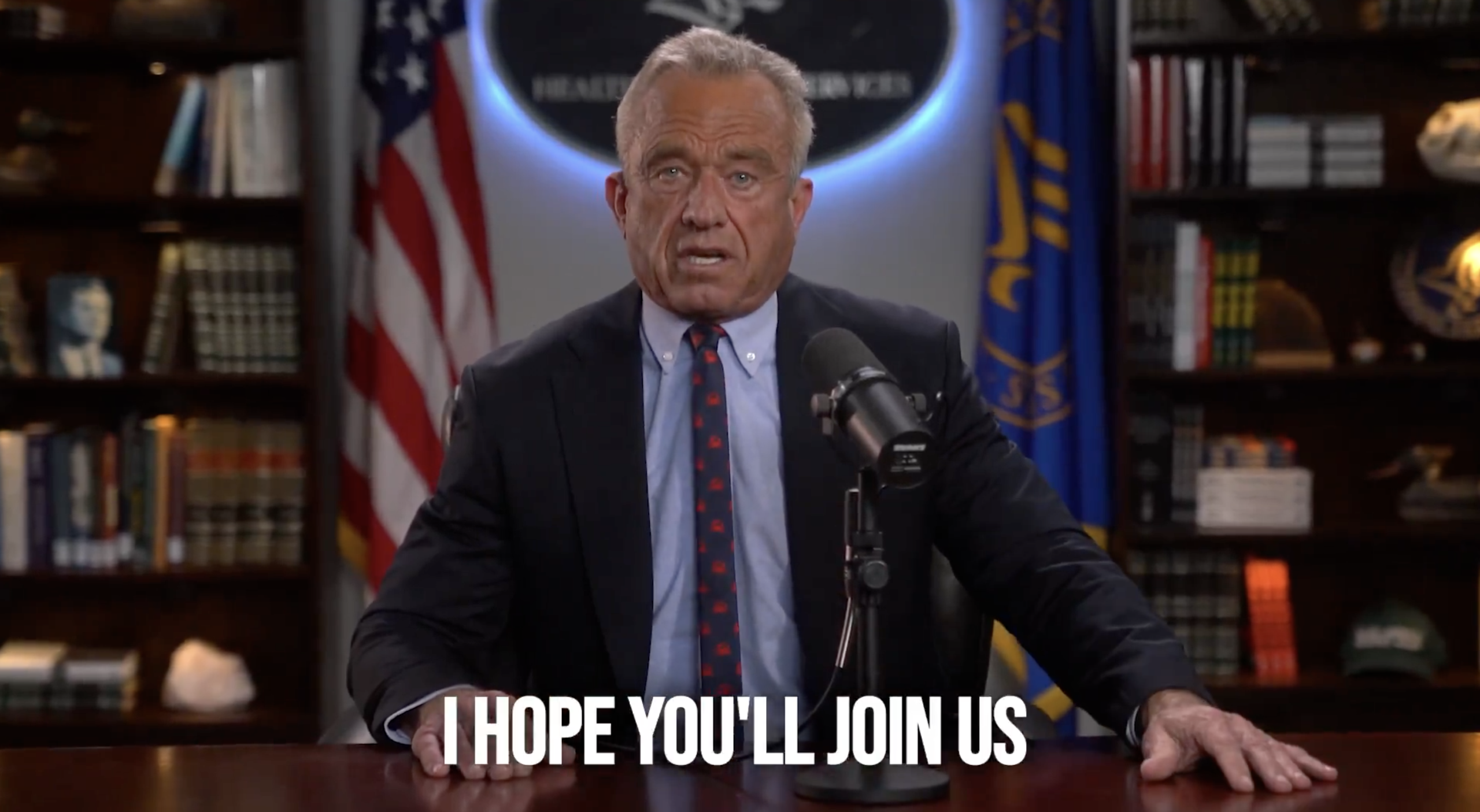
❓WHAT HAPPENED: Robert F. Kennedy Jr. (RFK Jr.), U.S. Secretary for Health and Human Services (HHS), has announced the launch of a new health-focused podcast titled The Secretary Kennedy Podcast.
👤WHO WAS INVOLVED: HHS, Sec. Robert F. Kennedy Jr. and HHS Digital Director Liam Nahill.
📍WHEN & WHERE: The podcast will officially launch next week; a teaser trailer was released on X (formerly Twitter) on Wednesday, April 8, 2026.
💬KEY QUOTE: “We’re going to name the names of the forces that obstruct the paths to public health.” – Robert F. Kennedy Jr.
🎯WHY? The podcast will serve as a platform for RFK Jr. and his Make America Healthy Again (MAHA) agenda, and as an outreach arm for HHS. It will be the first podcast hosted by a sitting U.S. Cabinet secretary.
Welcome to the first (and very much trial) roundup of the day's news from The National Pulse team. I'm your Editor-in-Chief, Raheem Kassam. Read more about our format experimentation here.
show more
Editor’s Notes
Behind-the-scenes political intrigue exclusively for Pulse+ subscribers.
❓WHAT HAPPENED: President Donald J. Trump announced a temporary ceasefire with Iran, pausing the conflict in the Middle East.
Newsletter
Need to Know.
Your free, daily feed from The National Pulse.
Thank You!
You are now subscribed to our newsletter.
👤WHO WAS INVOLVED: Donald Trump, Iran and its regime, and Pakistan as a mediator.
📍WHEN & WHERE: The ceasefire was announced 90 minutes before a U.S. deadline for devastating strikes to commence.
💬KEY QUOTE: “This will be a double-sided CEASEFIRE!” – Donald Trump
🎯IMPACT: Markets responded positively, with oil prices dropping and stocks rising.
IN FULL
President Donald J. Trump has announced a two-week ceasefire between the United States and Iran, pausing the 39-day conflict in the Middle East. The announcement came just 90 minutes before the deadline he had set for Iran to reopen the Strait of Hormuz or face devastating strikes.
Under the agreement, Iran will lift its blockade of the vital shipping lane in return for a temporary halt to American strikes on Iranian infrastructure. The deal was brokered with help from Pakistan.
In his statement, Trump made the conditional nature of the pause clear: “Subject to the Islamic Republic of Iran agreeing to the COMPLETE, IMMEDIATE, and SAFE OPENING of the Strait of Hormuz, I agree to suspend the bombing and attack of Iran for a period of two weeks.”
In a subsequent post on Truth Social, the President added, “A big day for World Peace! Iran wants it to happen, they’ve had enough! Likewise, so has everyone else! The United States of America will be helping with the traffic buildup in the Strait of Hormuz. There will be lots of positive action! Big money will be made. Iran can start the reconstruction process. We’ll be loading up with supplies of all kinds, and just ‘hangin’ around’ in order to make sure that everything goes well. I feel confident that it will.”
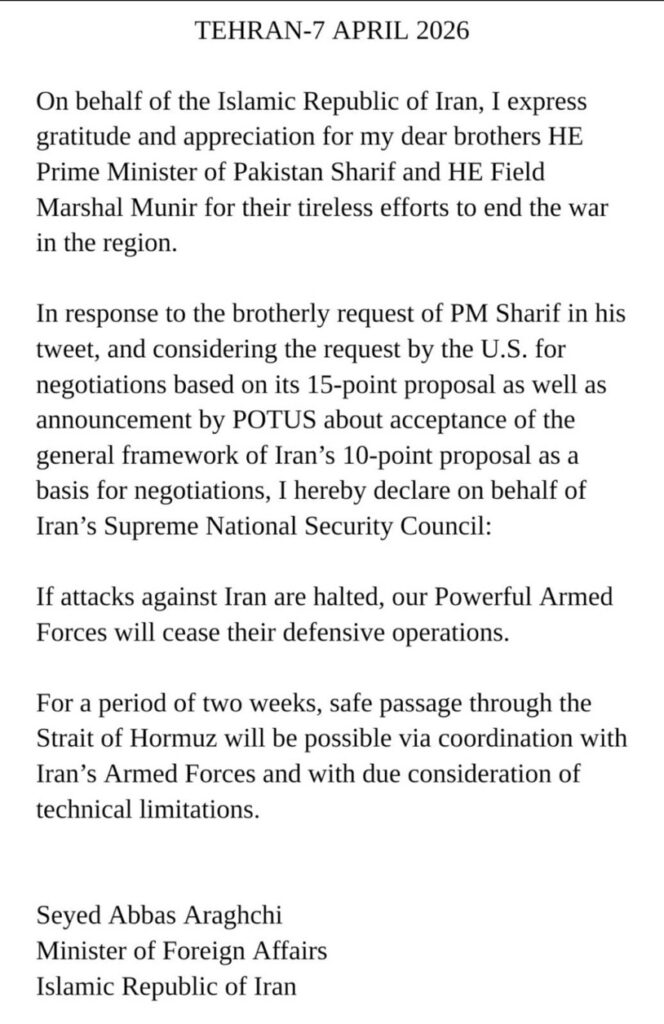
Trump also posted a statement from Iran:
The news triggered an immediate market reaction, with oil prices falling almost 17 percent and stock markets rising.
Although Iran has accepted the ceasefire, it has warned that it will restart attacks if the United States violates the truce. Talks aimed at securing a longer-term peace agreement are scheduled to continue in the Pakistani capital of Islamabad.
Trump expressed hope that the region could now enter what he called a “Golden Age of the Middle East!!!”
Join Pulse+ to comment below, and receive exclusive e-mail analyses.
show less
show more
By Popular Demand.
The National Pulse Now has an on-site comments section for members. Sign up today and be part of the conversation in our community of almost 15,000.
WE ARE 100% INDEPENDENT AND READER-FUNDED. FOR A GUARANTEED AD-FREE EXPERIENCE AND TO SUPPORT REAL NEWS, PLEASE SIGN UP HERE, TODAY.
❓WHAT HAPPENED: Canada’s proposed Bill C-9, known as the Combatting Hate Act, seeks to alter hate speech laws, raising concerns about potential criminal charges for quoting scripture.
👤WHO WAS INVOLVED: Canadian Minister of Justice Sean Fraser, Canadian Christians, religious and advocacy groups.
Newsletter
Need to Know.
Your free, daily feed from The National Pulse.
Thank You!
You are now subscribed to our newsletter.
📍WHEN & WHERE: Introduced in September 2025, passed the House of Commons on March 25, 2026, and is now heading to the Senate.
💬KEY QUOTE: “Bill C-9 makes it easier for people of faith and others to be criminally charged because of views that other people take offense to.” – Opposition lawmaker Andrew Lawton
🎯IMPACT: Critics argue the bill weakens freedom of expression and religion by removing the ‘good faith’ defense for religious texts.
IN FULL
A bill in Canada that could criminalize quoting the Bible as hate speech has sparked backlash from religious and conservative groups across the country. “Bill C-9 makes it easier for people of faith and others to be criminally charged because of views that other people take offense to,” warned Andrew Lawton, a Member of Parliament (MP) for the Conservative opposition.
Bill C-9, known as the Combatting Hate Act, was introduced by Minister for Justice and Attorney General Sean Fraser, and has already passed through the House of Commons, roughly equivalent to the U.S. House of Representatives. It will be debated in the Canadian Senate later this year.
The bill removes two sections of Canada’s criminal code: 319(3)(b) and 319(3.1)(b). Both specifically state that someone cannot be found guilty of hate speech if they “expressed or attempted to establish by an argument an opinion on a religious subject or an opinion based on a belief in a religious text”.
Marc Miller, an MP from the ruling Liberal Party who supports the bill, has cited passages from Leviticus, Deuteronomy, and Romans condemning homosexual acts as examples of religious text that could be classed as hate speech. “How do we somehow constitute this as being said in good faith? Clearly, there are situations in these texts where statements are hateful. They should not… be a defense,” he said during a House Justice Committee hearing.
The proposed changes have drawn criticism from Christians in Canada. “This narrowly framed exemption has served for many years as an essential safeguard to ensure that Canadians are not criminally prosecuted for their sincere, truth-seeking expression of beliefs made without animus and grounded in long-standing religious traditions,” the Canadian Conference of Catholic Bishops wrote to Canadian Prime Minister Mark Carney in a letter last year.
❓WHAT HAPPENED: U.S. Immigration and Customs Enforcement (ICE) agents shot an 18th Street Gang member in California after he attempted to use his vehicle as a weapon against officers.
👤WHO WAS INVOLVED: ICE agents, Carlos Ivan Mendoza Hernandez, and the Stanislaus County Sheriff’s Office.
Newsletter
Need to Know.
Your free, daily feed from The National Pulse.
Thank You!
You are now subscribed to our newsletter.
📍WHEN & WHERE: April 7, 2026, in Patterson, California, near an interstate overpass.
💬KEY QUOTE: “As officers approached the car, the wanted gang member weaponized his vehicle in an attempt to run an officer over.” – Todd Lyons, ICE
🎯IMPACT: The suspect was hospitalized, and the Federal Bureau of Investigation (FBI) is investigating.
IN FULL
U.S. Immigration and Customs Enforcement (ICE) agents shot Carlos Ivan Mendoza Hernandez, a member of the 18th Street Gang, during a targeted vehicle stop in Patterson, California, on Tuesday. “As officers approached the car, the wanted gang member weaponized his vehicle in an attempt to run an officer over. Following their training, our officers fired defensive shots to protect themselves, their fellow agents, and the public,” said ICE Director Todd Lyons.
Hernandez allegedly attempted to hit the ICE agents with his vehicle before he was shot. After he was shot, he was taken to a local hospital. Hernandez is wanted for questioning in El Salvador in connection with a murder.
The 18th Street Gang is one of the largest street gangs in Los Angeles. The gang has somewhere between 30,000 and 50,000 members across the United States, Mexico, and Central America. The gang is designated as a terrorist organization in the United States, El Salvador, and Guatemala. It is involved in various kinds of illegal activity, including murder, kidnapping, robbery, assault, drug trafficking, extortion, and prostitution. It is a multi-ethnic gang, although its membership draws heavily from Mexico and Central America.
The Stanislaus County Sheriff’s Office has said it will assist with the following investigation. The Federal Bureau of Investigation (FBI) will also assist with the investigation.
Join Pulse+ to comment below, and receive exclusive e-mail analyses.
show less
show more
By Popular Demand.
The National Pulse Now has an on-site comments section for members. Sign up today and be part of the conversation in our community of almost 15,000.
WE ARE 100% INDEPENDENT AND READER-FUNDED. FOR A GUARANTEED AD-FREE EXPERIENCE AND TO SUPPORT REAL NEWS, PLEASE SIGN UP HERE, TODAY.
❓WHAT HAPPENED: Florida Governor Ron DeSantis proposed banning first-cousin marriages in the state, a practice currently legal but prohibited in most states.
👤WHO WAS INVOLVED: Governor Ron DeSantis (R-FL), Florida lawmakers, and supporters of HB 733.
Newsletter
Need to Know.
Your free, daily feed from The National Pulse.
Thank You!
You are now subscribed to our newsletter.
📍WHEN & WHERE: Announcement made during a Tampa signing ceremony on Monday.
💬KEY QUOTE: “Florida doesn’t ban cousin marriage: That’s a hanging curveball for us to do; we need to do that.” – Ron DeSantis
🎯IMPACT: The proposal could reignite debate on cultural values, public health concerns, and immigration policies in Florida.
IN FULL
Florida is considering a potential ban on marriage between first cousins. “Florida doesn’t ban cousin marriage: That’s a hanging curveball for us to do; we need to do that,” said Governor Ron DeSantis (R-FL) in Tampa on Monday.
He added, “Other states have done it. I don’t know why we wouldn’t, but obviously that feeds into some of the stealth jihad that we see, when you’re allowing things like that. It’s things that are coming in from other cultures that are not consistent with the United States culture, and certainly our culture here in Florida.”
The Sunshine State already bans marriages between many close relatives, such as siblings, parents, grandparents, nieces, and nephews, but has yet to ban marriage between first cousins, though it is already prohibited in most U.S. states.
In 2025, a proposal (HB 733) to ban marriage between first cousins was dropped by the state’s legislature. If passed, the proposal would have gone into effect on July 1 this year. Supporters of a ban on marriage between first cousins cite genetic disorders and muddled, potentially abusive, family dynamics.
President Donald J. Trump’s administration has already taken a hard line against cousin marriage. Earlier this year, the White House criticized the government of the United Kingdom for evading demands to ban cousin marriage, reflecting the administration’s “civilizational concerns” about the country, as outlined in its National Security Strategy late last year.
❓WHAT HAPPENED: A Missouri teen, Miles Young, was lured into a deadly ambush and fatally shot after being deceived by suspects, including an illegal immigrant, prosecutors say.
👤WHO WAS INVOLVED: Victim Miles Young, 15; suspects Yefry Archaga, 18, and Praize King, 18; and an unidentified juvenile.
Newsletter
Need to Know.
Your free, daily feed from The National Pulse.
Thank You!
You are now subscribed to our newsletter.
📍WHEN & WHERE: The murder occurred on March 12, 2026, in Greene County, Missouri.
💬KEY QUOTE: “I just don’t wanna die.” – Miles Young, according to witnesses.
🎯IMPACT: Prosecutors have suggested that the attack may have been motivated by a previous homicide case in which Young was a witness set to testify.
IN FULL
Prosecutors have revealed that 15-year-old Miles Young pleaded for his life with illegal immigrant Yefry Archaga, 18, and his two accomplices before being fatally shot on March 12, 2026, in Greene County, Missouri. Young was lured into an ambush by the three suspects, who had convinced their victim that he was meeting up with a girl. According to witnesses, Young attempted to flee from his attackers but was chased down. He shouted, “I just don’t wanna die,” before being murdered.
Archaga and a second suspect, Praize King, 18, have both been charged with first-degree murder. Authorities believe another suspect, possibly a juvenile, remains unidentified.
According to court documents, Archaga orchestrated the ambush, making Young believe he was meeting a girl while tracking his location with others. The group reportedly used multiple vehicles to corner Young, who fled on foot before being chased and shot by Archaga.
On March 31, Archaga was arrested after a two-week manhunt and is currently being held on a U.S. Immigration and Customs Enforcement (ICE) detainer. Prosecutors have suggested that the attack may have been motivated by a previous homicide case in which Young was a witness set to testify. Archaga is scheduled to appear in court on April 13, and the investigation remains ongoing.
Join Pulse+ to comment below, and receive exclusive e-mail analyses.
show less
show more
By Popular Demand.
The National Pulse Now has an on-site comments section for members. Sign up today and be part of the conversation in our community of almost 15,000.
Share Story
FacebookTwitterWhatsappTruthTelegramGettrCopy Link
Real News Fan? Show It!
Many people are shocked to learn that because of active censorship, we currently have to spend more time making sure you can even see The National Pulse, than on producing the news itself. Which sucks. Because we do this for the truth, and for you.
But the regime doesn’t want you being informed. That’s why they want us to go away. And that will happen if more people don’t sign up to support our work. It’s basic supply and demand. So demand you get to read The National Pulse, unrestricted. Sign up, today.
We don’t sell ads, and refuse corporate or political cash. It all comes down to you, the reader. I hope you can help.



























.jpg)


