



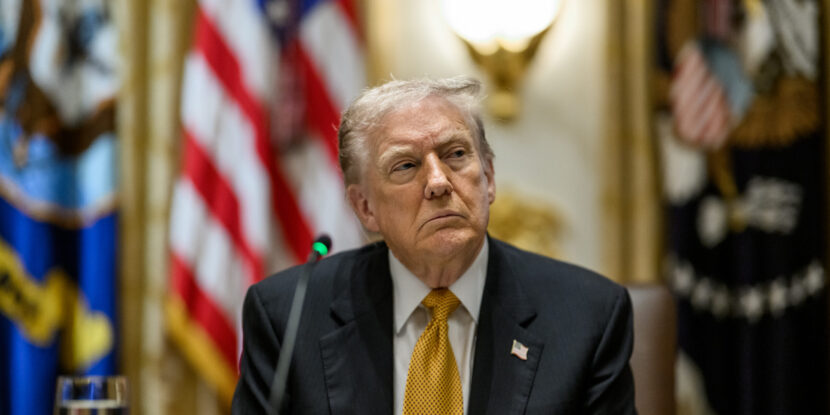
❓WHAT HAPPENED: President Donald J. Trump is believed to have previewed a draft executive order proposing new election safeguards, including voter ID requirements and a ban on most mail-in voting.
👤WHO WAS INVOLVED: President Trump, Peter Ticktin, and Director of National Intelligence (DNI) Tulsi Gabbard.
📍WHEN & WHERE: The rumored order was drafted in early 2026, while DNI Gabbard has been involved in election security reviews in Georgia and Puerto Rico.
💬KEY QUOTE: “Here we have a situation where the President is aware that there are foreign interests that are interfering in our election processes,” said Peter Ticktin.
🎯IMPACT: If enacted, the executive order would significantly alter election processes, requiring voter re-registration with photo ID and restricting mail-in voting.
President Donald J. Trump is believed to have reviewed a 17-page draft Executive Order that would declare a national emergency over election security concerns. The order, drafted by Florida attorney Peter Ticktin, proposes new voter ID requirements, a ban on most mail-in voting, and the elimination of voting machines. However, the proposal is facing significant pushback, as elections are largely left to state governments under the U.S. Constitution.
“Here we have a situation where the President is aware that there are foreign interests that are interfering in our election processes. That causes a national emergency where the President has to be able to deal with it,” Ticktin contends, referencing allegations that the Chinese Communist Party (CCP) attempted to interfere in the 2020 election. Notably, the draft order closely mirrors the legislative language of the SAVE Act, which has been adopted by the House of Representatives but has faced opposition in the U.S. Senate.
Meanwhile, Director of National Intelligence (DNI) Tulsi Gabbard has been involved in election security efforts, including overseeing investigations into voting machine vulnerabilities and reviewing foreign influence on past elections. Gabbard was present during the recent Federal Bureau of Investigation (FBI) seizure of 2020 ballots from a Fulton County, Georgia, election office.
A memo defending the legality of the order, authored by Ticktin, largely relies on the statutory text of the National Emergencies Act (NEA) and the International Emergency Economic Powers Act (IEEPA). “The IEEPA further grants the President authority to address ‘unusual and extraordinary threats’ originating outside the United States that impact national security, foreign policy, or the economy,” Ticktin writes in the memo.
“This authority includes the ability to regulate or prohibit transactions involving foreign property or interests, provided the President has declared a national emergency under the NEA,” he continues, adding, “For example, Executive Order 13848, issued under the IEEPA and NEA, declared a national emergency to address foreign interference in U.S. elections, citing such interference as an extraordinary threat to national security and foreign policy.”
Ticktin argues that “the President may utilize emergency powers to address foreign interference in elections, provided the requirements of the NEA and IEEPA are satisfied, and the actions taken fall within the scope of statutory authority.”
However, other legal analysts have pointed out that mere assertions of CCP election interference aren’t likely to be enough to prevent federal judges from enjoining the order. The NEA outlines the limits of presidential emergency powers and requires the President to specify respective authorizing statutes when invoking them. Meanwhile, IEEPA contains several economic emergency powers but does not contain any explicit election provisions.
Join Pulse+ to comment below, and receive exclusive e-mail analyses.