❓WHAT HAPPENED: Japanese Prime Minister Sanae Takaichi has announced a plan to dissolve parliament and hold a snap election.
👤WHO WAS INVOLVED: Prime Minister Sanae Takaichi, the Liberal Democratic Party (LDP), the Japan Innovation Party, and the Centrist Reform Alliance.
Newsletter
Need to Know.
Your free, daily feed from The National Pulse.
Thank You!
You are now subscribed to our newsletter.
📍WHEN & WHERE: The snap election is scheduled for February 8, 2026, in Japan, following an announcement on January 19, 2026.
🎯IMPACT: The election aims to restore the LDP’s majority in the Japanese legislature’s lower house and address pressing national issues like economic growth, defense spending, and the rising cost of living.
IN FULL
Japanese Prime Minister Sanae Takaichi has announced a snap national election for February 8, 2026. The decision comes as she seeks to capitalise on her surging public popularity and strengthen her party’s position in parliament.
The snap election will be a significant political test for Takaichi, who only took office in October of last year. She inherited a government where her Liberal Democratic Party (LDP) had lost its parliamentary majority, currently holding 199 out of 465 lower house seats. The LDP governs in coalition with the Japan Innovation Party, and Takaichi’s rise to Prime Minister was initially frustrated by a coalition of opposition parties seeking political concessions.
Prime Minister Takaichi is an ally of U.S. President Donald J. Trump and an opponent of immigration, which had been increased in recent years as a supposed solution to Japan’s low birthrate. “It is a fact that unlawful activity and violation of rules by some foreigners are causing the sense of unease and unfairness among Japanese people,” Takaichi said in her first address after taking office, pledging: “The government will respond decisively to these activities. It’s not xenophobia,”
Most see the snap election as a bid to restore the LDP’s majority, thereby strengthening its ability to pass legislation and pursue key initiatives such as increased defense spending and economic growth measures. Cost of living is primarily seen as the top issue for voters, with 45 percent citing it as their main concern in a recent poll. Other key issues include foreign relations and national security, especially amid China’s hostile actions in the region.
Meanwhile, the main opposition has formed a new bloc called the Centrist Reform Alliance, which currently holds 172 seats.
Join Pulse+ to comment below, and receive exclusive e-mail analyses.
By Popular Demand.
The National Pulse Now has an on-site comments section for members. Sign up today and be part of the conversation in our community of almost 15,000.
More From The Pulse
WE ARE 100% INDEPENDENT AND READER-FUNDED. FOR A GUARANTEED AD-FREE EXPERIENCE AND TO SUPPORT REAL NEWS, PLEASE SIGN UP HERE, TODAY.
British Conservative Party leader Olukemi “Kemi” Badenoch closed the Conservative conference in Birmingham, England, on Wednesday by attacking Nigel Farage’s Reform UK party over English identity. She told the hall she would not unite with people who “debate whether my mixed-race children are English,” despite no one in Reform having disputed this. Dan Hodges, a columnist for the Mail on Sunday newspaper, which opposed Brexit in 2016, issued a ringing endorsement: “Kemi Badenoch delivering the most powerful anti-racism speech I’ve seen from a mainstream British party leader.”
To help Raheem J. Kassam and his team bring you the truth about politicians and their corporate media boosters, please JOIN THE NATIONAL PULSE or MAKE A DONATION today.
Newsletter
Need to Know.
Your free, daily feed from The National Pulse.
Thank You!
You are now subscribed to our newsletter.
For anyone who has followed Hodges’s career, particularly his work for the far-left, George Soros-funded Hope Not Hate (HNH) organization, the endorsement was the kiss of death for Kemi.
Kemi Badenoch delivering the most powerful anti-racism speech I've seen from a mainstream British party leader.
Hodges has previously boasted that he worked for the Hope Not Hate organization. In December 2016, he wrote, “I used to work for Hope Not Hate. That’s how dangerously radical and left-wing the organisation is,” apparently believing that the connection would enhance HNH’s reputation rather than tarnish his. In January 2019, he reiterated, “I worked for Hope Not Hate. The campaign.”
In August 2026, defending the Conservatives standing a neo-Nazi activist claiming to be reformed as a candidate, he wrote that he knew the value of such people “because I worked with reformed neo-fascists during my time at the anti-extremism group Hope Not Hate.”
Hope Not Hate was founded in 2004 by Nick Lowles. Its record includes infiltration of right-wing groups, publishing “State of Hate” reports that have smeared populists and conservatives alongside neo-Nazi extremists, and campaigning against Reform candidates in elections. Lowles has personally spread false reports of Muslim women being targeted with acid during periods of public disorder, creating a risk of violent reprisals.
In 2015, the European arm of George Soros’s Open Society Foundations awarded Hope Not Hate Educational Ltd $166,092. The purpose, according to OSF’s own 2015 grantee list, was a two-year “Counter-Jihad Monitoring Unit.”
That is not HNH’s only progressivemoney. Public grant records also show support from the Sigrid Rausing Trust, the Joseph Rowntree Charitable Trust, the Paul Hamlyn Foundation, the Barrow Cadbury Trust, and Unbound Philanthropy. The charitable arm of HNH has, in turn, funded its campaigning company.
Nepo Baby Beginnings.
Daniel Pearce Jackson Hodges was born in Lewisham in 1969, the son of the actress and Labour Member of Parliament (MP) Glenda Jackson. He has admitted that his first job, as her parliamentary researcher, was “straight-forward nepotism.” After that came communications work for the GMB union, the London Development Agency, and Transport for London.
He was a Labour activist and supporter for long stretches, quit the party, rejoined in 2015 to oppose the far-left anti-Zionist Jeremy Corbyn, and then quit again. Since 2016, he has been a weekly Mail on Sunday columnist, presented as a Blairite voice inside a supposedly right-leaning paper as proof of viewpoint diversity. He now uses that position to boost the establishment Conservatives, particularly when they lean into liberal stances, in an effort to halt their displacement as the main party of the right by Nigel Farage’s Reform.
The Speech He Endorsed.
With Badenoch offering little to conservatives on tax cuts, industrial renewal, or immigration, where the Conservatives lack credibility following the Boriswave, the section of her speech most praised by Hodges and other liberals was a DEI-style attack on Reform figures like Suella Braverman MP—who is British Indian—for suggesting there is such a thing as an English ethnicity and ethnic identity based on ancestry. “I don’t want to explain to my son when we’re watching our brilliant English team play football that some people don’t think that black players are English,” she railed.
Hodges called it “the most powerful anti-racism speech I’ve seen from a mainstream British party leader.” He also characterized Badenoch as “absolutely destroying Reform over their Ethno-Nationalism.”
The endorsement not only undermines what standing Badenoch has as a right-wing figure, given Hodges’s past as a Labour and HNH activist, but leaves the Nigeria-raised Badenoch vulnerable to accusations of hypocrisy, as she has made no secret of her own very strong ethnic identity as a Yoruba woman, even going so far as to describe northern Nigerians as her “ethnic enemies” in 2024.
Kemi’s speech endorsed by Hope Not Hate activist Dan Hodges.
Join Pulse+ to comment below, and receive exclusive e-mail analyses.
show less
British Conservative Party leader Olukemi "Kemi" Badenoch closed the Conservative conference in Birmingham, England, on Wednesday by attacking Nigel Farage's Reform UK party over English identity. She told the hall she would not unite with people who “debate whether my mixed-race children are English,” despite no one in Reform having disputed this. Dan Hodges, a columnist for the Mail on Sunday newspaper, which opposed Brexit in 2016, issued a ringing endorsement: “Kemi Badenoch delivering the most powerful anti-racism speech I’ve seen from a mainstream British party leader.”show more
By Popular Demand.
The National Pulse Now has an on-site comments section for members. Sign up today and be part of the conversation in our community of almost 15,000.
WE ARE 100% INDEPENDENT AND READER-FUNDED. FOR A GUARANTEED AD-FREE EXPERIENCE AND TO SUPPORT REAL NEWS, PLEASE SIGN UP HERE, TODAY.
On Monday, the Institute for Public Policy Research (IPPR), a British left-wing think tank, released a report calling for the government to reverse Brexit, the country’s democratic decision to leave the European Union (EU). Significantly, multiple members of Prime Minister Andy Burnham’s top team are products of the IPPR.
The National Pulse maps the networks of the establishment left in Britain. If you value the work of Raheem J. Kassam and his team, please JOIN THE NATIONAL PULSE or MAKE A DONATION today.
Newsletter
Need to Know.
Your free, daily feed from The National Pulse.
Thank You!
You are now subscribed to our newsletter.
What Is The IPPR?
The Institute for Public Policy Research (IPPR) was founded in 1988 by businessman Clive Hollick and economist John Eatwell, both of whom represent the Labour Party in the House of Lords, the upper chamber of the United Kingdom’s bicameral legislature. The IPPR was established to develop progressive policy ideas and challenge free-market economics, which gained traction during the premiership of former Conservative Prime Minister Margaret Thatcher throughout the 1980s.
While the think tank describes itself as independent and non-partisan, it is deeply entwined with the governing Labour Party.
Who Funds The IPPR?
According to the IPPR’s 2025 financial disclosure, it received between £725,001 and £750,000 from left-wing billionaire George Soros’ Open Society Foundations (OSF).
The think tank also received between £325,001 and £350,000 from the European Climate Foundation, a Netherlands-based non-profit seeking to achieve Net Zero across Europe by 2050, and between £275,001 and £300,000 from the ClimateWorks Foundation. The latter has received donations from various non-profit organizations, including Amazon founder Jeff Bezos’ Earth Fund, and billionaire Michael Bloomberg’s Bloomberg Philanthropies, among others.
The IPPR has also taken between £150,001 and £175,000 from the Gates Foundation, established by Microsoft founder Bill Gates and his then-wife, Melinda French Gates.
Other foreign donations include between £275,001 and £300,000 from the Laudes Foundation and between £200,001 and £225,000 from the Fondation Pluralisme, two Switzerland-based non-profits broadly focused on climate change and human rights, respectively.
The organization’s most recent financial disclosure also lists between £175,001 and £200,000 from the Joseph Rowntree Foundation and between £100,001 and £125,000 from Justice Together, two UK-based ‘social justice’ charities, with the latter specifically seeking to oppose restrictive immigration and asylum policies.
According to the Charity Commission, Britain’s official independent charity regulator, the IPPR raised £4,682,349 in funding for the financial year ending December 31, 2024.
The National Pulse does not take government or corporate cash, so we need your support. Please JOIN THE NATIONAL PULSE or MAKE A DONATION today. We are 100% reader-funded.
The IPPR-Burnham Network.
There exists significant overlap between former IPPR personnel and the inner circle of Prime Minister Andy Burnham. James Purnell, Prime Minister Burnham’s Chief of Staff, served as Chair of the IPPR from July 2010 to March 2013. Purnell served as a Cabinet minister under former Labour Prime Minister Gordon Brown.
Graeme Cooke, Prime Minister Burnham’s Director of Policy, served as Director of Research at the IPPR from October 2012 to November 2014. He also worked as the organization’s Associate Director for Work and Families from October 2011 to October 2012. Cooke and Purnell co-edited We Mean Power: Ideas for the Future of the Left, a book published in 2010 by the Open Left project, an initiative by Demos, another British political think tank associated with the so-called “Soft Left” of Labour. Cooke and Purnell were head and director of the Open Left Project, respectively.
The book proposes reframing the immigration debate “from numbers to rules” and “re-presenting the open society” after attempts to incorporate “indigenous Englishness within a wider multicultural setting” proved “largely ineffective” at addressing the growing discontent of the “white working-class.”
Matthew McGregor, Prime Minister Burnham’s Director of Political Strategy, served as a Trustee for the IPPR from February 2024 to July 2026. McGregor previously served as CEO of 38Degrees, a progressive activist group that sought to prevent President Donald J. Trump’s state visit to the United Kingdom. McGregor also described the President as a “maniac with fascist tendencies” and Reform UK leader Nigel Farage “a racist piece of shit” on his now-deleted X (formerly Twitter) page. He also worked as Director of Communications for Hope Not Hate, a far-left activist group, from 2018 to 2021. In 2021, McGregor co-authored a report downplaying Britain’s grooming gang scandal with Liron Velleman, a former Labour councillor and the group’s former Political Organizer. In early January 2026, Velleman pleaded guilty to attempting to engage in sexual communication with a child.
Emma Norris, Special Adviser to Prime Minister Burnham, served as the IPPR’s Deputy Director from August 2025 to September 2026.
Miatta Fahnbulleh, the current Secretary of State for Energy Security and Net Zero, served as the IPPR’s Director of Policy and Research from December 2016 to December 2017. Her family was involved in multiple attempts to overthrow the Liberian government in the 1980s. “Much like Rep. Ilhan Omar in America, Miatta’s family actually worked for the government they later fled… Her grandfather was even charged with treason for cavorting with Chinese communists in the late 1960s. Miatta is just another in a long line of anti-Western, far leftists,” said Raheem Kassam, Editor-in-Chief of The National Pulse, back in July.
The IPPR’s Report.
According to the report, titled New World, New Relationship: Our Future with Europe,the IPPR argues that Britain “must again become a member of the European Union” and should make European Union membership its “medium-term goal.” The report claims that geopolitical uncertainty created by China, Russia, and the United States necessitates rejoining the EU and further claims that closer trade deals with the bloc will be insufficient. The IPPR calls on the British government to establish “closer ties between progressive parties across Europe,” “develop a new political language about Europe, reflected by the government in its communications strategy,” and rejoin “either through a referendum or a clear manifesto commitment.”
This follows research by The National Pulse modeling the severe impact of immigration on the United Kingdom if the country were to join the EU, responding t0 comments about rejoining made by the Prime Minister. “We could go all the way,” said Burnham at the time.
The National Pulse follows the money so you don’t have to. If you value the work of Raheem J. Kassam and his team, please JOIN THE NATIONAL PULSE or MAKE A DONATION today.
Join Pulse+ to comment below, and receive exclusive e-mail analyses.
show less
On Monday, the Institute for Public Policy Research (IPPR), a British left-wing think tank, released a report calling for the government to reverse Brexit, the country's democratic decision to leave the European Union (EU). Significantly, multiple members of Prime Minister Andy Burnham's top team are products of the IPPR.
show more
By Popular Demand.
The National Pulse Now has an on-site comments section for members. Sign up today and be part of the conversation in our community of almost 15,000.
WE ARE 100% INDEPENDENT AND READER-FUNDED. FOR A GUARANTEED AD-FREE EXPERIENCE AND TO SUPPORT REAL NEWS, PLEASE SIGN UP HERE, TODAY.
A historic French city hall that survived two world wars has been destroyed by youth rioters, as part of a wave of unrest, much of it involving young people from migration backgrounds, sweeping across President Emmanuel Macron’s France. The destruction comes amid nationwide violence that has left thousands of businesses damaged, thousands of rioters arrested, and many police officers injured.
The National Pulse brings you the latest research on current events. To support Raheem J. Kassam and his team, please JOIN THE NATIONAL PULSE or MAKE A DONATION today. We are 100% reader-funded.
Newsletter
Need to Know.
Your free, daily feed from The National Pulse.
Thank You!
You are now subscribed to our newsletter.
The 143-year-old city hall in Limoges, central France, was set ablaze by a masked mob on Saturday, October 17, during demonstrations over rising living costs and deteriorating public services. Rioters smashed windows and forced their way into the historic building before setting it on fire. Flames consumed much of the roof, while the building’s iconic 141-foot clock tower collapsed.
Residents compared the destruction to the devastating 2019 fire at Notre-Dame Cathedral in Paris, which shocked the entire world. Local officials described the destruction as a heritage catastrophe, while Limoges Mayor Guillaume Guérin criticized the lack of police protection, claiming officers had been diverted to deal with demonstrations elsewhere in the city.
France: The bell tower of Limoges City Hall has collapsed after a massive fire engulfed the historic building during protests.
The landmark, inaugurated in 1883, was more than 140 years old. https://t.co/7F4OO6tIiD
Limoges City Hall was inaugurated on July 14, 1883, deliberately coinciding with Bastille Day, the French national holiday commemorating the French Revolution. Designed by architect Charles-Alfred Leclerc, the neo-Renaissance building was inspired by Paris’s Hôtel de Ville and was an example of the architecture of France’s Third Republic.
Its elaborate stone facade, huge staircase, decorative interiors, and towering central belfry made it one of the city’s most recognizable landmarks. The building received historic monument protection in 1975 and served generations of residents as the city’s center of government.
Remarkably, the building survived both world wars due to its location in France’s midwest, far from the battlefields of Flanders of 1916 and the Nazi blitzkrieg in 1940. However, mass migration and far-left violence proved to be phenomena that it could not survive.
Thousands Arrested as France Descends Into Rioting.
The destruction in Limoges was part of a much wider outbreak of violence that engulfed major French cities, including Paris, Marseille, Lyon, and Bordeaux. Around 2,400 people were arrested during the weekend’s unrest, while thousands of businesses suffered damage or looting. More than 3,000 shops were damaged nationwide.
French newspaper Le Mondereported that Prime Minister Sébastien Lecornu had confirmed 150 injured police officers, but that was an early estimate, and the true number is likely higher. Rioters themselves also suffered serious injuries, including injuries from French police riot-control weapons.
In Marseille, rioters briefly breached the city hall, while the residence of the prefect in Bordeaux was damaged. Groups of rioters also approached within approximately 300 meters of the Élysée Palace, the French president’s official residence.
France’s Long History of Riot-Related Destruction.
The burning of Limoges City Hall is not the first occasion on which rioting has threatened France’s historic buildings and public institutions. During the 2018 Yellow Vest protests, far-left agitators vandalized the Arc de Triomphe in Paris, one of France’s most recognizable national monuments.
The 2023 riots following the police shooting of migrant-background teenager Nahel Merzouk were even more destructive. According to an official French Senate investigation, those disturbances resulted in 2,508 buildings being burned or damaged, including 105 town halls, 243 educational establishments, and 273 police or gendarmerie (paramilitary police) buildings. Rioters also burned 12,031 vehicles and vandalized or looted more than 1,000 businesses. The Senate estimated the total property damage at nearly €1 billion ($1.12 billion), with insurers recording €793 million ($889 million) in claims.
Among the cultural losses was the Jean-Macé Library in Metz, which was burned to the ground during the violence, destroying a significant collection of books and other materials.
Macron’s Repeated Failure Is Destroying France.
While President Macron has condemned the latest violence, blaming radical far-left groups and opportunistic criminals for exploiting demonstrations originally organized around education and living standards, he has done little to contain it. Some analysts have questioned whether organized extremists alone can explain the scale of the disorder, with some noting the broad leftist networks involved, many of which go well beyond France itself.
The French government has responded with additional policing and localized restrictions, including overnight curfews in parts of Paris. For Limoges, however, the consequences of the violence are already irreversible. A landmark that stood through two world wars is largely destroyed, with taxpayers expected to foot the bill for an expensive reconstruction or demolition.
Join Pulse+ to comment below, and receive exclusive e-mail analyses.
show less
A historic French city hall that survived two world wars has been destroyed by youth rioters, as part of a wave of unrest, much of it involving young people from migration backgrounds, sweeping across President Emmanuel Macron's France. The destruction comes amid nationwide violence that has left thousands of businesses damaged, thousands of rioters arrested, and many police officers injured.
show more
By Popular Demand.
The National Pulse Now has an on-site comments section for members. Sign up today and be part of the conversation in our community of almost 15,000.
WE ARE 100% INDEPENDENT AND READER-FUNDED. FOR A GUARANTEED AD-FREE EXPERIENCE AND TO SUPPORT REAL NEWS, PLEASE SIGN UP HERE, TODAY.
Britain’s Labour government is allowing thousands of migrants to secure de facto permanent residency every week by delaying promised immigration restrictions. Many are entered Britain as part of the Boriswave, a mass influx engineered by the former Conservative government following the COVID-19 pandemic.
The National Pulse researches the stories that matter to you. To support Raheem J. Kassam and his team, please JOIN THE NATIONAL PULSE or MAKE A DONATION today. We are 100% reader-funded.
Newsletter
Need to Know.
Your free, daily feed from The National Pulse.
Thank You!
You are now subscribed to our newsletter.
More than 200,000 legal migrants have reportedly received indefinite leave to remain (ILR) despite tougher settlement requirements being promised last year. Around 5,000 migrants are reportedly securing permanent settlement every week under existing arrangements, even as government ministers debate extending the standard qualifying period from five to ten years.
The Conservatives created the conditions for the surge in settlement by dramatically relaxing controls on legal immigration, disregarding their repeated pledges to substantially reduce it. Labour, despite promising to tighten the rules, has failed to implement reforms that could prevent hundreds of thousands of Boriswave arrivals from becoming de facto permanent residents.
The Tories Own the Boriswave.
Boris Johnson’s government introduced a new points-based immigration system in December 2020, supposedly to restore British control over immigration following Brexit. Instead, the Conservatives greatly expanded eligibility for foreign workers outside of the EU, lowered skills requirements for sponsored employment, uncapped student and work visas, and opened additional routes for lower-paid care workers and their dependants.
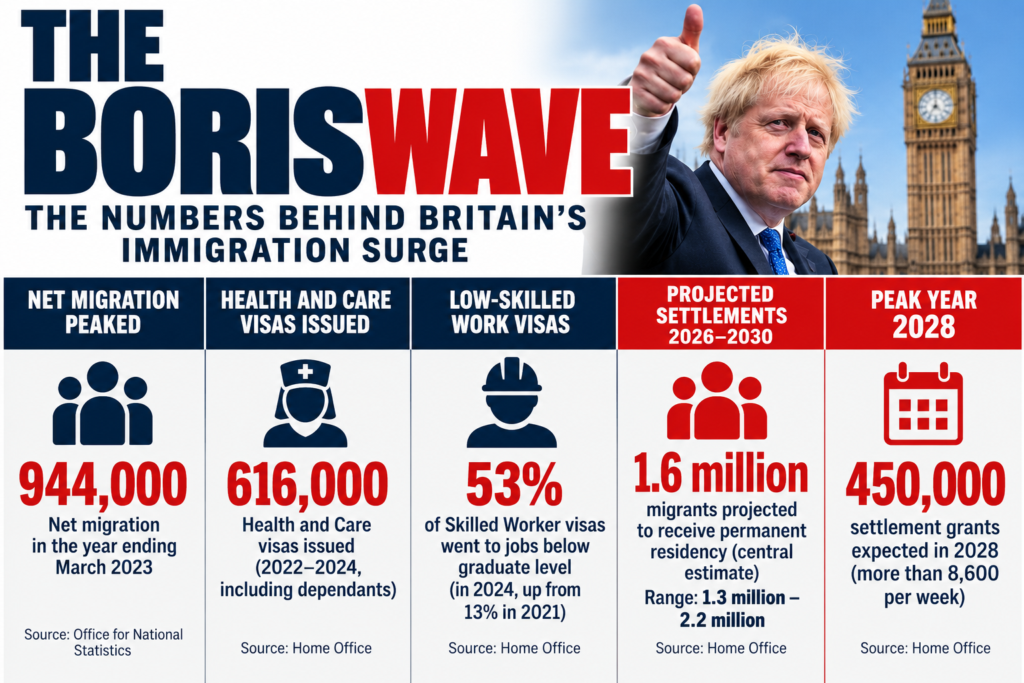
According to the Home Office’s own assessment of the settlement system, approximately 616,000 people entered Britain through the Health and Care visa route alone between 2022 and 2024, most of them dependants rather than the workers the scheme was supposedly designed to attract.
The Conservatives also expanded the “skilled” worker routes to occupations below graduate level. By the year ending June 2024, 53 percent of Skilled Worker visas issued to main applicants were for jobs below graduate-level skill requirements.
Brexit had been sold to voters as an opportunity to restore national control over Britain’s borders, including by Johnson himself. Instead, while Conservative ministers ended European “free movement” immigration, they introduced an uncapped points system that facilitated record levels of arrivals from outside the European Union, far larger than the decrease in EU immigration.
The Office for National Statistics (ONS) subsequently revised its estimates of net migration, placing the peak at approximately 944,000 in the year ending March 2023.
Up to 2.2 Million Migrants Could Settle by 2030.
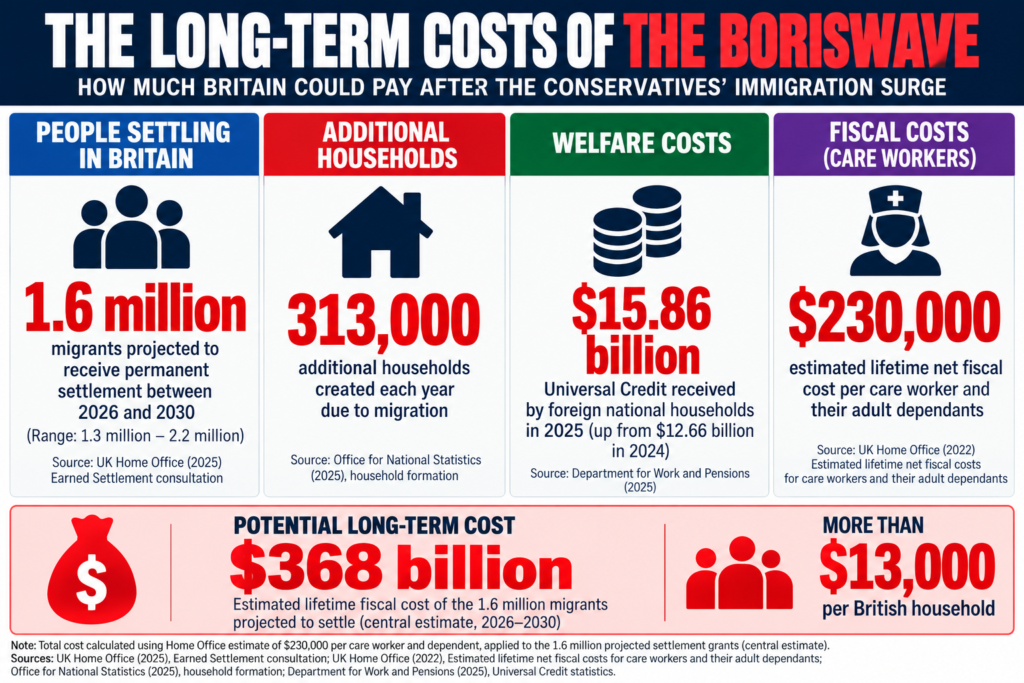
The Home Office’s official settlement forecasts estimate that between 1.3 million and 2.2 million migrants could obtain Indefinite Leave to Remain between 2026 and 2030 under projected settlement patterns. The department expects settlement grants to peak in 2028, when approximately 450,000 people could receive ILR. That would represent an average of more than 8,600 grants per week, nearly doubling the approximately 5,000 being reported now.
Much of the increase can be traced directly to decisions taken by Conservative ministers. The Home Office forecasts that approximately 462,000 people who originally entered through the Health and Care visa route could obtain ILR between 2026 and 2030. Another 306,000 are projected to settle after arriving through other Skilled Worker routes.
In 2028 alone, the department expects approximately 210,000 settlement grants to people who originally entered through the Health and Care route. The forecasts also include “family reunion” chaim migration, Hong Kong British National (Overseas) visa holders, and others.
Labour’s Promised Crackdown Appears to Be a Mirage.
Labour initially proposed doubling the standard qualifying period for indefinite leave to remain from five to ten years as part of its immigration reforms. Home Secretary Shabana Mahmood outlined a more extensive system of earned settlement, under which applicants would have to demonstrate economic contribution, integration, and compliance with immigration requirements.
The government’s November 2025 consultation also proposed a 15-year qualifying period for certain lower-skilled workers, alongside longer periods for applicants whose circumstances trigger additional requirements. Mahmood has also proposed applying the changes to migrants already living in Britain who had not yet obtained ILR.
However, the proposal provoked opposition within Labour, with many Members of Parliament (MPs) lobbying against retrospectively changing the conditions for millions of foreign workers who are already in Britain. Open borders proponents and others say that migrants who arrived legally under the Conservative government’s rules should not have their settlement expectations overturned after years of residence.
The consultation closed in February 2026, but the central reforms remained unresolved as of October 19. Meanwhile, the settlement pipeline established by Johnson and his Conservative successors continues to operate.
The Long-Term Cost of the Conservative Immigration Experiment.
Permanent settlement does not automatically grant every recipient welfare payments, but it generally removes the immigration restrictions that prevent many temporary visa holders from accessing many public funds. ILR holders can become eligible for Universal Credit, social housing, and other benefits. They can also generally apply for British citizenship after meeting additional residence and eligibility requirements.
This raises questions about the long-term fiscal consequences of the Conservatives’ decision to expand immigration through low-paid employment routes. A Home Office fiscal assessment of care workers and their adult dependants examines how earnings, tax contributions, public services, and welfare expenditure affect the lifetime fiscal impact of this category of migration.
Meanwhile, government figures reported in September showed that households containing at least one foreign national received approximately £11.9 billion ($15.86 billion) in Universal Credit during 2025, up from £9.5 billion ($12.66 billion) in 2024.
Labour’s proposed restrictions would delay settlement for many applicants, potentially postponing their access to certain benefits. However, the final fiscal impact will depend on which migrants are covered, what transitional arrangements are introduced, and how settlement affects their employment and tax contributions.
Britain’s Immigration Crisis Is a Failure of the Entire Establishment.
Labour’s hesitation over settlement reform presents an opportunity for Nigel Farage and his Reform UK party, but the Boriswave is fundamentally a legacy of the Conservative government. Their post-Brexit immigration system admitted unprecedented numbers of foreign nationals, many on pathways that could eventually lead to indefinite leave to remain.
Labour inherited that system and has now spent months debating how to change it, while thousands continue securing settlement under the existing rules.
Join Pulse+ to comment below, and receive exclusive e-mail analyses.
show less
Britain's Labour government is allowing thousands of migrants to secure de facto permanent residency every week by delaying promised immigration restrictions. Many are entered Britain as part of the Boriswave, a mass influx engineered by the former Conservative government following the COVID-19 pandemic.
show more
By Popular Demand.
The National Pulse Now has an on-site comments section for members. Sign up today and be part of the conversation in our community of almost 15,000.
WE ARE 100% INDEPENDENT AND READER-FUNDED. FOR A GUARANTEED AD-FREE EXPERIENCE AND TO SUPPORT REAL NEWS, PLEASE SIGN UP HERE, TODAY.
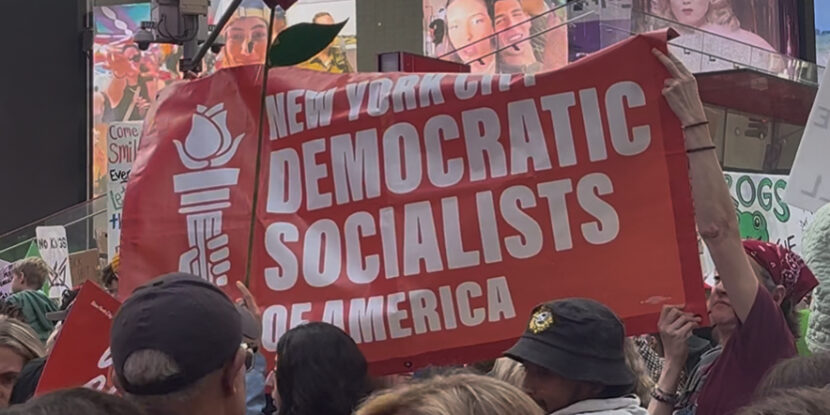
The Democratic Socialists of America (DSA) claim to represent the working class and minority communities, while promising a clean break from the Democratic Party establishment. However, surveydata on the organization’s membership suggests otherwise.
The National Pulse provides you with the data that matters. If you value the work of Raheem J. Kassam and his team, please JOIN THE NATIONAL PULSE or MAKE A DONATION today.
Newsletter
Need to Know.
Your free, daily feed from The National Pulse.
Thank You!
You are now subscribed to our newsletter.
Profile of DSA Members.
According to a 2025 membership survey, 66 percent of Democratic Socialists of America (DSA) members are white. The same survey found that Women and so-called “non-binary” people account for 54 percent of the membership.
The DSA’s official 2021 membership survey shows that 32 percent of members identify as “LGBTQIA+,” 80 percent of members hold a bachelor’s degree, and 60 percent identify as irreligious. It also found that 57 percent of DSA members live in urban areas and that 96 percent of members live in an area with a DSA chapter. The average member is approximately 33 years old, significantly younger than the average DSA member before 2016.
This means that the average DSA member is whiter, younger, more secular, more LGBT, and wealthier than the average American.
In contrast, 57 percent of Americans are non-Hispanic white, the average age of an American is 39 years old, and approximately nine percent of Americans identify as LGBT. Around one percent of Americans identify as “non-binary.” Roughly 28 percent of Americans are religiously unaffiliated, 38 percent have at least a bachelor’s degree, and 18 percent earn at least $100,000 a year.
This matters because white, college-educated, relatively affluent, urban voters were one of the few demographic constituencies to shift toward the Democrats between 2020 and 2024, when Kamala Harris lost both the electoral and popular vote to President Donald J. Trump. As such, it appears that the kind of people currently lining the ranks of the DSA are scarcely different from those currently lining the ranks of the Democrat establishment.
The National Pulse does not take government or corporate cash, so we need your support. Please JOIN THE NATIONAL PULSE or MAKE A DONATION today. We are 100% reader-funded.
Priorities of DSA Members.
According to the University of Massachusetts Amherst’s August 2026 National Public Opinion Poll, 96 percent of Democrats who identify very strongly with the DSA support raising taxes on the wealthy, the most popular policy in the survey.
However, support for giving citizenship to illegal immigrants polled at 91 percent among strongly DSA-aligned Democrats. According to its official policy program, the DSA seeks to “grant amnesty for all immigrants regardless of status.” As such, it is reasonable to assume that the figure represents overwhelming support among DSA-aligned Democrats for effectively open borders.
This means that open borders is just as popular with DSA-aligned Democrats as free healthcare and more popular than several proposals the DSA has become identified with, such as defunding the police (85 percent support) and recognizing a Palestinian state (84 percent support). The survey also revealed that 62 percent of Democrats who identify very strongly with the DSA support giving non-citizens voting rights, compared to just 29 percent of non-DSA Democrats.
According to polling conducted immediately after the 2024 presidential election by Blueprint, a Democrat-aligned public research firm, 77 percent of swing voters believed that the Democrats had not been tough enough on illegal immigration. The poll showed that 73 percent of swing voters believed that Democrats “support immigrants more than American citizens” and that 72 percent believed that Democrats “don’t care about securing the border.” Blueprint’s research also showed that the issue of immigration was practically tied with inflation as the most important reason for voters rejecting Harris.
This followed Blueprint polling from December 2023, which showed that 56 percent of Americans believed then-President Joe Biden was “more liberal” than themselves on immigration. The same poll showed that 42 percent of Americans viewed Biden as “far more liberal” than themselves on immigration and that 53 percent wanted stricter asylum and refugee rules. This included 61 percent of registered Independents.
Therefore, not only do DSA members bear a striking resemblance to the Democrat establishment they claim to oppose, but they also share the same fundamental priorities, despite some shades of difference over economic and foreign policy.
The National Pulse keeps you informed about the inner workings of the American far left. If you value the work of Raheem J. Kassam and his team, please JOIN THE NATIONAL PULSE or MAKE A DONATION today.
Join Pulse+ to comment below, and receive exclusive e-mail analyses.
show less
The Democratic Socialists of America (DSA) claim to represent the working class and minority communities, while promising a clean break from the Democratic Party establishment. However, survey data on the organization's membership suggests otherwise.
show more
By Popular Demand.
The National Pulse Now has an on-site comments section for members. Sign up today and be part of the conversation in our community of almost 15,000.
WE ARE 100% INDEPENDENT AND READER-FUNDED. FOR A GUARANTEED AD-FREE EXPERIENCE AND TO SUPPORT REAL NEWS, PLEASE SIGN UP HERE, TODAY.
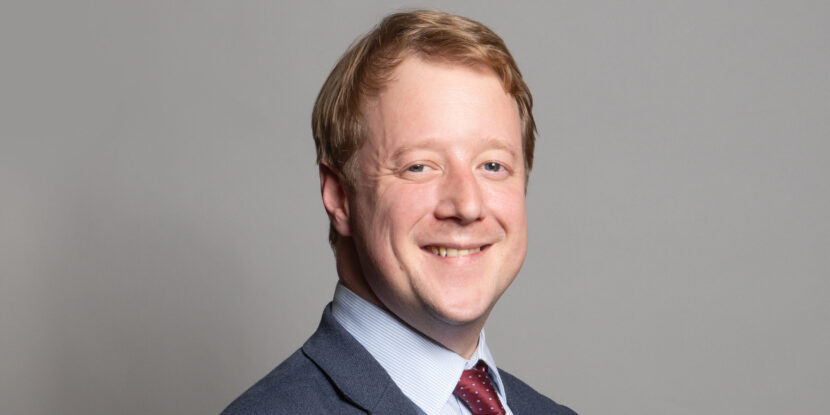
Paul Bristow, former Member of Parliament (MP) for Peterborough and current Conservative Party Mayor of Cambridgeshire and Peterborough, has made a series of questionable decisions over the course of his political career.
The National Pulse maps the establishment’s networks. To support Raheem J. Kassam and his team, please JOIN THE NATIONAL PULSE or MAKE A DONATION today. We are 100% reader-funded.
Newsletter
Need to Know.
Your free, daily feed from The National Pulse.
Thank You!
You are now subscribed to our newsletter.
Appointing Ansar Ali.
In September 2023, Bristow faced criticism after hiring former Labour councillor Ansar Ali as a caseworker and translator in his constituency office. Ali had been suspended from the Labour Party in 2021 after allegedly posting antisemitic material between 2014 and 2017. The former Labour councillor shared content about “Nazi-Zionist collaboration” and a “Zionist Israeli government lobby.” Labour later reinstated Ali, who left the party in January 2023.
In an article for The Jewish Chronicle titled “Why I have employed a former Labour councillor who was once suspended for antisemitism,” Bristow claimed that he knew Ali had been suspended but had not closely checked the reasons before hiring him.
Consultant Lobbying.
In November 2021, Bristow wrote an article in The Times newspaper titled “Let’s ban MPs from consultant lobbying,” which argued for increased transparency and stricter standards.
However, before entering Parliament in 2019, Bristow founded PB Political Consulting, a health public affairs lobbying firm. In January 2020, Bristow stepped down as director and transferred control to his wife, Sara Bristow. The firm was renamed Healthcomms Consulting and absorbed by Political Lobbying and Media Relations (PLMR), a consulting lobbying firm, in 2022.
While Bristow admitted his background as a lobbyist, he defended his wife’s role in running his family’s lobbying business. “When I became an MP, I handed over the reins and ownership of my communications business to my wife. That wasn’t a contrived move. She had been a company employee for many years and had already taken over from me for much of the preceding year,” wrote Bristow, claiming he now has nothing to do with the company. The then-MP seemingly suggested that concerns regarding his wife’s influence were rooted in sexism. “The other argument is that my wife should lose her job. Whenever I hear this, I realise that the 21st century hasn’t advanced quite as far as I assumed. She is far better at running the company than I was,” wrote Bristow.
In April 2021, it was reported that Bristow had claimed £10,500 in parliamentary expenses for rent between April and November 2020, even as he was renting out three residential properties in London. “The current system for MPs says to rent one home or use hotels. I’ve followed both the letter and the spirit of the rules which were written to avoid MPs profiting from subsidised mortgages,” the then-MP for Peterborough insisted at the time.
Cash for Questions Allegations.
In November 2020, PoliticsHome reported that Bristow had submitted parliamentary questions on health issues connected to areas covered by his family’s lobbying business. After transferring control of PB Consulting to his wife, the firm ran several health-related All-Party Parliamentary Groups (APPGs), informal groupings of MPs from various parties dedicated to examining a specific area of policy. For instance, in September 2020, Bristow submitted a question about the National Health Service (NHS) Breast Screening Programme, while his wife’s firm ran the APPG on Women’s Health.
PB Consulting also received funds from campaign groups and private healthcare companies. According to PoliticsHome, Bristow “retrospectively amended a number of Written Questions to declare his financial interests.”
Donations From the United and Cecil Club.
According to his register of interests as Mayor of Cambridgeshire and Peterborough, Bristow is a member of the United and Cecil Club, a members’ association that raises money for Conservative Party candidates. In January 2020, Bristow’s local Conservative association received a £2,500 donation from the club.
The United and Cecil Club has long attracted scrutiny, as money can potentially be routed through the association in order to obscure ineligible donors. This is particularly important as the club has historically directed its fundraising efforts towards marginal constituencies, such as Peterborough, where Bristow was narrowly elected in 2019 with 46.7 percent of the vote.
Since the last general election, third parties, such as Nigel Farage’s Reform UK party, have gained traction, meaning that slight shifts in the opinion polls, potentially owing to additional resources, could cost parties significant numbers of seats, heightening concerns regarding unspecified sources of donations.
Join Pulse+ to comment below, and receive exclusive e-mail analyses.
show less
Paul Bristow, former Member of Parliament (MP) for Peterborough and current Conservative Party Mayor of Cambridgeshire and Peterborough, has made a series of questionable decisions over the course of his political career.
show more
By Popular Demand.
The National Pulse Now has an on-site comments section for members. Sign up today and be part of the conversation in our community of almost 15,000.
WE ARE 100% INDEPENDENT AND READER-FUNDED. FOR A GUARANTEED AD-FREE EXPERIENCE AND TO SUPPORT REAL NEWS, PLEASE SIGN UP HERE, TODAY.
The National Pulse brings you key research on topics that matter. To support Raheem J. Kassam and his team, please JOIN THE NATIONAL PULSE or MAKE A DONATION today. We are 100% reader-funded.
Newsletter
Need to Know.
Your free, daily feed from The National Pulse.
Thank You!
You are now subscribed to our newsletter.
The confrontation erupted during an October 16 European Union summit in Brussels, where Frederiksen called on the European Commission to investigate the consequences of Spanish Socialist Prime Minister Pedro Sánchez’s illegal alien regularization program. The Danish leader accused Spain of pursuing policies fundamentally at odds with the direction of most European governments, warning that national immigration decisions could have consequences far beyond their own borders.
The dispute exposes a growing contradiction at the heart of the European project, with many asking how the free movement of people within the bloc can survive if single states can grant access to hundreds of thousands of foreigners all on their own.
Spain Versus the Rest of Europe.
Spain’s Socialist government has defended its mass regularization program as a means of bringing illegal immigrants into the legal workforce. However, the initiative has drawn sharp criticism from governments pursuing increasingly restrictive immigration policies.
Meloni’s government in Italy has prioritized reducing illegal crossings in the Mediterranean, negotiating agreements with North African countries, and developing migrant-processing facilities in Albania. Denmark, meanwhile, has emerged as one of Europe’s most restrictive countries on asylum despite being governed by Frederiksen’s center-left Social Democrats. Her government has emphasized deportations, strictly temporary protection, and discouraging asylum seekers from settling in the country permanently.
Germany has also reluctantly shifted toward tougher enforcement under Chancellor Friedrich Merz, with his government supporting stricter border controls and faster removals, largely to counteract the rise of the populist Alternative for Germany (AfD).
The political realignment was particularly evident at Friday’s summit, where 18 European governments gathered to discuss tougher migration measures, including potential restrictions on asylum procedures during emergencies.
Schengen: One Country’s Decision, Everyone’s Problem.
At the center of the controversy is the European Union’s Schengen system, which allows travel across most EU countries without internal border checks. Under Schengen’s common rules, non-EU nationals holding valid residence permits from participating countries can generally travel throughout the area for up to 90 days within a 180-day period. Migrants granted citizenship by one EU member acquire EU citizenship, with full free movement rights across the bloc.
Residence permits do not automatically authorize employment or permanent settlement in another member state. Nevertheless, critics argue that granting legal status to large numbers of previously illegal immigrants creates additional opportunities for movement throughout Europe.
The problem has become especially contentious following the migration crisis in Spain’s North African exclave of Ceuta, where tens of thousands of migrants crossed from Morocco in July. Italy subsequently suspended aspects of Schengen travel arrangements with Spain, citing security concerns. Madrid complained that the restrictions were unjustified.
Europe’s Border Crisis Began Long Before Spain’s Amnesty.
Europe has struggled to develop a common immigration policy since the 2015 migrant crisis, when more than a million migrants entered the continent, particularly through Greece and Italy, at the instigation of Germany. The crisis overwhelmed asylum systems, exposed disagreements over responsibility for arrivals, and contributed to the rise of anti-mass migration populist parties across Europe.
Migration pressures have since shifted between routes through the Mediterranean, the Balkans, and Spain. Unauthorized migration, people-smuggling networks, and difficulties returning rejected asylum applicants remain persistent.
Brussels Struggles to Find a Common Solution.
The EU attempted to address these longstanding problems through its Pact on Migration and Asylum, which entered into application in June 2026. The reforms introduced common screening procedures, strengthened identity and security checks, accelerated certain asylum decisions, and established mechanisms for sharing responsibility between member states.
Disagreements remain, however, over deportation centers in third countries, asylum restrictions, and the consequences of national regularization programs.
Denmark, Italy, and Poland have pushed for greater coordination when one government’s immigration decisions could affect its neighbors. Supporters of tougher policies argue that mass amnesties risk encouraging further illegal migration.
The European Union is now asking itself how its system can survive, so long as a single nation state can allow in hundreds of thousands of illegals, without consultation from other members, and give them a path to EU citizenship.
Join Pulse+ to comment below, and receive exclusive e-mail analyses.
show less
European leaders are increasingly divided over mass immigration amnesties, with Italian Prime Minister Giorgia Meloni and Danish Prime Minister Mette Frederiksen leading the latest backlash against Spain's decision to legalize hundreds of thousands of illegals.
show more
By Popular Demand.
The National Pulse Now has an on-site comments section for members. Sign up today and be part of the conversation in our community of almost 15,000.
WE ARE 100% INDEPENDENT AND READER-FUNDED. FOR A GUARANTEED AD-FREE EXPERIENCE AND TO SUPPORT REAL NEWS, PLEASE SIGN UP HERE, TODAY.
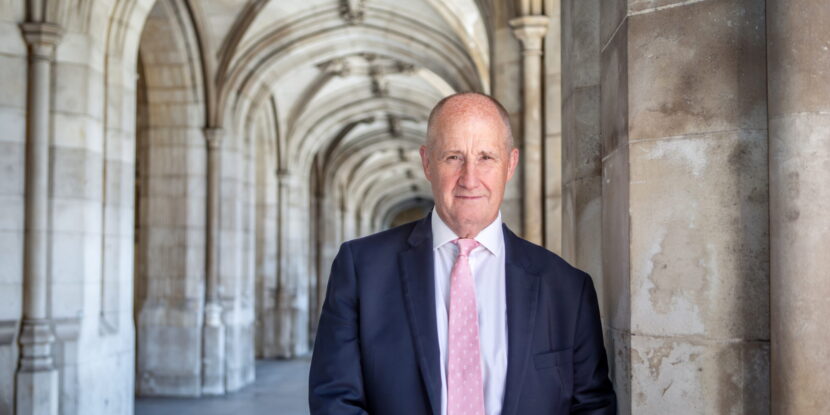
Kevin Hollinrake, the Conservative Party chairman under Kemi Badenoch and Member of Parliament (MP) for Thirsk and Malton, presents himself as a plain-speaking Yorkshire businessman-turned-politician. Yet the liberal “Conservative,” who opposed Brexit and has described himself as “very supportive of the push to get to net zero… as soon as possible,” has displayed a pattern of poor judgment and awkward defenses of questionable behavior, from claiming living expenses from the taxpayer as a landlord with multiple properties, to receiving hospitality from asylumhousing developers and taking an aggressive stance against miscarriage of justice victims while he was a government minister responsible for the scandal-hit Post Office.
The Expenses Double-Dip: Claiming Rent While Renting Out Properties.
In April 2021, The Observer identified Hollinrake among 42 Conservative MPs who claimed their own rent on expenses while renting out other residential properties for at least £10,000 a year. Hollinrake claimed £2,925 each month from April to November 2020 for London accommodation while owning a share of five different rental properties in York.
A local reader’s letter in the Gazette & Herald highlighted the contrast: Hollinrake topping expenses tables (over £88,000 in one earlier period), receiving a directorship income of around £59,000 plus rental income on top of his MP salary, while the average salary in his area was far lower. The letter noted he had voted to freeze local housing allowance for private tenants on low incomes.
Hollinrake’s response was that it was not reasonable to expect him to cover his own London accommodation costs. Parliamentary registers continue to list his residential property interests in York with rental income.
Shares in a Company Opposed to Renters’ Reform.
As Shadow Housing Secretary, Hollinrake faced pressure to recuse himself from debates on the Renters (Reform) Bill, later the Renters’ Rights Act. He holds shareholdings valued at more than £70,000 in the Property Franchise Group plc, an estate agency franchising group that has lobbied on regulatory reforms, including against increased renters’ rights. He also has a significant stake in Habitats Online Ltd (lettings and estate agency services) and remains a portfolio landlord with shares in multiple York properties.
Hollinrake insists that his interests are properly declared. He did not recuse himself from leading opposition to the legislation.
Hospitality from a Developer of HMOs for Asylum Seekers.
In 2025, as Conservative Party chairman (and previously Shadow Housing Secretary), Hollinrake accepted roughly £2,000 in hospitality—flights, hotel, and dinner for himself and a family member—from Living Redefined to attend a property conference in the south of France. The company has promoted converting family homes into houses in multiple occupation (HMOs) for the controversial asylum accommodation market, claiming close work with the Home Office and high returns, for instance, turning a two-bed house into a five-bed HMO for a claimed 32 percent return on investment.
Living Redefined later said it matches landlords with social housing providers and does not hold direct Home Office contracts. Hollinrake previously opposed a large asylum reception center in his constituency.
I think we’re going to start a new theme on @TheNatPulse today.
It’s going to be called #SleazeWatch, and document all the things about politicians that the mainstream media won’t report, no longer mention, or have swept under the rug.
In March 2024, as Post Office minister, Hollinrake defended the party’s decision to retain millions from major donor Frank Hester after reports that Hester said seeing Labour lawmaker Diane Abbott on television made him “want to hate all black women” and that “she should be shot.” Hester later apologized for being “rude.”
Hollinrake told broadcasters the comments were clearly racist and wrong, but he did not believe Hester himself was a racist. He said the party was content to spend the money and would take another £10 million “on the basis that we don’t believe Mr Hester is a racist.” The party later accepted further donations from Hester.
APPG Resignation.
In 2016, Hollinrake resigned as vice-chairman of the All-Party Parliamentary Group (APPG) on Unconventional Oil and Gas after constituents raised concerns that it was almost entirely funded by companies with fracking interests. His constituency was the focus of Third Energy’s shale gas plans. He claimed the funding would not influence views but resigned “to make sure that my impartiality is not called into question.”
Horizon Inquiry Apology.
As Post Office minister from October 2022 to July 2024, Hollinrake was responsible for government oversight of the Post Office during the fallout from the Horizon IT scandal—one of the largest miscarriages of justice in British history. Between 1999 and 2015, faulty accounting software supplied by Fujitsu (known as Horizon) made it appear that money was missing from more than 900 Post Office branches. Hundreds of sub-postmasters were prosecuted for theft, fraud, or false accounting; many were convicted, bankrupted, imprisoned, or took their own lives.
The Post Office long maintained the system was reliable and that the shortfalls were caused by the postmasters themselve, but a 2019 High Court judgment and subsequent investigations established that Horizon was defective and that the Post Office had suppressed evidence of bugs and errors.
An official statutory inquiry (the Post Office Horizon IT Inquiry) was established to examine how the scandal occurred, the role of senior Post Office executives and government ministers, and the handling of compensation for victims. When Hollinrake appeared before the inquiry in November 2024, chairman Sir Wyn Williams pressed him on the government’s and Post Office’s decision to take an adversarial, lawyer-heavy approach to processing compensation claims. Hollinrake apologised, stating that claims had not been settled quickly enough and that “arming themselves with lawyers” was “one of the mistakes I made.” He claimed that if he had his time again, he would have done things differently.
Standards Investigation.
In 2026, Hollinrake, by then party chairman, was investigated under Rule 14 of the MPs’ Code of Conduct for allegedly lobbying the Parliamentary Commissioner for Standards inappropriately. Hollinrake had previously referred Nigel Farage to the Commissioner over supposed paperwork filing issues, and was accused of seeking to influence the Commissioner’s decision. An interim report claims Hollinrake did not lobby the Commissioner, although a full report into his actions is currently being withheld from the public, pending the resolution of the Farage case.
The National Pulse needs your support to bring you in-depth analysis from around the world. To help Raheem J. Kassam and his team, please JOIN THE NATIONAL PULSE or MAKE A DONATION today. We are 100% reader-funded.
Join Pulse+ to comment below, and receive exclusive e-mail analyses.
show less
Kevin Hollinrake, the Conservative Party chairman under Kemi Badenoch and Member of Parliament (MP) for Thirsk and Malton, presents himself as a plain-speaking Yorkshire businessman-turned-politician. Yet the liberal "Conservative," who opposed Brexit and has described himself as "very supportive of the push to get to net zero... as soon as possible," has displayed a pattern of poor judgment and awkward defenses of questionable behavior, from claiming living expenses from the taxpayer as a landlord with multiple properties, to receiving hospitality from asylum housing developers and taking an aggressive stance against miscarriage of justice victims while he was a government minister responsible for the scandal-hit Post Office.
show more
By Popular Demand.
The National Pulse Now has an on-site comments section for members. Sign up today and be part of the conversation in our community of almost 15,000.
WE ARE 100% INDEPENDENT AND READER-FUNDED. FOR A GUARANTEED AD-FREE EXPERIENCE AND TO SUPPORT REAL NEWS, PLEASE SIGN UP HERE, TODAY.
On Thursday, the Department of Justice (DOJ) sued California over suspected noncitizen ballots being counted in the state, marking another major election integrity push by President Donald J. Trump.
The National Pulse keeps you updated on the latest developments in American politics. If you value the work of Raheem J. Kassam and his team, please JOIN THE NATIONAL PULSE or MAKE A DONATION today.
Newsletter
Need to Know.
Your free, daily feed from The National Pulse.
Thank You!
You are now subscribed to our newsletter.
The Background.
The Department of Justice (DOJ) lawsuit follows a 48-hour ultimatum for California to stop counting approximately 20,000 mail-in ballots suspected of having been cast by noncitizens and to review an alleged noncitizen voter list. The deadline has since expired, and the DOJ has asked a federal judge to stop the count. Under U.S. electoral law, noncitizens are legally barred from voting in federal elections, but vetting is not stringent. The case is part of a broader effort by the Trump administration to boost election security ahead of the November midterms, which recent polling suggests will be tight.
“This is not political or controversial. 18 U.S.C. § 611 [voting by aliens] makes it a federal offense for noncitizens to vote in a federal election. We will not allow California to dilute the votes of American citizens,” posted First Assistant United States Attorney for the Central District of California Bill Essayli.
The dispute follows months of growing tension between the federal and state governments over access to voter registrationdata and efforts to identify potentially ineligible voters. Back in May, the DOJ said it had authority to obtain statewide voter rolls and share them with the Department of Homeland Security.
Time is up for California
We gave California 48 hours to review and flag more than 20,000 noncitizen voters recently mailed live ballots.
California refused.
This morning we filed a federal court action seeking an emergency order requiring California to sequester ballots… pic.twitter.com/4D9E2UyBHm
— F.A. United States Attorney Bill Essayli (@USAttyEssayli) October 15, 2026
What Can the DOJ Do?
According to the DOJ, the Department of Homeland Security (DHS) identified the alleged noncitizen voters by comparing California voter registration records with federal immigration data and other databases. The DOJ wants California to verify voters’ citizenship before counting their ballots. This follows a U.S. Census Bureau report published in August which revealed that more than 24,000 noncitizens voted in the 2020 presidential election, and a September DHS investigation into 1,620 cases of noncitizens casting ballots. Noncitizen voting in California, specifically, has been a problem forover 20 years.
The DOJ’s complaint argues that California’s decision to count the alleged noncitizen votes conflicts with the federal government’s authority under the U.S. Constitution’s Supremacy Clause, as federal law prohibits noncitizens from voting in federal elections. As such, California cannot implement state measures or make decisions that contradict that rule. The complaint also argues that California’s decision to count the alleged noncitizen votes contradicts the Constitution’s Elections Clause, which allows Congress to impose federal election requirements.
“California declined to work with the Federal Government to determine whether those individuals are citizens who are legally entitled to vote in the federal election,” reads the complaint.
Californian officials have disputed the federal government’s conclusions. “The USDOJ’s relentless efforts to unlawfully gain access to states’ protected voter data and purge voter rolls serve only to cause chaos and fuel public distrust in our elections,” said California Secretary of State Shirley Weber. State officials also maintain that voter eligibility is governed through the state’s registration and election processes, rather than the federal election requirements.
However, California state law automatically mails a vote-by-mail ballot to every registered voter. As such, it is very plausible that noncitizens have managed to vote by mail-in ballot. This ties into the Trump administration’s parallel push to reform mail-in ballots, which Democrats and their allies have sought to derail in the courts.
Legal Hurdles and Public Concerns.
The immediate issue is whether the federal court will order California to withhold and verify the disputed ballots before counting them. The lawsuit could face significant legal obstacles. For instance, the DOJ’s demand could conflict with federal restrictions on large-scale voter roll removals within 90 days of an election. The court must first decide whether to grant the DOJ’s request. The ruling could affect how states handle citizenship verification and the scope of federal electoral oversight.
The National Pulse breaks down the latest lawfare campaigns. If you value the work of Raheem J. Kassam and his team, please JOIN THE NATIONAL PULSE or MAKE A DONATION today.
Join Pulse+ to comment below, and receive exclusive e-mail analyses.
show less
On Thursday, the Department of Justice (DOJ) sued California over suspected noncitizen ballots being counted in the state, marking another major election integrity push by President Donald J. Trump.
show more
By Popular Demand.
The National Pulse Now has an on-site comments section for members. Sign up today and be part of the conversation in our community of almost 15,000.
WE ARE 100% INDEPENDENT AND READER-FUNDED. FOR A GUARANTEED AD-FREE EXPERIENCE AND TO SUPPORT REAL NEWS, PLEASE SIGN UP HERE, TODAY.
One of Britain’s largest trade unions, which is a majorfunder and founder of the left-wing Labour Party, is demanding that employers train British workers before importing foreign labor, in a potentially significant challenge to the country’s longstanding reliance on mass immigration.
The National Pulse brings you the latest research and analysis every week. To support Raheem J. Kassam and his team, please JOIN THE NATIONAL PULSE or MAKE A DONATION today. We are 100% reader-funded.
Newsletter
Need to Know.
Your free, daily feed from The National Pulse.
Thank You!
You are now subscribed to our newsletter.
Gary Smith, general secretary of the GMB union, has called for restrictions on companies sponsoring overseas workers unless they can demonstrate substantial investment in training the domestic workforce. Smith singled out Britain’s shipbuilding industry, where major defense contractors, including BAE Systems and Babcock, have recruited hundreds of migrant workers from countries such as the Philippines and South Africa to do jobs as welders, electricians, and fitters.
Although Smith says he supports immigration in principle, he argues that employers should not be allowed to use foreign recruitment as an alternative to paying competitive wages and developing British talent.
Britain Imports Workers While Domestic Training Falls Behind.
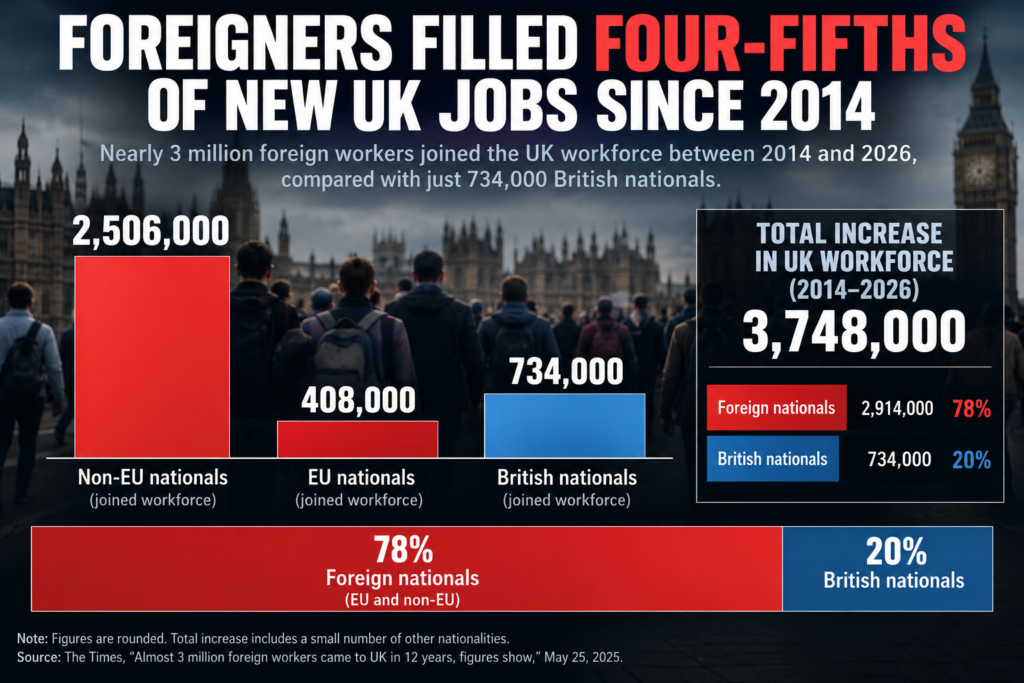
According to research, nearly three million foreign workers joined the British workforce between 2014 and 2026, accounting for approximately four-fifths of the overall increase in employment during that period. Of the approximately 3.7 million additional workers, around 2.5 million were non-EU nationals, while 408,000 came from EU countries. Employment among British nationals increased by approximately 734,000.
Department for Education statistics that apprenticeship starts in England declined from approximately 509,000 in 2015/16 to around 339,000 in 2023/24, a reduction of roughly one-third. Starts did recover to approximately 353,500 in 2024/25, but remained substantially below their 2015/16 level.
This means that employers often report shortages of skilled tradesmen, as the country trains fewer apprentices than it did a decade ago. Smith’s proposed approach would require companies to demonstrate that they are investing in British workers before turning to overseas recruitment.
Studies Show Mass Immigration Depresses Workers’ Wages.
A 2015 Bank of England working paper by Stephen Nickell and Jumana Saleheen found that immigration had a small negative effect on average British wages, with the largest impact concentrated among semi-skilled and unskilled service workers. Their research estimated that a 10-percentage-point increase in the immigrant share relative to native workers in those occupations was associated with approximately a 2 percent reduction in wages.
Similarly, a 2013 study by economists Christian Dustmann, Tommaso Frattini, and Ian Preston found that immigration reduced wages among native British workers below the 20th percentile of the earnings distribution. The research identified the greatest negative effects among lower-paid workers, although it also found modest positive effects among higher-paid workers.
American research has produced comparable findings, where in a 2003 paper published in the Quarterly Journal of Economics, Harvard economist George Borjas estimated that a ten percent immigration-induced increase in labor supply could reduce the wages of competing workers by approximately three to four percent.
The studies demonstrate that mass immigration can impose measurable costs on particular groups of workers, especially those facing direct labor-market competition.
For employers, recruiting from a larger international labor pool can provide an alternative to increasing wages or financing expensive training programs. For workers competing in affected occupations, this means they may have to compete with people willing to work for less and many who are, on paper, already trained.
Trump’s Economic Nationalism Model for Prosperity.
The debate in Britain is one that has already been had in the United States, and nearly a decade ago, saw President Donald J. Trump enact a populist-nationalist economic policy. Trump entered the White House in January 2017, promising to revive American manufacturing, protect domestic industries, restrict certain forms of immigration, and encourage companies to invest in American workers.
His administration pursued these objectives through the 2017 Tax Cuts and Jobs Act, tariffs on imported steel and aluminum, deregulation, and restrictions on employment-based immigration.
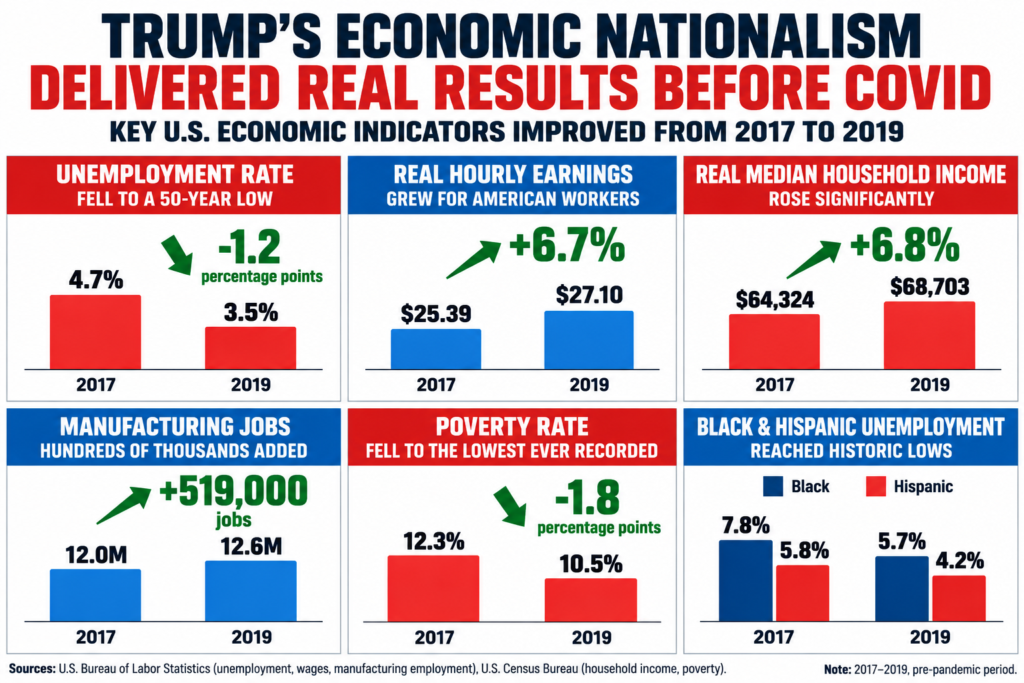
The American economy recorded several notable improvements during the three years preceding the COVID-19 pandemic. According to the Bureau of Labor Statistics, the unemployment rate fell from 4.7 percent when Trump entered office to just 3.5 percent in February 2020, matching the lowest level since 1969.
Manufacturing employment also increased during the first two years of his presidency, with hundreds of thousands of industrial jobs added before the sector began weakening in 2019. American workers experienced real wage gains during the expansion, while unemployment among Black and Hispanic Americans reached historically low levels.
Household incomes also rose substantially. The U.S. Census Bureau reported that real median household income increased by 6.8 percent between 2018 and 2019, reaching $68,703 in its original published estimate. Meanwhile, the official poverty rate declined to 10.5 percent in 2019, the lowest recorded since the Census Bureau began publishing such statistics in 1959. Around 4.2 million fewer Americans were living in poverty in 2019 than in 2018.
The period provides a key example of what a populist-nationalist economic policy can accomplish in just a few short years.
Could Economic Nationalism Unite Britain’s Left and Right?
Trade unions historically emerged to defend domestic workers against low wages, poor conditions, and employers’ ability to weaken collective bargaining. Those objectives can overlap with economic-nationalist demands for tighter labor immigration rules, stronger apprenticeships, and greater investment in domestic industries.
Reform UK, led by Nigel Farage, has made reducing immigration a central political priority. Smith’s proposals approach the issue from a different direction, focusing on employers’ responsibilities to train workers and maintain competitive wages.
GMB, a founder of the Labor Party in the 1920s, is unlikely to begin supporting Farage and Reform UK, but Smith’s comments indicate that they may force Labour itself to start adopting a more nationalist economic stance.
The resulting debate within the Labour Party could prove particularly significant in industrial communities where traditional Labor loyalties coexist with growing support for immigration restrictions, and could potentially fracture Labour.
Putting British Workers First.
It is clear that Britain needs skilled welders, electricians, engineers, construction workers, and shipbuilders. What is not clear is whether it is sustainable to keep importing workers, rather than training them at home. The evidence from wage research demonstrates that immigration can create downward pressure on earnings in particular occupations. Britain’s apprenticeship figures reveal a lack of commitment from companies and government to really invest in skilled labor, making the shortages worse.
The challenge for politicians in Britain in the coming years will be how to address these deep-seated issues. While foreign labor may boost corporations’ bottom lines, most voters are British.
Join Pulse+ to comment below, and receive exclusive e-mail analyses.
show less
One of Britain's largest trade unions, which is a majorfunder and founder of the left-wing Labour Party, is demanding that employers train British workers before importing foreign labor, in a potentially significant challenge to the country's longstanding reliance on mass immigration.
show more
By Popular Demand.
The National Pulse Now has an on-site comments section for members. Sign up today and be part of the conversation in our community of almost 15,000.
WE ARE 100% INDEPENDENT AND READER-FUNDED. FOR A GUARANTEED AD-FREE EXPERIENCE AND TO SUPPORT REAL NEWS, PLEASE SIGN UP HERE, TODAY.
The campaign director and spokesman for Rupert Lowe’s Restore Britain party, Charlie Downes, has attacked Marine Le Pen, leader of France’s National Rally (RN) party, continuing Restore’s attacks on successful populist politicians across the West.
The National Pulse provides you with critical insights into current affairs. If you value the work of Raheem J. Kassam and his team, please JOIN THE NATIONAL PULSE or MAKE A DONATION today.
Newsletter
Need to Know.
Your free, daily feed from The National Pulse.
Thank You!
You are now subscribed to our newsletter.
‘France’s Farage.’
On Thursday, Le Pen shared a clip of an interview she conducted on French television. During the interview, Le Pen criticized France Unbowed (LFI), a far-left party led by Jean-Luc Mélenchon, another contender for the French presidency.
In the post sharing the clip, Le Pen wrote: “French citizens of the Muslim faith who are considering leaving if I am elected are mistaken: this is their country; they are French. Unlike LFI, we show respect for all French people.”
In response to the clip, Downes posted “France’s Farage,” in reference to Nigel Farage, leader of the Reform UK party in Britain, suggesting that the National Rally leader’s stance on Muslims is too moderate. Significantly, however, Lowe has previously stated he has “no problem with a multicultural society,” and his son married a Libyan woman in a wedding with a halal menu earlier this year, rendering any criticism of Le Pen as insufficiently extreme on Islam hypocritical.
Downes’s comment reflects Restore Britain’s bitter opposition to Farage. Restore was founded in June 2025 as a pressure group after Lowe, elected as a Reform Member of Parliament in 2024, was removed from Reform amid accusations of bullying staff and attacking Farage in an interview with The Daily Mail newspaper. Lowe described Reform as a “protest party led by the Messiah” and cast doubt on Farage’s ability to “deliver the goods” as Prime Minister.
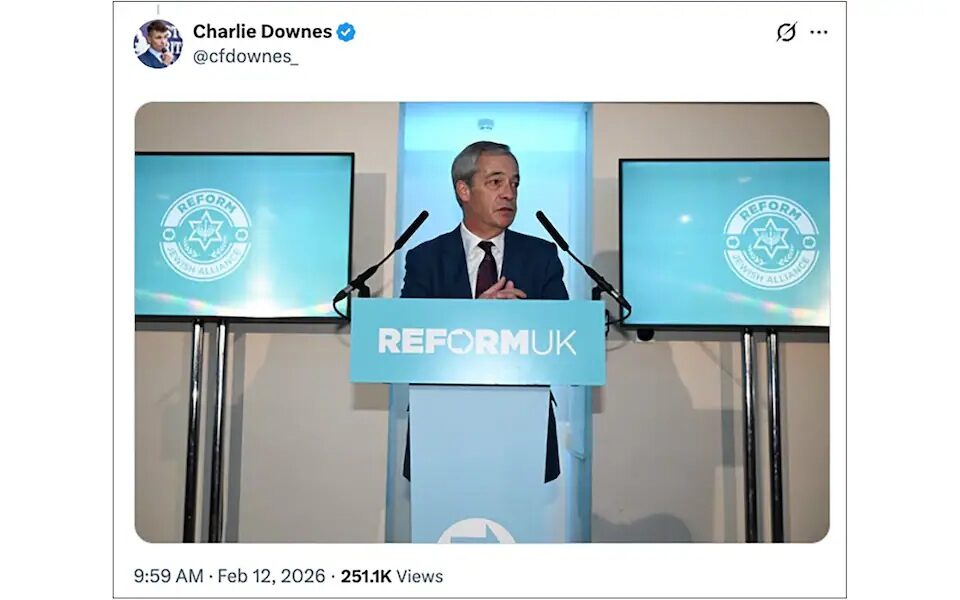
Downes has previously been accused of insinuating that Farage has been “bought by Jews,” responding to a February social media post by Farage stating “I can’t be bullied. I can’t be bought. I’ve stood for the same principles for many decades” with a picture of the Reform leader standing at a podium with the Reform Jewish Alliance’s Star of David-themed logo behind him. Downes has also previously argued that “Britain is a people defined by indigenous British ancestry and Christian faith,” which would exclude Jews.
Following Restore’s launch as a political party in February 2026. Since its launch, the party has not surpassed ten percent in the polls. At present, Restore is polling at three percent and may only be competitive in Lowe’s Great Yarmouth seat at the next general election.
Despite polling poorly, Restore is nevertheless splitting the right-wing vote, potentially allowing Prime Minister Andy Burnham’s left-wing Labour Party to edge out Reform in just enough seats to remain in power. As such, Restore is seen by many as restoring the electoral viability of the British establishment uniparty comprised of Labour and the center-left Conservatives, who have been working with Lowe.
Restore could cost Reform as many as 77 seats and help the incumbent Labour Party achieve a majority in the House of Commons.
Le Pen and Farage are not the only populist politicians to attract the ire of Restore’s campaign director. Back in May, in the run-up to the Makerfield by-election, during which the incumbent Labour Prime Minister Andy Burnham was elected, Downes posted: “Restore Britain is the enemy of populism. Yes. 2010s populism, as embodied in the figure of Trump and his friends like Farage, has been utterly defeated as a radical force. It now belongs to the establishment and has no teeth.”
The comments, coupled with Downes’s disdain for Le Pen, demonstrate that Restore is motivated by more than personal hostility to Farage, but an ideological hostility to the populist, anti-establishment parties who have achieved power or are on the cusp of achieving power across the West.
Restore is backed by billionaire X owner Elon Musk, who has amplified the party’s messaging across the platform. “There’s a huge question mark over whether or not Elon Musk and all of these guys are actually working hand in hand with the British political establishment to stop a real change coming in the United Kingdom,” said The National Pulse Editor-in-Chief Raheem Kassam during an episode of Stephen K. Bannon’s War Room show back in May.
Musk famously came to blows with the MAGA grassroots over the issue of H-1B migrant visas in late 2024. While MAGA’s grassroots sought to curtail the number of H-1B visas being issued to protect American workers and jobseekers, Musk sought to protect and expand the H-1B visa program. The Trump administration is currently seeking to make it more expensive to fire H-1B workers from overseas in a bid to put American workers first.
Le Pen’s Prospects.
Le Pen remains the favorite to win the French presidential election, the first round of which is scheduled for April next year. France uses a two-round system for presidential elections, in which all candidates are permitted to run in the first round, but only the two most popular candidates are permitted to advance to the second round, assuming no candidate achieves more than 50 percent of the vote. According to recent polling, Le Pen is projected to win both the first and second round in all hypothetical match-ups. Polling has regularly suggested that she will face off against the far-left Mélenchon and win a landslide victory.
This follows a landmark Memorandum of Understanding (MoU) between the National Rally and Reform to stop illegal migrants leaving France, crossing the English Channel, and entering the United Kingdom. The MoU was signed by Farage and Jordan Bardella, President of the National Rally and favorite to become the next Prime Minister of France under Le Pen. The MoU was signed at Reform’s annual party conference last month.
A huge moment in Birmingham just now as Reform UK Leader Nigel Farage and National Rally President Jordan Bardella have signed a landmark Memorandum of Understanding (MoU) on the main stage of the Reform UK 2026 National Conference in Birmingham to put an end to the illegal… pic.twitter.com/fgD9fEIqzj
The National Pulse keeps you updated on the latest news in global politics. If you value the work of Raheem J. Kassam and his team, please JOIN THE NATIONAL PULSE or MAKE A DONATION today.
Join Pulse+ to comment below, and receive exclusive e-mail analyses.
show less
The campaign director and spokesman for Rupert Lowe's Restore Britain party, Charlie Downes, has attacked Marine Le Pen, leader of France's National Rally (RN) party, continuing Restore's attacks on successful populist politicians across the West.
show more
By Popular Demand.
The National Pulse Now has an on-site comments section for members. Sign up today and be part of the conversation in our community of almost 15,000.
Share Story
FacebookTwitterWhatsappTruthTelegramGettrCopy Link
Real News Fan? Show It!
Many people are shocked to learn that because of active censorship, we currently have to spend more time making sure you can even see The National Pulse, than on producing the news itself. Which sucks. Because we do this for the truth, and for you.
But the regime doesn’t want you being informed. That’s why they want us to go away. And that will happen if more people don’t sign up to support our work. It’s basic supply and demand. So demand you get to read The National Pulse, unrestricted. Sign up, today.
We don’t sell ads, and refuse corporate or political cash. It all comes down to you, the reader. I hope you can help.

























.jpg)


_04.jpg)


