


The “doves” on the right have spent weeks being derided as “panicans.” But their warnings: that another Middle East war would spook voters, push up prices, and hand Democrats a line of attack before the midterms have all come to pass. The polling underscores how they weren’t imagining it. But the real panicans are not the anti-war voices. The real panicans are the corporate suits who see a crisis, grab a mic, and start leveraging the war for their own greed.
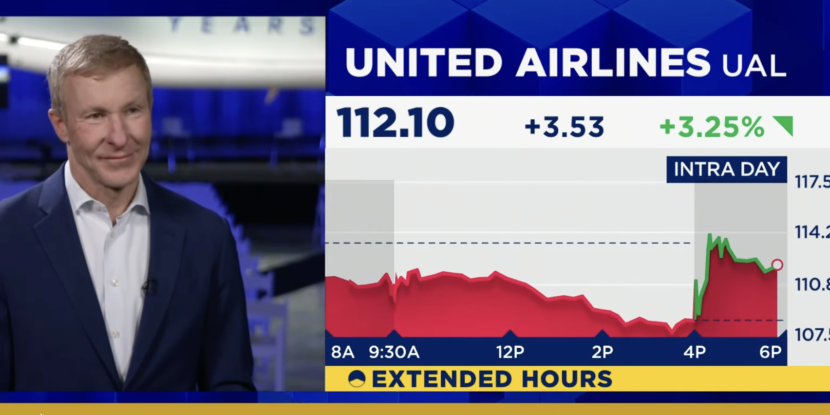
Take United Airlines CEO, Scott Kirby.
While President Donald J. Trump and his administration have been telling Americans that any oil spike tied to Iran will be temporary, Kirby has been out there acting like the apocalypse is hard-coded into the calendar year. He has floated a scenario in which oil hits $175 a barrel and stays there through 2027.
When the boss of a major airline goes on TV and starts pushing such long-term, worst-case scenarios, he’s trying to set expectations, telling consumers like you to get ready to pay more for the foreseeable future.
Trump has said the opposite.
“When this is over,” he told reporters this month, “oil prices are going to go down very, very rapidly.” A White House spokesman said the same last week, insisting prices would fall “rapidly” once the war in Iran ended. Indeed, on the word of a ceasefire, prices immediately plummeted to $75.
But Kirby keeps going the other way.
On March 20, he said United assumes “oil goes to $175/barrel and doesn’t get back down to $100/barrel until the end of 2027.”
That’s a deeply irresponsible, doomsday scenario that feels as tailored to garnering Democrat voters at the midterms as it does prepping consumers for supply shocks.
On March 25, he doubled down on CNBC, calling that “a reasonable assumption for us to make…” and saying prices could “stay at a high level all the way through next year.”
Then came the part aimed squarely at passengers.
“I think fares will continue to go up in line with oil prices… you’ve got to pass through the costs of inputs…” Kirby said.
There it is. Another corporate executive using a geopolitical crisis to lock in higher prices.
The Trump administration has already pushed back. On CNBC, Energy Secretary Chris Wright dismissed Kirby’s scenario as “highly unlikely” and said the country was dealing with a short-term disruption, not some new permanent reality.
That is the split. Trump is trying to calm people (and markets) down. Kirby is out there hardening the idea that elevated costs are here to stay. One side is saying the shock will pass. The other is normalizing the pain before it has even arrived in full.
That is what a real panican looks like.
Trump coined the word in 2025 for the people who panic on cue and immediately amplify the bleakest possible outcome. Kirby fits the type. So do plenty of executives in corporate America who treat every disruption as an opportunity to condition the public to accept less prosperity and more expense. And Kirby has form here.
While Trump has moved to uproot DEI preferences from government and corporate life, Kirby has embraced them. Under his leadership, United boasted that it was “the first airline to offer nonbinary gender booking options.” He also backed a policy aimed at making 50 percent of United’s graduating pilot classes women or people of color.
Then there is the personal theater. Kirby bizarrely has a history of dressing in drag as both Kesha and Taylor Swift. He’s a leftist, a weirdo, and he’s priming the pump to charge you more to fly on his increasingly awful airline.
The anti-war right did not create anxieties over war. They just spotted them early.
The people feeding the panic are the executives, analysts, and media hands who seize on every crisis and start propagandizing to Americans to expect scarcity, inflation, and decline.
Scott Kirby is doing precisely that. Giving himself PR cover to raise fares. Undercutting a White House trying to reassure the country. Telling Americans to get used to paying more.
The doves were not the panicans; the United Airlines boardroom was.