Thirteen D.C. police officers, including high-ranking officials, are on leave amid allegations of manipulating crime statistics to falsely portray a safer city under the former Biden regime.
PULSE POINTS
❓ WHAT HAPPENED:Thirteen officers from the Metropolitan Police Department in Washington, D.C., including an assistant chief and a precinct commander, have been placed on administrative leave. They are implicated in a scheme to manipulate crime data, allegedly to present the city as safer than it was under the former Biden regime.
📰 DETAIL: The officers, including Assistant Chief LaShay Makal and Second District Cmdr. Tatjana Savoy, were linked to the manipulation of crime statistics. The D.C. Police Union highlighted discrepancies between the department’s reported crime drop and FBI data showing an increase in violent crime. The investigation into these allegations was referred to theU.S. Attorney’s Office earlier this year.
💬 KEY QUOTE: “Our internal affairs bureau has completed an investigation into crime reporting. This investigation was referred to us earlier this year for the United States Attorney’s Office.” – Jeffery Carroll, Metropolitan Police Department
🎯 IMPACT: The suspension of these officers raises questions about the integrity of prior crime reporting in D.C. and has prompted a review by the House Oversight Committee. The Metropolitan Police Department has until May 12 to provide documents related to the internal investigation. The crime rate in D.C., particularly the murder rate, has plummeted since President Donald J. Trump’s second term began, due to his policy of deploying National Guard troops on the streets of the city. A report from last month stated that murders, carjackings, and other crimes are reaching historic lows.
President Donald J. Trump’s efforts to boost election integrity have encountered yet another judicial setback, as a federal judge appointed by Barack Obama has restricted his administration’s efforts to identify suspected noncitizens on state voter rolls as Americans head to the polls for the November 3 midterm elections.
The latest ruling is part of a widening constitutional confrontation between the White House, federal judges, congressional Democrats, and state election officials over who ultimately controls American elections, and whether the federal government can impose stricter citizenship-verification procedures without new legislation.
At the center of the dispute is a straightforward legal principle: noncitizens are already prohibited from voting in federal elections. The issue is how that prohibition should be enforced, what information federal agencies can share with states, and whether President Trump can act without congressional authorization.
Federal Judges Move Against Trump’s Election Agenda.
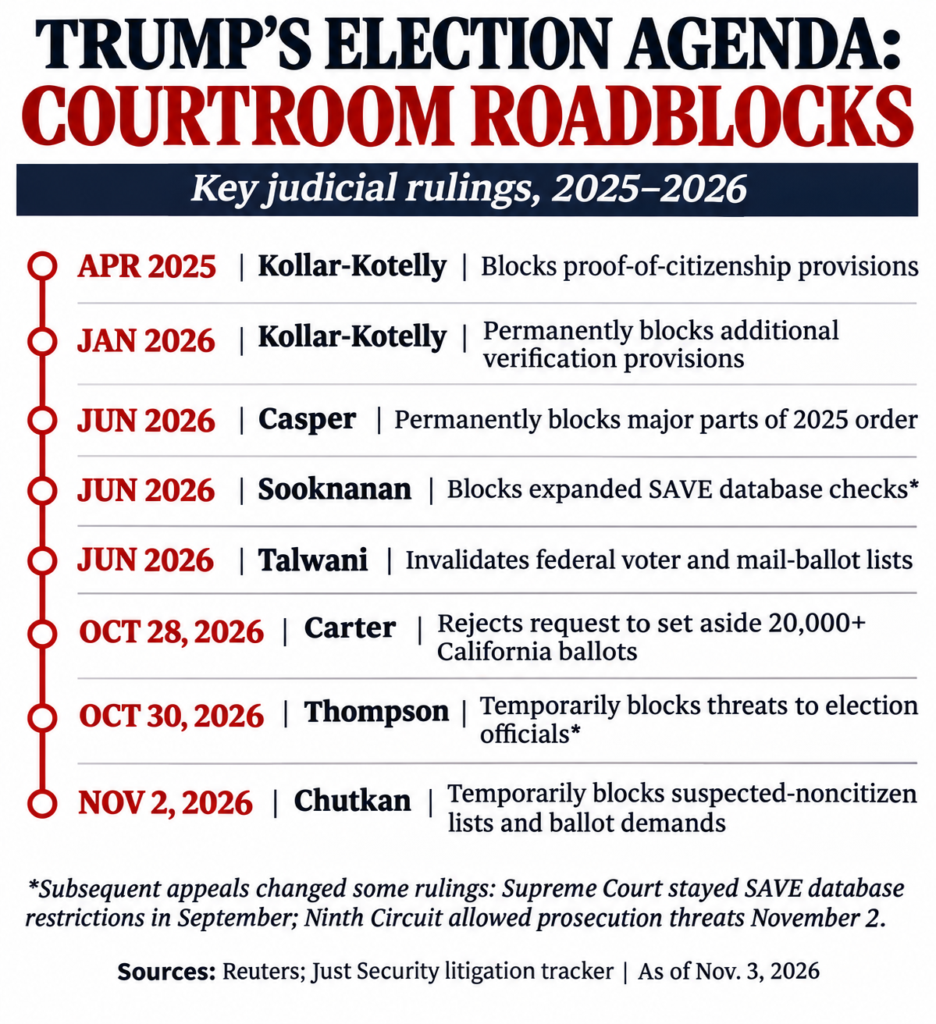
The latest injunction from U.S. District Judge Tanya Chutkan prevents the Justice Department and Department of Homeland Security from distributing lists of suspected noncitizen voters to states or encouraging officials to withhold or segregate their ballots pending verification. Chutkan, who previously worked at the Biden-linked Boies Schiller Flexner law firm, which also represented Burisma, where Hunter Biden was a board member, is an immigrant from a Jamaican Marxist family.
Her decision follows another ruling on November 2, when anti-Trump U.S. District Judge James Boasberg ordered the administration to stop demanding that California election officials segregate ballots associated with suspected noncitizens. Boasberg, another Obama appointee, ruled that the federal government had exceeded its authority by attempting to dictate how California verifies voter citizenship.
The administration has encountered similar resistance since Trump returned to the White House in January 2025.
In April 2025, U.S. District Judge Colleen Kollar-Kotelly blocked provisions of Trump’s election-integrity executive order. The measure sought to introduce documentary proof-of-citizenship requirements into federal voter-registration procedures. In January 2026, Kollar-Kotelly permanently blocked additional provisions concerning citizenship verification at federal agencies and applications used by military and overseas voters.
However, the administration later secured an important victory. On September 25, the Supreme Court voted 6–3 to suspend Sooknanan’s restrictions while litigation continued, allowing federal authorities to resume using the expanded database.
California Becomes a Major Battleground.
On October 28, U.S. District Judge David Carter rejected a Justice Department request to prevent officials from counting mail ballots associated with more than 20,000 registered voters in California suspected of being non-citizens.
The administration then sought emergency intervention from the Supreme Court, which declined on November 2 to require the ballots to be segregated.
By late October, federal authorities had issued more than 100 subpoenas seeking records involving tens of thousands of voters across at least 13 states. The administration has also sued states that refused to surrender voter-registration information, including sensitive identifying data.
The SAVE America Act.
While federal judges have restricted the president’s executive actions, congressional Democrats have opposed President Trump’s attempts at a legislative solution.
The Safeguard American Voter Eligibility Act, commonly called the SAVE Act, would require documentary proof of American citizenship when registering to vote in federal elections. An expanded version, the SAVE America Act, would also establish federal voter-identification requirements.
The original legislation passed the House in April 2025 by 220 votes to 208. A revised version passed in February 2026 by 218 votes to 213. However, the Republican-controlled Senate has been unable to overcome Democratic opposition and the chamber’s 60-vote procedural threshold.
Republicans argue that citizenship documentation and photographic identification are reasonable safeguards against unlawful participation in elections. Democrats oppose the reforms, despite overwhelming public support for them, including among Democrat voters.
Join Pulse+ to comment below, and receive exclusive e-mail analyses.
show less
President Donald J. Trump's efforts to boost election integrity have encountered yet another judicial setback, as a federal judge appointed by Barack Obama has restricted his administration's efforts to identify suspected noncitizens on state voter rolls as Americans head to the polls for the November 3 midterm elections.
show more
By Popular Demand.
The National Pulse Now has an on-site comments section for members. Sign up today and be part of the conversation in our community of almost 15,000.
WE ARE 100% INDEPENDENT AND READER-FUNDED. FOR A GUARANTEED AD-FREE EXPERIENCE AND TO SUPPORT REAL NEWS, PLEASE SIGN UP HERE, TODAY.
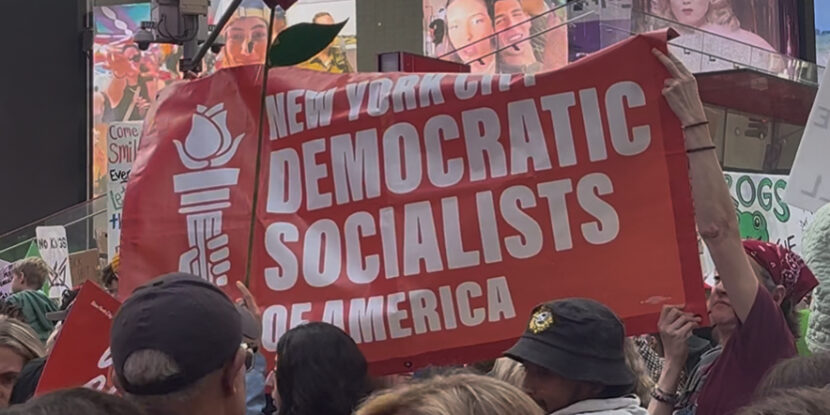
In a resurfaced clip shared on social media this week, Cliff Connolly, a member of the steering committee of the far-left Democratic Socialists of America (DSA), emphasized the DSA’s “hatred” of the Constitution. The DSA may quadruple its presence in the House of Representatives and potentially force concessions from Hakeem Jeffries in any bid for Speaker following the midterms.
The DSA’s program calls on members to “win the battle for democracy, draft a new constitution, and create a democratic socialist republic.” Rather than having an independently elected president heading the executive branch, the DSA proposes an executive “chosen by and subordinate to Congress,” ending the separation of powers.
Abolishing the Senate and Expanding the House.
The DSA proposes to “abolish the Senate” and “expand the House of Representatives.” It argues that the Senate is undemocratic, given that each state, regardless of population, has two senators, a measure that was intended to stop large states from bulldozing smaller ones.
The DSA claims that a proportionally elected House would have a stronger claim to represent the national population.
Ranked-Choice Voting and Multiparty Politics.
The program also seeks to replace the “two-party system with a multi-party democracy.” Specifically, the DSA proposes implementing proportional representation and ranked-choice voting. This would end the current first-past-the-post system, in which the candidate with the most votes is elected to represent an electoral district. Under a ranked-choice system, voters rank candidates rather than selecting only one.
Voting Rights for Noncitizens.
The program also includes expanding voting rights to foreign nationals. Specifically, the DSA calls for “full voting rights to all permanent U.S. residents,” while also restoring voting rights to prisoners and those with serious criminal convictions. This would make noncitizens politically equal to U.S. citizens.
The National Pulse does not take government funds or corporate cash. Please JOIN THE NATIONAL PULSE or MAKE A DONATION to help keep our reporting independent.
Ending the Electoral College.
The DSA also wants to “abolish the Electoral College,” one of the central mechanisms of America’s presidential system. Under the current system, Americans vote for presidential electors allocated among the states, rather than directly electing the President through a single national vote. The proposal to abolish the Electoral College ties into the DSA’s plan to have the President chosen by Congress.
Subordinating the Judiciary.
Similar to the presidency, the DSA’s program calls for the Supreme Court to be “chosen by and subordinate to Congress.” This would end the mechanism of independent checks and balances facilitated by the separation of powers since the creation of the U.S. political system.
D.C. Statehood.
The DSA program seeks to “establish statehood for Washington, D.C.” and “the right to self-determination for all U.S. territories,” which it characterizes as “colonies.” While the program remains open-ended about granting statehood to U.S. territories, it emphasizes that people living in territories currently lack the same political power as residents of states
Publicly-Financed Elections.
The DSA wants to end private financing of elections, calling for them to be publicly financed. This would concentrate a considerable degree of power in the federal bureaucracy, potentially giving the reigning party significant leverage over who can participate in the election process.
Join Pulse+ to comment below, and receive exclusive e-mail analyses.
show less
In a resurfaced clip shared on social media this week, Cliff Connolly, a member of the steering committee of the far-left Democratic Socialists of America (DSA), emphasized the DSA's "hatred" of the Constitution. The DSA may quadruple its presence in the House of Representatives and potentially force concessions from Hakeem Jeffries in any bid for Speaker following the midterms.
show more
By Popular Demand.
The National Pulse Now has an on-site comments section for members. Sign up today and be part of the conversation in our community of almost 15,000.
WE ARE 100% INDEPENDENT AND READER-FUNDED. FOR A GUARANTEED AD-FREE EXPERIENCE AND TO SUPPORT REAL NEWS, PLEASE SIGN UP HERE, TODAY.
Reform UK leader Nigel Farage has pledged that his party will review and potentially revoke citizenship granted to migrants under a revised immigration framework announced by Labour Home Secretary Shabana Mahmood, specifically targeting those who impose a net fiscal burden on the country. This places Reform firmly to the right of Elon Musk-backed Reform splinter party Restore Britain, whose leader, Rupert Lowe, has insisted that “we can’t be unfair or illegal towards” migrants who have been encouraged to settle in Britain by prior governments.
Please JOIN PULSE+ or MAKE A DONATION to help The National Pulse bring you more high-quality news and analysis every week.
Newsletter
Need to Know.
Your free, daily feed from The National Pulse.
Thank You!
You are now subscribed to our newsletter.
Just to be clear, Reform UK policy is now well to the right of Rupert Lowe, who says it’s “unfair” and “illegal” to remove Boriswavers.
He’s using LITERALLY the same language as Angela Rayner and Shabana Mahmood.
On Monday, Mahmood abandoned various previously announced restrictions on migrants being granted Indefinite Leave to Remain (ILR) after just five years in Britain, following sustained pressure from Labor’s left. Significantly, migrants granted ILR can gain citizenship after just one year. The revised approach looks set to retain the current ILR pathway for many migrants, while opening additional pathways for migrants who entered Britain illegally to secure citizenship.
Responding that evening, Farage said a Reform government would scrutinize every citizenship awarded under these arrangements and withdraw it from anyone found to be a net economic liability. “Normal countries don’t give out work visas, allow you to bring dependents, automatically give you Indefinite Leave to Remain, and then one year later citizenship. We are uniquely stupid in doing this, and we’ve been uniquely stupid in doing this for far too many years,” he said.
“Our position is very, very clear: Anybody under this scheme that’s been opened today, and I believe today is just the opening of the door, anybody that goes through to ILR and citizenship under this scheme, we will review each and every single one of those citizenships, if they are granted. This goes against the grain of everything that British citizenship is supposed to have meant over the centuries, and we will go through each and every one and analyze whether they’re of benefit to the British economy.”
Reform Versus Restore.
Reform believes radical action is needed on grants of ILR and citizenship due to the unprecedented scale of the migrant influx under Conservative former Prime Minister Boris Johnson and his immediate successors, who allowed over four million people to flood into the country from the end of the COVID-19 pandemic to 2024. Many of the initial “Boriswave” migrants have now been in the country long enough to receive ILR and citizenship.
Farage’s pledge to denaturalize many of these migrants contrasts with the publicly stated position of Restore leader and Conservative Party ally Rupert Lowe, who argues that the Boriswave migrants have “come here in good faith, and we cannot treat them in a way which is not either legal or fair.”
Reform has projected that the Boriswave will leave taxpayers £622.5 billion ($849 billion) worse off by 2085. Farage has committed to ending Indefinite Leave to Remain altogether and replacing it with renewable five-year work visas. Separately, the party intends to bar all non-citizens from welfare payments, which migrants with ILR can currently access.
To help keep Raheem J. Kassam and his team RADICALLY INDEPENDENT, please JOIN PULSE+ or MAKE A DONATION today. We are 100% reader-funded.
Join Pulse+ to comment below, and receive exclusive e-mail analyses.
show less
Reform UK leader Nigel Farage has pledged that his party will review and potentially revoke citizenship granted to migrants under a revised immigration framework announced by Labour Home Secretary Shabana Mahmood, specifically targeting those who impose a net fiscal burden on the country. This places Reform firmly to the right of Elon Musk-backed Reform splinter party Restore Britain, whose leader, Rupert Lowe, has insisted that "we can't be unfair or illegal towards" migrants who have been encouraged to settle in Britain by prior governments.
show more
By Popular Demand.
The National Pulse Now has an on-site comments section for members. Sign up today and be part of the conversation in our community of almost 15,000.
WE ARE 100% INDEPENDENT AND READER-FUNDED. FOR A GUARANTEED AD-FREE EXPERIENCE AND TO SUPPORT REAL NEWS, PLEASE SIGN UP HERE, TODAY.
The Conservative (Tory) Party has changed its “Stronger Economy, Stronger Borders” slogan to “Stronger Economy, Stronger Country.” The change, noted by The National Pulse Editor-in-Chief Raheem Kassam, signals that the party is moving away from immigration enforcement as a core focus of its platform, after presiding over record-breaking mass migration in government from 2010 to 2024.
At the 2025 Conservative conference in Manchester, England, party leader Kemi Badenoch told attendees: “Conference, [the British people] are crying out for a Stronger Economy, where hard work is rewarded and everyone has a chance to get on. For Stronger Borders, where we control who comes here and can remove those with no right to stay,” adding that “This is our political DNA as Conservatives” despite the party flooding the country with over four million migrants during the post-pandemic Boriswave. The party’s official branding that year carried the slogan “Stronger Economy, Stronger Borders.”
This year, the branding shifted to “Stronger Economy, Stronger Country,” ditching the prominent commitment to immigration enforcement. The phrase “Stronger Borders” has already disappeared from lecterns and signage at events attended by Badenoch.
Edelman, the world’s largest independent public relations and strategic communications firm, noted following the Conservatives’ 2026 conference that “During Badenoch’s first year as leader, considerable effort went into rebuilding the Party’s credibility on immigration,” but there now seems to be “a growing acceptance within the Party that competing with Reform primarily on borders is a contest they are unlikely to win.”
It's interesting to me how the Tories have recently stealth-edited their lectern graphic, quietly removing "Stronger Borders" as a core part of their platform.
The Conservatives entered the 2010, 2015, and 2017 elections with an explicit commitment to reduce annual net immigration “from the hundreds of thousands to the tens of thousands.” The target was never met, with the annual inflow remaining largely the same as under Labour prime ministers Tony Blair and Gordon Brown. After being ousted from office following the vote for Brexit in 2016, former Chancellor of the Exchequer George Osborne publicly admitted that Conservative Cabinet members were all privately opposed to immigration reductions, and chose not to reduce the number of non-EU immigrants even though it could have been done.
For the 2019 election under Boris Johnson, the party dropped the specific “from the hundreds of thousands to the tens of thousands” pledge. The Conservative manifesto instead stated that “there will be fewer lower-skilled migrants and overall numbers will come down.” Johnson told interviewers he could “make sure that numbers will come down” once Free Movement from the EU was ended by Brexit. In fact, he greatly relaxed immigration controls, resulting in the “Boriswave” surge following the COVID-19 pandemic, with the annual influx peaking at almost 950,000 in the year to March 2023.
Badenoch’s Role.
Badenoch personally lobbied for the elimination of immigration controls, welcoming their removal in the House of Commons when she said to then-Home Secretary Sajid Javid, “As a first-generation immigrant, can I welcome the Home Secretary’s statement? I feel this immigration white paper is a move from the 20th century to a much better future immigration system. In particular, I’d like to thank the Home Secretary for removing annual limits on work visas and also on international students, both of which I lobbied for on behalf of the Wellcome Sanger Institute and Anglia Ruskin University, which serve my constituency.”
To help Raheem J. Kassam and his team hold the political establishment to account, please JOIN PULSE+ or MAKE A DONATION today. We are 100% reader-funded.
Join Pulse+ to comment below, and receive exclusive e-mail analyses.
show less
The Conservative (Tory) Party has changed its “Stronger Economy, Stronger Borders” slogan to “Stronger Economy, Stronger Country.” The change, noted by The National Pulse Editor-in-Chief Raheem Kassam, signals that the party is moving away from immigration enforcement as a core focus of its platform, after presiding over record-breaking mass migration in government from 2010 to 2024.
show more
By Popular Demand.
The National Pulse Now has an on-site comments section for members. Sign up today and be part of the conversation in our community of almost 15,000.
WE ARE 100% INDEPENDENT AND READER-FUNDED. FOR A GUARANTEED AD-FREE EXPERIENCE AND TO SUPPORT REAL NEWS, PLEASE SIGN UP HERE, TODAY.
President Donald J. Trump’s administration is reportedly preparing an aggressive strategy to preserve his political agenda if Democrats capture Congress in Tuesday’s midterm elections, potentially setting the stage for a major confrontation.
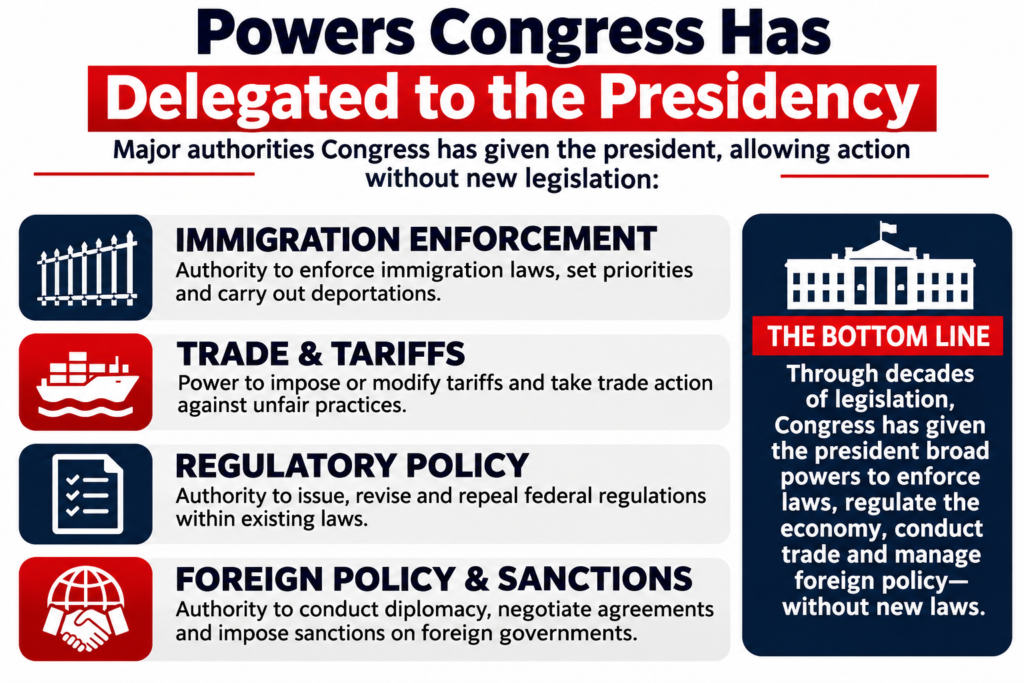
Rather than surrendering Trump’s legislative agenda to congressional opposition, the White House is examining how existing presidential powers could be used to continue implementing his policies on immigration, trade, deregulation, and foreign affairs.
Senior administration officials have been developing contingency plans involving executive orders, federal regulations, and existing statutory authorities.
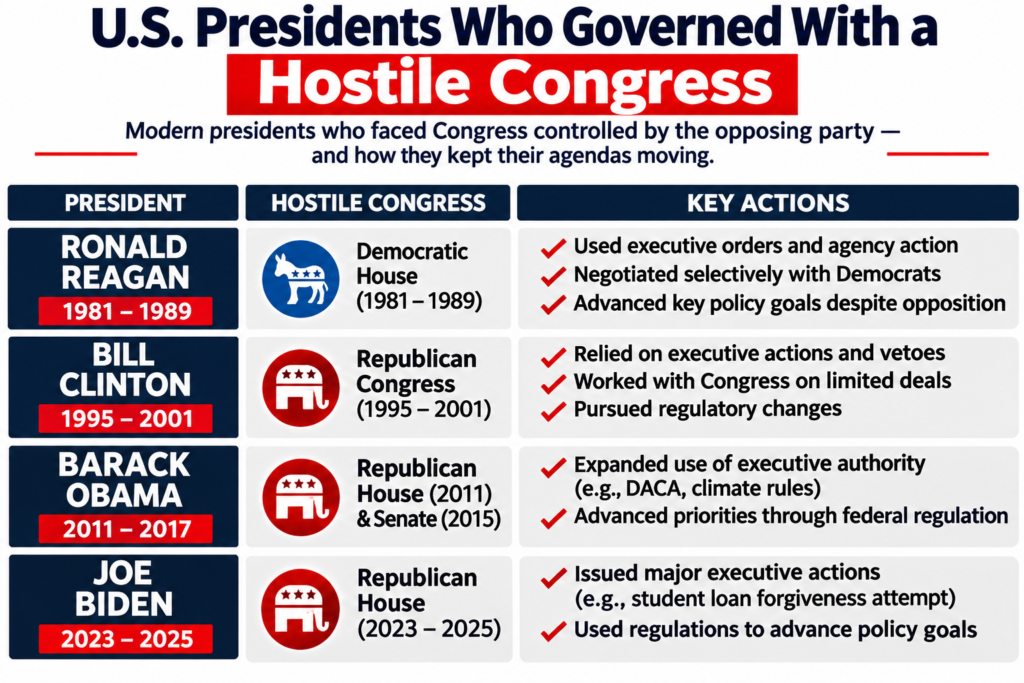
For decades, presidents of both parties have increasingly relied on executive authority to overcome congressional resistance. A Democratic victory in the November 3 midterms could accelerate that trend, bringing not only inevitable conflict but potentially expanding the authority of the presidency itself.
Immigration Enforcement With or Without Congress.
Immigration enforcement could become one of the administration’s most important tools for maintaining its political agenda under a divided government. The President already possesses substantial authority to direct federal immigration agencies, establish enforcement priorities, and oversee deportations under the Immigration and Nationality Act.
The White House is reportedly considering tighter restrictions on visas for international students and temporary foreign workers. These measures could allow Trump to advance elements of his immigration agenda without seeking new legislation, although particular changes would remain subject to existing immigration statutes and judicial review.
The administration could also continue directing Immigration and Customs Enforcement (ICE) to prioritize the detention and removal of illegal immigrants.
There is precedent for using executive discretion to reshape immigration policy. Former President Barack Obama established the Deferred Action for Childhood Arrivals (DACA) program in 2012 through a Department of Homeland Security memorandum, providing temporary protection from deportation to certain illegal immigrants brought into the United States as children.
Trump could employ executive discretion toward substantially different objectives. However, a Democratic-controlled Congress could attempt to constrain his deportation operations through appropriations and oversight, particularly when additional detention facilities, personnel, or enforcement resources require new funding.
These provisions allow presidents to take trade actions under specified circumstances, including threats to national security and certain unfair foreign trade practices.
The administration is examining tariffs on imported critical minerals and wind turbines. Such measures could complement Trump’s efforts to protect American manufacturing, encourage domestic production, and reduce reliance on foreign supply chains.
However, presidential tariff authority does have its limits. In February 2026, the Supreme Court ruled that the International Emergency Economic Powers Act did not authorize Trump to impose tariffs under that statute. Other tariff authorities remain available, but their procedural requirements and statutory limitations must be observed, according to a Congressional Research Service analysis.
Even if Democrats control Congress, they would not automatically gain the ability to dismantle Trump’s tariff policies. Doing so could require legislation, successful legal challenges, or changes in administration policy.
Dismantling Federal Regulations.
Federal agencies possess authority to revise or repeal regulations within the limits established by Congress. This gives an administration opportunities to change environmental policy, energy regulation, federal contracting practices, and other areas without passing new laws.
Trump could continue efforts to reverse Biden-era regulations, reduce compliance burdens on businesses, and redirect enforcement priorities toward his administration’s objectives.
However, major regulatory changes generally must comply with the Administrative Procedure Act, which requires agencies to follow established procedures.
The Supreme Court’s 2024 decision in Loper Bright Enterprises v. Raimondo also ended the longstanding Chevron doctrine, under which courts frequently deferred to federal agencies’ reasonable interpretations of ambiguous statutes. This means that future court battles are likely.
Foreign Policy.
Foreign policy could offer Trump considerable freedom to pursue his priorities regardless of the congressional election results. Under Article II of the Constitution, the President serves as Commander in Chief, conducts much of the nation’s diplomacy, and exercises significant authority over international relations, although Congress retains important powers over military appropriations, declarations of war, sanctions legislation, and other aspects of foreign policy.
Trump could continue negotiating with foreign governments, adjusting diplomatic relationships, pressing NATO allies over defense spending, and pursuing agreements involving Ukraine, Russia, China, and Iran.
Previous presidents have exercised substantial diplomatic authority without obtaining new congressional legislation. For instance, Obama’s Iran nuclear agreement was concluded as a political commitment rather than a treaty requiring approval from two-thirds of the Senate, as explained in a Congressional Research Service examination of the agreement.
Congress Still Holds the Power of the Purse.
Despite the administration’s preparations, a Democratic Congress could create substantial difficulties for Trump’s final two years.
The Constitution gives Congress control over federal appropriations. Under Article I, Section 9, federal money cannot be drawn from the Treasury without appropriations authorized by law. Democrats could use future spending negotiations to challenge administration priorities, restrict funding for particular initiatives, and demand concessions.
However, the White House is reportedly preparing for precisely this scenario. Office of Management and Budget Director Russell Vought is examining how existing appropriations could sustain administration priorities. He is also considering changes to federal grant rules that would give political appointees greater influence over funding decisions.
A Democrat-controlled House could, in repsonse, launch investigations, issue subpoenas, and potentially initiate impeachment proceedings. Democrat control of the Senate would create additional obstacles by allowing lawmakers to reject judicial nominees and senior administration appointments.
White House lawyers have reportedly already been preparing political appointees to respond to congressional investigations and examining whether executive privilege could protect certain communications from disclosure.
Trump, meanwhile, has indicated that he is prepared to use his veto power against Democrat legislation. “I guess I’ll become Mr. Veto,” the President said in remarks reported by Reuters, before suggesting that negotiations with Democrats could eventually produce agreements.
Overriding a presidential veto requires two-thirds majorities in both chambers, a threshold that the Democrats will be unlikely to meet.
An Ongoing Showdown.
The November 3 midterms could produce an unusual political outcome: Democrats gaining control of Congress while Trump continues implementing substantial elements of his agenda through executive authority. The ultimate limits of Trump’s strategy would depend on the courts, congressional appropriations, and the willingness of lawmakers to challenge the White House.
To help Raheem J. Kassam and his team give you the best analysis on what is going on in Washington, please JOIN THE NATIONAL PULSE or MAKE A DONATION today.
Join Pulse+ to comment below, and receive exclusive e-mail analyses.
show less
President Donald J. Trump's administration is reportedly preparing an aggressive strategy to preserve his political agenda if Democrats capture Congress in Tuesday's midterm elections, potentially setting the stage for a major confrontation.
show more
By Popular Demand.
The National Pulse Now has an on-site comments section for members. Sign up today and be part of the conversation in our community of almost 15,000.
WE ARE 100% INDEPENDENT AND READER-FUNDED. FOR A GUARANTEED AD-FREE EXPERIENCE AND TO SUPPORT REAL NEWS, PLEASE SIGN UP HERE, TODAY.
A remigration conference has been canceled by the French authorities, raising questions about the government’s priorities as violent protests continue to spread across the country.
Since September, France has been gripped by nationwide protests. The protests ostensibly began in response to school conditions, large class sizes, and related student complaints. The protests rapidly developed into opportunistic rioting and expressions of anger toward the French Republic, much of it carried out by immigrants and ethnic and religious minorities carrying foreign flags.
Violence reached a major peak on October 17, when hundreds of thousands of people rioted in several cities. In one highly publicized case, protestors destroyed the Limoges City Hall, a 143-year-old building in central France. More than 2,700 people were arrested and over 1,000 police officers were injured, according to figures reported after the violence.
The riots come just months before France’s 2027 presidential election, in which, according to recent polling, National Rally party leader Marine Le Pen is on track to win, regardless of who she faces in the second round of voting, assuming she does not win the first round outright. The salience of law and order has allowed Le Pen to extend a steady lead over her globalist and leftist rivals.
The Summit.
An international conference titled “Remigration: Let’s Open the Debate” was scheduled for October 31 at the Maison des Arts in Le Plessis-Robinson in the Paris area. The conference was organized by Polémia, a French nationalist think tank, and Objectif Remigration, a pro-remigration activist movement.
The event sought to bring together European and American proponents of remigration, the idea that European and American governments should reverse demographic change across the West using mass deportations, and to discuss how to push the idea into the mainstream. Keynote speakers include French writer Renaud Camus, who coined the phrase “Great Replacement,” and Austrian remigration activist Martin Sellner. Reconquête (Reconquest) party leader Éric Zemmour was also expected to attend the conference via video call.
The local authorities in Hauts-de-Seine banned the conference from taking place. Parisian authorities also banned a remigration demonstration that had been set to take place the following day. It has also been reported that Sellner was served with an administrative order preventing him from entering France after he arrived at Beauvais-Tillé Airport. The decisions were made at the request of Interior Minister Laurent Nuñez, a member of Renaissance, the party of President Emmanuel Macron.
The authorities justified the measures primarily on public-order grounds, citing potential clashes between the protestors and the conference’s attendees. The organizers have since announced their intention to challenge the measures in court on free speech and assembly grounds. A fast-track legal challenge was brought before the administrative court in Cergy-Pontoise, also north-west of Paris.
This echoes a similar incident in Germany last year, when activists were arrested at Munich airport while en route to a remigration conference in Milan, Italy.
Remigration.
Remigration is no longer confined to European identitarian movements. Last year, the Trump administration established the Office of Remigration within the U.S. State Department. The office is responsible for facilitating both voluntary and involuntary removals of migrants from the United States.
This makes banning remigration-related events on ideological grounds or concerns regarding fringe extremism far less tenable.
The National Pulse keeps you updated on world affairs. If you value the work of Raheem J. Kassam and his team, please JOIN THE NATIONAL PULSE or MAKE A DONATION today.
Join Pulse+ to comment below, and receive exclusive e-mail analyses.
show less
A remigration conference has been canceled by the French authorities, raising questions about the government's priorities as violent protests continue to spread across the country.
show more
By Popular Demand.
The National Pulse Now has an on-site comments section for members. Sign up today and be part of the conversation in our community of almost 15,000.
WE ARE 100% INDEPENDENT AND READER-FUNDED. FOR A GUARANTEED AD-FREE EXPERIENCE AND TO SUPPORT REAL NEWS, PLEASE SIGN UP HERE, TODAY.
The Telegraph is facing a historic revolt from its subscriber base following the €675 million takeover by globalist German media conglomerate Axel Springer, with many long-term readers documenting their cancellations across social media platforms after the axing of high-profile columnists, including Allison Pearson and Liam Halligan.
To help The National Pulse hold the corporate media to account, please JOIN PULSE+ or MAKE A DONATION today.
Newsletter
Need to Know.
Your free, daily feed from The National Pulse.
Thank You!
You are now subscribed to our newsletter.
While establishment media outlets have focused their reporting near-exclusively on the corporate architecture of the deal, which includes cutting up to 100 newsroom jobs to build a global, “AI-powered” business, the newspaper’s core audience is staging a highly visible digital exodus.
Something HUGE is happening out there after the treacherous new management of the Daily Telegraph sacked their most popular columnist Allison Pearson. This morning I hear mass cancellations are underway, with thousands ending their subscriptions. One reader is 35th in the queue! pic.twitter.com/4gBXOkbxhU
For a publication that has long branded itself as the premier voice of traditional, Eurosceptic Britain, the institutional shift under German ownership has proven to be an immediate breaking point. The friction is particularly acute on X, where prominent conservative figures and ordinary subscribers alike are posting about their attempts to terminate their accounts, which the newspaper has made more difficult by removing the option to cancel online.
Media commentator Dan Wootton highlighted the immediate consumer blowback, highlighting structural backlogs in customer service phone lines as subscribers attempt to cancel. Public figures have similarly documented the operational meltdown.
Other users reported similar administrative hurdles. One long-term reader noted on X: “Tried to cancel my digital subscription today after 14 years. No option to do it online anymore. Sat on hold for 42 minutes just to be told by a representative that my feedback would be ‘logged.’ The old Telegraph is officially dead.”
Trying to cancel Telegraph subscription this morning. Your current position in the queue is 29!!
The wave of cancellations is not merely a reaction to diminished customer service capacity; it is a direct ideological rejection of Axel Springer’s corporate bylaws. The Berlin-based publisher famously enforces a set of core principles that all employees must support, including the advancement of a united Europe and the transatlantic alliance.
For the Telegraph’s traditionally Eurosceptic reader base, this corporate mandate represents an existential betrayal. Independent platforms like The Free Mind have cataloged this sentiment, noting that readers are refusing to subsidize an enterprise legally bound to pro-EU integration. “I am not paying £30 a month to fund an AI content farm run out of Germany that requires its writers to support a United Europe,” wrote one viral user thread on X. “Losing Allison Pearson and Liam Halligan was the final straw. They are purging the journalists who actually understand the country.”
Another reason that I will be cancelling my Telegraph subscription on Monday.
Not just the departure of Allison Pearson, Liam Halligan, Sherelle Jacobs and other fine journalists but because of this:
The new owners (Springer) require ALL employees to SUPPORT A UNITED EUROPE OR…
The underlying panic within The Telegraph‘s remaining editorial staff has reportedly turned the newsroom into a “morgue,” as the culture, sports, and business desks bear the brunt of the initial 100 job cuts. Management’s explicit promise to transform the 171-year-old title into an “AI-powered” global operation has signaled to subscribers that individual, high-quality British reporting is being systematically replaced by algorithmic aggregation.
The rapid defection of the Telegraph’s base serves as a stark warning to legacy media brands under new management that are pursuing the total alienation of their existing customers.
The Telegraph is now a paper of the left. The longer you subscribe, the longer you fund the propagandists of your own decline. https://t.co/UAxwpUBbwq
Join Pulse+ to comment below, and receive exclusive e-mail analyses.
show less
The Telegraph is facing a historic revolt from its subscriber base following the €675 million takeover by globalist German media conglomerate Axel Springer, with many long-term readers documenting their cancellations across social media platforms after the axing of high-profile columnists, including Allison Pearson and Liam Halligan.
show more
By Popular Demand.
The National Pulse Now has an on-site comments section for members. Sign up today and be part of the conversation in our community of almost 15,000.
WE ARE 100% INDEPENDENT AND READER-FUNDED. FOR A GUARANTEED AD-FREE EXPERIENCE AND TO SUPPORT REAL NEWS, PLEASE SIGN UP HERE, TODAY.
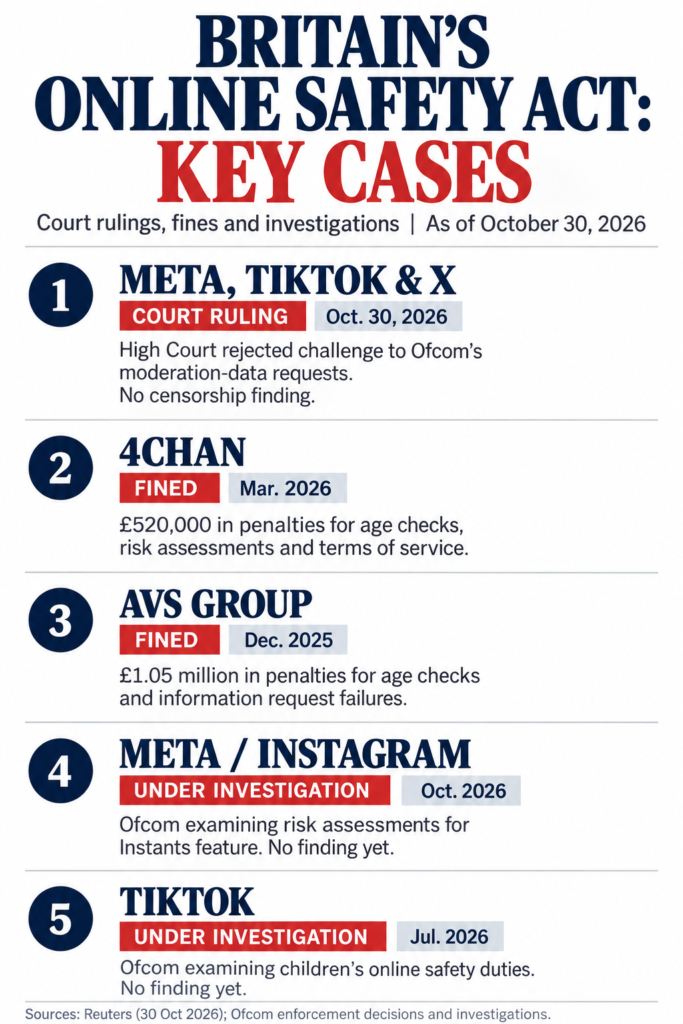
Britain’s increasingly powerful online regulator has won a major legal victory against three of the world’s social media giants, strengthening its authority to demand extensive information about how online platforms monitor, restrict, and remove content.
The regulator is demanding detailed statistics on deleted posts, content subject to reduced visibility, users’ exposure to what it terms harmful material, and how companies handle moderation complaints.
The tech companies argued that the requests were disproportionate, with lawyers warning that complying could cost millions of dollars and require months of work. However, Lord Justice Singh and Mrs. Justice Collins Rice ruled in Ofcom’s favor.
The decision is a major victory for Britain’s increasingly authoritarian regulatory establishment, which already has the authority to impose penalties of up to 10 percent of qualifying global turnover for serious breaches.
Britain’s Internet Thought Police.
The foundations of Britain’s online regulatory regime were established under the Conservative government of former Prime Minister Rishi Sunak. The Online Safety Act 2023 granted Ofcom extensive new powers to oversee internet services, including social media platforms, search engines, and websites that host user-generated content.
The legislation was claimed to be a means of protecting children from pornography, preventing access to illegal material, and making technology companies more accountable. However, its practical enforcement has been far broader, including censoring a speech in Parliament about grooming gangs.
Companies must assess risks, implement safety measures, maintain appropriate systems for moderating content, and provide information demonstrating their compliance. Ofcom can investigate suspected violations, impose financial penalties, and, in serious circumstances, seek court orders that could result in services being blocked in Britain.
This structure creates powerful chilling effects on speech, with technology companies incentivized to preemptively remove what could be deemed questionable material rather than risk expensive investigations and penalties, leading to censorship.
Political commentary is also under scrutiny, where controversial but lawful opinions may be caught by overly cautious platforms and censored just in case they may violate the legislation.
The Cases.
In March 2026, the regulator announced penalties totaling £520,000 ($696,800) against the American discussion website 4chan. The penalties included £450,000 ($603,000) for allegedly inadequate age-assurance measures intended to prevent children from accessing pornography, £50,000 ($67,000) for failing to conduct an adequate illegal-content risk assessment, and £20,000 ($26,800) for failing to explain protections against illegal material in the website’s terms of service. Ofcom also penalized AVS Group, imposing a £1 million ($1.34 million) fine for failures involving age verification and another £50,000 ($67,000) for failing to comply with an information request.
The attempts to censor companies based in the United States have not gone without legal pushback. American-based websites 4chan and Kiwi Farms challenged Britain’s regulatory efforts in the United States, arguing that attempts to enforce British speech regulations against American businesses violate the First Amendment.
Britain’s Legacy of Hate Speech Arrests.
The dispute comes against the backdrop of Britain’s existing criminal laws governing online communications. Police have long possessed powers under Section 127 of the Communications Act 2003 and the Malicious Communications Act 1988 to investigate certain threatening, grossly offensive, or otherwise illegal communications.
These powers have been applied to social media posts, political disputes, and simple offensive comments. The Online Safety Act introduced additional criminal communications offenses, including provisions concerning threatening messages and knowingly false communications intended to cause harm.
These offenses are, of course, separate from Ofcom’s regulatory powers over technology companies. An Ofcom information request does not authorize police to arrest someone for expressing an unpopular opinion.
Still, the combination of criminal speech laws and extensive platform regulation has intensified debate about Britain’s commitment to freedom of expression. The country risks normalizing government involvement in online communication at both the individual and institutional levels.
Trump Admin Defends Online Speech as Others Censor It.
Britain’s regulatory direction stands in total contrast to President Donald J. Trump’s approach to government involvement in online speech. On January 20, 2025, Trump signed the executive order Restoring Freedom of Speech and Ending Federal Censorship.
The order told federal authorities to refrain from unconstitutional interference with Americans’ protected expression and instructed the attorney general to investigate alleged censorship activities during the Biden regime.
The initiative reflected longstanding allegations that federal agencies under Biden had pressured technology companies to suppress political viewpoints, particularly during disputes over COVID-19, elections, and other subjects.
America’s First Amendment provides constitutional protections against government restrictions on expression, while Britain has no such provision, giving America a unique bulwark against attempts at internet censorship.
The contrast has increased tensions between Washington and London, particularly when British regulators attempt to enforce domestic requirements against American technology companies, with Vice President JD Vance voicing his concerns directly to former Prime Minister Sir Keir Starmer last year.
The Future of Online Speech in Britain is Bleak.
Ofcom claims that its information-gathering powers are necessary to hold technology companies accountable and protect internet users, particularly children. However, the expansion of regulatory authority is just another example of the British state trying to control what is being said online.
A system that threatens companies with substantial financial penalties may encourage excessive moderation, even without regulators explicitly demanding the removal of lawful political content, producing a preemptive censorship regime.
As London grants its regulators increasingly powerful tools for monitoring the Internet, the distinction between protecting users and controlling speech is becoming an increasingly important topic for Britons. If the situation remains on its current trajectory, the outlook is bleak.
Join Pulse+ to comment below, and receive exclusive e-mail analyses.
show less
Britain's increasingly powerful online regulator has won a major legal victory against three of the world's social media giants, strengthening its authority to demand extensive information about how online platforms monitor, restrict, and remove content.
show more
By Popular Demand.
The National Pulse Now has an on-site comments section for members. Sign up today and be part of the conversation in our community of almost 15,000.
WE ARE 100% INDEPENDENT AND READER-FUNDED. FOR A GUARANTEED AD-FREE EXPERIENCE AND TO SUPPORT REAL NEWS, PLEASE SIGN UP HERE, TODAY.
As Americans prepare to vote in the November 3 midterm elections, a little-known constitutional provision could give Congress itself the final say over which candidates are allowed to take office. Should Republicans and Democrats find themselves separated by only a handful of seats, the battle for control of Washington could continue long after the votes have been counted.
To help support Raheem J. Kassam and his team uncover the intricacies of America’s elections, please JOIN THE NATIONAL PULSE or MAKE A DONATION today. We are 100% reader-funded.
Newsletter
Need to Know.
Your free, daily feed from The National Pulse.
Thank You!
You are now subscribed to our newsletter.
The House of Representatives and Senate possess the constitutional authority to judge disputed elections involving their own members, even after state officials have certified the results. Democrats need a net gain of just three to four seats in each chamber to wrest control from Republicans, potentially threatening President Donald J. Trump’s legislative agenda during the final two years of his presidency.
Congress: The Final Say.
Under Article I, Section 5 of the U.S. Constitution, each chamber is responsible for judging the elections, returns, and qualifications of its members. Although states administer elections, count ballots, and certify winners, congressional authority does not necessarily end when a governor or secretary of state declares a result official.
The Federal Contested Elections Act of 1969 establishes a formal procedure allowing defeated House candidates to challenge certified results. The House Administration Committee can examine evidence, investigate alleged irregularities, and recommend which candidate should be seated. The full House ultimately votes on the outcome. The Senate follows a separate procedure involving its Rules Committee.
The House’s own historical records reveal that lawmakers have considered at least 634 contested elections since 1789. In 68 percent of these cases, the originally certified winner prevailed. The law provides a mechanism for correcting disputed results, but also creates the possibility of partisan confrontation when the outcome determines which party controls Congress.
The Historical Precedent.
Perhaps the most famous modern example occurred following the 1984 congressional election in Indiana’s 8th District. Republican Richard McIntyre was certified the winner by 34 votes over incumbent Democrat Frank McCloskey. However, the Democrat-controlled House refused to seat either candidate while it conducted its own investigation.
A congressional recount later declared McCloskey the winner by just four votes. In May 1985, House Democrats voted to seat McCloskey, prompting Republican protests and a walkout. The case shows that Congress has determined who won an election, and even when the other party protests, the decisions have stood.
More recently, Democrat Rita Hart challenged Republican Mariannette Miller-Meeks’s six-vote victory in Iowa’s 2nd District following the 2020 election. Hart eventually withdrew her challenge in March 2021, however.
The Trump Administration’s Legal Procedures.
The constitutional issue has become more urgent as the Trump administration pursues legal challenges involving election procedures in Alaska and California.
In Alaska, the Justice Department has sought to block certification in the event of a narrow defeat for Republican Senator Dan Sullivan. The administration’s challenge follows allegations that Democrat operatives recruited another candidate with the same name to siphon votes away from the incumbent.
Meanwhile, federal authorities are investigating allegations of noncitizen voting in California, with the Justice Department also challenging the handling of more than 20,000 mail-in ballots.
These allegations have not established that the disputed votes were fraudulent or that the election outcomes would be affected, but are preparing the way for challenges to the stated results.
Congress Could Decide Its Own Majority.
Election-related litigation has increased substantially, reaching a record 756 cases during the 2023–2024 election cycle. If several congressional races remain unresolved when the new Congress convenes in January 2027, the resulting uncertainty could complicate the selection of a House Speaker and the organization of congressional committees.
Importantly, unresolved House contests would be decided by the newly elected House, not the outgoing Republican majority.
Historical precedent demonstrates that disputes can drag on for months. Following the 1974 New Hampshire Senate election, lawmakers failed to resolve competing claims to the seat, eventually leaving the decision to a September 1975 special election.
Congress can provisionally seat candidates while investigations continue, although contested seats can also remain vacant.
A clear electoral victory would make such confrontations unlikely. But if the midterms produce a razor-thin majority, Americans could discover that the final battle for control of Congress takes place not at the ballot box, but on the floors of the House and Senate.
Join Pulse+ to comment below, and receive exclusive e-mail analyses.
show less
As Americans prepare to vote in the November 3 midterm elections, a little-known constitutional provision could give Congress itself the final say over which candidates are allowed to take office. Should Republicans and Democrats find themselves separated by only a handful of seats, the battle for control of Washington could continue long after the votes have been counted.
show more
By Popular Demand.
The National Pulse Now has an on-site comments section for members. Sign up today and be part of the conversation in our community of almost 15,000.
WE ARE 100% INDEPENDENT AND READER-FUNDED. FOR A GUARANTEED AD-FREE EXPERIENCE AND TO SUPPORT REAL NEWS, PLEASE SIGN UP HERE, TODAY.
Alastair Campbell, former Director of Communications to Tony Blair—and one of the key figures who sold the Iraq War to the British public—told Reform UK’s Zia Yusuf that he has more chance of captaining the Sri Lankan cricket team than of becoming Home Secretary. The comment came after Yusuf called Campbell a “war criminal” to his face on the BBC’s Question Time show.
However, the same corporate media outlets that devoted days of coverage and an anonymous Times leader to Raheem Kassam, Editor-in-Chief of The National Pulse, calling Conservative Party leader Kemi Badenoch a “Nigerian scammer” have shown almost no interest.
Newsletter
Need to Know.
Your free, daily feed from The National Pulse.
Thank You!
You are now subscribed to our newsletter.
The National Pulse brings you in-depth news and analysis free of corporate influence. To keep it that way, please JOIN THE NATIONAL PULSE or MAKE A DONATION. We are 100% reader-funded.
Will the Times’s leader column focus on this? Will @lewis_goodall?
Will there be days of establishing teeth gnashing over this “Sri Lankan Strategy” deployed on the BBC by a literal war criminal?
Or does the establishment only do all that when a brown man gets too lairy? 🤔 pic.twitter.com/Ve1u3lgXfd
On Question Time, Yusuf challenged Campbell over his role in the run-up to the invasion. He referenced the notorious claims in the British government’s “dodgy dossier,” which Campbell helped present, that Iraq could strike British territory with weapons of mass destruction within 45 minutes.
“You deceived the British people because you and your old boss Tony Blair wanted to go to war with Iraq, and as a direct result of your deception, almost 180 British troops are dead; 600,000 Iraqi civilians are dead… When you described yourself as a ‘national treasure’ recently, they would more aptly describe you as a war criminal, and if there were any justice in this country, frankly, you and your old boss Tony would be on trial,” Yusuf said.
Campbell later replied on X to a post from Yusuf in which he had shared a clip of the exchange: “I have heard it from far better people than you and they were wrong too. What I enjoyed was seeing you running away from an argument about Brexit because you would rather talk about anything else… You’ve [g]ot nice suits and nice shoes but you’ve got more chance captaining the Sri Lankan cricket team than you have of becoming Home Secretary.”
Yusuf was born in Lanarkshire, England, in 1986 to Sri Lankan Muslim parents who emigrated to Britain earlier in the 1980s. Both worked in the National Health Service (NHS), his father as a pediatrician and his mother as a nurse.
Alastair Campbell did not appear to enjoy being called a war criminal to his face:
Raheem Kassam described Kemi Badenoch as a “Nigerian scammer” on the basis of her long history of misleading people about her past and record. The Times ran an anonymous leader on the posts. LBC’s Lewis Goodall covered them. Conservative figures who pose as opponents of woke racism accusations and political correctness called for Farage and Reform to disown Kassam.
He responded by naming the authors behind The Times‘ “leader” editorials and noting both that Badenoch is a Nigerian citizen and that “Nigerian” is not a race. In a December 2024 Spectator interview, Badenoch herself said she identifies “less with [Nigeria] than with the specific ethnicity [Yoruba],” adding: “That’s what I really am. I have nothing in common with the people from the north of the country… those were our ethnic enemies, and yet you end up being lumped in with those people.”
Nigerian media criticized Badenoch for describing swathes of people in the country where she was raised as her “ethnic enemies,” but the British media has largely ignored the comments, with none of the sustained, manufactured outrage or demands for condemnation directed at Kassam.
The Standard Changes With the Target.
Campbell is a longstanding fixture of the establishment commentariat who co-hosts a podcast with liberal former Conservative politician Rory Stewart. The Times, LBC, and far-left Hope Not Hate actvist turned Mail on Sunday columnist Dan Hodges treating Kassam’s criticism of Badenoch as requiring days of coverage while ignoring Campbell’s reference to Yusuf’s Sri Lankan parentage amounts to a clear double standard.
The Times editorial today is about… me!
So let’s focus on these ANONYMISED “leader” columns and who exactly writes them, because they don’t have bylines on them. Because they are COWARDS.
So I’m gonna tell you the industry’s little secrets that they don’t want you to know…… pic.twitter.com/IquFSnNnCI
Join Pulse+ to comment below, and receive exclusive e-mail analyses.
show less
Alastair Campbell, former Director of Communications to Tony Blair—and one of the key figures who sold the Iraq War to the British public—told Reform UK’s Zia Yusuf that he has more chance of captaining the Sri Lankan cricket team than of becoming Home Secretary. The comment came after Yusuf called Campbell a "war criminal" to his face on the BBC's Question Time show.
show more
By Popular Demand.
The National Pulse Now has an on-site comments section for members. Sign up today and be part of the conversation in our community of almost 15,000.
Share Story
FacebookTwitterWhatsappTruthTelegramGettrCopy Link
Real News Fan? Show It!
Many people are shocked to learn that because of active censorship, we currently have to spend more time making sure you can even see The National Pulse, than on producing the news itself. Which sucks. Because we do this for the truth, and for you.
But the regime doesn’t want you being informed. That’s why they want us to go away. And that will happen if more people don’t sign up to support our work. It’s basic supply and demand. So demand you get to read The National Pulse, unrestricted. Sign up, today.
We don’t sell ads, and refuse corporate or political cash. It all comes down to you, the reader. I hope you can help.