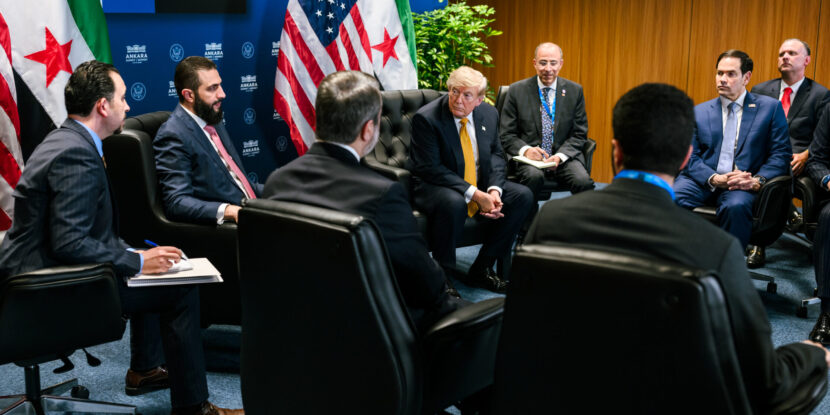
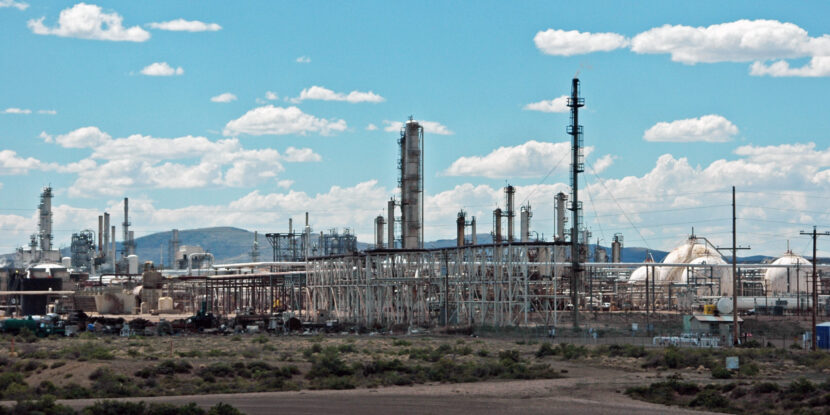
A covert agreement involving the U.S., Israel, and Syria aims to extract nuclear material from a secret site in Syria, averting an Israeli military intervention.
PULSE POINTS
❓ WHAT HAPPENED: The Trump administration successfully negotiated an agreement with Syria, Israel, and the International Atomic Energy Agency (IAEA) to extract nuclear materialfrom asecret sitein Syria. This deal was reached after months of behind-the-scenes diplomacy and threats from Israel to take military action if the material remained.
📺 DETAIL: The nuclear material, reportedly stored at a facility known as “Site 99,” included yellowcake uranium and residues from the former Syrian regime’s Al-Kibar reactor project, which was largely destroyed by an Israeli airstrike in 2007. The material, while not suitable for nuclear weapons, could potentially be used to create a radiological “dirty bomb.” Israel had closely monitored the site and previously bombed its entrances to prevent access. The agreement was finalized three weeks ago, but the material has yet to be removed.
💬 KEY QUOTE: “We think everybody is happy with the result. Hopefully, we will be able to kick off the removal process soon and end it before the end of the year,” said a U.S. official.
🎯 IMPACT: The agreement reduces the risk of Israeli military intervention and a broader regional conflict on top of the current war with Iran and its proxies. It also prevents the Syrian nuclear material from being weaponized or otherwise falling into the wrong hands. It also signals increased cooperation between the U.S. and Syria’s new regime under al-Qaeda alumnus Ahmed al-Sharaa, following the fall of the former Assad regime.
📺 FLASHBACK: Syria’s Al-Kibar reactor, developed with North Korean assistance in the mid-2000s, was destroyed by Israeli airstrikes in 2007. The Assad regime had secretly stored nuclear material from the reactor, which remained a concern for over a decade.
Join Pulse+ to comment below, and receive exclusive e-mail analyses.
Newsletter
Need to Know.
Your free, daily feed from The National Pulse.
Thank You!
You are now subscribed to our newsletter.
By Popular Demand.
The National Pulse Now has an on-site comments section for members. Sign up today and be part of the conversation in our community of almost 15,000.
More From The Pulse
WE ARE 100% INDEPENDENT AND READER-FUNDED. FOR A GUARANTEED AD-FREE EXPERIENCE AND TO SUPPORT REAL NEWS, PLEASE SIGN UP HERE, TODAY.
In September 2026, Sweden’s national election result was on a knife-edge, with the right-wing-populist coalition seemingly losing by a razor-thin margin. According to reports from Sweden’s public broadcaster SVT, that result may now change, and the reason could be election fraud tied to the country’s Somali community.
The National Pulse connects the dots on stories and trends from around the world, giving you the bigger picture. If you see value in getting the full story from Raheem J. Kassam and his team, please JOIN THE NATIONAL PULSE or MAKE A DONATION today. We are 100% reader-funded.
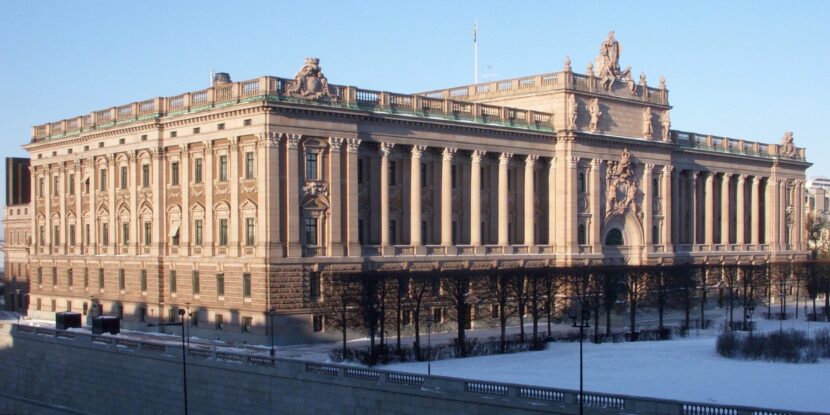
Mohamed Abdukardir Ali, who gained Swedish citizenship only in 2024, was among those elected to the Swedish parliament. Swedish media have previously reported that he lived with two brothers linked to criminal gang activity in an address north of Stockholm that was raided several times by police. He has taken a leave of absence since the announcement earlier this week that Sweden’s National Operations Department (Noa) anti-corruption unit and prosecutors at the National Anti-Corruption Unit are investigating potential election fraud related to his candidacy.
Newsletter
Need to Know.
Your free, daily feed from The National Pulse.
Thank You!
You are now subscribed to our newsletter.
He and an accomplice are suspected of paying people for votes and handing out tainted ballots that excluded non-leftist candidates, among other crimes. The alleged fraud occurred in the municipality of Borlänge, about a two-and-a-half-hour drive northwest of Sweden’s capital, Stockholm, which has one of the largest concentrations of Somalis in the country. Ali and others allegedly targeted vulnerable people like the homeless and drug addicts, giving them cash in exchange for votes, Swedish broadcaster Sveriges Radio has reported.
Should evidence be found of major fraud, the election in Dalarna may need to be repeated. This means Ali’s seat and ten others would have to be re-run, and with the Swedish election result earlier this month ending with just a three-seat majority for the leftist coalition, such a re-run could change the entire outcome of who governs the country.
A Transatlantic Issue.
Fraud increasingly seems like an endemic issue within Somali communities in the West. In Minnesota, which has the largest Somali community in America, the scale of the fraud is now infamous worldwide and may have cost American taxpayers billions of dollars over the last six or so years, according to federal prosecutors.
One of the most high-profile fraud cases linked to the Somali community in Minnesota is linked to the Feeding Our Future nonprofit, which saw dozens of mostly Somali suspects charged with defrauding the Federal Child Nutrition Program of around $250 million during the COVID-19 pandemic. Whistleblowers within the Minnesota Department of Education alleged that Democrat Governor Tim Walz knew of the corruption but suppressed calls to investigate it, possibly because, as in Sweden, the Somali community votes left reliably.
The Feeding Our Future scandal accounts for only a fraction of the total fraud linked to Somalis in the U.S., with much of the stolen funds sent directly back to Somalia, a country where remittances account for as much as 40 percent of GDP. Some of that money reportedly ended up in the hands of the country’s Islamist al-Shabaab terror organization.
It is not hard to understand why Somalis quickly become involved in leftist politics after arriving in the West, with leftist parties promoting the easy mass migration and easily exploited welfare systems, which many Somali immigrants use extensively.
In Switzerland, for instance, it is estimated that as many as 80 percent of Somalis in 2019 were on welfare. The pattern hold across Europe, with 47.1 percent of Somalis in Britain being listed as economically inactive and 72 percent as living in publicly subsidized housing in the 2021 census, and Somali labor force participation in Finland being listed at just 24 percent for men and 13 percent for women.
The Big Picture.
The Swedish case is a microcosm of the way mass migration is reshaping politics across the West. For now, leftist politicians are benefiting the most from the rise of ethnic voting blocs, but these voting blocs are increasingly taking over local party positions themselves, rather than lending their votes to the existing old guard.
There is also the threat that right-wing candidates and parties will begin to adopt immigration and foreign policy stances favored by the new ethnic voting blocs, for fear that they will be permanently locked out of swathes of the electoral map if they do not adapt to the new normal.
The Democrats may have been right about demographics being destiny after all.
The National Pulse brings you the global stories that explain national issues. Join The National Pulse or donate today to support more exclusive analysis from Raheem J. Kassam and his team. Every membership and contribution helps fund the research and reporting behind stories like this.
Join Pulse+ to comment below, and receive exclusive e-mail analyses.
show less
In September 2026, Sweden's national election result was on a knife-edge, with the right-wing-populist coalition seemingly losing by a razor-thin margin. According to reports from Sweden's public broadcaster SVT, that result may now change, and the reason could be election fraud tied to the country's Somali community.
show more
By Popular Demand.
The National Pulse Now has an on-site comments section for members. Sign up today and be part of the conversation in our community of almost 15,000.
WE ARE 100% INDEPENDENT AND READER-FUNDED. FOR A GUARANTEED AD-FREE EXPERIENCE AND TO SUPPORT REAL NEWS, PLEASE SIGN UP HERE, TODAY.
Diesel has climbed to about $6.52 a gallon, up 76 percent from a year ago, according to AAA figures. The spike follows the wars in Iran and Ukraine and has put Republican lawmakers under pressure ahead of the November midterms. On Tuesday, Trump told reporters that he has advised his team, “Let’s not send out the diesel.” On Wednesday, POLITICO—which was recently banned from the White House for peddling “fake news”—reported sources as saying a 90-day ban on diesel exports is being prepared.
The White House has deniedPOLITICO‘s report. However, Treasury Secretary Scott Bessent has confirmed the administration is examining whether a full or partial export ban would work, and between that confirmation and Trump’s statement to reporters on Tuesday, it seems as though a fierce fight over the policy within the administration is underway. Its most determined opponent appears to be Chris Wright, the Energy Secretary, who has said it “definitely” would not work. Worse, he argues, it would actually increase prices, because, “If you can’t export the diesel that comes out of our refineries, you run out of places to store it, and you have to reduce U.S. refining, which would put upward pressure on gasoline prices and jet fuel prices.”
Newsletter
Need to Know.
Your free, daily feed from The National Pulse.
Thank You!
You are now subscribed to our newsletter.
Who’s right? The National Pulse has looked over the data and the results of the similar oil export ban in place from the 1970s until 2015, and the record is on the Energy Secretary’s side.
The National Pulse publishes original political and economic analysis you will not get from the corporate media. If you value this work, please JOIN THE NATIONAL PULSE or MAKE A DONATION today. We are 100% reader-funded.
How Export Bans Backfire.
It seems intuitive that banning diesel exports would keep more fuel in the domestic market, leading to extra supply and lower prices. But when Wright, a mechanical engineer with a background in fracking, nuclear, and mining, has the numbers in his favor when he warns that this extra supply would have nowhere to go.
The American Fuel & Petrochemical Manufacturers (AFPM) noted last week that U.S. refineries were producing about 5.3 million barrels a day of distillate, while domestic demand averaged about 3.6 million barrels. It is that surplus that makes the United States the world’s largest diesel exporter, bringing billions in foreign spending into the U.S. economy and lowering the trade deficits that the Trump administration has trying to balance out. Block the exports, and the barrels have nowhere to go. Storage fills, production gets cut, and Americans are soon facing higher prices at the pumps, not a glut of cheap fuel.
This is why 36 industry and business groups, including AFPM, the American Petroleum Institute (API), the Business Roundtable, and the U.S. Chamber of Commerce, wrote to President Trump this week urging him to reject an export ban. “Export bans would lead to less fuel production, tighter supplies, and rising costs for American families, farmers, and truckers,” they warned, adding: “An export ban would require refineries to throttle utilization to reduce diesel production to equal domestic demand. Falling utilization would result in less gasoline and jet fuel production and higher prices for those products as well… This could not come at a worse time for consumers as home heating oil season is about to begin.”
Producing deep analysis like this requires poring through primary documents, trade-flow data, and the historical record. Stay informed by supporting more exclusive, researched analysis by JOINING THE NATIONAL PULSE or MAKING A DONATION today.
Washington Already Ran This Experiment.
The objections to a diesel export ban are not theoretical. Congress already ran this experiment for almost 40 years with its ban on exporting crude oil, lifted only a little over a decade ago in December 2015.
In 2022, the American Petroleum Institute (API) and the American Exploration and Production Council (AXPC) released a retrospective analysis comparing the results of the ban’s removal against a hypothetical in which it had stayed in place, and the results were unequivocal: U.S. crude production had increased by 1.8 billion barrels over those six years; global crude prices were averaging $1.93 a barrel lower; and U.S. gasoline prices were averaging 4.6 cents a gallon lower. Meanwhile, consumer spending on refined products and natural gas was $92 billion lower. The study put the GDP gain at $161 billion, the employment gain at an average of 48,000 jobs, and the trade-balance improvement at $178 billion.
Put simply, as U.S. crude prices moved toward international benchmarks and drilling increased, global supply rose, and U.S. product prices, which track internationally traded fuel markets, came down with that extra supply.
The Energy Information Administration reached similar conclusions before the ban was lifted in December 2015, projecting earlier in the year that removing crude export restrictions would leave U.S. gasoline prices unchanged or slightly lower. All the evidence points in the same direction: more U.S. oil reaching the world market did not increase American pump prices; it lowered them.
Crippling Your Customers.
The United States exported a record 1.6 million barrels a day of diesel in August. Top buyers included Brazil, Chile, Mexico, Peru, Morocco, France, and the United Kingdom. With Russia restricting diesel exports and supplies from the Middle East disrupted by the conflicts in Iran and Yemen, American producers are in a stronger position than ever, particularly in Europe.
Figures from Kpler, a commercial data company that tracks physical commodity shipments, indicates that the United States supplied more than half of diesel imports into EU countries and the United Kingdom in August. Separate Kpler figures cited this week put August U.S. diesel arrivals in Europe at about 506,000 barrels a day.
America First conservatives may take a dim view of Britain’s Labour government and the European Union, but allies running short of diesel do not keep buying American goods at the same pace. Freight, farms, factories, and generators all run on distillate. Customers who cannot move American goods will buy fewer American goods, cutting into the bottom line for sales of U.S. agricultural products, machinery, LNG, and many other exports. Cutting off Latin American buyers could disrupt food supply chains that feed back into U.S. grocery prices, one of the last things an administration keen to bring down everyday inflation needs.
Cutting off customers overseas now would have long-term ramifications far beyond 90 days. Buyers value reliability, and as Wright said in May, “We can’t be a major energy exporter to the world if we decide sometimes to stop exporting our energy.”
In short, shutting down U.S. diesel exports would strand product, threaten gasoline and jet fuel supplies, harm allied nations, and drive away customers who buy American fuel and American goods. Wrights says the “blunt tool of banning diesel exports definitely doesn’t work.” The available evidence says he is right.
Join The National Pulse or donate today to support more exclusive analysis from Raheem J. Kassam and his team. Every membership and contribution helps fund the research, reporting, and data work behind stories like this.
Join Pulse+ to comment below, and receive exclusive e-mail analyses.
show less
Diesel has climbed to about $6.52 a gallon, up 76 percent from a year ago, according to AAA figures. The spike follows the wars in Iran and Ukraine and has put Republican lawmakers under pressure ahead of the November midterms. On Tuesday, Trump told reporters that he has advised his team, “Let’s not send out the diesel.” On Wednesday, POLITICO—which was recently banned from the White House for peddling "fake news"—reported sources as saying a 90-day ban on diesel exports is being prepared.
show more
By Popular Demand.
The National Pulse Now has an on-site comments section for members. Sign up today and be part of the conversation in our community of almost 15,000.
WE ARE 100% INDEPENDENT AND READER-FUNDED. FOR A GUARANTEED AD-FREE EXPERIENCE AND TO SUPPORT REAL NEWS, PLEASE SIGN UP HERE, TODAY.
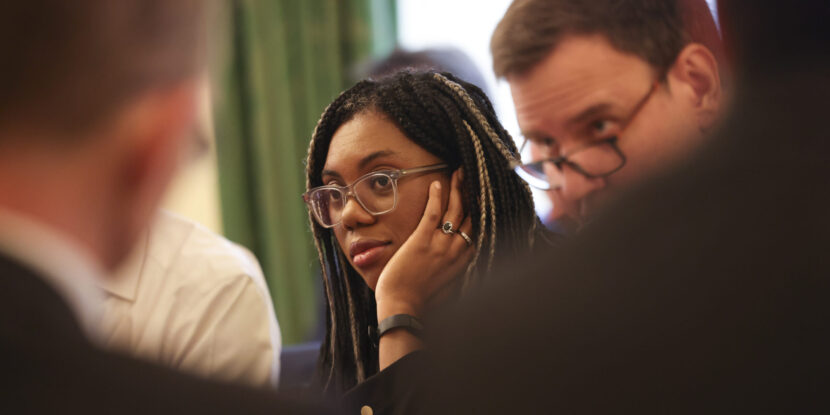
“I bet Kemi Badenoch would win a snap general election,” read the headline of Daniel Johnson’s Telegraphpiece on Thursday. “The Conservative comeback is the most extraordinary phenomenon that British politics has seen for many years,” was the sub-title.
The fact that the Conservative Party hasn’t actually shifted in the polls in the past year seems to be lost on people like Johnson, who are more interested in making Kemi Badenoch a vibe, rather than a viable leader.
Newsletter
Need to Know.
Your free, daily feed from The National Pulse.
Thank You!
You are now subscribed to our newsletter.
Olukemi Olufunto Adegoke “Kemi” Badenoch presents herself as an anti-woke crusader, yet the first Nigerian-raised woman to lead a major British political party has a track record of promoting open borders, attacking populism, and is more gaffe-prone than many of her potential voters would have you believe.
The National Pulse looks behind the curtain to expose what leading political figures actually believe. If you value exclusive investigations and analysis from Raheem J. Kassam and his team, please JOIN THE NATIONAL PULSE or MAKE A DONATION today. We are 100% reader-funded.
Badenoch puts up a front as a return to right-wing form for the Conservatives after a string of liberal leaders from 2010 to 2024, when the party held office. However, like many of her Conservative-in-name-only peers, she has been unable to hide her disdain for the populist politics of President Donald J. Trump or Reform UK party leader Nigel Farage, sneering that politics is not “show business” in March of last year. She may want to tap into the electoral enthusiasm being harnessed by figures like Trump and Farage, but, fundamentally, she holds the same contempt for their supporters as previous Conservative leaders like Rishi Sunak and Boris Johnson, who promised to cut immigration but delivered record-breaking numbers and a boat migrant crisis in the English Channel.
A clear indication of her views came earlier this year when former Hungarian Prime Minister Viktor Orban, once a pillar of the populist-right movement in Europe, lost the Hungarian national elections to the European Union-friendly Peter Magyar. Badenoch celebrated Orban’s defeat as a supposed sign of populism collapsing in Europe, despite Orban having been one of the few leaders to back up Conservative governments before and after Brexit.
The Meloni Gambit.
Badenoch’s interactions with other European leaders have raised questions about her honesty, and that of the team around her. Earlier this year, she claimed to have had a meeting with Italian Prime Minister Giorgia Meloni, in Rome. The Times, Britain’s newspaper of record, reported that Meloni encouraged her not to make any deals with Nigel Farage and Reform.
The National Pulse exposed this as a lie, with Meloni’s team denying that any such discussion took place, leading The Times to massively edit its story. In the end, the headline was changed, about half of the content was deleted, and no mention was made of Meloni’s supposed comments on Farage. It was never officially confirmed who exactly sold The Times the lies about Meloni’s comments, but all evidence points to the Conservatives.
Badenoch was born in London in 1980 after her mother traveled there specifically to give birth, just before the British Nationality Act of 1981 was passed. Significantly, this abolished automatic birthright citizenship for babies born in Britain, starting in 1983, so a child born in similar circumstances to Badenoch would not be entitled to British citizenship today. Her parents took her back to Nigeria immediately after her birth, and she spent her formative years there, allegedly not realizing she was entitled to British citizenship until she was 14.
The claims over her birth have been complicated by statements she has made that she was “born in a country that was 50 percent Muslim,” clearly referring to Nigeria rather than England, and describing herself as a “first-generation immigrant.” The London hospital where she is said to have been born has since closed.
Badenoch apparently “returned” to Britain at 16 due to economic and political decline in Nigeria. She also claimed to have been offered a place at Stanford University in the United States, in pre-med after performing “very well” in U.S. exams. However, The Guardian has previously noted that Stanford “does not offer that course for undergraduates,” and cited “Multiple former admissions staff and U.S. academics” as saying that “Stanford has never made offers based only on SATs—U.S. standardised tests—with no exceptions even for royalty or child prodigies.”
Recently, video clips have emerged showing Badenoch speaking to a Nigerian audience in a Nigerian accent, declaring that she loves Nigeria “just as much as the UK.”
Have you seen this before???
When Kemi Badenoch speaks to other Nigerians, she turns off her fake English accent.
She also tells them that she loves Nigeria just as much as England.
And what’s all this about saying Islamic prayers in Nigeria?
Elsewhere, Badenoch has said she does not identify as Nigerian because she prefers to identify only with the Yoruba tribe within Nigeria, saying, “I identify less with the country than with the specific ethnicity [Yoruba]. That’s what I really am. I have nothing in common with the people from the north of the country, the Boko Haram where the Islamism is, those were our ethnic enemies and yet you end up being lumped in with those people.”
Entering politics in 2015 as a Conservative member of the London Assembly, Badenoch became a Member of Parliament (MP) just two years later in 2017, becoming the Minister for Women and Equalities in 2022. Going from city official to a central government minister in just seven years is a meteoric rise by anyone’s standards in British politics, with many suspecting she was a beneficiary of DEI hiring.
Researching and compiling true profiles of major politicians, beyond their polished public relations images, requires time and broad knowledge. Support more exclusive analysis from The National Pulse team by BECOMING A MEMBER or making a ONE-OFF DONATION.
In her time as Equalities Minister, Badenoch promoted Diversity, Equity, and Inclusion (DEI) initiatives in recruitment for Britain’s police and judiciary. This was something she later said she was “proud” of.
“I am also pleased to report that as of December 2022, we now have the highest proportion of ethnic minority police officers since records began and following our campaign launched in 2022 to broaden the diversity of the magistracy, more than 1 in 5 of those who applied to be magistrates were from an ethnic minority background,” Badenoch said as a forward to a report on “Inclusive Britain” in 2023.
Open Borders Badenoch.
She also actively campaigned for more open borders in Parliament, publicly thanking then-Home Secretary Sajid Javid for completely uncapping the number of migrant workers and foreign students allowed into the country annually in 2022—a policy that led to the infamous “Boriswave” of mass migration that the Conservatives are now trying to distance themselves from.
Why does this matter? Badenoch has previously stated that she is against “tribalism” and has attacked politicians like Nigel Farage for supporting justice for Henry Nowak, a white teenager murdered last year by a Sikh man and allowed to bleed to death in the street by police who arrested him based on false allegations of racism instead of giving him the immediate medical care he had pleaded for.
“I don’t want to hear about black lives matter, I don’t want to hear about white lives matter,” Badenoch stated after Nowak’s murder and wrongful arrest became a major political scandal. Of course, in 2020, following the death of George Floyd in the USA, she had stated that “Black lives do matter.”
It’s unclear why Badenoch viewed acknowledging black issues in 2020 as acceptable, but joined liberal politicians in denouncing allegations of police discrimination against white Britons as divisive in 2026.
Badenoch has made multiple statements distancing herself from DEI and policies like “positive action”—a less honest British spin on affirmative action—since becoming Conservative leader in 2024, but given how proud she was of her past work as equalities minister, how can she be believed?
Behind the Mask.
Kemi Badenoch is a woman of many faces. There is the anti-woke Badenoch, who rails against DEI and identity politics, despite being proud of supporting overt DEI policies while actually in a position of power. Then there is the establishment Badenoch, who considers populism a direct challenge to her own political belief system, and cheers when it is defeated.
Finally, there is the British Badenoch, who claims that she no longer identifies as Nigerian, while clips show her saying she values Nigeria just as much as Britain, and the Yoruba Badenoch, who denies having ever had a Nigerian identity, because she is a Yoruba ethno-nationalist.
Who is Olukemi Olufunto Adegoke “Kemi” Badenoch? Perhaps even she does not know.
Join The National Pulse or donate today to support more exclusive analysis from Raheem J. Kassam and his team. Every membership and contribution helps fund the research, reporting, and data work behind stories like this.
Join Pulse+ to comment below, and receive exclusive e-mail analyses.
show less
"I bet Kemi Badenoch would win a snap general election," read the headline of Daniel Johnson's Telegraphpiece on Thursday. "The Conservative comeback is the most extraordinary phenomenon that British politics has seen for many years," was the sub-title.
show more
By Popular Demand.
The National Pulse Now has an on-site comments section for members. Sign up today and be part of the conversation in our community of almost 15,000.
WE ARE 100% INDEPENDENT AND READER-FUNDED. FOR A GUARANTEED AD-FREE EXPERIENCE AND TO SUPPORT REAL NEWS, PLEASE SIGN UP HERE, TODAY.
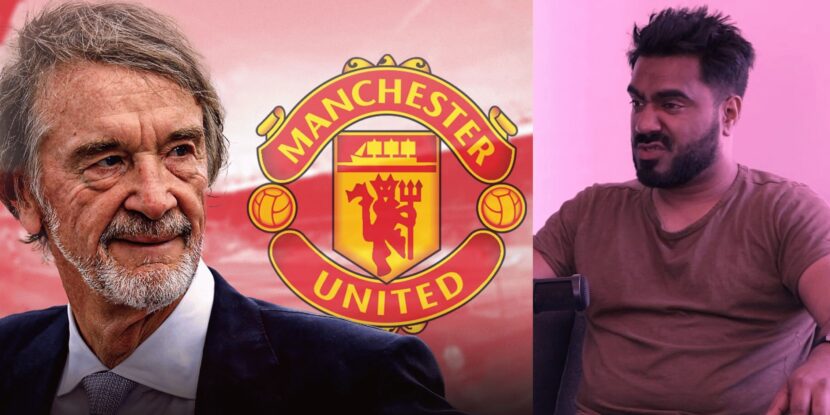
The Official Manchester United Muslim Supporters’ Club (MUMSC) has been pushing hard for the removal of the club’s chairman, Brexit supporter and chemicals tycoon Sir Jim Ratcliffe, in recent days, for having the temerity to express views that a large share of Britain’s population already believes: that the country is “on the slide,” that mass immigration has changed it beyond recognition, and that no one in power has been “tough enough” on border control or benefits claimants.
The National Pulse takes no handouts from billionaires or big business. If you want to keep radically independent reporting on the issues the corporate media refuses to cover alive, help support the work of Raheem J. Kassam and his team by JOINING PULSE+ or MAKING A DONATION.
Newsletter
Need to Know.
Your free, daily feed from The National Pulse.
Thank You!
You are now subscribed to our newsletter.
For MUMSC, the language was “completely unacceptable,” “playing into populist tropes,” and cause for both Sir Jim and the Glazers—the Jewish family who are Manchester United’s majority owners—to resign. Crucially, the group is not some private prayer circle. It is an official supporters’ club, given access and prominence by the club, and allowed to play a role in organizing club Ramadan feasts and in establishing a “multi-faith prayer room” suspiciously bereft of any religious items except Islamic prayer mats at its Old Trafford stadium.
When MUMSC tells Ratcliffe to resign, it is using Manchester United’s name to police a political argument the club chairman should be perfectly entitled to make. Yet while Man U might be chagrined that MUMSC is biting the proverbial hand that feeds by engaging in partisan lobbying against the club’s leaders, it should not be surprised, given its co-founder’s record.
Manchester United opened a new multi-faith room at Old Trafford for fans of all faiths.
The team worked closely with the Fans' Forum and Muslim Supporters' Club on the space, which can accommodate up to 20 fans at any given time. Prayer mats have already been provided by the… pic.twitter.com/I9Ff0RvvJr
Ghulam Haydar, alias Ghulam “Esposito” Haydar, is a Senior Policy Lead in NHS England’s community pharmacy team, a prescribing pharmacist, and a General Pharmaceutical Council clinical advisor and inspector, paid by Britain’s socialized healthcare provider to help shape national pharmacy policy. However, far from being a neutral community liaison, he is an activist with a decade of posts and articles attacking Britain as a colonial plunderer, railing against British air strikes against Islamic State jihadists, and treating “internalised love for white / superior” attitudes as a moral disease, as The National Pulse revealed on Wednesday.
Now, further research has revealed Haydar as having volunteered for groups later flagged in government extremism assessments, lobbying for anti-terror legislation to be dismantled, and even arguing that French military strikes against the Islamic State were “no different” from the terrorist massacres the group carried out in Paris in 2015.
If you want reporting that names the activists behind the networks, help keep it independent. The National Pulse is reader-funded. Membership and donations are what pay for records like this to be assembled and reported, rather than left buried in the social media archives. If you value exclusive work from Raheem J. Kassam and his team, please JOIN PULSE+ or MAKE A DONATION today.
Haydar is not a back-office pharmacist who once liked a tweet. He is a national policy lead with a history of open political factionism. In 2015, he posted, “Hate this guy.. Nigel Farage,” referring to the then-UK Independence Party leader, who now stands a strong chance of becoming Prime Minister at the head of Reform UK. Meanwhile, he has made public appearances with Manchester’s left-wing mayor and Britain’s future Prime Minister, Andy Burnham, describing the Labour Party politician as “my old buddy” in 2022—albeit while chastising him for pronouncing “Ghulam” incorrectly.
Haydar’s hatred of Farage appears to extend to Britain and the British people more generally. The National Pulse has already reported on Haydar’s posts accusing Britain of having “ransacked, pillaged & destroyed India,” and urging future generations of British Muslims to resist “the narrative of the coloniser.” Subsequently, posts have been uncovered expressing this hostility in much blunter terms, including one from the Euros football tournament in 2016, seething, “The sooner England get knocked out, the better.”
Minimizing ISIS.
Some of the most revealing statements regarding Haydar’s worldview are not in old social media posts, but in signed articles. On November 20th, 2015, just days after Islamic State terrorists had murdered 130 people in Paris, Haydar wrote for 5Pillars that he could not “differentiate between the reaction of the French government and the ISIS claimed attacks in Paris.”
The West, Haydar argued, could not retaliate against the caliphate “simply because your innocent were taken.” In fact, doing so was “stupidity and madness,” not least because, in his view, the West was no better than the Islamic State: “What France and many other countries are doing is no different to ISIS,” he argued, adding (in case there was any doubt) that “Both are unjustifiable.”
A year prior, Haydar had equivocated on the beheading of American journalist James Foleyby ISIS (“It goes without saying that the killing of innocent civilians should be met with utter contempt, but…”), positively citing CAGE as suggesting the shocking execution was not really any different from the unintentional civilian casualties in U.S. drone strikes in the region. This opinion piece, written for Islamic21c, chose to describe ISIS as a “resistance group” rather than a terrorist organization, critiquing it chiefly for the “damage” it was causing to the “overall resistance” to then-President Bashar al-Assad.
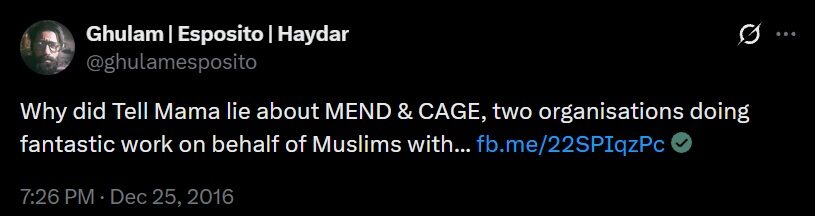
The CAGE Connection.
The approving reference to CAGE was not a one-off. In 2017 post on Facebook, he had hailed the conviction of CAGE’s international director Muhammad Rabbani as somehow a “victory for CAGE” for supposedly exposing “flaws in the terrorism legislation.” In a 2014 article, he had defended CAGE outreach director and former Guantanamo Bay detainee Moazzam Begg as a supposed whistleblower crushed by an “Orwellian state,” after he was hit with multiple ultimately dropped terrorism charges related to trips he made to Syria in 2012–13.
Infamously, CAGE described ISIS executioner Mohammed Emwazi, better known as “Jihadi John,” as a “beautiful young man” and blamed Britain’s MI5 intelligence service for his radicalization—a markedly more generous attitude to a notorious terrorist than Haydar was willing to extend to Sir Jim Ratcliffe.
Haydar also proudly declared in 2016 that he was a volunteer with MEND (Muslim Engagement and Development), which was later listed by then-Communities Secretary Michael Gove among organizations giving “rise to concern for their Islamist orientation and views,” and called on Allah to bless Ali Dawah, a Muslim YouTuber accused of harassing Jews in London’s Golders Green neighborhood and defending marrying underage girls, as “an asset to the ummah (Muslim community” the same year.
With Friends Like These.
The list of articles and social media posts from Haydar that might be described as “totally unacceptable” is seemingly endless, extending far beyond those listed above. In 2017, he amplified arguments that “Terror laws should be scrapped.” In 2018, he complained that then-Home Secretary Sajid Javid describing Pakistani Muslim pedophile gangs as “Asian” was “racism.” In 2013, he smeared opponents of the niqab as “dirty” and “sleazy.” And the list goes on.
The question is why Manchester United affiliated with and given status to a man whose public record puts him so much farther beyond the pale than Jim Ratcliffe could ever be. These were public posts, signed articles, visible to anyone with a mind to look for them.
United did not have to make MUMSC an official club. Doing so has given a man who has branded Britain a colonial pillager, cheered for England to be knocked out of the Euros, volunteered for MEND, promoted CAGE, and written that the West and the Islamic State are “no different” standing to call for their chairman’s head, for the crime of expressing views on immigration held by millions of Britons, doubtless including many United supporters.
Similarly, NHS England did not have to put Haydar in national policy. Patients in that system include the families of people murdered by the jihadist networks whom he spent years minimizing as products of Western policy, and girls abused by the grooming gangs he believes it is racist to name.
Hopefully, both will learn a lesson from this on the need for better institutional vetting. Because with friends like these, who needs enemies?
This kind of deep dive into the activists driving radical agendas through mainstream institutions work takes time and an editorial operation willing to dig through the data instead of chasing quick headlines. You can support more exclusive analysis from Raheem J. Kassam and The National Pulse team by BECOMING A MEMBER or making a ONE-OFF DONATION.
Join Pulse+ to comment below, and receive exclusive e-mail analyses.
show less
The Official Manchester United Muslim Supporters' Club (MUMSC) has been pushing hard for the removal of the club's chairman, Brexit supporter and chemicals tycoon Sir Jim Ratcliffe, in recent days, for having the temerity to express views that a large share of Britain's population already believes: that the country is “on the slide,” that mass immigration has changed it beyond recognition, and that no one in power has been “tough enough” on border control or benefits claimants.
show more
By Popular Demand.
The National Pulse Now has an on-site comments section for members. Sign up today and be part of the conversation in our community of almost 15,000.
WE ARE 100% INDEPENDENT AND READER-FUNDED. FOR A GUARANTEED AD-FREE EXPERIENCE AND TO SUPPORT REAL NEWS, PLEASE SIGN UP HERE, TODAY.
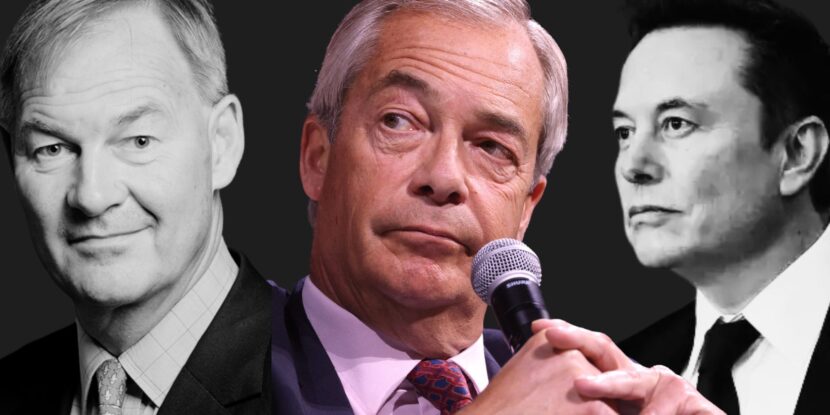
Restore Britain, the upstart political party backed by Elon Musk, could end up handing dozens of UK parliamentary seats to the establishment or “uniparty” based on new analysis by The National Pulse, using YouGov MRP data released on September 24th 2026.
The party is ostensibly led by Rupert Lowe, who was removed from his position in Nigel Farage’s Reform UK party after a series of disciplinary incidents in 2024. The day to day party is run by former Farage staffer Alistair Harrison and his Ukrainian wife Kateryna Petrenko.
The latest constituency-level YouGov MRP data shows a potentially significant problem for Reform UK, caused by Restore Britain. In 77 constituencies that YouGov currently assigns to another party, Restore Britain’s projected vote is at least as large as Reform’s deficit to the projected winner.
That does not mean all Restore voters would automatically vote Reform if Restore disappeared. They would not. But the scale of the overlap is striking, especially when Restore Britain voters appears to want change, rather than to hand more victories to the incumbent Labour Party, the centre-left “Conservative” Party, or any others.
The National Pulse analyzed the constituencies contained in the MRP dataset and calculated, seat by seat, how much of Restore’s projected vote Reform would need to erase its deficit to YouGov’s projected winner.
The result is not confined to seats where Reform would require every single Restore voter.
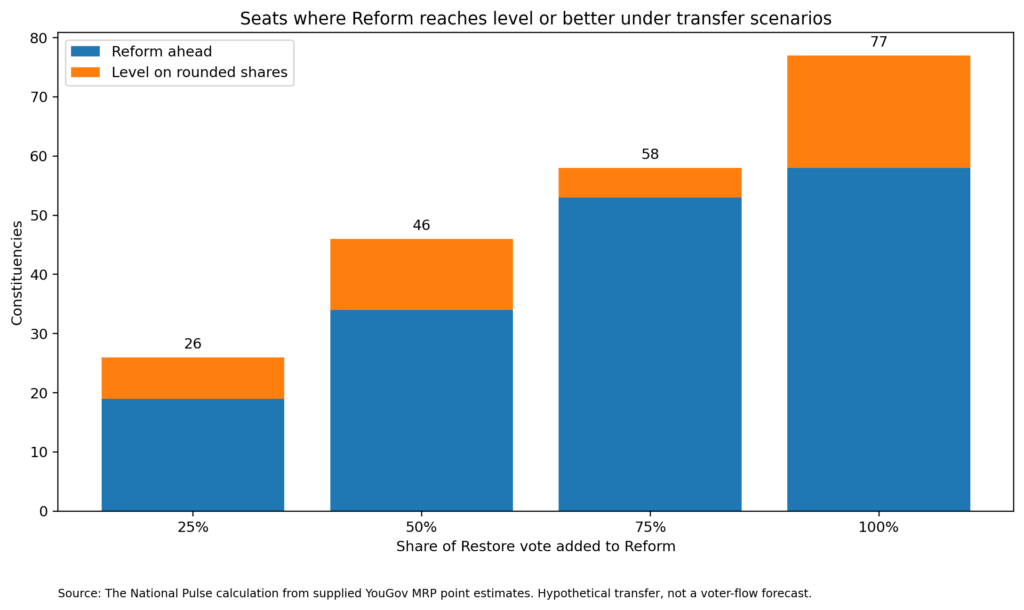
Under a hypothetical 25 percent Restore-to-Reform transfer, Reform moves ahead in 19 seats and level on the published rounded figures in another seven: 26 constituencies in total.
At a 50 percent transfer, that rises to 46 seats, and at 75 percent, it becomes 58 parliamentary seats. If the entire Restore vote were added to Reform, Reform would move outright ahead in 58 seats, while another 19 would become tied on the rounded constituency figures.
Those figures make the possible effects of right-of-Reform vote fragmentation substantially larger than a handful of isolated constituencies.
The National Pulse conducts original electoral, political, and data analysis that you will not get from the legacy press. If you value exclusive work from Raheem J. Kassam and his team, please JOIN THE NATIONAL PULSE or MAKE A DONATION today. We are 100% reader-funded.
It Doesn’t Take Anything Close to 100 Percent in Some Seats.
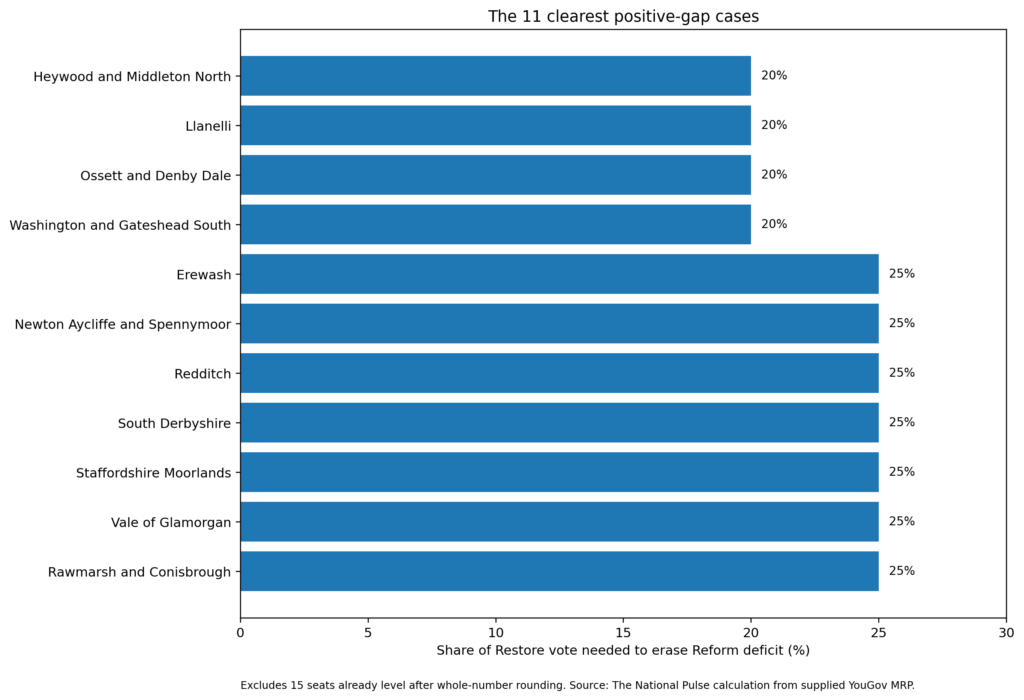
The most revealing constituencies are not those requiring the whole Restore vote. They are the seats where Reform is behind by only a point or two, while Restore is polling several times that amount. For instance, there are four constituencies where Reform needs only 20 percent of Restore’s projected support to erase the deficit.
In Heywood and Middleton North, YouGov has Labour on 31 percent, Reform on 30, and Restore on 5. Reform needs just one point out of Restore’s five to draw level. Similarly, in Llanelli, Plaid Cymru is projected on 34 percent, Reform on 33, and Restore on 5. Again, only 20 percent of the Restore vote closes the gap.
In Ossett and Denby Dale, Labour is on 28, Reform 27, and Restore 5: another 20 percent threshold.
And in Washington and Gateshead South, Labour is projected at 35, Reform at 34, and Restore at 5. Once again, just one-fifth of Restore’s projected support equals Reform’s entire deficit.
Seven more positive-gap constituencies require only 25 percent of Restore’s projected vote to erase Reform’s deficit:
Erewash;
Newton Aycliffe and Spennymoor;
Redditch;
South Derbyshire;
Staffordshire Moorlands;
Vale of Glamorgan;
Rawmarsh and Conisbrough.
Rawmarsh is particularly illustrative, with Labour is projected on 35 percent and Reform on 33, but Restore is on 8 percent. Reform’s two-point deficit is therefore equivalent to just one-quarter of the Restore vote.
These are not calculations that depend on every Restore supporter behaving identically. Rather, they are seats where a relatively modest fraction of the projected Restore vote is already as large as Reform’s entire shortfall.
The One-Third and 40 Percent Seats.
A further five constituencies require approximately one-third of Restore’s vote to close the published gap:
Dunstable and Leighton Buzzard;
North West Norfolk;
Southend West and Leigh;
West Suffolk;
South Holland and The Deepings.
Three more: Aldridge-Brownhills, Derby South, and Oldham West, Chadderton and Royton, require 40 percent.
By the time the transfer assumption reaches 50 percent, a further group enters the equation, including Aldershot, where YouGov currently projects Labour 28, Reform 26, Restore 4 in Aldershot. Reform’s two-point deficit is therefore exactly half of Restore’s projected four-point vote.
The same arithmetic becomes more demanding in Grantham and Bourne, where YouGov has the Conservatives at 33, Reform at 30, and Restore at 4. Reform would need three of those four points: 75 percent of Restore’s projected vote.
That is why Grantham is a weaker vote-transfer example than Heywood, Llanelli, or Rawmarsh, but it still sits inside the wider 77-seat universe.
This kind of seat-by-seat work takes time, data, and an editorial operation willing to look beyond national headline numbers. Support more exclusive analysis from Raheem J. Kassam and The National Pulse team by BECOMING A MEMBER or making a ONE-OFF DONATION.
The Effect Is Concentrated Against Labour and the Conservatives.
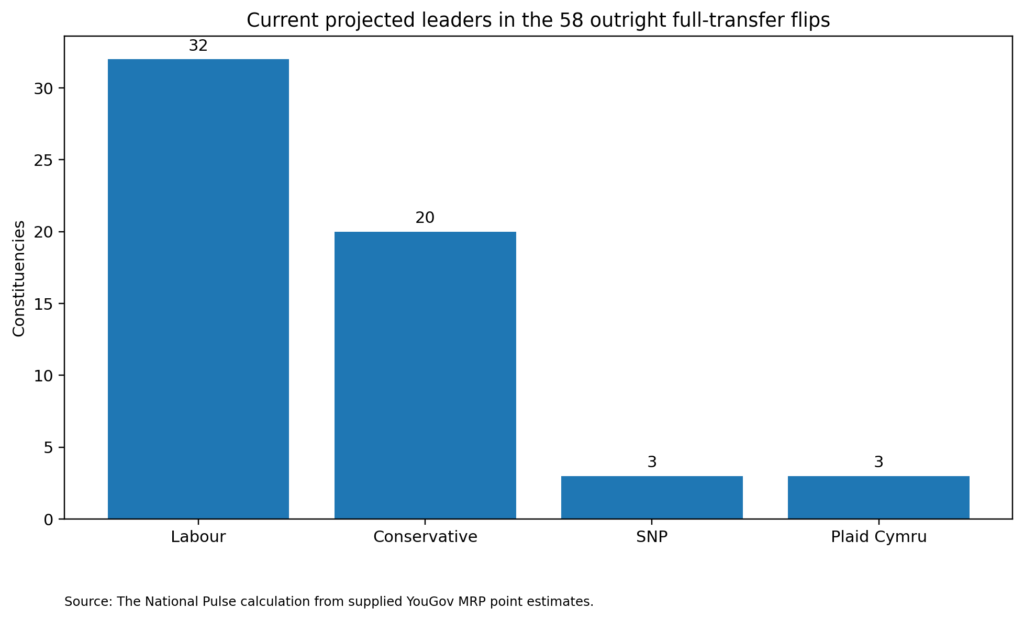
Among the 58 constituencies that become outright Reform leads under the maximal 100 percent transfer calculation, YouGov currently projects that Restore Britain would help cause the following scenarios:
Labour ahead in 32;
The Conservatives ahead in 20;
The SNP ahead in 3;
Plaid Cymru ahead in 3.
This is a damning scenario for Musk, Lowe, and Restore Britain, showing how in a poll where they do not even keep one seat in the UK Parliament (the YouGov MRP shows Lowe losing his Great Yarmouth seat), the party would hand dozens of seats to Labour, tens to the Tories, and even some to the far-left Scottish National Party and Plaid Cymru in Wales.
In Britain’s increasingly fragmented first-past-the-post system, margins that small can be electorally consequential even when the national numbers appear modest.
The National Pulse will continue digging into the constituency-level numbers, not merely repeating national polling headlines. Join The National Pulse or donate today to support more exclusive analysis from Raheem J. Kassam and his team. Every membership and contribution helps fund the research, reporting, and data work behind stories like this.
show less
Restore Britain, the upstart political party backed by Elon Musk, could end up handing dozens of UK parliamentary seats to the establishment or "uniparty" based on new analysis by The National Pulse, using YouGov MRP data released on September 24th 2026.
show more
By Popular Demand.
The National Pulse Now has an on-site comments section for members. Sign up today and be part of the conversation in our community of almost 15,000.
WE ARE 100% INDEPENDENT AND READER-FUNDED. FOR A GUARANTEED AD-FREE EXPERIENCE AND TO SUPPORT REAL NEWS, PLEASE SIGN UP HERE, TODAY.
The British government has unveiled plans for a new agency to counter supposed disinformation, sparking censorship and surveillance concerns.
PULSE POINTS
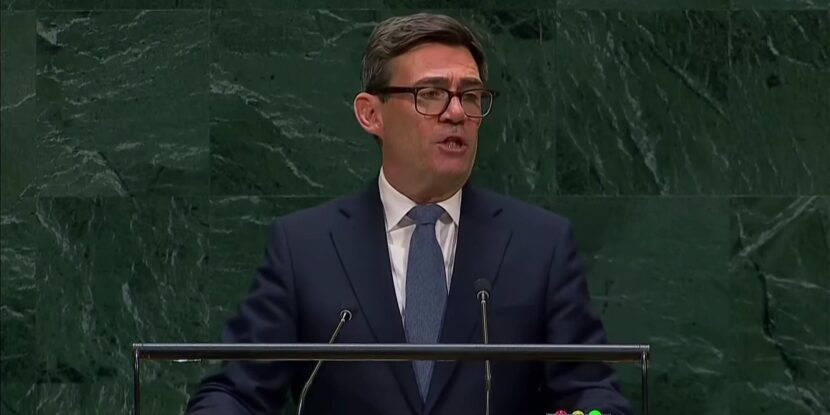
❓ WHAT HAPPENED: British Prime Minister Andy Burnham announced the creation of a National Centre for Information Defence, aimed at countering alleged foreign disinformation and “information attacks.” The center will collaborate with intelligence agencies, law enforcement, and social media platforms to address what the government characterizes as threats, using Russia as the main pretext.
📺 DETAIL: Speaking at the United Nations General Assembly this week, Burnham described the initiative as a response to foreign campaigns spreading “distorted and untrue” narratives, which he claimed undermine national unity and trust. He specifically accused Russia of spending £1.3 billion (~$1.7bn) annually on disinformation efforts, including the use of bots, fake websites, and falsified media. Burnham also alleged Russian interference in Britain’s 2019 general election and amplification of so-called “far-right narratives,” causing concern that the true purpose of the center will be to suppress criticismof mass migration and state-sponsored diversity, equity, and inclusion.
🎯 IMPACT: The announcement has drawn sharp criticism from civil liberties groups and political figures who warn the initiative could lead to censorship and abuse of power. Reform UK party leader Nigel Farage likened the move to a “Ministry of Truth,” while the Big Brother Watch organization raised concerns over potential targeting of lawful domestic speech under the guise of countering disinformation.
💬 KEY QUOTE: “Andy Burnham is setting up a Ministry of Truth to clamp down on free speech.” – Nigel Farage
🎯 FLASHBACK: Critics argue that previous government initiatives, such as the Counter Disinformation Unit and the 77th Brigade, have already been used to monitor and suppress lawful speech critical of the government, raising fears of expanded surveillance.
The State Department is targeting individuals and networks facilitating commercial birth tourism.
PULSE POINTS
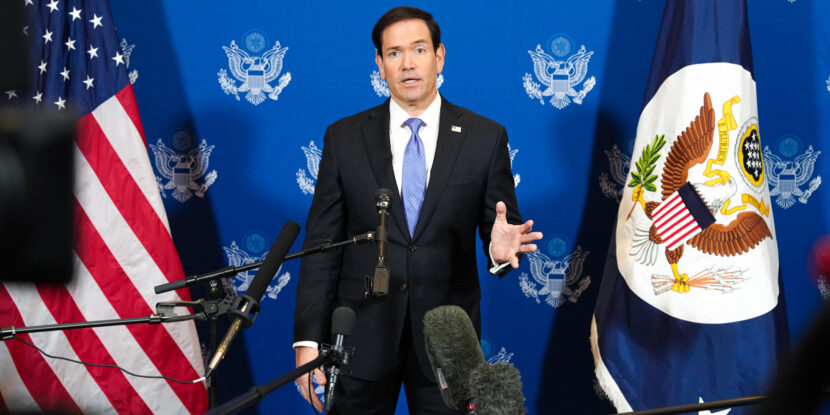
❓ WHAT HAPPENED: Secretary of State Marco Rubio announced a new visa restriction policy targeting networks and individuals engaged in commercial birth tourism. The policy, implemented under Section 212(a)(3)(C) of the Immigration and Nationality Act, aims to prevent exploitation of U.S. immigration rules for foreign-born children to obtain citizenship.
📺 DETAIL: Birth tourism involves foreign nationals traveling to the U.S. primarily to give birth, so their children automatically obtain American citizenship. The Trump administration attempted to restrict this “birthright citizenship” to fewer foreign nationals, but the Supreme Court ruled the restrictions unconstitutional. new policy targets those who facilitate this practice, including birth-tourism businesses, visa fixers, and certain medical providers. This builds on previous measures, such as the 2020 State Department guidance allowing consular officers to deny visas for suspected birth tourism purposes.
💬 KEY QUOTE: “American citizenship is not for sale,” Rubio stated, denouncing birth tourism networks “coaching foreigners to defraud the U.S. visa system, arranging travel and housing, and even forging documents.”
🎯 IMPACT: The policy underscores the broader effort by the U.S. government to tighten immigration enforcement and address loopholes exploited by foreign nationals. While the announcement does not single out any specific nationality, it coincides with ongoing U.S.-China friction, with birth tourism by wealthy Chinese nationals having been a recurring issue.
📺 FLASHBACK: In January 2020, the State Department introduced guidance allowing officers to deny B visas if they believed the applicant’s primary purpose was birth tourism. This new policy builds on that foundation by targeting facilitators and organizations involved in the practice.
Join Pulse+ to comment below, and receive exclusive e-mail analyses.
Newsletter
Need to Know.
Your free, daily feed from The National Pulse.
Thank You!
You are now subscribed to our newsletter.
show less
The State Department is targeting individuals and networks facilitating commercial birth tourism.
show more
By Popular Demand.
The National Pulse Now has an on-site comments section for members. Sign up today and be part of the conversation in our community of almost 15,000.
WE ARE 100% INDEPENDENT AND READER-FUNDED. FOR A GUARANTEED AD-FREE EXPERIENCE AND TO SUPPORT REAL NEWS, PLEASE SIGN UP HERE, TODAY.
The Trump administration is reportedly weighing a 90-day ban on diesel exports, a move that has sparked internal debate and warnings of potential negative consequences for fuel prices.
PULSE POINTS
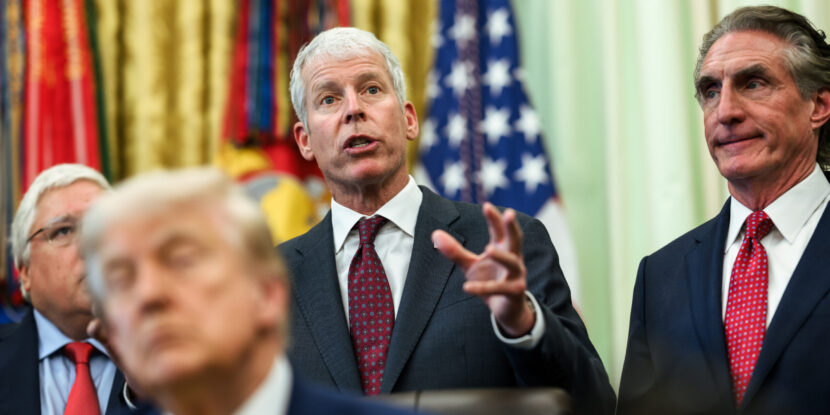
❓ WHAT HAPPENED: The Trump administration is reportedly preparing to implement a 90-day ban on diesel exports in response to record-high diesel prices, which have surged by 76 percent over the past year, according to AAA. This is despite Energy Secretary Chris Wright’s recent warning that such bans are counterproductive.
💬 KEY QUOTE: “The blunt tool of banning diesel exports definitely doesn’t work… If you can’t export the diesel that comes out of our refineries, you run out of places to store it, and you have to reduce U.S. refining, which would put upward pressure on gasoline prices and jet fuel prices.” – Energy Secretary Chris Wright
🎯 IMPACT: Critics, including members of the administration and the oil industry, warn that the ban could lead to reduced refining capacity, potentially increasing gasoline and jet fuel prices in the long term, despite any short-term relief it might bring to diesel costs.
📺 DETAIL: The legal process for the ban is still under discussion. This would mark the first restriction on U.S. energy exports since a decades-old ban on oil exports was lifted in 2015. Significantly, the lifting of the ban resulted in fuel prices falling rather than rising, as it increased global supply and cut costs across the wider international market.
Blocking U.S. diesel exports could end up being a self-defeating move. The idea does little to address the underlying causes of high fuel prices (*cough* end the war *cough*) and, by disrupting existing supply chains, could leave some Americans paying even more.
Join Pulse+ to comment below, and receive exclusive e-mail analyses.
show less
The Trump administration is reportedly weighing a 90-day ban on diesel exports, a move that has sparked internal debate and warnings of potential negative consequences for fuel prices.
show more
By Popular Demand.
The National Pulse Now has an on-site comments section for members. Sign up today and be part of the conversation in our community of almost 15,000.
WE ARE 100% INDEPENDENT AND READER-FUNDED. FOR A GUARANTEED AD-FREE EXPERIENCE AND TO SUPPORT REAL NEWS, PLEASE SIGN UP HERE, TODAY.
The Republican National Committee has filed a lawsuit against New Jersey election officials, demanding transparency after discovering noncitizens on the voter rolls.
PULSE POINTS
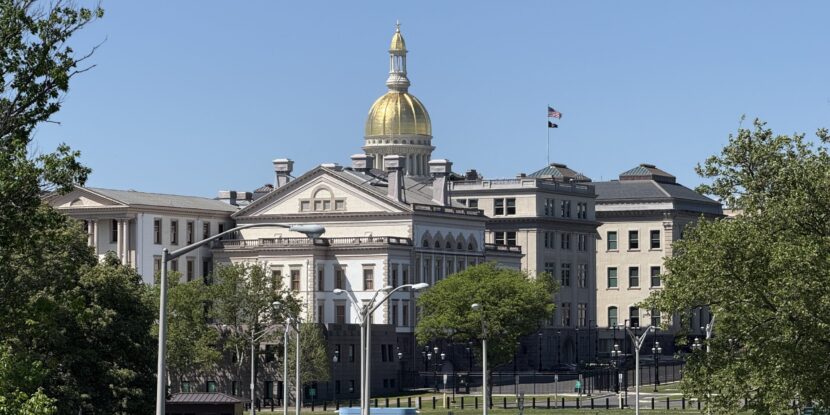
❓ WHAT HAPPENED: The Republican National Committee (RNC) and New Jersey GOP leaders filed a lawsuit against state election officials and five counties, alleging they failed to release federally mandated voter roll maintenance records. The lawsuit follows the discovery of noncitizens on the state’s voter rolls and aims to compel transparency.
📺 DETAIL: The RNC alleges that New Jersey election officials and county authorities in Bergen, Hudson, Middlesex, Somerset, and Union counties have withheld key records required by federal law. This follows revelations of over 6,600 noncitizens being registered to vote, some of whom had participated in past elections. The RNC has previously sued the state over similar issues, with this lawsuit serving as part of a broader campaign to ensure election integrity nationwide.
💬 KEY QUOTE: “The RNC exposed noncitizens on New Jersey’s voter rolls. Now, election officials are hiding the records that would tell voters how it happened. The RNC won’t stand for it.” – RNC Chairman Joe Gruters
💬 SECONDARY QUOTE: “New Jerseyans deserve complete transparency following Gov. Sherrill’s admission that over 6,600 noncitizens were added to our voter rolls… Election officials must immediately release these records, so voters get the complete truth.” ” – Rep. Tom Kean Jr. (R-NJ)
🎯 IMPACT: The lawsuit seeks to uncover how noncitizens were added to voter rollsand whether they were removed following discovery. Congressional investigators are also probing these issues, raising broader concerns about election integrity and transparency ahead of the 2026 midterms.
📺 FLASHBACK: In June, reports revealed that some noncitizens self-attested their status while seeking naturalization, yet were found to have voted in prior elections. Academic research shows that, despite it being illegal for noncitizens to vote, they do so in sufficient numbers to alter election outcomes, and tend to favor the Democrats.
Join Pulse+ to comment below, and receive exclusive e-mail analyses.
show less
The Republican National Committee has filed a lawsuit against New Jersey election officials, demanding transparency after discovering noncitizens on the voter rolls.
show more
By Popular Demand.
The National Pulse Now has an on-site comments section for members. Sign up today and be part of the conversation in our community of almost 15,000.
WE ARE 100% INDEPENDENT AND READER-FUNDED. FOR A GUARANTEED AD-FREE EXPERIENCE AND TO SUPPORT REAL NEWS, PLEASE SIGN UP HERE, TODAY.
Disgraced Hollywood mogul Harvey Weinstein received a 15-year sentence for sexually assaulting a production assistant in 2006.
PULSE POINTS
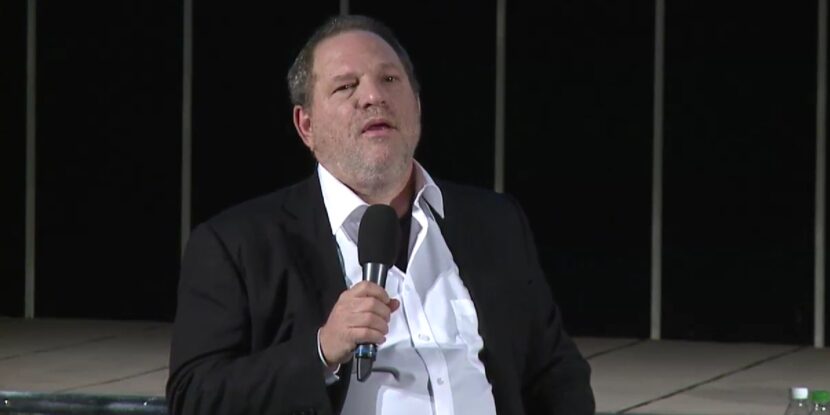
❓ WHAT HAPPENED: Harvey Weinstein was sentenced to 15 years in prison on Wednesday for sexually assaulting television production assistant Miriam Haley in 2006. This marks the second sentencing in the case, following the overturning of a prior conviction and a new jury’s finding him guilty in June 2025.
📺 DETAIL: Miriam Haley described the lasting trauma Weinstein caused in a victim impact statement, calling it a “life sentence” for her. Weinstein, who has denied all allegationsof rape and sexual assault from multiple women, expressed remorse for Haley’s pain but maintained his innocence. Manhattan District Attorney Alvin Bragg commended Haley and other survivors for their courage throughout the legal process, saying, “I’m moved, as we should all be moved, by their courage and their steadfastness through what has obviously been a challenging process.”
💬 KEY QUOTE: “Having been sexually assaulted by Harvey Weinstein has had a devastating effect on my life and sense of security that may never go away,” said Miriam Haley during her statement to the court. “It’s a life sentence for me.”
🎯 IMPACT: Weinstein has already served over six years in prison as his case moved through the legal system, and he is expected to appeal this latest sentence. The accusations against Weinstein became a catalyst for and a focal point in the #MeToo movement, particularly when it was more focused on abuses of power in Hollywood rather than the actions of men generally.
Join Pulse+ to comment below, and receive exclusive e-mail analyses.
Newsletter
Need to Know.
Your free, daily feed from The National Pulse.
Thank You!
You are now subscribed to our newsletter.
show less
Disgraced Hollywood mogul Harvey Weinstein received a 15-year sentence for sexually assaulting a production assistant in 2006.
show more
By Popular Demand.
The National Pulse Now has an on-site comments section for members. Sign up today and be part of the conversation in our community of almost 15,000.
Share Story
FacebookTwitterWhatsappTruthTelegramGettrCopy Link
Real News Fan? Show It!
Many people are shocked to learn that because of active censorship, we currently have to spend more time making sure you can even see The National Pulse, than on producing the news itself. Which sucks. Because we do this for the truth, and for you.
But the regime doesn’t want you being informed. That’s why they want us to go away. And that will happen if more people don’t sign up to support our work. It’s basic supply and demand. So demand you get to read The National Pulse, unrestricted. Sign up, today.
We don’t sell ads, and refuse corporate or political cash. It all comes down to you, the reader. I hope you can help.














_5_(48916532038).jpg)

.jpg)


