Democrats are reviving their campaign to transform Washington, D.C., into America’s 51st state following their victories in the 2026 midterm elections, reopening a constitutional battle that could dramatically alter the balance of power in Congress.
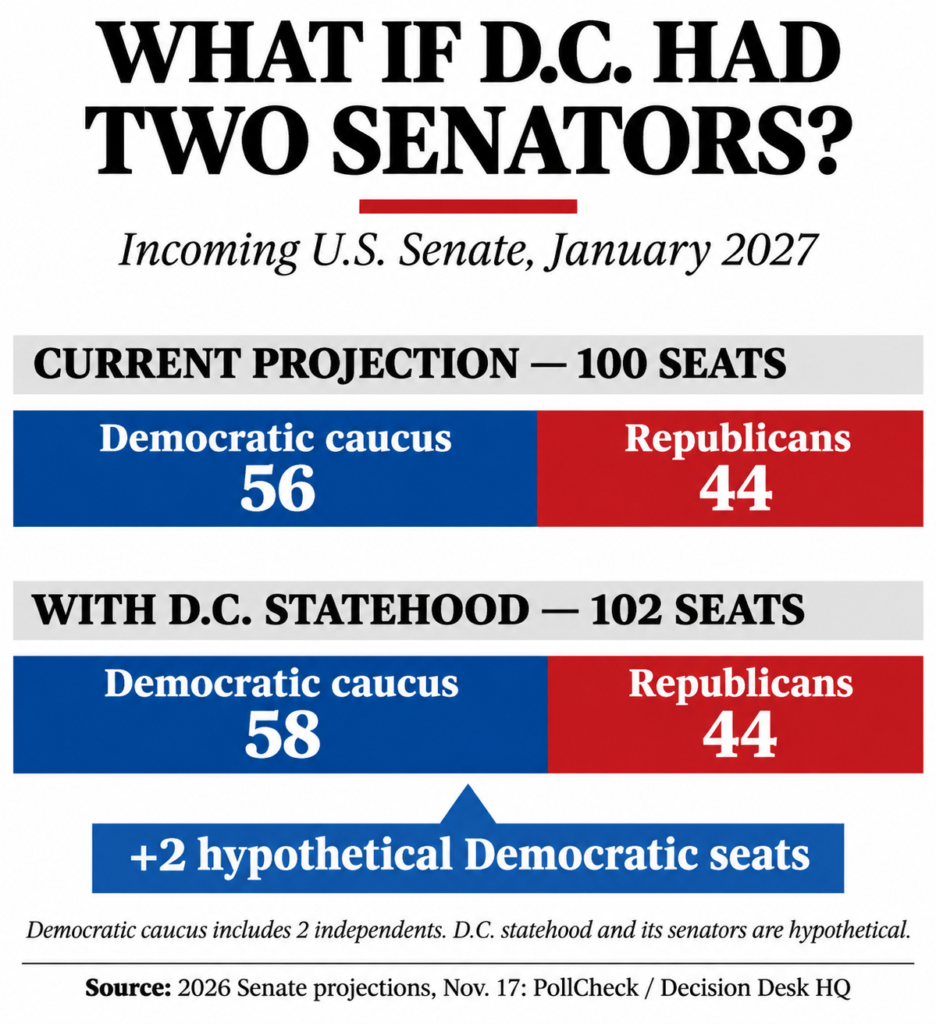
The push would give residents of the nation’s capital full congressional representation for the first time. It would also create two new Senate seats in one of America’s most reliably Democrat-voting jurisdictions, potentially handing the party a more or less permanent political advantage.
However, the proposal faces significant constitutional obstacles, Republican opposition, and the prospect of a veto by President Donald J. Trump.
Democrats Seek a 51st State for Their Own Benefit.
Washington, D.C., residents currently elect a delegate to the House of Representatives who can participate in legislative activities but cannot vote on the final passage of legislation. The district has no senators, despite its residents paying federal taxes and participating in presidential elections.
Democrats have long argued that this arrangement denies Washington residents the democratic representation enjoyed by Americans living in the 50 states.
The Democrat-controlled House previously approved D.C. statehood legislation in 2020 and again in 2021, but neither proposal became law. Incoming Democrat congressional majorities following the midterms could revive the legislation, although controlling Congress alone is not enough to make the proposal a reality.
Two More Democrat Senators.
Under the Constitution, every state receives two senators regardless of population. Washington’s overwhelmingly Democratic electorate means that statehood would likely produce two additional Democratic senators and at least one voting House member.
That could prove decisive in closely divided Senates, affecting everything from federal legislation to judicial confirmations and presidential appointments. Republicans have described the statehood campaign as an effort to expand Democrat power rather than simply address political representation.
A Constitutional Showdown.
The Constitution presents a major obstacle to the Democrat proposal. Article I, Section 8 establishes Congress’s authority over a federal district serving as the seat of government. The founders deliberately placed the national capital outside the jurisdiction of any individual state.
Democratic proposals would circumvent this arrangement by shrinking the federal district to a small enclave containing the White House, Capitol, Supreme Court, and other federal buildings. The remaining residential and commercial territory would become a new state called Washington, Douglass Commonwealth.
Supporters argue that Congress can authorize the arrangement through ordinary legislation because the Constitution establishes a maximum size for the federal district but no minimum. However, a Congressional Research Service analysis identifies unresolved constitutional questions, including whether Congress can create a state from territory originally designated as the federal capital.
The Twenty-Third Amendment presents an additional issue. It grants presidential electors to the federal district, potentially leaving a drastically reduced capital district with three electoral votes unless the amendment is repealed, something that would be far more difficult.
Trump Remains a Bulwark Against Democrat Plans.
Incoming Democratic delegate Robert White Jr., who will succeed longtime representative Eleanor Holmes Norton, has openly emphasized the partisan benefits of statehood. “The agenda gets done if you have the votes — and D.C. statehood gives you more votes,” White said.
Still, Democrats face formidable barriers. Statehood legislation could encounter the Senate’s 60-vote filibuster threshold, while President Trump could veto any bill reaching his desk. Overriding that veto would require two-thirds majorities in both chambers. A constitutional amendment, if required, would also need ratification by 38 states.
The renewed campaign therefore threatens to become another confrontation between congressional Democrats and the Trump administration, with the future composition of the Senate potentially hanging in the balance.