On Friday, the National Institute of Statistics and Economic Studies (INSEE), France’s national statistics office, revealed that the country’s economy grew less during the third quarter than initially believed, putting France in a technical recession.
Technical Recession.
INSEE initially estimated that the French economy had contracted by 0.1 percent in Q3 2026. However, this estimate was subsequently revised, showing that the French economy had actually contracted by 0.2 percent. INSEE also revised its Q2 2026 estimate from an initial figure of zero growth to a slight contraction of roughly 0.02 percent.
This means that France’s economy has contracted for two consecutive quarters, putting the country in a technical recession. A technical recession is conventionally defined as two consecutive quarters, or six consecutive months, of negative real GDP growth. While a technical recession by itself does not suggest widespread economic hardship, it serves as an important warning sign for policymakers and as a rule of thumb in identifying a slowing economy.
France’s Mounting Economic Woes.
The revised figures paint a worsening financial picture for Europe’s second-largest economy. Earlier this week, the country’s Manufacturing PMI (Purchasing Managers’ Index) downgraded to 47.9, a year low, from 49.5 last month. France’s Composite PMI, a metric of economic activity across both manufacturing and services, also fell to 46.2, a six-month low, from 46.6 last month.
Furthermore, French economic sentiment has declined by 2.3 points, according to the European Commission’s most recent Business and Consumer Survey, reflecting a broader Europe-wide trend of declining economic confidence. “In November 2026, the Economic Sentiment Indicator (ESI) eased further in both the EU (-0.5 points to 96.0) and the euro area (-0.7 points to 95.8). The Employment Expectations Indicator (EEI) also fell in both areas (EU: -0.6 points to 97.9, euro area: -1.3 points to 96.8). The two indicators score below their long-term average of 100,” explained the survey’s summary.
France is also grappling with significant public sector debt, which currently sits at approximately 119 percent of GDP.
A Boost for Le Pen?
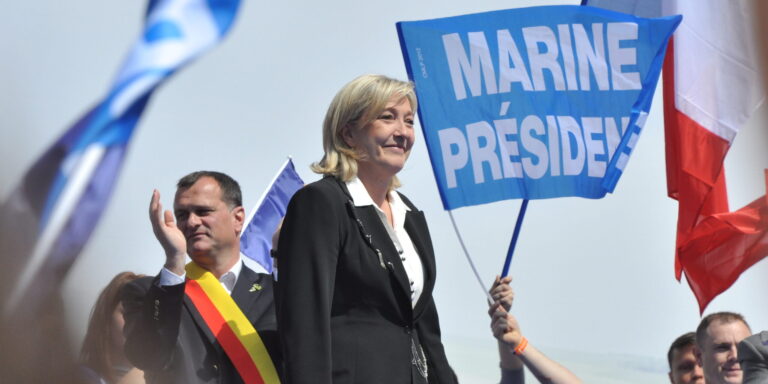
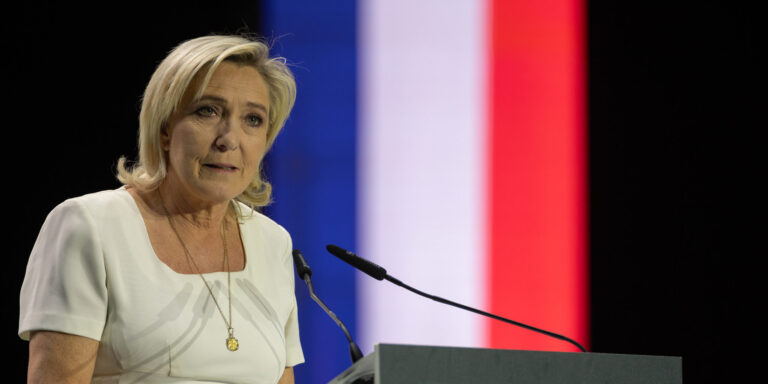
France’s economic woes could help propel National Rally (RN) leader Marine Le Pen to victory in next year’s presidential election. All recent polling gives Le Pen a double-digit lead over her rivals, and projects that she will defeat all potential challengers in the second round of voting. For instance, according to polling released today, Le Pen has a 17-point lead over Jean-Luc Mélenchon, leader of the far-left France Unbowed party and her closest rival.
Further polling has revealed that purchasing power is a key concern among French voters, with public debt and deficits also featuring prominently.