



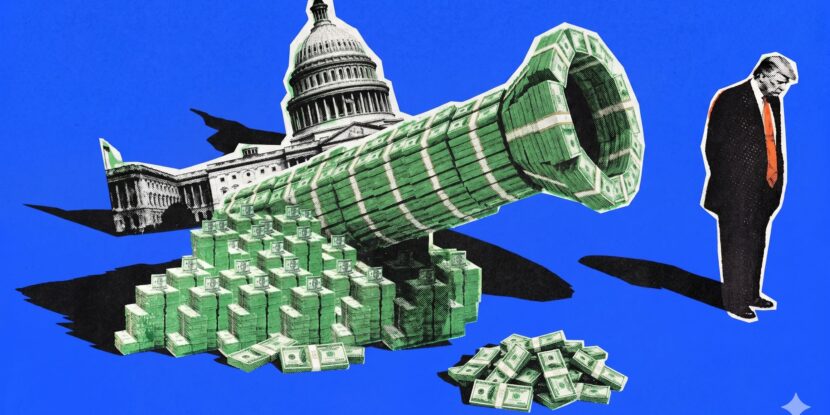

For one brief moment the federal government proposed to do something it almost never does, which is to concede that its own machinery had been turned into a weapon and to offer the people it crushed a route to redress. The now infamous Anti-Weaponization Fund was seeded with a deliberately symbolic $1.776 billion drawn from the Judgment Fund under the settlement of the President’s suit over his own leaked tax returns.
That is precisely what they moved to crush it.
A single federal judge in the Eastern District of Virginia froze the fund within days, with a hearing on whether to extend the block set for 12 June, and the same establishment that spent a decade swearing the agencies were neutral suddenly located deep constitutional misgivings about compensating the agencies’ victims.
Democratic governors and legislators raced to smother any payout that survived the courts, with Gavin Newsom even vowing to tax California recipients at 100 percent and copycat bills appearing in New York, New Jersey, Connecticut, and Wisconsin, alongside a federal measure its own authors were proud enough to brand the SLUSH FUND Act. That this single idea provoked so much coordinated outrage is a massive tell.
Stephen K. Bannon was wrongly prosecuted and imprisoned over a congressional subpoena of the precise kind that, aimed the other way, yields a sternly worded letter and nothing further. Peter Navarro also went to prison. Michael Flynn was put through years of an investigation that the government’s own records later showed it had cause to drop long before it chose to.
And there are a number of cases that never reach cable news. We at The National Pulse have heard testimony from a number of people who have reached out to us to explain how they were persecuted, having assets seized, their homes raided, placed on no fly lists. Some of these cases are still unresolved.
White River Energy Corp is another example. A small Arkansas oil and gas firm which built a business around Native American sovereign tax credits. Its filings were processed without incident until one of its referral agents, Billy Long, was nominated to run the IRS, at which point it became a target of convenience.
The company maintains the credits are legitimate, but what followed was not quiet enforcement but a public campaign, with Senator Ron Wyden firing off letters demanding a Justice Department investigation and branding the arrangement a fraud in the press, after which the agency’s posture conveniently hardened. All because Wyden wanted to stop Billy Long. For White River, however, the damage is done.
The pattern here is precisely the point. The pressure didn’t begin inside a neutral tax administration applying the code without fear or favor; it began with a U.S. Senator hunting a political scalp, amplified by a sympathetic press, and it landed on people with neither the profile nor the war chest to fight back.
It is more than fair to ask how impartial that administration is. We know, because she posted it herself, that a serving IRS Appeals Officer – Niki Wilkinson – used her own public LinkedIn account to defend a central figure from the Lois Lerner-era targeting scandal, to dismiss congressional concern about political bias as a “farce,” and to accuse the sitting President of corruption, all while occupying a role whose entire legitimacy rests on the appearance of neutrality.
While many outlets have reported that Wilkinson was fired from the IRS, it remains unclear as to whether she simply got demoted, instead.
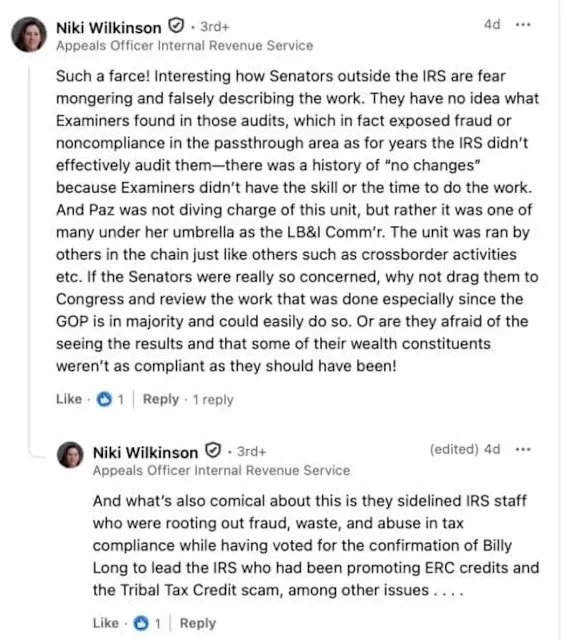
A tax authority cannot demand that citizens trust its impartiality while its officers editorialize against half the country on a public social media feed.
This is exactly why the fund was right, and why letting it die would be a lasting mistake. Weaponization cannot be resolved by waiting for the offending officials to retire on their whopping full pensions. As we have previously said, the people must be compensated, and the next politician who reaches for the IRS or any government agency as a campaign instrument must know that the bill eventually arrives.