Deputy Secretary of Homeland Security John Tien quietly resigned this week, in an unexpected move buried in the news cycle under the Trump indictment and missing submersible. Tien follows Customs and Border Protection chief Chris Magnus, Immigration and Customs Enforcement (ICE) acting chief Tae Johnson, and US Border Patrol Chief Raul Ortiz, all of whom bowed out in recent months.
Officially, Tien says he wants to spend more time with his family. It’s a euphemistic rationale, especially as just weeks ago he was giving interviews about his “new challenge” in the job, claiming he has “a responsibility to be both seen and heard.”
But like Magnus, Johnson and Ortiz, he is unlikely to be seen or heard from again, at least in this government.
Speculation will necessarily abound, but Biden’s border has arguably been the most colossal failure of his three years in office thus far, and there’s plenty to pick from.
Moves to prevent an embarrassing surge in border crossings ahead of an election year may be informing the departures. After all, Tien recently refused to confirm that he believes crossing the border illegally should even be a crime.
Magnus, meanwhile, resigned in November amidst pressure to reduce crossings – instructions contrary to his belief in sanctuary cities and states, and a distraction from his priorities of increasing female recruitment and clamping down on agents’ social media posts.
Ortiz, at Border Patrol, is said to have sought retirement, having only landed the gig in 2021, after 32 years of service.
“After a 32-year Border Patrol career spanning multiple Sectors, HQ tours, and overseas assignments in Afghanistan, I have decided to retire from federal service on June 30th,” he said in May.
Illegal crossings have been at (or near) record highs for much of 2022 and 2023. It was widely expected, including by Department of Homeland Security Secretary Alejandro Mayorkas, that this situation would dramatically worsen with the expiration of Trump-era Title 42 border controls in May.
Hastily reinforced Title 8 controls criminalizing illegal entry have so far prevented the worst of the catastrophe, but migrants presenting themselves at points of entry have hit an all-time high as a side-effect.
Jack Montgomery contributed to this report.
show less
Deputy Secretary of Homeland Security John Tien quietly resigned this week, in an unexpected move buried in the news cycle under the Trump indictment and missing submersible. Tien follows Customs and Border Protection chief Chris Magnus, Immigration and Customs Enforcement (ICE) acting chief Tae Johnson, and US Border Patrol Chief Raul Ortiz, all of whom bowed out in recent months.
show more
Governor Ron DeSantis is either getting his messaging mixed, or admitting he would be half as effective a President as Donald Trump.
Trump, playing to his experience in the job, goaded the Florida governor this week, stating: “When [DeSantis] says eight years, every time I hear it, I wince… because I say, if it takes eight years to turn this around, then you don’t want him… as your president.”
When told about Trump’s remarks, DeSantis snapped back: “Why didn’t he do it his first four years?”
But speaking on stage in Iowa, DeSantis said: “Let’s just be clear, it really does take two terms as president to be able to finish this job… And I don’t think he could fix it in one single four-year term.”
His messaging doesn’t seem to be working.
“Trump’s strength is his term as president,” George Pierson, a college student from Waukee told CNN.
Still, good news that DeSantis admitted Trump’s four years in office were his “first”. Conceding so soon, Ron?
The buried lede in this clip is that DeSantis says "first" four years, implying a second four years to come.
For all the talk of “modernization”, the Coronation of King Charles III in Westminster Abbey on Saturday was a fundamentally Christian service replete with prayers, hymns, and scripture. The service underscored the fact that Christianity is still the bedrock of Western culture, even in increasingly faithless times.
Many countries including Norway, Sweden, the Netherlands, and Japan have retained their monarchies as constitutional adornments and sources of tourism revenue, but none have the prestige of the British monarchy — which is also the monarchy of Canada, Australia, New Zealand, and eleven other Commonwealth Realms from the Caribbean Sea to the Pacific Ocean.
American conservatives, given the centrality of their country’s historic grievances against George III to their identity, are seldom royalists. Yet most can appreciate, albeit from afar, the British monarch’s status as a living link with over a thousand years of history, and the many rich traditions associated with monarchy — and in particular the way it underlines Christianity’s vital role in preserving Western culture.
Westminster Abbey itself noted that the order of service for the Coronation was “a reminder that coronations take place within a Communion service or Eucharist.”
“The monarch is crowned in the name of God, surrounded by prayer, and the first thing that the newly-crowned monarch does is receive Holy Communion as a sign of his dependency on God,” the abbey stressed.
The King of Kings.
While those unfamiliar with the Coronation service may labor under the misapprehension that it is an unseemly exercise in elevating a mortal man above his fellows in idolatrous fashion, nothing could be further from the truth. Many rituals stress that the King must be a servant of God and of his people.
The Cross of Wales, containing purported relics of the True Cross, led Charles to the Abbey, where he was met with the words: “Your Majesty, as children of the kingdom of God we welcome you in the name of the King of kings,” as a reminder that no man stands higher than Christ.
“In His name and after His example I come not to be served but to serve,” Charles replied.
Not long after, the Moderator of the General Assembly of the Church of Scotland presented the King with a Bible, telling him: “Sir, to keep you ever mindful of the law and the Gospel of God as the Rule for the whole life and government of Christian Princes, receive this Book, the most valuable thing that this world affords. Here is Wisdom; this is the royal Law; these are the lively Oracles of God.”
The Archbishop of Canterbury asked Charles to swear a series of Christian oaths, among them a promise to “to the utmost of [his] power maintain the Laws of God and the true profession of the Gospel”.
“The things which I have here before promised, I will perform and keep. So help me God,” the King concluded in his responses, hand on the Bible presented to him by the Moderator.
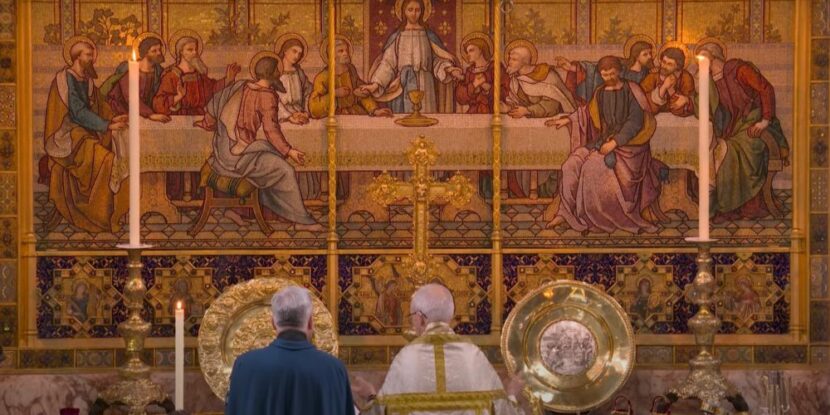
The “most sacred” part of the coronation was Charles’s anointing with holy oil; a semi-private ceremony that took place behind a special screen with the King divested of his robes and kneeling in a simple white shirt.
“Thy prophets of old anointed priests and kings to serve in Thy name and in the fullness of time Thine only Son was anointed by the Holy Spirit to be the Christ, the Saviour and Servant of all,” the Archbishop said to God as he prepared to perform the anointing.
“By the power of the same Spirit, grant that this holy oil may be for Thy servant Charles a sign of joy and gladness; that as King he may know the abundance of Thy grace and the power of Thy mercy, and that we may be made a royal priesthood, a holy nation, a people for Thine own possession.”
The anointing King Charles III is taking place.
His Majesty is shielded from public view for privacy reasons.
To Charles, as the anointing was carried out to the music of Handel, the Archbishop said: “[A]s Solomon was anointed king by Zadok the priest and Nathan the prophet, so may you be anointed, blessed, and consecrated King over the peoples, whom the Lord your God has given you to rule and govern; in the name of the Father, and of the Son, and of the Holy Spirit. Amen.”
A Conservative Manifesto.
Later in the service, the King was offered the so-called Jeweled Sword of Offering accompanied by Byzantine Chant, including the line: “Give the king your judgements, O God… May he defend the poor among the people, deliver the children of the needy and crush the oppressor. Alleluia.”
Charles was implored by the Archbishop to reign according to what many would regard as a profoundly conservative manifesto as the sword was presented:
“With this sword do justice, stop the growth of iniquity, protect the holy Church of God and all people of goodwill, help and defend widows and orphans, restore the things that are gone to decay, maintain the things that are restored, punish and reform what is amiss, and confirm what is in good order: that doing these things you may be glorious in all virtue; and so faithfully serve our Lord Jesus Christ in this life, that you may reign for ever with Him in the life which is to come. Amen.”
The Archbishop of Canterbury crowns King Charles III.
With even the leftward-drifting Conservative Party increasingly disinterested in ruling according to such principles, which clash at a fundamental level with the woke, secularizing zeitgeist, the Coronation was a very rare instance of such genuinely conservative ideals being articulated at the very heart of public life.
show less
For all the talk of "modernization", the Coronation of King Charles III in Westminster Abbey on Saturday was a fundamentally Christian service replete with prayers, hymns, and scripture. The service underscored the fact that Christianity is still the bedrock of Western culture, even in increasingly faithless times. show more
Share Story
FacebookTwitterWhatsappTruthTelegramGettrCopy Link
Real News Fan? Show It!
Many people are shocked to learn that because of active censorship, we currently have to spend more time making sure you can even see The National Pulse, than on producing the news itself. Which sucks. Because we do this for the truth, and for you.
But the regime doesn’t want you being informed. That’s why they want us to go away. And that will happen if more people don’t sign up to support our work. It’s basic supply and demand. So demand you get to read The National Pulse, unrestricted. Sign up, today.
We don’t sell ads, and refuse corporate or political cash. It all comes down to you, the reader. I hope you can help.