




Monday, February 23, 2026

Trump Campaign: Democrats Didn’t Turn Out for Kamala in Early Vote.

President Donald J. Trump‘s 2024 presidential campaign says Democrats are facing a significant turnout problem hearing into Election Day on November 5. A memo issued by the campaign’s chief data consultant, Tim Saler, argues that “Republicans are outperforming elections past in absentee ballots and early votes cast” while “Democrats are facing a precipitous decline in urban turnout…”

“Democrats are spinning themselves and reporters by claiming that their voters will turn out on Election Day when polls show otherwise and, most importantly, that’s asking Democrat voters to do something they have absolutely no history of doing,” Saler writes. He adds: “If Democrats, who historically vote ahead of Election Day, haven’t been motivated to show up for Kamala yet, why do we expect them to show up tomorrow?”

DEMOCRAT SPIN. 

Throughout October, Vice President Kamala Harris and Democrat campaign surrogates aggressively pushed their voters to cast ballots during the early voting period. During a rally in Erie, Pennsylvania, in mid-October, Harris told her supporters: “In Erie County, you can vote early in person. Now is the time to make your plan to vote, and if you have already received your ballot in the mail, please do not wait.”

The corporate media parroted the early vote messaging from top Democrats, with The Hill stating last month that the “Harris campaign and Democratic groups are working hard to push their supporters to vote early in this year’s election” and that the campaign “wants to maximize its early advantage.”

EARLY VOTE COLLAPSE.

However, Saler’s memo notes that data shows Democratic voters appear to have largely ignored the Harris campaign’s effort. Citing TargetSmart, the Trump campaign states urban turnout in Arizona is down 385,285 voters compared to the same point in 2020. Likewise, the female vote is down by 170,011 in the state.

In Georgia, urban turnout is down by 153,846 votes, while female voter turnout is down by 46,732. North Carolina has seen a decrease of 175,470 in its rural turnout and 154,459 drop among women. Similarly, Nevada’s urban vote is down 191,199, while women are down 126,112 voters.

Among the so-called “blue wall” states, Michigan has seen a catastrophic collapse in urban turnout, down 321,523 from this point in 2020. Female turnout is down over 200,000 votes. The Michigan numbers are mirrored closely by Pennsylvania, which saw a decline of 381,519 urban voters and a staggering 450,802 female voters. Meanwhile, Wisconsin has seen 100,733 fewer urban and 238,452 female voters during the early vote period.

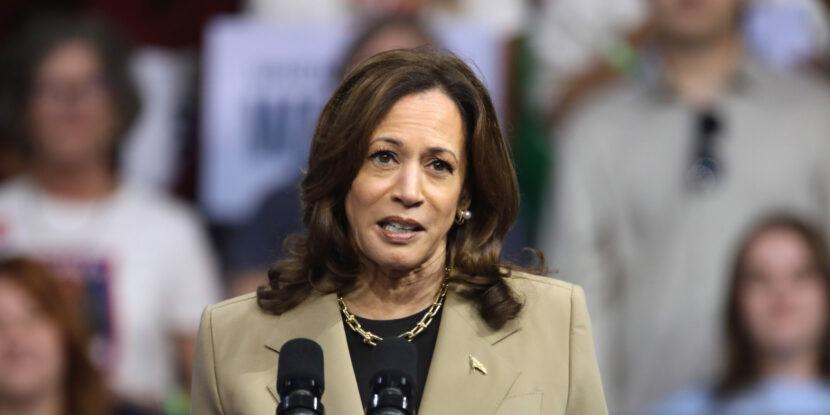
Image by Gage Skidmore.

show less
President Donald J. Trump's 2024 presidential campaign says Democrats are facing a significant turnout problem hearing into Election Day on November 5. A memo issued by the campaign's chief data consultant, Tim Saler, argues that "Republicans are outperforming elections past in absentee ballots and early votes cast" while "Democrats are facing a precipitous decline in urban turnout..." show more

BREAKING: GA Supreme Court Rules Absentee Ballots Received After Election Day Will NOT Be Counted.

The Georgia Supreme Court has reversed a lower court decision to extend the state’s absentee ballot deadline from November 5 to November 8 after Cobb County election officials failed to send the ballots to around 3,000 voters in a timely manner. Last week, a Cobb County judge unilaterally extended the election date for impacted voters in contravention of state and federal law.

“Upon consideration of the Emergency Motion for Supersedeas of Appellants The Republican National Committee and Georgia Republican Party, Inc., as well as the briefs filed by the parties and the amicus curiae, Appellants’ emergency motion for supersedeas is GRANTED,” Georgia’s high court wrote in their decision. The court adds: “Consistent with OCGA § 21-2-386, the Cobb County Board of Elections and Registration (the “Board”) may count only those absentee ballots received by the statutory deadline of 7:00 p.m. on Election Day, November 5, 2024.”

The ruling directs Cobb County election officials to sequester any ballots received after the November 5 deadline, emphasizing that they are not to be included in the county. Pursuant to Georgia state election law, the ballots are to be preserved until the court orders them destroyed.

Republican National Committee co-chairman Michael Whatley hailed the decision as a win for election integrity. “HUGE election integrity victory in Georgia,” Whatley stated in a post on X (formerly Twitter). He continued: “Democrat-run Cobb County wanted to accept 3,000 absentee ballots AFTER the Election Day deadline. We took this case to the Georgia Supreme Court.”

“We just got word that we WON the case. Election Day is Election Day — not the week after,” he added.

Image by Harrison Keely.

show less
The Georgia Supreme Court has reversed a lower court decision to extend the state's absentee ballot deadline from November 5 to November 8 after Cobb County election officials failed to send the ballots to around 3,000 voters in a timely manner. Last week, a Cobb County judge unilaterally extended the election date for impacted voters in contravention of state and federal law. show more

Georgia GOP Says Fulton County is Violating State Ballot Drop Box Law.

The Georgia Republican Party is alleging Fulton County election officials are keeping certain voter centers open in predominantly Democratic-heavy areas over the weekend to accept absentee ballots in what they say violates Georgia law. In a statement issued late Friday night, the Georgia GOP announced they have filed a lawsuit against Fulton County for violating state election law, which restricts the use of ballot drop boxes after the early voting period ends.

“It has come to our attention that Fulton County election officials are planning to open four election offices this weekend “to accommodate voters seeking to hand-return their absentee ballots,” the Georgia GOP says, continuing: “This is a blatant violation of Georgia law, subsection (d) of Code Section 21-5-385. O.C.G.A § 21-2-382 which states ‘all drop boxes shall be closed when the advance voting period ends.’ This must be stopped immediately and those willfully breaking Georgia law should be held accountable.”

“Fulton County’s patently illegal acts give us no choice but to immediately file suit,” the state Republican Party adds.

Georgia state election mandates an early voting period beginning on “the fourth Monday immediately prior to each primary or election” and ending ” on the Friday immediately prior to each primary, election, or runoff.” However, voters are allowed to mail or hand in absentee ballots at any point “before the day of the primary or election.”

The Georgia GOP’s complaint appears to be contingent on the concern that Fulton County voter centers are acting as ballot drop boxes in all but name and that local election officials are using conflicting statutes to unlawfully extend the early voting period beyond its legally mandated conclusion.

show less
The Georgia Republican Party is alleging Fulton County election officials are keeping certain voter centers open in predominantly Democratic-heavy areas over the weekend to accept absentee ballots in what they say violates Georgia law. In a statement issued late Friday night, the Georgia GOP announced they have filed a lawsuit against Fulton County for violating state election law, which restricts the use of ballot drop boxes after the early voting period ends. show more

Over 15 Million People Have Already Voted in America’s Presidential Election.

With just two weeks until Election Day, over 15 million people have already voted in the U.S. election. According to data from the University of Florida’s Election Lab, five million people have voted early in person, and another 10 million have voted by mail. There are over 56 million mail-in ballot requests, meaning around 46 million remain outstanding.

During the 2020 presidential election, over 65.5 million mail-in ballots were cast. In total, 2020 saw over 155 million people vote, the highest turnout—by percentage—since 1900. While turnout in the 2024 election may not match that seen in 2020, early indications suggest the presidential contest will still see a significant number of votes cast—and that should actually bode well for former President Donald J. Trump.

ARIZONA & NEVADA.

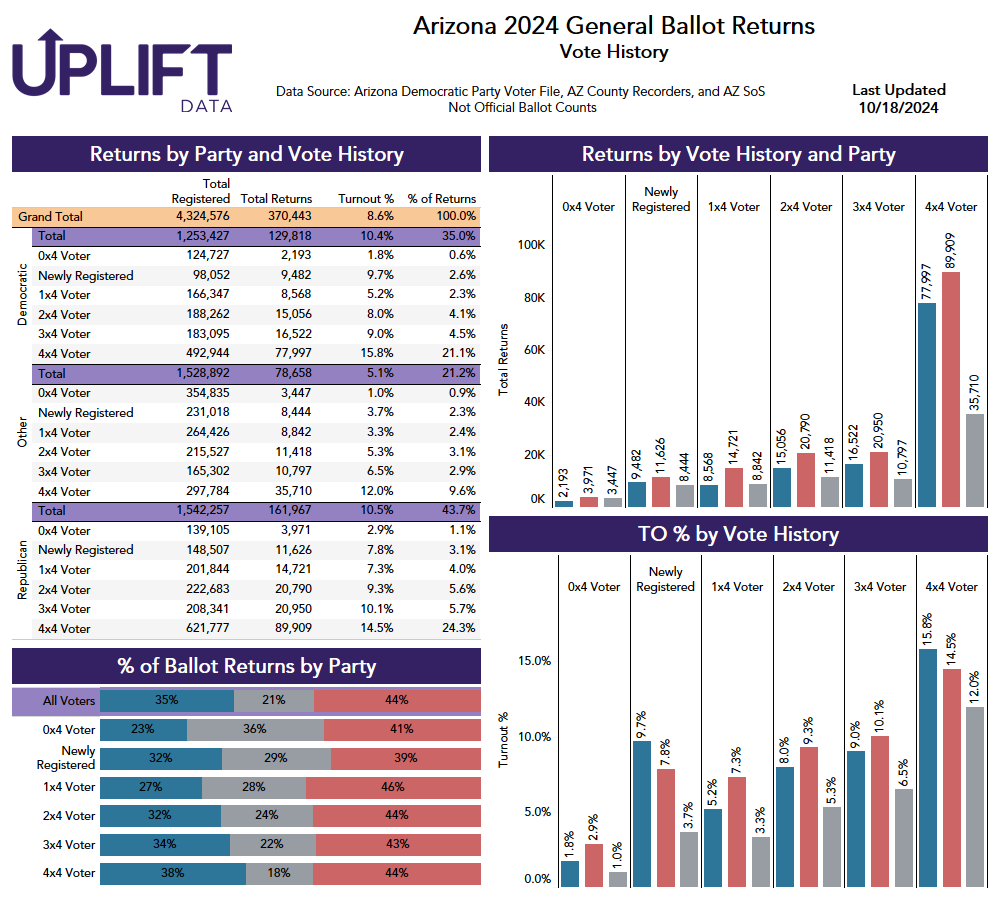
In Arizona, early vote totals show Republicans outpacing Democrats and Independents in terms of ballots returned by low-propensity voters. These Americans, who have not voted or only voted once in the last several elections, are anticipated to play an outsized role in the 2024 election and determine whether President Trump or his Democratic Party opponent, Vice President Kamala Harris, takes the White House.

Similarly to Arizona, Nevada’s early vote appears to be breaking fairly heavily towards Republicans—while Democrats hold the advantage on the state’s mail-in ballots.

Again—like Arizona—Republicans in Nevada appear to be moving low-propensity voters, while Democrats seem to be mostly reliant on voters who have consistently voted in the past several elections.

PENNSYLVANIA.

Meanwhile, one state where turnout appears to be lagging—and where lower turnout could be a good sign for Republicans—is Pennslyvania. As of noon on October 21, Republicans continue to outpace Democrats in absentee ballot requests. Interestingly, the total number of requests among Democrats is currently down from their 2020 totals by around 1.2 million, while Republicans are only off by about 250,000.

show less
With just two weeks until Election Day, over 15 million people have already voted in the U.S. election. According to data from the University of Florida's Election Lab, five million people have voted early in person, and another 10 million have voted by mail. There are over 56 million mail-in ballot requests, meaning around 46 million remain outstanding. show more

Counties Devastated by Hurricane Helene Allowed to Change Voting Plans.

The western North Carolina counties ravaged by Hurricane Helene will be allowed a degree of flexibility in their voting plans after a vote by the North Carolina State Board of Elections on Monday. Adopted by a unanimous vote, the election board passed a resolution authorizing the impacted counties to change early voting and Election Day polling sites, increased discretion in the appointment of poll workers, and greater flexibility for votes on they receive and return their absentee ballots.

“We will continue to make voting accessible to voters,” said Republican election board member Stacy Eggers following the decision. He added: “Whether we need four-wheelers, horses or helicopters, this disaster highlights the need for consistency in our work and making sure that we get to the locations that the voters expect us to be.”

Areas lacking poll workers will be allowed to bring election staff from other parts of the state or reassign workers to other polling locations. In addition, those who lost absentee ballots in the storm can request a new one at their local election office, and those displaced can return their ballot to any North Carolina election office.

According to state election officials, all fourteen county election board offices that were closed in the wake of Hurricane Helene have now reopened for operations. Despite this, many of the county election officials in the western areas of the state still do not have power or running water in their homes, making the fulfillment of their duties difficult. Additionally, several previously designated polling sites have been partially or completely destroyed, making them unusable.

The election board members insist that North Carolina’s plans to begin early voting on October 17 will proceed as scheduled despite the devastation in the western counties.

show less
The western North Carolina counties ravaged by Hurricane Helene will be allowed a degree of flexibility in their voting plans after a vote by the North Carolina State Board of Elections on Monday. Adopted by a unanimous vote, the election board passed a resolution authorizing the impacted counties to change early voting and Election Day polling sites, increased discretion in the appointment of poll workers, and greater flexibility for votes on they receive and return their absentee ballots. show more

RNC Legal Fail Means Officials CAN ‘Cure’ Ballots After They’ve Been Cast.

The Pennsylvania Supreme Court has declined to hear a lawsuit brought by the Republican National Committee (RNC) and Pennsylvania GOP to halt several of the state’s counties from engaging in so-called “notice and cure” procedures, which allow voters to make changes to their mail-in ballots after they are cast. According to the court, the lawsuit brought by the RNC and state party was too close to the election for a ruling to be made.

Critics have long alleged that the RNC under Ronna Romney-McDaniel and its new leadership had failed to take the required actions quickly enough to materially impact the 2024 election, with this case serving as further evidence. Chris LaCivita and Michael Whatley took over the RNC from McDaniel in early March 2024, allowing for plenty of time to file the case over the summer. They sued in late September, six months later.

Previously, the state’s high court held that counties do not have to allow “notice and cure” procedures; however, over half of Pennsylvania’s counties allow the practice.

While the court’s decision to not hear the “notice and cure” lawsuit is a blow to election integrity efforts in Pennsylvania—a critical swing state in the 2024 election that some believe may determine the presidential contest—the court did deliver a win for fair elections in a second decision handed down.

The court declined to hear a lawsuit brought by Democrat-aligned voting rights groups challenging a Pennsylvania law requiring mail-in ballots to be posted with the correct date in order to be tallied. Like the RNC lawsuit, the court determined that the filing had been made too close to the election to be ruled upon.

During the 2022 mid-term election, around 10,000 mail-in ballots were disqualified because their envelopes did not have the correct date.

show less
The Pennsylvania Supreme Court has declined to hear a lawsuit brought by the Republican National Committee (RNC) and Pennsylvania GOP to halt several of the state's counties from engaging in so-called “notice and cure” procedures, which allow voters to make changes to their mail-in ballots after they are cast. According to the court, the lawsuit brought by the RNC and state party was too close to the election for a ruling to be made. show more

Media Preps Public to Expect Trump Win Followed by Mail-In Ballot Reversal.

The Washington Post Editorial Board is priming readers to expect an apparent victory for Donald J. Trump on election night, being reversed by a flood of mail-in ballots, as in 2020. “If Democrats continue to vote by mail more than Republicans, early returns will probably show Mr. Trump leading, but the gap will close as votes are tallied,” the board writes, describing this as a “red mirage.”

Trump, The Washington Post recalls, described this as a case of “Democrats dumping ballots” in 2020, but the board insists it was actually “an entirely foreseeable and legitimate consequence of voting patterns and state counting policies.”

The board notes that “Mr. Trump may well win this election fair and square” but stresses that “Democrats returned 18 million ballots by mail compared with about 10 million from Republicans across 20 states with party registration data” in 2020 and that “it will probably still take longer to tally the high volume of ballots in [Democrat-voting] urban centers such as Philadelphia and Milwaukee than the lower number in redder, rural areas.”

However, The Washington Post concedes that the Democrats’ mail-in voting advantage narrowed in 2022, with the left-liberal party casting 7.6 million mail-in ballots compared to 5.1 million for the Republicans.

ENTIRELY LEGITIMATE?

Despite the Democrat and corporate media’s insistence that mail-in voting is secure, research suggests such ballots were substantially fraudulent in 2020.

For instance, polling of mail-in voters by the Heartland Institute found that 17 percent of respondents voted in states where they were no longer residents, 21 percent filled out ballots for someone else, and 17 percent “forge[d] the signature of a friend or family member on their behalf, with or without their permission”—all election law violations that would render the ballots invalid. Ten percent of respondents also said they knew someone else who had committed these offenses.

Rasmussen polling resulted in similar findings regarding mail-in voters casting ballots in the wrong state and filling out other people’s documents. One in 10 Rasmussen respondents also said they were offered “pay” or a “reward” for voting in 2020.

show less
The Washington Post Editorial Board is priming readers to expect an apparent victory for Donald J. Trump on election night, being reversed by a flood of mail-in ballots, as in 2020. "If Democrats continue to vote by mail more than Republicans, early returns will probably show Mr. Trump leading, but the gap will close as votes are tallied," the board writes, describing this as a "red mirage." show more

WATCH: Hidden Camera Reveals Muslims Used Voter Fraud To Gain Power In This U.S. State.

In a series of undercover videos, Democrat lawmakers and left-wing activists candidly describe how Muslim activists gamed state election laws—and in many instances violated those laws—ostensibly to the benefit of the Democratic Party. They detail how Muslims in the state have used a combination of voter fraud, ballot harvesting, and intimidation to gain power in several of the state’s cities.

Karen Majewski, who served as the Mayor of Hamtramck from 2006 until 2021, claims that Muslim candidates would fill out the absentee ballots while sitting in the voter’s dining room. “The absentee ballots are being filled out in people’s dining rooms by the candidates,” Majewski says in the undercover video. Under Michigan law, only close family members or an election official can handle a voter’s absentee ballot and deliver it to a drop box.

According to Majewski, both Michigan’s Attorney General Dana Nessel and federal officials are investigating instances of election fraud perpetrated in the state’s Bangladeshi and Yemeni communities. However, she notes that government officials have declined to address the problems in the past.

In another video, Lynn Blasey—a former candidate for Hamtramck’s city council, claims the Mulsim community held a secret meeting before the 2021 election where absentee ballots were auctioned off to the candidates, with the highest bidder subsequently winning their respective elections.

It should be noted that Hamtramck became the first Muslim-majority city in the United States in 2013, with a population primarily drawn from Yemen, Bangladesh, and Pakistan. In 2021, Hamtramck became the first U.S. locality to elect an all-Muslim city council and mayor. However, some progressive activists now feel betrayed after Muslim lawmakers barred LGBTQ displays on city property in June of last year.

WATCH: 

show less
In a series of undercover videos, Democrat lawmakers and left-wing activists candidly describe how Muslim activists gamed state election laws—and in many instances violated those laws—ostensibly to the benefit of the Democratic Party. They detail how Muslims in the state have used a combination of voter fraud, ballot harvesting, and intimidation to gain power in several of the state's cities. show more
mail in ballot

REPORT: ‘At Least’ 1-in-5 Mail-In Voters Admit to 2020 Fraud, Without Which Trump WOULD Still Be President.

Research by the Heartland Institute confirms that mail-in voting in 2020 was tainted by widespread fraud. Justin Haskins, director of the Socialism Research Center at the think-tank, revealed how they polled people on whether they voted in 2020 and whether they used an absentee ballot. Respondents who answered ‘yes’ to both questions received a series of follow-up queries.

Poll respondents were not asked directly whether they committed voter fraud. Instead, they were asked if they engaged in certain behaviors that are illegal under electoral law. Haskins revealed:

  • 17 percent answered ‘yes’ when asked, “Did you vote in a state where you’re no longer a legal resident?”
  • 21 percent answered ‘yes’ when asked, “Did you fill out a ballot for someone else on their behalf?”
  • 17 percent answered ‘yes’ when asked if they “forge[d] the signature of a friend or family member on their behalf, with or without their permission?”

“So, all told, it’s at least, and I say at least, one in five mail-in ballots involved some kind of fraudulent activity,” Haskins highlighted.

The Heartland Institute also asked respondents whether they used an absentee ballot, and if they knew anyone who had admitted to committing one of the above forms of voter fraud. Ten percent answered ‘yes.’

Mail-in or postal voting is banned or heavily restricted in many countries, due to the ease of fraud and the difficulty of proving it after the fact.

NO WIDESPREAD FRAUD?

Despite insisting there is no evidence of “widespread” fraud in 2020, the authorities are increasingly being forced to acknowledge the abuse of mail-in ballots in the U.S. In November 2023, a judge overturned the results of a Democrat primary after Mayor Joe Ganim, who was losing the race, surged into the lead after a suspicious influx of absentee ballots. In February 2024, Craig Callaway, a Democrat organizer and former President of the City Council of Atlantic City, was arrested for an elaborate scheme involving paid “messengers” and his office filing vote-by-mail applications and casting ballots on people’s behalf without their knowledge.

Republican lawmakers have attempted to strengthen election integrity in several states, but Democrat governors are vetoing the bills.

WATCH:

show less
Research by the Heartland Institute confirms that mail-in voting in 2020 was tainted by widespread fraud. Justin Haskins, director of the Socialism Research Center at the think-tank, revealed how they polled people on whether they voted in 2020 and whether they used an absentee ballot. Respondents who answered 'yes' to both questions received a series of follow-up queries. show more

Editor’s Notes

Behind-the-scenes political intrigue exclusively for Pulse+ subscribers.

RAHEEM J. KASSAM Editor-in-Chief
The data here comes from a study conducted late in 2023, with a report published just a few months later, in February 2024
The data here comes from a study conducted late in 2023, with a report published just a few months later, in February 2024 show more
for exclusive members-only insights