




Monday, February 23, 2026

Argentina’s Milei Stabs Trump in the Back on Chinese EVs.

PULSE POINTS

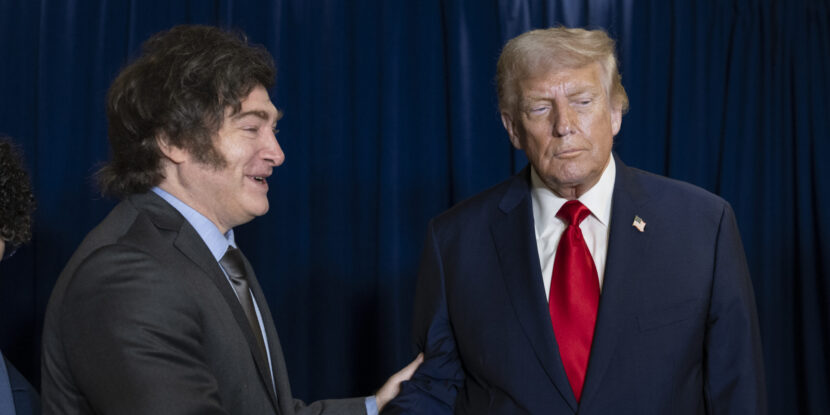
WHAT HAPPENED: Argentina’s President Javier Milei, a supposed ally of the Trump administration, appears to have done an about-face, cozying up to the Chinese Communist Party (CCP) and opening his country to a huge number of electric vehicles imported from China.

👤WHO WAS INVOLVED: Javier Milei, Chinese electric vehicle companies like BYD, U.S. President Donald J. Trump, U.S. Treasury Secretary Scott Bessent, U.S. automakers, and the Chinese Communist Party (CCP).

📍WHEN & WHERE: A shipment of 5,800 BYD-made electric and hybrid vehicles arrived in Argentina earlier this week.

🎯IMPACT: The opening of Argentina to a flood of Chinese goods is a stunning rebuke to the U.S. after President Donald J. Trump signed a $20 billion currency swap deal that stabilized the South American nation’s currency last October, ahead of critical elections for Milei’s government.

IN FULL

Argentina’s President Javier Milei, a supposed ally of the Trump administration, appears to have done an about-face, cozying up to the Chinese Communist Party (CCP) and opening his country to a large number of electric vehicles imported from China. Under Milei, Argentina has reversed a number of import restrictions, especially on cheap Chinese-made automobiles, with a Chinese cargo ship delivering a stunning 5,800 BYD-made electric and hybrid vehicles earlier this week.

The opening of Argentina to a flood of Chinese goods is a stunning rebuke of the U.S., where President Donald J. Trump signed a $20 billion currency swap deal that stabilized the South American nation’s currency last October, ahead of critical elections for Milei’s government. Notably, the Argentine currency crisis was primarily the result of a panic sparked by corruption allegations within Mielei’s own La Libertad Avanza party, which prompted investors to flee the peso.

In response to the crisis, the U.S. Treasury Department took emergency measures to help stabilize  Argentina’s economy and currency, as the country under Milei has been considered a staunch regional ally. Despite criticism from Democrats and some conservatives who viewed the aid as a bailout for a foreign nation, Trump‘s Treasury Secretary Scott Bessent stated at the time, “Argentina now has the opportunity to embrace economic freedom, and our stabilization agreement is a bridge to a better economic future for Argentina, not a bailout.”

Earlier this year, the Treasury Department announced that Argentina had repaid the funds it drew from the $20 billion currency swap. Still, President Milei effectively created a carve-out for Chinese electric vehicles, which are so cheap that they fall below Argentina’s $16,000 tariff threshold, unlike U.S. autos.

While Argentina’s under-maintained electric grid—for the moment—prevents total Chinese domination of its electric vehicle market, if improvements are made—possibly with Chinese financing—China is poised to run the table.

Join Pulse+ to comment below, and receive exclusive e-mail analyses.
show less
show more

Japan to Begin Importing U.S.-Made Toyotas Following Talks With Trump.

PULSE POINTS

WHAT HAPPENED: Toyota announced it will start importing three U.S.-made models to Japan next year.

👤WHO WAS INVOLVED: Toyota, Japanese consumers, American manufacturers, and U.S. President Donald J. Trump.

📍WHEN & WHERE: Announcement made on December 19, 2025, for action beginning next year in Japan.

💬KEY QUOTE: “They don’t take our cars, but we take MILLIONS of theirs!” – Donald Trump

🎯IMPACT: Toyota says the move is aimed at improving Japan-U.S. trade relations and addressing trade imbalance concerns.

IN FULL

Japanese automobile giant Toyota announced it will import three of its U.S.-manufactured models to Japan starting next year. The move is largely seen as a response to U.S. President Donald J. Trump’s tariff policies and concerns he has raised about America’s trade imbalance with Japan, particularly regarding the automotive market.

In April, President Trump posted on Truth Social regarding the disparity between the U.S. and Japanese auto markets, writing: “They don’t take our cars, but we take MILLIONS of theirs!” The America First leader has frequently criticized the East Asian nation for using non-tariff trade barriers, such as regulatory measures and surtaxes, to protect its domestic auto industry from U.S. competition.

According to Toyota, the U.S.-made Camry sedan, Highlander SUV, and Tundra pickup truck will be made available to Japanese consumers. The company, in a statement, said the move is meant “to meet the diverse needs of a broad range of customers, while also helping to improve Japan-U.S. trade relations.”

Toyota enjoys a significant share of the U.S. automobile market, ranking as the second-top-selling automaker. However, American-made vehicles lack a similar presence in Japan, where General Motors (GM)—the U.S. auto industry leader—saw only a few hundred sales of models from its Chevrolet and Cadillac lines in the country last year.

The National Pulse reported in May that German auto industry giant Mercedes-Benz announced it will shift additional production to the United States, with the aim of localizing the assembly of a new “core segment” vehicle at its facility in Tuscaloosa, Alabama. Like Toyota, Mercedes-Benz’s move is largely seen as a response to Trump’s tariffs.

Join Pulse+ to comment below, and receive exclusive e-mail analyses.

show less
show more

Trump Moves to Tackle Affordability Crisis With ‘Tiny Cars.’

PULSE POINTS

WHAT HAPPENED: President Donald J. Trump approved the manufacturing of “tiny cars” in the United States.

👤WHO WAS INVOLVED: President Trump, U.S. automakers, and federal regulators.

📍WHEN & WHERE: Announced on Friday via Truth Social.

💬KEY QUOTE: “They can be propelled by gasoline, electric, or hybrid. These cars of the very near future are inexpensive, safe, fuel efficient and, quite simply, AMAZING!!! START BUILDING THEM NOW!” – Donald Trump

🎯IMPACT: The decision aims to lower costs for consumers while offering new, efficient vehicle options.

IN FULL

President Donald J. Trump cleared the way on Friday for U.S. automakers to begin manufacturing “tiny cars.” The ultra-compact vehicle models are popular across Europe amd in Japan and other East Asian nations. Designed for use in urban areas with narrow streets, the Trump administration believes American car makers will be able to compete in both the domestic and Asian auto markets.

“I have just approved TINY CARS to be built in America. Manufacturers have long wanted to do this, just like they are so successfully built in other countries,” President Trump wrote in a post on Truth Social. He added: “They can be propelled by gasoline, electric, or hybrid. These cars of the very near future are inexpensive, safe, fuel efficient and, quite simply, AMAZING!!! START BUILDING THEM NOW! Thank you to the DOJ and the Departments of Transportation and Environment.”

The regulatory approval of ultra-compact vehicle models is one facet of the Trump White House’s affordability policy push ahead of the 2026 midterm elections. In recent weeks, the administration has shifted focus to domestic policy to lower costs for American consumers and provide financial relief to families.

In July, The National Pulse reported that General Motors (GM) CEO Mary Barra had announced the company was in the process of moving billions of dollars of production back into the U.S., as well as retrofitting some of its American manufacturing facilities to produce more internal combustion engine autos instead of electric vehicles. Barra emphasized that the auto giant will likely undertake additional measures beyond an already planned $4 billion U.S. production investment, citing President Trump’s tariff policies as a primary driver behind the decision.

Image by Nicolás Boullosa.

Join Pulse+ to comment below, and receive exclusive e-mail analyses.
show less
show more

Ford Recalls 115,000 Vehicles in U.S. Due to Steering Flaw.

PULSE POINTS

WHAT HAPPENED: Ford Motor Company has issued a recall for 115,539 vehicles in the U.S. due to a steering defect that could lead to the detachment of the steering column’s upper shaft.

👤WHO WAS INVOLVED: Ford Motor Company, the National Highway Traffic Safety Administration (NHTSA), and the affected models’ owners.

📍WHEN & WHERE: The issue was first reviewed on June 26, 2025, and the recall involves vehicles produced at the Kentucky Truck Plant before October 1, 2020.

🎯IMPACT: Vehicle owners will receive notifications starting October 6, 2025, with remedies expected in December. No accidents or injuries have been reported related to the defect.

IN FULL

The Ford Motor Company has announced a recall for 115,539 vehicles in the United States, prompted by concerns raised by the National Highway Traffic Safety Administration (NHTSA) over a steering defect. The defect, if present, could cause the upper shaft of the steering column to detach, significantly increasing the risk of a crash.

The recall affects the 2020-2021 Ford F-Super Duty trucks, including the F-250, F-350, and F-450 models. Concerningly, this could impact upwards of between 10 percent and 15 percent of F-series trucks sold by the automaker over that year—marking a signficant recall measure.

According to the second-largest automaker in the United States, Ford dealers will inspect and—if necessary—repair or replace the steering column’s upper shaft free of charge to vehicle owners. NHTSA noted that vehicle owners will be notified of the issue starting October 6, 2025, with a second round of notifications expected in December once a definitive remedy is in place.

The issue was first reviewed by Ford’s Critical Concern Review Group on June 26, 2025. Investigations revealed changes in the manufacturing process, with a second staking method introduced in February 2021 to improve the upper shaft’s design. Vehicles produced at the Kentucky Truck Plant before October 1, 2020, were found to have potentially defective parts. However, no accidents or injuries have been linked to the defect so far.

This recall follows several others by Ford in recent months, including one earlier in the month for 1.45 million vehicles over a defective rear-view camera system and another in August involving 355,656 light trucks with faulty instrument panel displays.

Image by Ivan Radic.

Join Pulse+ to comment below, and receive exclusive e-mail analyses.
show less
show more

Trump Tariffs Force Top Automaker to Invest Billions in U.S., Ditch Mexico.

PULSE POINTS

WHAT HAPPENED: General Motors (GM), in a letter to shareholders, said it is now in the process of shifting billions of dollars of production back into the U.S. in response to President Donald J. Trump’s tariff policies.

👤WHO WAS INVOLVED: GM CEO Mary Barra, President Trump, Mexico, and U.S. autoworkers.

📍WHEN & WHERE: The production shift was announced in a second-quarter earnings letter to GM shareholders on July 22, 2025.

💬KEY QUOTE: “In addition to our strong underlying operating performance, we are positioning the business for a profitable, long-term future as we adapt to new trade and tax policies, and a rapidly evolving tech landscape.” — GM CEO Mary Barra

🎯IMPACT: GM is now projecting it will produce more than two million of its vehicles in the U.S. each year.

IN FULL

The largest automaker in the United States says it is scaling back its manufacturing footprint abroad, especially in Mexico, and instead investing billions in its America-based facilities in response to President Donald J. Trump’s imposition of tariffs on foreign imports, including automobiles. General Motors (GM) CEO Mary Barra, in a letter to shareholders, said the company is in the process of moving billions of dollars of production back into the U.S., as well as retrofitting some of its American manufacturing facilities to produce more internal combustion engine autos instead of electric vehicles.

Barra emphasized that the auto giant will likely undertake additional measures beyond an already planned $4 billion U.S. production investment to “greatly reduce our tariff exposure.” The letter continues: “In addition to our strong underlying operating performance, we are positioning the business for a profitable, long-term future as we adapt to new trade and tax policies, and a rapidly evolving tech landscape.”

Notably, the GM CEO announced that the company is now projecting to produce more than two million of its vehicles in the U.S. each year. As part of achieving this objective, GM has begun pausing truck production at at least one of its plants in Mexico, with assembly being moved to Michigan instead. Additionally, the company says it is investing nearly $1 billion in a powertrain facility in Buffalo, New York, focusing on producing gas-powered V8 engines for its truck and sport utility vehicle lines.

GM’s Chief Financial Officer, Paul Jacobson, echoed Barra, stating: “Over time, we remain confident that our total tariff expense will come down as bilateral trade deals emerge and our sourcing and production adjustments are implemented.” Notably, while GM saw its revenue slide in the second quarter, the automaker contends this was primarily due to flagging electric vehicle sales and a recall involving a software problem with its electric vehicles as well. The automaker’s total revenue still beat Wall Street expectations.

Join Pulse+ to comment below, and receive exclusive e-mail analyses.
show less
show more

Trump Tariffs Spur General Motors to Shift Production From Mexico, Commit $4 Billion to U.S.

PULSE POINTS:

What Happened: General Motors (GM) plans to invest $4 billion in U.S. plants over the next two years, while also shifting production of two vehicle lines away from Mexico in response to President Donald J. Trump’s tariff policies.

👥 Who’s Involved: GM and its U.S.-based manufacturing plants, GM Chairwoman and CEO Mary Barra, GM President Mark Reuss, U.S. President Donald J. Trump, and Mexico.

📍 Where & When: GM announced the investment and production shift on Tuesday, June 10, 2025.

💬 Key Quote: “We believe the future of transportation will be driven by American innovation and manufacturing expertise,” GM CEO and Chairwoman Mary Barra said in a statement.

⚠️ Impact: Increased U.S. vehicle production, thousands of new jobs, and a shift of manufacturing from Mexico to the U.S.

IN FULL:

General Motors (GM) has announced a $4 billion investment plan to expand its U.S. manufacturing operations over the next two years. The move comes in response to President Donald J. Trump’s tariff policies, including a 25 percent Section 232 tariff on autos.

“We believe the future of transportation will be driven by American innovation and manufacturing expertise,” GM CEO and Chairwoman Mary Barra said in a statement. Meanwhile, the company’s president, Mark Reuss, added: “Today’s news goes well beyond the investment numbers—this is about hardworking Americans making vehicles they are proud to build and that customers are proud to own.”

The investment is expected to increase GM’s annual vehicle production capacity to over two million units and create between 3,000 and 4,000 jobs. Notably, as part of the U.S. production plan, GM will shift its production of the gas-powered Chevy Blazer and Chevy Equinox to new U.S. facilities. Additionally, some full-size SUVs and light-duty pickups, such as the Silverado, will be moved to pre-existing Michigan-based plants. All of these vehicles are currently manufactured in Mexico.

While GM has framed this as a long-term strategy, it clarified that this investment is separate from its immediate efforts to mitigate the estimated $4 to $5 billion in tariff costs expected this year.

show less

PULSE POINTS:

show more

Trump Tariffs Force Germany’s Mercedes-Benz to Shift More Production to America.

PULSE POINTS:

What Happened: Mercedes-Benz announced on Thursday, May 1, that it will shift additional production to the United States, with the aim of localizing the assembly of a new “core segment” vehicle at its facility in Tuscaloosa, Alabama.

👥 Who’s Involved: Mercedes-Benz, President Donald J. Trump, BMW, Honda, Hyundai, Kia, Nissan, Stellantis, Toyota.

📍 Where & When: The announcement was made on May 1, 2025, with plans to have production of the “core segment” vehicle entirely moved to Alabama by 2027.

💬 Key Quote: In a statement announcing the move, Mercedes-Benz North America CEO Jason Hoff said: “We are getting even closer to the U.S. customer by localizing a core segment model in Tuscaloosa, strengthening our ties to the North American market where a range of Mercedes-Benz vehicles including the GLE and GLS models have their roots.”

⚠️ Impact: The move by Mercedes-Benz is the latest announcement by a major global corporation that it intends to increase its production base in the United States following President Trump’s imposition of a global 10 percent tariff on all foreign imports and additional trade duties on foreign steel and automobiles last month.

IN FULL:

Mercedes-Benz is set to expand its manufacturing operations in the United States, as the company plans to produce an additional vehicle at its Tuscaloosa, Alabama, facility. This move comes amid the Trump administration’s emphasis on bolstering American manufacturing, urging automakers to enhance their domestic production efforts to avoid tariffs imposed on foreign auto and steel imports earlier this year.

“We are getting even closer to the U.S. customer by localizing a core segment model in Tuscaloosa, strengthening our ties to the North American market where a range of Mercedes-Benz vehicles including the GLE and GLS models have their roots,” Mercedes-Benz North America CEO Jason Hoff said in a statement announcing the move on Thursday.

The decision aligns with other shifts in the automotive industry toward onshoring production. BMW is contemplating increasing its workforce in South Carolina with additional shifts. Honda intends to transfer production of its Civic model from Japan to U.S. facilities. Additionally, Hyundai has announced a significant $20 billion investment aimed at strengthening its American production capabilities. This includes a new $5.8 billion steel plant in Louisiana, aiding in Hyundai’s goal of localizing production in the United States.

Kia, in collaboration with Hyundai, plans to manufacture hybrid vehicles in Georgia. Nissan is evaluating the possibility of moving production from Mexico to the U.S. Additionally, Stellantis is set to restart its Belvidere, Illinois plant to produce a midsize pickup truck, while Toyota intends to increase hybrid vehicle production at its West Virginia facility.

The National Pulse reported earlier on Thursday that satellite radio provider SiriusXM told investors on its quarterly earnings call that it does not anticipate tariffs to significantly impact the company’s revenue. Notably, SiriusXM is heavily reliant on new car sales to build its subscriber base, holding installation agreements with most U.S. automakers.

show less

PULSE POINTS:

show more

SiriusXM CFO Dismisses Tariff Concerns on Earnings Call: ‘We Sleep Well at Night.’

PULSE POINTS:

What Happened: SiriusXM reported a decrease in first-quarter revenue and subscribers. Despite this, CFO Tom Barry indicated that the company is not significantly impacted by tariff-related pressures on car sales. Notably, in 2024, an estimated 92.7 percent of SiriusXM’s revenue came from subscriptions to its satellite radio service, a large portion of which is tied to installation deals with much of the American automobile industry.

👥 Who’s Involved: SiriusXM, CFO Tom Barry, CEO Jennifer Wirtz, and the Trump White House.

📍 Where & When: The quarterly revenue numbers and comments regarding tariff impacts were revealed on May 1 during SiriusXM’s earnings call.

💬 Key Quote: “Big picture, we sleep well at night,” Barry said, noting the company had not seen a significant negative impact on auto sales stemming from President Donald J. Trump’s imposition of tariffs on foreign imports earlier this year.

⚠️ Impact: SiriusXM’s unique business model, heavily reliant on new car sales and installment contracts with automobile manufacturers, makes the company especially vulnerable to disruptions impacting the auto industry. The comments from company executives indicating that they see tariffs having only a minimal impact on revenue suggest negative economic forecasts pushed by Wall Street may be overblown.

IN FULL:

Executives with SiriusXM, the satellite radio provider, stated during a quarterly earnings call on Thursday that they do not believe the foreign import tariffs imposed by President Donald J. Trump will significantly impact the company’s revenue. The comments are notable as SiriusXM is heavily reliant on revenue derived from subscribers to its satellite radio service, which is pre-installed in many American automobiles.

During the Thursday morning earnings call, SiriusXM CFO Tom Barry stated that the company does not anticipate “that tariff-related pressure on new car sales will have a material impact on our subscriber or financial performance this year.” While Barry cautioned that “like every business, we’ll continue to closely monitor ongoing developments and broader consumer health,” he emphasized to investors, “Big picture, we sleep well at night.”

While SiriusXM did state that its revenue decreased in the first quarter of 2025 by four percent, to slightly over $2 billion, Barry and the company’s CEO, Jennifer Wirtz, stressed that lower-than-expected advertising profits drove the decline. The satellite radio provider’s business model is heavily reliant on new car sales and installment contracts with automakers to grow its subscriber base. In 2024, an estimated 92.7 percent of SiriusXM’s revenue came from subscriptions to its satellite radio service, a large portion of which is tied to the installation deals with much of the American automobile industry.

The confidence expressed by the SiriusXM executives that the Trump administration tariffs will have minimal impact on their future earnings contrasts with the narrative being pushed by economic analysis on Wall Street, which continues to forecast a high likelihood of a recession later this year. Notably, the outlook presented by Barry mirrors consumer data that suggests the U.S. economy remains steady despite a 0.3 percent contraction in GDP in the first quarter announced on Wednesday.

Image by Thomson200.

show less

PULSE POINTS:

show more

Trump Secures $21 Billion Hyundai Investment, New Steel Mill Planned.

President Donald J. Trump’s tariff policies have secured a major investment from Korean automaker Hyundai. At least $5.8 billion will be invested in a new steel plant in Louisiana. Announced Monday, March 24, the endeavor is part of a broader commitment by the South Korean automaker, which plans to channel $21 billion into various U.S. projects over the next few years.

The new plant is forecast to produce 2.7 million metric tons of steel annually. It will also provide over 1,400 jobs, bolstering local employment. According to President Trump, this facility marks Hyundai’s inaugural steel production venture on U.S. soil and will support its automotive manufacturing operations in Alabama and Georgia.

Trump linked Hyundai’s hefty investment to the efficacy of U.S. tariff policies, suggesting that these duties have played a pivotal role in attracting foreign manufacturing and investment. He highlighted that Hyundai’s future output would be cultivated on American ground, thus bypassing any tariffs that would apply if production were based overseas.

Further details provided by President Trump indicated significant expansions for Hyundai beyond just the steel sector. The carmaker intends to amplify its automobile manufacturing capabilities in Georgia and propel investments into cutting-edge U.S. tech enterprises.

President Trump’s tariffs are expected to come into full effect on April 2, a day the President has referred to as “Liberation Day.” He also called for the Federal Reserve to cut interest rates as the tariffs come into force, arguing it would ease the transition of the American economy.

WATCH:

Image by Gage Skidmore.

show less
President Donald J. Trump's tariff policies have secured a major investment from Korean automaker Hyundai. At least $5.8 billion will be invested in a new steel plant in Louisiana. Announced Monday, March 24, the endeavor is part of a broader commitment by the South Korean automaker, which plans to channel $21 billion into various U.S. projects over the next few years. show more

Trump Says EU’s Purpose Is to ‘Screw’ the United States, Announces Upcoming Tariffs.

President Donald J. Trump has stated that the purpose of the European Union (EU) is to “screw the United States,” announcing a decision has been made to enact a 25 percent tariff on automobiles and other products imported from the bloc. Speaking to reporters during the first meeting of his new Cabinet, the President said, “They don’t accept our cars, they don’t essentially accept our farm products; they use all sorts of reasons why not.”

Trump explained that he loves the countries of Europe, recognizing his own European ancestry, but that the U.S. has a deficit of around $300 billion with the EU. “It was formed to screw the United States; I mean, let’s be honest,” Trump said. “And they’ve done a good job of it. But now, I’m President.”

When asked about potential retaliation from the EU, Trump stated, “They can’t. I mean, they can try, but they can’t.”

President Trump also announced that tariffs against Canada and Mexico are set to be enacted on April 2— although they may be delayed again. The tariffs were previously delayed when both Canada and Mexico vowed to do more to tackle border issues, including the trafficking of the deadly drug fentanyl.

WATCH:

show less
President Donald J. Trump has stated that the purpose of the European Union (EU) is to "screw the United States," announcing a decision has been made to enact a 25 percent tariff on automobiles and other products imported from the bloc. Speaking to reporters during the first meeting of his new Cabinet, the President said, "They don't accept our cars, they don't essentially accept our farm products; they use all sorts of reasons why not." show more