



Monday, February 23, 2026

Trump Says He Will Impose Tariffs on the EU ‘Soon.’

President Donald J. Trump has signaled the possibility of imposing tariffs on European Union (EU) imports following similar actions against Canada and China. Tariffs on Mexico, originally part of the same executive order addressing Canada and China, were delayed by one month on Monday after Mexico’s President Claudia Sheinbaum announced she would send 10,000 Mexican National Guard to help secure and prevent the flow of fentanyl over the U.S. southern border.

Speaking with the press in Maryland as he returned to the White House from a brief trip to Florida, Trump said the imposition of tariffs on the EU could happen “pretty soon.” While the measures enacted against Canada—and potentially Mexico—are aimed at pushing the two countries neighboring America to crack down on the cross-border illicit drug trade and illegal immigration, tariffs against the EU would be more likely intended to end its trade imbalance with the U.S. in the automobile and agricultural sectors.

“They don’t take our cars, they don’t take our farm products, they take almost nothing and we take everything from them. Millions of cars, tremendous amounts of food and farm products,” President Trump said, clarifying that the United Kingdom would likely not face similar measures as the EU thanks to Brexit. While the President does contend that some British trade practices are “out of line,” he emphasized that a trade deal with Prime Minister Keir Starmer can be worked out.

EIGHTY YEARS OF UNFAIR TRADE. 

The EU has expressed strong opposition to Trump’s tariff strategies against Canada, Mexico, and China, promising a response if targeted. Notably, the United States has a significant trade deficit with the EU’s leading economy, Germany.

Since the end of World War II, the American government has allowed Germany to maintain high tariffs on U.S. automobiles and steel without retaliation. The policy—established under the Marshall Plan in 1948—was intended to rebuild the German economy and prevent it from falling under the influence of the Soviet Union.

Today, the German economy is the largest in Europe and the third-largest in the world, and the Soviet Union no longer exists.

Image by Burçak Pekin.

show less
President Donald J. Trump has signaled the possibility of imposing tariffs on European Union (EU) imports following similar actions against Canada and China. Tariffs on Mexico, originally part of the same executive order addressing Canada and China, were delayed by one month on Monday after Mexico's President Claudia Sheinbaum announced she would send 10,000 Mexican National Guard to help secure and prevent the flow of fentanyl over the U.S. southern border. show more
China Spying

U.S. to Prohibit Russian, Chinese Tech in Vehicles.

The United States will prohibit the use of software from Russia and China in passenger vehicles, citing national security threats, the Department of Commerce announced on Tuesday. According to the Department’s Bureau of Industry and Security—a subagency tasked with monitoring national security threats posed by foreign-produced materials—the technologies from China and Russia pose significant risks to the security of American citizens, as well as government and military officials.

Published in the federal register, the ban applies to software for vehicles model year 2027 and hardware for model year 2030. While enacted by the outgoing Biden government, the move underscores incoming President Donald J. Trump’s call for building robust domestic semiconductor and automotive industries. The Commerce Department emphasized the necessity of the measure given the advanced technological capabilities embedded in modern vehicles, such as cameras, microphones, and GPS systems. When connected to the Internet, these technologies could be exploited by foreign adversaries to access sensitive information, among other concerning issues.

The rule specifically targets technologies within the Vehicle Connectivity System (VCS) and the Automated Driving System (ADS). According to the Commerce Department, these technologies pose unacceptable security risks if developed or manufactured by entities linked to the People’s Republic of China or Russia. Additionally, the rule forbids the sale of new connected vehicles incorporating the foreign hardware or software in the U.S., even if assembled domestically. Commercial vehicles will be addressed in a separate and pending regulation.

Recent cybersecurity threats, such as activities associated with the Chinese Communist Party (CCP) sponsored Volt Typhoon group, have underscored the urgency for preventive steps. Officials warned that with numerous connected vehicles expected on the roads, the potential for sabotage and data breaches increases significantly due to the extensive personal data collected by these vehicles.

show less
The United States will prohibit the use of software from Russia and China in passenger vehicles, citing national security threats, the Department of Commerce announced on Tuesday. According to the Department's Bureau of Industry and Security—a subagency tasked with monitoring national security threats posed by foreign-produced materials—the technologies from China and Russia pose significant risks to the security of American citizens, as well as government and military officials. show more

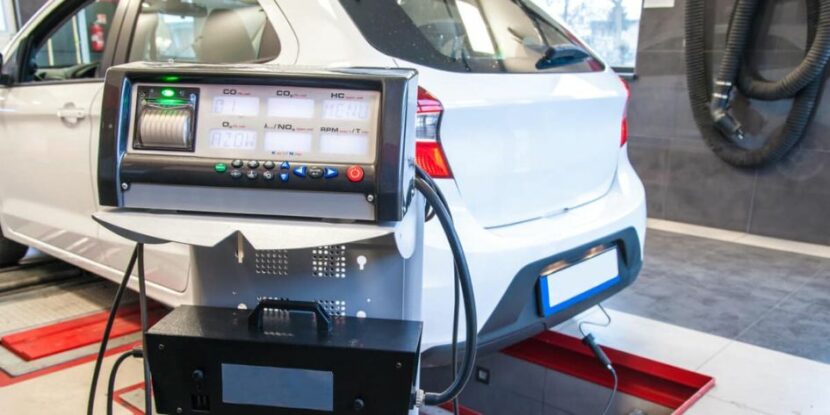
Biden Govt Set To Roll Out Industry Crippling Auto Emission Standards.

President Joe Biden is pushing forward with his green agenda, reportedly preparing to introduce strict emissions restrictions that could — in essence — compel electric vehicle (EV) sales. The Environmental Protection Agency looks set to implement regulations the Biden government surmises could propel EVs to account for roughly two-thirds of new car and light truck sales by 2032, a notable increase from less than 10 percent last year. Such measures aim to reduce pollution and CO2 emissions and align with the U.S.’ commitment to the Paris Agreement, which proposes significantly lowering greenhouse gas emissions by 2030.

The transportation sector remains the United States’ most significant contributor to climate pollution. Manish Bapna, chief of the Natural Resources Defense Action Fund, suggested that reducing transportation’s 20 percent carbon footprint is essential to achieving “real, concrete progress.”

However, the President will have to navigate new emission regulations amidst resistance from Michigan voters and auto industry workers who are cautious of an abrupt shift to EVs. American automakers emphasize that these EV targets are unachievable without improved charging infrastructure. Auto industry economists note that the rising labor costs combined with the need for expensive EV infrastructure make electric vehicles less attractive to consumers at price points. The high costs may pressure the EPA to back down and establish more moderate emission reduction goals in the short term, though still targeting the same 2032 objectives.

show less
President Joe Biden is pushing forward with his green agenda, reportedly preparing to introduce strict emissions restrictions that could — in essence — compel electric vehicle (EV) sales. The Environmental Protection Agency looks set to implement regulations the Biden government surmises could propel EVs to account for roughly two-thirds of new car and light truck sales by 2032, a notable increase from less than 10 percent last year. Such measures aim to reduce pollution and CO2 emissions and align with the U.S.’ commitment to the Paris Agreement, which proposes significantly lowering greenhouse gas emissions by 2030. show more

The ‘Bloodbath’ Hoax.

Legacy media outlets alongside Joe Biden’s presidential campaign are peddling a fresh hoax about the 45th President, Donald Trump, after a rally speech in Ohio on Saturday.

During the address, Trump remarked there would be a “bloodbath” in the car manufacturing industry if Joe Biden were to be re-elected. POLITICO and others immediately began misrepresenting the comments, claiming “it was unclear what the former president meant exactly,” while the Biden campaign falsely accused the former president of “doubl[ing] down on his threats of political violence.”

Trump was clearly referring to a looming economic bloodbath for the American car industry, with it being impossible to interpret his comments any other way without malice.

“China now is building a couple of massive plants where they’re going to build the cars in Mexico… they think that they’re going to sell those cars into the United States with no tax at the border,” Trump said during his speech in Ohio.

“[I]f you’re listening, President Xi – and you and I are friends, but he understands the way I deal – those big monster car manufacturing plants that you’re building in Mexico right now, and you think… you’re going to not hire Americans and you’re going to sell the cars to us? No,” he pledged.

“We’re going to put a 100 percent tariff on every single car that comes across the line, and you’re not going be able to sell those cars – if I get elected,” Trump explained. “Now, if I don’t get elected, it’s going to be a bloodbath,” he added.

The 45th President was, therefore, clearly referring to an economic bloodbath, in line with one of the dictionary definitions of the term, and not political violence, as Biden and the media alleged.

On Sunday morning, former Speaker Nancy Pelosi peddled the hoax, unchallenged, on CNN, even claiming Trump said he would “exact a bloodbath” if he wasn’t re-elected.

Jack Montgomery contributed to this article.

show less
Legacy media outlets alongside Joe Biden’s presidential campaign are peddling a fresh hoax about the 45th President, Donald Trump, after a rally speech in Ohio on Saturday. show more
uaw

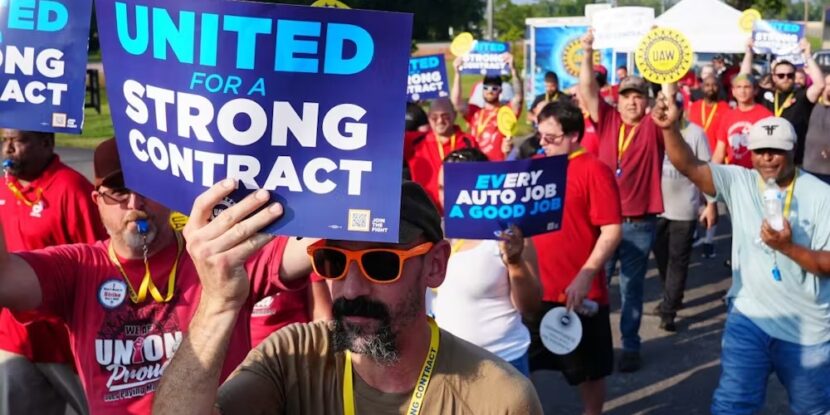
United Automobile Workers Strike Against Ford, General Motors, and Stellantis.

United Automobile Workers (UAW) members are taking unprecedented strike action against Ford, General Motors, and Stellantis at three plants across the Midwest, demanding wage increases on par with recent hikes in compensation for the chief executives of the three automakers as inflation bites.

Thousands of workers are striking at plants in Michigan, Missouri, and Ohio as bosses remain at loggerheads with UAW president Shawn Fain, offering workers roughly half the wage increase he is demanding and rejecting his other proposals on healthcare, pensions, and other issues of concern outright.

UAW workers have never downed tools at plants for all three companies at once, but the strikes are still targeted fairly narrowly, with the vast majority of the 150,000 unionized workers for the automakers continuing to work elsewhere – at least for now.

The prospect of a broader strike is worriesome for Joe Biden, who claims to be the “most pro-union president in American history,” especially as the UAW has not yet endorsed him for 2024 and members seem dissatisfied with his efforts – or lack thereof – to resolve the dispute.

“I don’t know what he’s done,” remarked Garry Quick Quick, UAW president in Fain’s hometown of Kokomo, Indiana.

“Ask him. I don’t think he knows what he’s done. Seriously. I’m not trying to be mean,” Quick added.

show less
United Automobile Workers (UAW) members are taking unprecedented strike action against Ford, General Motors, and Stellantis at three plants across the Midwest, demanding wage increases on par with recent hikes in compensation for the chief executives of the three automakers as inflation bites. show more