



Monday, February 23, 2026

29 Million Early Mail-In and In-Person Votes Already Cast.

Around 29 million Americans have now cast early votes, either in-person or by mail. Data company TargetSmart reports that 43 percent of early voters so far are registered Democrats, 39 percent are Republicans, and 18 percent are not aligned with the two major parties.

While early voting does favor the Democrats slightly overall, other sources indicate Vice President Kamala Harris’s party is doing a worse job turning out supporters in battleground states than in previous elections, while Republicans are turning out much stronger for former President Donald J. Trump.

CNN—using data from Catalist, election officials, and Edison Research—notes that at this point in the 2020 election, early votes in Pennsylvania were 71 percent Democratic and 20 percent Republican. This year, the Democrats have dropped to 61 percent, and the GOP has risen to 29 percent.

Meanwhile, the Democratic advantage has vanished in North Carolina. In 2020, they led the GOP on 40 percent to 28 percent; now, the parties are tied at 34 percent.

Conversely, the GOP now leads early voting in Arizona and Nevada, accounting for 42 percent and 38 percent of early voters, respectively. Democrats sit at 36 percent in both states. At this point in 2020, the Democrats led Republicans in both states, 42 percent to 34 percent and 44 percent to 33 percent.

Local media in Nevada report an “unheard of” advantage for Republicans in early in-person voting, and the GOP is also said to be ahead in mail-in votes—traditionally a Democrat strength—in North Carolina. Early voting is also taking place in Georgia, Michigan, and Wisconsin, but information on the party registration of early voters in those swing states is not available.
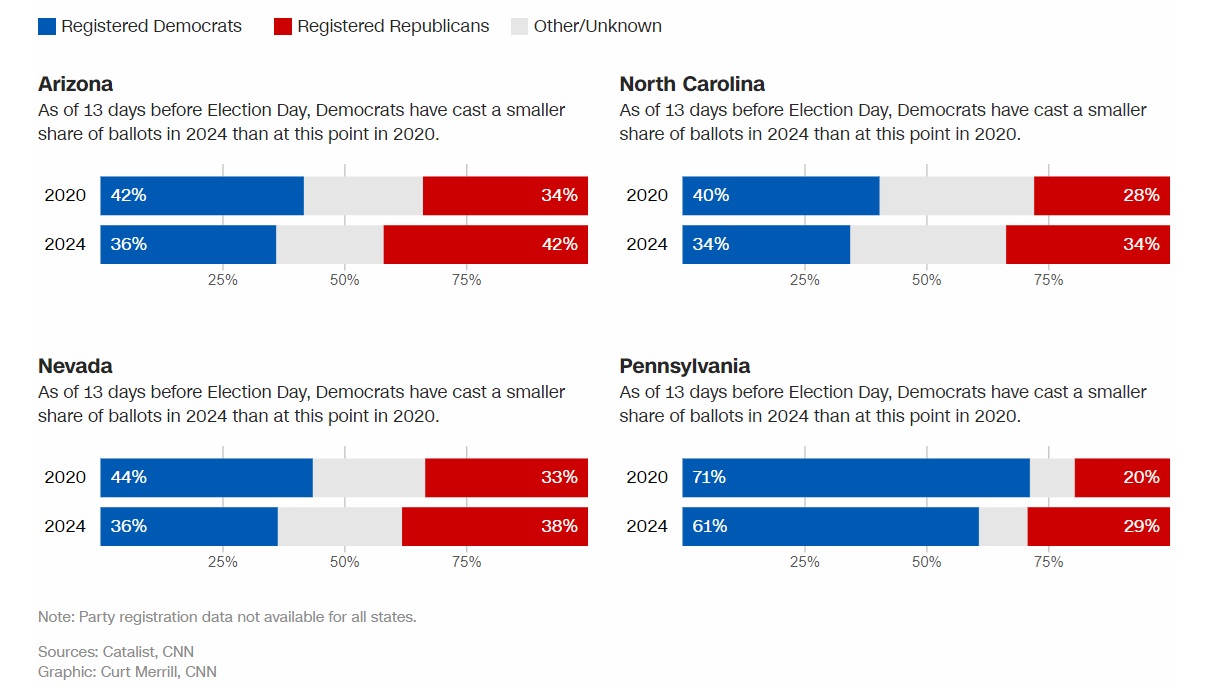
Source: CNN.
show less
Around 29 million Americans have now cast early votes, either in-person or by mail. Data company TargetSmart reports that 43 percent of early voters so far are registered Democrats, 39 percent are Republicans, and 18 percent are not aligned with the two major parties. show more

Slick Willie Emerges for Kamala.

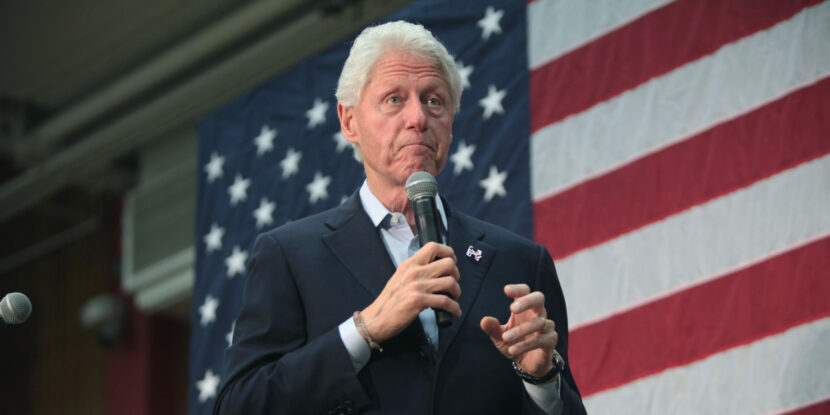
Vice President Kamala Harris’s 2024 presidential campaign is enlisting the support of former U.S. President Bill Clinton, also known as ‘Slick Willie,’ in another attempt to lure back male voters who are abandoning the Democratic Party in droves. The sobriquet was also used by Harris’s old lover and once-San Francisco Mayor, Willie Brown, who gave the Vice President her start in politics via a sexual relationship.

In recent weeks, support for the Harris campaign appears to have stalled out—with rural men and young black men becoming increasingly turned off by the Democratic Party nominee.

Hoping to turn around her prospects—especially among male voters—Harris has been forced to turn to former President Clinton and former President Barack Obama, as well as Senator John Fetterman (D-PA), to act as campaign surrogates in critical swing states. The move comes after failed attempts by the 2024 Democratic Party’s vice presidential nominee, Governor Tim Walz (D-MN), and Second Gentleman Doug Emhoff to win over crucial male support.

Former President Clinton’s activities begin in Georgia this Sunday and Monday, followed by a bus tour in North Carolina, contingent on recovery from recent hurricanes. The campaign’s focus targets counties previously won by President Donald J. Trump. Clinton, 78, aims to reengage voters who supported him during his successful 1992 presidential bid when he carried Georgia.

Unlike conventional rallies, Clinton will attend local fairs and porch gatherings, speaking to smaller crowds, reminiscent of his early campaign style from the 1992 New Hampshire primary. Economic topics will be at the forefront of Clinton’s discussions, in alignment with themes he has emphasized since the Democratic National Convention (DNC) this past summer.

The campaign tour by the former president mirrors a smaller initiative in Pennsylvania spearheaded by Sen. Fetterman. The National Pulse previously reported that Fetterman will attend over a half dozen events across rural Pennsylvania in the final weeks before the election.

Image by Gage Skidmore.

show less
Vice President Kamala Harris's 2024 presidential campaign is enlisting the support of former U.S. President Bill Clinton, also known as 'Slick Willie,' in another attempt to lure back male voters who are abandoning the Democratic Party in droves. The sobriquet was also used by Harris's old lover and once-San Francisco Mayor, Willie Brown, who gave the Vice President her start in politics via a sexual relationship. show more

The RCP Polling Average Gives Trump a Landslide Win.

With less than 30 days until the 2024 presidential election, one major polling average suggests former President Donald J. Trump is on pace for an Electoral College landslide victory over Vice President Kamala Harris. According to the polling aggregates compiled by RealClearPolitics (RCP), Trump holds the edge in five of the seven critical battleground states.

The data, comprised of an average of publically available presidential race polling in each state, shows Trump leading Harris in Georgia by 1.5 percent, Arizona by 1.4 percent, North Carolina by 0.6 percent, Michigan by 0.5 percent, and Pennsylvania by 0.2 percent. Harris, meanwhile, leads Trump in Nevada and Wisconsin by 1.1 percent and 0.6 percent, respectively.

While the RCP average suggests Trump is on pace to win just shy of 300 electoral votes, the razor-thin margins in all seven states indicate the race remains statistically a toss-up between the two candidates. Despite an early surge in support following her entry into the 2024 race after President Biden was pressured out of seeking re-election, Harris’s polling numbers have plateaued in recent weeks.

The Vice President has struggled to consolidate support among both young and working-class voters. According to recent data released by the Teamsters Union, its members are breaking for Trump over Harris by a two-to-one ratio. In Pennsylvania, almost 50 percent of the state’s male population has just a high school diploma or less—often indicative of a working-class background.

Another deciding factor in the 2024 presidential election is likely to be the Hispanic vote. Trump is making significant gains among this critical demographic, especially among Hispanic men. The 2020 census indicates that Hispanics make up about 30 percent of the population in both Arizona and Nevada.

Image by Gage Skidmore.

show less
With less than 30 days until the 2024 presidential election, one major polling average suggests former President Donald J. Trump is on pace for an Electoral College landslide victory over Vice President Kamala Harris. According to the polling aggregates compiled by RealClearPolitics (RCP), Trump holds the edge in five of the seven critical battleground states. show more

Govt Dependence is Skyrocketing in U.S. Swing States.

American dependence on government assistance has skyrocketed in recent years, especially in critical 2024 battleground states. According to new data from the Economic Innovation Group, government assistance is now crucial for residents in 70 percent of counties in Georgia, Michigan, and North Carolina. In Pennsylvania, 60 percent of counties are reliant on government spending programs.

Reliance on government aid has increased exponentially over the past two decades, with 53 percent of counties nationwide now drawing a bulk of their income from government spending. Just 10 percent of counties were reliant on government spending in the year 2000.

Social safety net programs like Social Security, SNAP, Medicare, and Medicaid account for most of the assistance, with the increased reliance driven—in part—by the aging U.S. population. As more members of the Baby Boomer generation retire from the workforce, these programs will continue to see their budgets balloon.

Additionally, the concentration of high-salaried workers in major U.S. cities is compounding the problem. Almost all of the counties reliant on government aid are rural or recently de-industrialized through outsourcing. This has resulted in American wealth becoming concentrated in just a few major cities.

Runaway healthcare costs are also a contributing factor. According to the Economic Innovation Group report, medical costs “have risen nearly twice as quickly as overall inflation over the past several decades.”

The overreliance on government assistance programs among critical election demographics in battleground states could make tackling the country’s ballooning deficit a politically fraught decision for either major U.S. political party. “Significantly raising taxes and dramatically cutting… programs could choke off the very economic activity that finances [them] and immiserate the lives of people who depend on them,” the report notes.

show less
American dependence on government assistance has skyrocketed in recent years, especially in critical 2024 battleground states. According to new data from the Economic Innovation Group, government assistance is now crucial for residents in 70 percent of counties in Georgia, Michigan, and North Carolina. In Pennsylvania, 60 percent of counties are reliant on government spending programs. show more

Dem-Run Swing States Are Refusing Take RFK off The Ballot.

Robert F. Kennedy Jr. has withdrawn from the presidential race in key states and endorsed former President Donald J. Trump. However, there is resistance to removing his name from ballots in several Democrat-run states. The pivotal swing states of Michigan, Wisconsin, and Colorado are all declining to remove his name.

In Michigan, officials claim it is too late for Kennedy to withdraw as the nominee of the Natural Law Party. “Minor party candidates cannot withdraw, so his name will remain on the ballot in the November election,” insists the spokeswoman for Michigan Secretary of State Jocelyn Benson, a China-linked Democrat.

Wisconsin’s Elections Commission also voted 5-1 on Tuesday against removing Kennedy’s name.

Colorado, too, refuses to remove the independent candidate from the state ballot. However, it is less of a true swing state than Michigan or Wisconsin, leaning fairly decisively toward the Democrats.

However, Nevada is allowing Kennedy to remove his name—following an agreement between his legal team and Democratic National Committee (DNC) lawyers who had been suing to take him off the ballot. Kennedy’s name is also being removed from ballots in Arizona, Pennsylvania, Florida, Texas, and Ohio.

North Carolina remains a state to watch. According to Patrick Gannon, the North Carolina State Board of Elections’ Public Information Officer, Kennedy has been nominated by the We The People Party. Gannon says that if the party withdraws Kennedy’s nomination, officialmustto assess the feasibility of reprinting ballots, with nearly a third of the state’s counties already beginning the printing process.

Nicole Shanahan, Kennedy’s running mate, criticized Democrats in an interview on Tuesday, expressing disappointment with the party’s treatment of Kennedy and saying it had lost its moral compass.

Image by Gage Skidmore.

show less
Robert F. Kennedy Jr. has withdrawn from the presidential race in key states and endorsed former President Donald J. Trump. However, there is resistance to removing his name from ballots in several Democrat-run states. The pivotal swing states of Michigan, Wisconsin, and Colorado are all declining to remove his name. show more

Here’s How RFK’s Trump Endorsement Impacts the Battleground States.

New election data released by Trump pollster Tony Fabrizio indicates that Robert F. Kennedy Jr.’s suspension of his independent presidential bid in around ten battleground states—and endorsement of former President Donald J. Trump—will likely boost the Republican ticket. Additionally, Fabrizio’s polling data confirms suspicions that Kennedy drew more votes from the former Republican President than from either of the Democratic Party nominees, formerly Joe Biden and now Kamala Harris.

The data, drawn from the Trump pollster’s most recent survey of battleground states, shows RFK Jr. capturing five percent of the vote in Arizona, three percent of the vote in Georgia and North Carolina, and four percent in NevadaMichiganPennsylvania, and Wisconsin. In all seven states, the polling shows RFK Jr. supporters breaking by about a two-to-one ratio for former President Trump over Democratic Party nominee Kamala Harris.

In Arizona, RFK Jr. supporters break for Trump by 53 percent to Harris’s 28 percent, with 19 percent undecided. The results are a bit closer in Georgia, with Trump‘s net gain over Harris among RFK Jr. voters only being 13 percent, and in Michigan, the net gain is only two percent. In the remaining four states of North Carolina, Nevada, Pennslyvania, and Wisconsin, RFK Jr. voters break for Trump between 16 and 21 percent.

While the vote share may seem small, each of these battlegrounds could be decided on the narrowest of margins. According to the RealClearPolitics polling average for top battleground states, Trump leads Harris by just 0.2 percent in Arizona, by 1.4 percent in Nevada, by 0.2 percent in Pennsylvania, by 0.9 percent in North Carolina, and by just one percent in Georgia. Meanwhile, Harris leads Trump by one percent in Wisconsin and two percent in Michigan.

READ: 

show less
New election data released by Trump pollster Tony Fabrizio indicates that Robert F. Kennedy Jr.'s suspension of his independent presidential bid in around ten battleground states—and endorsement of former President Donald J. Trump—will likely boost the Republican ticket. Additionally, Fabrizio's polling data confirms suspicions that Kennedy drew more votes from the former Republican President than from either of the Democratic Party nominees, formerly Joe Biden and now Kamala Harris. show more

Editor’s Notes

Behind-the-scenes political intrigue exclusively for Pulse+ subscribers.

RAHEEM J. KASSAM Editor-in-Chief
This is a real coup, in no small part thanks to the long-standing work of Stephen K
This is a real coup, in no small part thanks to the long-standing work of Stephen K show more
for exclusive members-only insights

Trump Leads in 5 Key Battlegrounds as Young, Nonwhites Abandon Biden.

A recent collection of polls by The New York Times, Siena College, and The Philadelphia Inquirer revealed that Donald J. Trump leads over President Biden in five major battleground states. The shifting political landscape likely stems from concerns over economic conditions and the situation in Gaza among younger, Black, and Hispanic voters, potentially disrupting the Democratic coalition that bolstered Biden in 2020.

The polls indicate that in a head-to-head scenario, more voters in Michigan, Arizona, Nevada, Georgia, and Pennsylvania would vote for Trump, with Biden leading only in Wisconsin among the six states surveyed. However, Biden’s margin increases slightly among likely voters, where he manages a slim lead over Mr. Trump in Michigan while reducing his deficit in Wisconsin and Pennsylvania.

Despite winning all six states in 2020, the surveys suggest a considerably tighter race for President Biden’s reelection campaign, emphasizing the importance of victories in Pennsylvania, Michigan, and Wisconsin, alongside maintaining his 2020 map elsewhere.

The minor-party candidates and independent contender Robert F. Kennedy Jr. received an average of 10 percent of the votes across the six states, drawing relatively equally from both major-party candidates. This reveals another variable to consider in the upcoming presidential race, possibly influencing the final outcomes in these crucial states.

Younger and minority voters are increasingly abandoning their support of Biden. This exodus is primarily driven by Biden’s performance on the economy and previous strong support for Israel in its war against Hamas in Gaza. Although the Biden regime has lately reversed its position on Israel in an attempt to woo those voters, the recent polls suggest that the U-turn is not having its desired effect.

show less
A recent collection of polls by The New York Times, Siena College, and The Philadelphia Inquirer revealed that Donald J. Trump leads over President Biden in five major battleground states. The shifting political landscape likely stems from concerns over economic conditions and the situation in Gaza among younger, Black, and Hispanic voters, potentially disrupting the Democratic coalition that bolstered Biden in 2020. show more
trump biden

DATA: Trump Gets Bump In 5 Crucial Battleground States.

Former President Donald Trump is now ahead in key battleground states, surpassing Joe Biden in recent polls released on Wednesday, indicating a swing in political momentum. According to the latest Bloomberg/Morning Consult poll, Trump’s lead, already evident in Arizona, Nevada, and North Carolina since March, has expanded. Additionally, Trump is now also leading in Pennsylvania and Wisconsin.

Trump’s lead has extended to six points in a head-to-head comparison between the two in Michigan and seven other swing states. The polled margins put Trump one point ahead in Pennsylvania, four points in Wisconsin, six in Georgia, seven in Arizona, eight in Nevada, and ten in North Carolina.

Conversely, Biden remains in the lead in Michigan by a slight margin of two points. This lead, however, has slimmed since March when both candidates were tied. The economy stands as the most imperative issue to voters, with 51 percent of the respondents signaling their concern about its worsening state by year-end.

Survey takers also had far more faith in Trump’s economic management, with the former president having a 16-point lead when voters were asked under whose administration the U.S. economy was better. A survey released earlier this month revealed that over half of Americans rate Biden’s economy as “poor.”

show less
Former President Donald Trump is now ahead in key battleground states, surpassing Joe Biden in recent polls released on Wednesday, indicating a swing in political momentum. According to the latest Bloomberg/Morning Consult poll, Trump’s lead, already evident in Arizona, Nevada, and North Carolina since March, has expanded. Additionally, Trump is now also leading in Pennsylvania and Wisconsin. show more