❓WHAT HAPPENED: Authorities in Belgium arrested three people plotting a jihadist-inspired attack using drone-mounted explosives.
👤WHO WAS INVOLVED: Three young adults were arrested, with Prime Minister Bart De Wever among the potential targets.
📍WHEN & WHERE: Arrests occurred in Antwerp, Belgium, and were announced on Thursday, October 9, 2025.
💬KEY QUOTE: “Drones are a big problem. Islamism is too, but we’ve known that for a while.” – Belgian Defense Minister Theo Francken
🎯IMPACT: The plot highlights the ongoing threat of Islamic terrorism and the potential misuse of drones in major Western cities.
IN FULL
Belgian authorities have arrested three suspects in Antwerp suspected of planning a jihadist-inspired attack involving drone-mounted explosives. The suspects were detained as part of an investigation into what federal prosecutors described as “attempted terrorist murder and participation in the activities of a terrorist group.”
Federal prosecutor Ann Fransen confirmed the arrests but did not provide details on the intended targets. However, Belgian newspaper Nieuwsblad reported that Prime Minister Bart De Wever was among those intended to be targeted in the attack.
During a search of one suspect’s residence, investigators discovered an improvised explosive device. At another location, a 3D printer was found, which is believed to have been used to produce parts for the planned attack.
Two suspects are currently being held for questioning by federal police and are expected to appear before an investigating judge. The third has been released. The alleged plan involved using drones to carry out attacks, raising alarms about the growing use of drones in terrorism.
Belgium’s defence minister, Theo Francken, responded to the news by posting on X, “Drones are a big problem. Islamism is too, but we’ve known that for a while.” His comments reflect broader concerns in Belgium, which has faced a series of high-profile terrorism cases in recent years. In 2023, for instance, a radicalized gunman killed two Swedish soccer fans in Brussels before being shot dead by police. The country has also seen instances of extremist rhetoric in public, including a rally in which an Islamist preacher shouted, “Allah, burn the Jews.”
The use of drones in terror plots is part of a growing trend worldwide. In the Sahel region of Africa, al-Qaeda-linked militants have carried out dozens of attacks using commercially available drones modified to carry explosives. Similarly, in Mexico, drug cartels have increasingly adopted drones as tools for both surveillance and combat, with hundreds of bomb-dropping drone attacks recorded over the past year. Cartels have even developed specialized drone units and first-person view (FPV) drone systems capable of precision strikes.
A rally marking the anniversary of the October 7 massacres in Israel in the heart of the European Union (EU) saw an unidentified Islamist preacher allegedly yell, “Allah, burn the Jews!” The rally, which took place on October 7 in the EU capital of Brussels, Belgium, in front of the city’s Stock Exchange, was organized by the pro-Palestinian group United for Palestine.
Video has emerged of the rally, with several conservative Belgian politicians speaking out, including lawmaker Michael Freilich of the New Flemish Alliance, who introduced several questions to the Belgian parliament regarding the incident.
Sam van Rooy of the populist Vlaams Belang party also spoke out on the incident in parliament, saying, “According to research, more than half of the Muslims in Belgium have anti-Semitic ideas.”
“The Quran is at least as anti-Semitic as Mein Kampf. According to the Quran and the Hadith, Christians and unbelievers are also inferior beings who must be oppressed and killed,” he added.
“Allah, brûle les Juifs” : La Ligue belge contre l’antisémitisme saisit le parquet
Lundi 7 octobre 2024, une foule haineuse a célébré le premier anniversaire des pogroms du 7 octobre à la Bourse de Bruxelles, en appelant au meurtre des Juifs.
While the preacher who called for the killing of Jews was a speaker at the event, the identity of the man is unknown, and the organizers have refused to tell local media. They did, however, condemn “hatred towards the Jewish people” in a statement.
The Belgian League Against Anti-Semitism announced they would be referring the issue to the public prosecutor’s office, calling for criminal charges to be brought against the preacher and others.
Since Hamas slaughtered over 1,000 civilians on October 7, 2023, in Israel, anti-Semitism in Europe has surged, with Jews in countries like France expressing fear for their future.
A rally marking the anniversary of the October 7 massacres in Israel in the heart of the European Union (EU) saw an unidentified Islamist preacher allegedly yell, "Allah, burn the Jews!" The rally, which took place on October 7 in the EU capital of Brussels, Belgium, in front of the city's Stock Exchange, was organized by the pro-Palestinian group United for Palestine.
show more
Young European voters are increasingly identifying with right-wing populist and nationalist parties ahead of the June 6-9 European Parliament elections, according to analysis conducted by POLITICO Europe. The surge in support for these parties, which predominantly oppose mass legal and illegalimmigration, could portend a serious shift in the European Union‘s approach to the ongoing migrant crisis across the continent.
Young voters have apparently established parity with the so-called “Boomer” generation in terms of backing “anti-immigration and anti-establishment parties” in Belgium, France, Portugal, Germany, and Finland. In the Netherlands, the anti-establishment Freedom Party led by Geert Wilders was swept into leadership of a coalition government on a campaign tying high housing costs to unchecked immigration. This message saw a significant appeal among young voters in the country.
Like the Freedom Party in the Netherlands, Portugal’s populist and nationalist Chega rode a wave of youth votes to power. Again, like in the Dutch elections, the political right in Portugal found connecting massimmigration with the country’s housingcrisis a formidable campaign message.
The Greens and other left-leaning parties are losing ground among young voters in Germany and Finland. Increasingly, young males in both European countries are backing parties that oppose massimmigration and support the preservation of native customers and cultures. Meanwhile, young female voters are increasingly scattered among various political movements, causing a dilution of support among left-wing political parties.
“AfD in Germany doesn’t even have to grow to become the largest because [the Socialists] and the [Christian Democrats] will naturally shrink, and the young voters are scattered across all parties,” said Dutch political researcher Josse de Voogd, in a recent interview. Meanwhile, in France, the National Rally — a nationalist political party — sits at 32 percent support among 18-to-25-year-olds, partly on the leadership of 28-year-old Jordan Bardella.
show less
Young European voters are increasingly identifying with right-wing populist and nationalist parties ahead of the June 6-9 European Parliament elections, according to analysis conducted by POLITICO Europe. The surge in support for these parties, which predominantly oppose mass legal and illegalimmigration, could portend a serious shift in the European Union's approach to the ongoing migrant crisis across the continent.
show more
Belgian researchers are harnessing the power of artificial intelligence (AI) to make their nation’s world-famous beer taste even better.
Researchers from KU Leuven University, led by Professor Kevin Verstrepen, are using AI to explore the intricate complexities of aroma perception.
“Beer — like most food products — contains hundreds of different aroma molecules that get picked up by our tongue and nose, and our brain then integrates these into one picture. However, the compounds interact with each other, so how we perceive one depends also on the concentrations of the others,” Verstrepen said.
Verstrepen’s team analyzed 250 commercial Belgian beers, assessing their chemical makeup and features like alcohol content, pH, sugar concentration, and over 200 different flavor-related compounds. A tasting panel evaluated each beer on 50 different attributes, and their scores were correlated with 180,000 online reviews from RateBeer, finding shared views on particular preferences.
The AI models built from these data sets were used to predict taste profiles based on the beer’s chemical composition. The models then suggested enhancements to a commercial beer, such as adding lactic acid and glycerol, which improved panelist ratings on several parameters, including sweetness and body.
“Tiny changes in the concentrations of chemicals can have a big impact, especially when multiple components start changing,” said Verstrepen. And although AI can help brewers understand how to make beer better, it cannot — as of yet — brew the beer for them.
“The AI models predict the chemical changes that could optimise a beer, but it is still up to brewers to make that happen starting from the recipe and brewing methods,” he said.
show less
Belgian researchers are harnessing the power of artificial intelligence (AI) to make their nation’s world-famous beer taste even better.
show more
With over 40 elections set for the United States, United Kingdom, and a host of other nations in 2024, U.S. corporate media giant Bloomberg is questioning whether inviting regular citizens to vote for representative governments really serves “democracy”.
In an article by Tobin Harshaw, a Bloomberg opinion editor who previously edited the opinion section at for The New York Times, readers are warned that ‘2024 Is the Year of Elections and That’s a Threat to Democracy’.
Harshaw notes: “41% of the world’s population is having major elections this year. Yay democracy! Right? Not really.” He argues that because people may exercise their democratic right to vote for “extremist populist parties – mostly right-wing,” that elections are not good for democracy.
Weighing the “chances everything turns out alright – somebody other than Trump wins the U.S. presidency; the UK regains its senses [and reverses Brexit]; China is dissuaded from invading its ‘rogue province’; the Middle East finds peace; and dictatorships fall left and right,” the Bloomberg editor cites writers John Micklethwait and Adrian Wooldridge as estimating that the “liberal world” has a ten percent chance of prevailing.
“EEK! ” writes Harshaw, who is almost 60 years old, adding: “Big Yikes!”
This year could see Donald Trump become President-elect again, national conservative and populist parties greatly increase their presence in the European Parliament of the European Union, and discontent over mass migration grow the Flemish nationalist presence in the Belgian legislature to the point that the country breaks up.
2024 will also see elections held in Russia – but not Ukraine, as Volodymyr Zelensky has suspended them – and Taiwan, where victory for the Democratic Progressive Party could increase the chances of a Chinese invasion.
show less
With over 40 elections set for the United States, United Kingdom, and a host of other nations in 2024, U.S. corporate media giant Bloomberg is questioning whether inviting regular citizens to vote for representative governments really serves "democracy".
show more
Editor’s Notes
Behind-the-scenes political intrigue exclusively for Pulse+ subscribers.
By the end of the year, pretty much everything that doesn’t guarantee functioning majorities for globalist politicians will be labelled “a threat to democracy,” as I explained this morning: A large majority of Americans now call Biden’s border situation not just a “crisis” but actually an “invasion,” per new @Rasmussen_Poll numbers
By the end of the year, pretty much everything that doesn’t guarantee functioning majorities for globalist politicians will be labelled “a threat to democracy,” as I explained this morning: A large majority of Americans now call Biden’s border situation not just a “crisis” but actually an “invasion,” per new @Rasmussen_Poll numbers show more
Nationalist and populist political parties will enter 2024 hoping for a bumper election year. Over the course of the year, 40 national elections will occur, representing 41 percent of the global population, and 42 percent of global gross domestic product.
If 2016 seemed like a populist-nationalist year to remember, 2024 could easily surpass it. Here are the most critical elections to watch for in 2024:
European Parliament: June 6-9, 2024
The European Union’s 27 member states will head to the polls in early June, choosing their representation at the supranational, globalist European Parliament. Typically already an election which attracts massive “protest votes,” Europe’s worsening migrant crisis will naturally push voters to the right, a concern already top of mind for European Union (EU) apparatchiks like Josep Borrell.
Recent victories for nationalist and populist parties in Italy, Finland, the Netherlands, and Sweden also underscore a snowballing backlash against European elites over their embrace of open borders. The Identity and Democracy group, a bloc of eurosceptic and nationalist parties from 10 different European nations, appears poised to challenge the Liberals for position as the third largest voting block in the European Parliament. This is no small feat, given how heavily the deck is stacked against them by European Parliamentary authorities.
Continued economic stagnation, discontent over the accelerating migrant crisis, persistent warmongering, and general disenfranchisement could manifest a new, tectonic shift in European Union politics.
America, November 5, 2024.
Former President Donald Trump continues to pull ahead of Democrat incumbent Joe Biden. Much like Europe, the crisis at the U.S. southern border is fueling a voter backlash against Democrats nationally. Alongside a weak economy throughout 2023/24, as well as soaring crime and intensifying culture wars, America is evidently looking for a change. Biden’s approval ratings are lower than Trump’s at the same point in his first term, and nearly eight in 10 Americans say the country is on the wrong track.
Early polling also indicates Trump leads Biden in all but one of the critical 2024 swing states, with Biden yet to faces the additional headwinds from an advancing Congressional impeachment inquiry into his abuses of office and public corruption. Also of great concern for the 81-year old Democrat is growing discontent over the Ukraine-Russia war, the Israel-Hamas War, and indeed his popularity amongst minority voters.
In the hopes of heading off a Trump victory in 2024, the Biden regime has launched an unprecedentedlaw-farecampaign against the near-certain Republican nominee. If elected, Trump has indicated his intent to use his second term to kneecap America’s “deep state” – using tools like the Schedule F designation to remove career federal bureaucrats.
One critical issue facing the U.S. electorate, however, is the integrity of the nation’s ballot processes. Long viewed as the “international observers”, the U.S. has fallen behind other nations in prioritizing election integrity, paper ballots, same day voting, and same day counting. Instead, America’s elections are plagued by weeks of mail-in voting, machine errors, and state-level denialism of such problems. These issues have routinely been exploited, predominantly by the political left, at both a local and national level.
The United Kingdom (by Jan 2025).
Though it will likely occur in 2024, the manner in which the UK holds its elections is somewhat quirky, with the nation having tried the idea of a “fixed term Parliament” before reverting to a looser system whereby the Prime Minister can advise the Monarch to dissolve parliament at any point within a five year period.
Polls indicate the governing “Conservative” Party is likely to lose its functioning majority in Parliament to the Labour Party, which hasn’t been in power since the end of the war-hungry Blair/Brown regime of 1997-2010.
Populists enjoyed great influence in British politics through much of the Conservatives’ years in office, with the Damoclean sword of Nigel Farage’s UK Independence Party (UKIP) forcing then-Prime Minister David Cameron to offer a referendum on leaving the EU – a plebiscite which was won by a 52-48 margin. Farage then went on to set up the Brexit Party, to ensure Britain actually left the EU.
Now reconstituted as the Reform Party, the organization has been a victim of its own success, sinking in the polls, and struggling to cut through outside the viewership of the less-left-wing ‘GB News’ channel.
The Conservatives, meanwhile, have squandered their majority, allowing the public tax burden to increase, boosting mass immigration, and supporting more wars around the world.
Sir Keir Starmer’s Labour Party is likely to further promote mass migration, climate change alarmism, and tax-hiking policies, a notion which has led Farage to seriously consider a return to frontline politics in order to stave off the country’s further decline.
Belgium Might Disappear.
The European Parliament elections will be closely followed by a federal election in Belgium, which French wartime leader Charles De Gaulle disparaged as “a country invented by the British to annoy the French.” The nation’s status as the EU institutions’ main center of power grants it outsized importance – and the 2024 elections could set it on a path to breaking up altogether.
Belgium is divided between French-speaking Wallonia to the south and Dutch-speaking Flanders to the north, with the EU and national capital of Brussels a Francophone enclave inside the latter. The country often goes for long periods without an elected parliament, as rival parties from the two regions struggle to hammer out coalition agreements. In Flanders, the populist Flemish independentist party Vlaams Belang (Flemish Interest) is currently prospering at the expense of the establishment right.
Vlaams Belang’s growing appeal is driven by public dissatisfaction over a worsening migrant crisis, in a country already home to notorious no-go zones. Leader Tom Van Grieken has described the Belgian state as a “forced marriage,” and a strong election result could enable him to make good on a pledge to secure an “orderly division” of the country – or, if necessary, unilateral secession.
And So Much More.
With around forty national elections taking place in 2024, nationalist and populist parties will likely be competitive in both national and regional elections in Austria, India, South Korea, Romania, the Czech Republic, Portugal, Slovakia, Finland, Croatia, and further afield.
Taiwan will face a close national election between the liberal Democratic Progressive Party, the nationalist Kuomintang, and the populist Taiwan People’s Party. Russia and Ukraine are poised to face potentially impactful elections too. The National Pulse will be providing further insight as each election grows nearer.
The National Pulse will be here to cover it all. Make sure you have the free app and turn on notifications to stay informed. Will Upton, Jack Montgomery, and Raheem Kassam contributed to this report.
show less
Nationalist and populist political parties will enter 2024 hoping for a bumper election year. Over the course of the year, 40 national elections will occur, representing 41 percent of the global population, and 42 percent of global gross domestic product.
show more
The Belgian city of Ghent has been forced to cancel a Christmas event featuring a black female Santa Claus who called for the nation to be liberated from its “colonial ideology.” The character – “Queen Nikkolah” – was marketed as an African alternative to Santa, replacing his red suit with a Palestinian flag.
Laura Nsengiyumva created Queen Nikkolah in 2017, and intended to provide kids with a far-left spin no Christmas. Nsengiyumva claims Nikkolah was born from a need to “deconstruct the colonial myth around Sinterklaas” – the Dutch St. Nicholas figure.
The decision was criticized by Mayor Mathias De Clercq: “There is nothing wrong with Sinterklaas, as we know him… We shouldn’t try to turn him into something else.”
Members of the New Flemish Alliance Party (N-VA) similarly called out the event as “woker than woke.”
The news comes amid ongoing discussions about racial stereotyping in the Christmas traditions of Belgium and the Netherlands. Specifically, the figure of ‘Black Pete’ or Zwarte Piet, a black-faced boy with painted red lips who accompanies Sinterklaas, has come under fire. Last month, the city of Kortrijk saw its first protest demanding a more inclusive celebration without stereotypes.
show less
The Belgian city of Ghent has been forced to cancel a Christmas event featuring a black female Santa Claus who called for the nation to be liberated from its "colonial ideology." The character – "Queen Nikkolah" – was marketed as an African alternative to Santa, replacing his red suit with a Palestinian flag.
show more
Suspected radical Islamic terrorist Abdesalem Lassoued, a 45-year-old Tunisian, has been shot dead in the Belgian and European Union capital of Brussels, after being hunted down by Belgian counter-terrorism police.
The migrant was believed to have shot and killed two Swedish soccer fans just three miles from the King Baudouin Stadium, where Sweden was playing against Belgium in a qualifier for the European Football Championship 2024, in what the Belgian prime minister described as “an act of terrorism”. The match was suspended following the slayings.
Lassoued reportedly carried out the attack with a Kalashnikov-style rifle – despite strict European gun controls – and cried “Allahu Akbar!” as he struck. The common Arabic phrase roughly translates to “[Our] God is greater [than your God]!”
Police shot him in the Schaerbeek area of Brussels.
This story is developing…
show less
Suspected radical Islamic terrorist Abdesalem Lassoued, a 45-year-old Tunisian, has been shot dead in the Belgian and European Union capital of Brussels, after being hunted down by Belgian counter-terrorism police.
show more
Six radical Islamic terrorists responsible for the deaths of 32 people in the Belgian capital of Brussels seven years ago have finally been found guilty, with Salah Abdeslam, Mohamed Abrini, Oussama Atar, Osama Krayem, Ali El Haddad Asufi, and Bilal El Makhoukhi convicted of terrorist murders at the Brussels Airport and the Maelbeek metro station.
Two others, identified as a Rwandan and a Tunisian, beat their murder charges but were still convicted of taking part in terrorist activities, while brothers Smail and Ibrahim Farisi were acquitted on all counts.
In addition to the 32 people killed directly by the bombings, the courts ruled that the Islamic State operatives were responsible for the deaths of three other people, including a cancer patient who had to halt his treatment due to injuries sustained in the attack, one survivor who later died by suicide due to post-traumatic stress, and one who was euthanized by the state for similar reasons.
Not all of the terrorists are in custody, actually with Oussama Atar being tried in absentia. He is believed to have possibly been killed in Syria. Like Abdeslam, Attar is also connected to the radical Islamic terrorist attacks in France in 2015, which saw 137 people murdered in a concert gun massacre, a series of bombings, and several random spray shootings of cafés and restaurants across the city.
show less
Six radical Islamic terrorists responsible for the deaths of 32 people in the Belgian capital of Brussels seven years ago have finally been found guilty, with Salah Abdeslam, Mohamed Abrini, Oussama Atar, Osama Krayem, Ali El Haddad Asufi, and Bilal El Makhoukhi convicted of terrorist murders at the Brussels Airport and the Maelbeek metro station.
show more
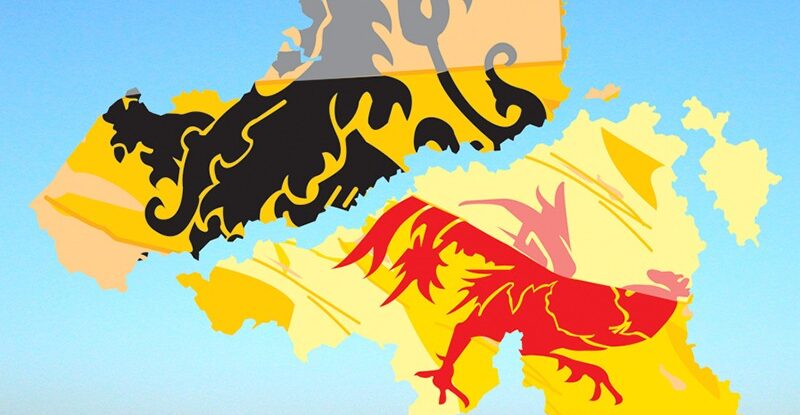
Mass migration is accelerating the nation of Belgium’s break up, with populist independence parties for the Dutch-speaking north ready to separate from the French-speaking south. The country is approximately the same size as the state of Maryland, with a population the size of Ohio.
Home to the European Union’s de facto capital of Brussels – a French-speaking island in the Dutch-speaking Flanders region – as well as NATO’s headquarters, Belgium is currently experiencing an immigration surge on par with the migrant crisis of 2015-16.
Problems with migrant integration have long been apparent in Belgian society, with riots in France over a police shooting recently spreading to Brussels for no other reason than the fact they involved a migration-background youth. Raheem Kassam, editor-in-chief of The National Pulse, was covering the formation of no-go zones in Belgium as long ago as 2017.
The country’s Dutch-speaking Flemish have had enough, with the so-called “far-right” Vlaams Belang (Flemish Interest) party poised to become to biggest in the country in next June’s elections.
“We believe Belgium is a forced marriage,” says Vlaams Belang leader Tom Van Grieken.
“[W]e have to come to an orderly division. If they don’t want to come to the table with us, we’ll do it unilaterally,” he warns.
Historically, Belgian politics has been dominated by French-speaking Wallonia, but it has lost its grip on power in recent years. The Belgian government, currently comprised of a seven-party coalition, is highly dysfunctional, and the country has gone as long as 652 days with no one in charge due to politicians with highly divergent beliefs being unable to reach compromises following national elections.
show less
Mass migration is accelerating the nation of Belgium's break up, with populist independence parties for the Dutch-speaking north ready to separate from the French-speaking south. The country is approximately the same size as the state of Maryland, with a population the size of Ohio.
show more
Share Story
FacebookTwitterWhatsappTruthTelegramGettrCopy Link
Real News Fan? Show It!
Many people are shocked to learn that because of active censorship, we currently have to spend more time making sure you can even see The National Pulse, than on producing the news itself. Which sucks. Because we do this for the truth, and for you.
But the regime doesn’t want you being informed. That’s why they want us to go away. And that will happen if more people don’t sign up to support our work. It’s basic supply and demand. So demand you get to read The National Pulse, unrestricted. Sign up, today.
We don’t sell ads, and refuse corporate or political cash. It all comes down to you, the reader. I hope you can help.