



Wednesday, May 13, 2026

Migrant Households Are Claiming £1 Billion a MONTH in UK Welfare Benefits.

PULSE POINTS

WHAT HAPPENED: Nearly £1 billion (~$1.3 billion) in welfare benefits is being claimed monthly by households with at least one foreign national in the United Kingdom, according to government data.

👤WHO WAS INVOLVED: Foreign nationals, Prime Minister Sir Keir Starmer’s Labour Party government, Conservative (Tory) Member of Parliament (MP) Neil O’Brien, who secured the information, and Reform Party leader Nigel Farage.

📍WHEN & WHERE: Data from March 2022 to the present, across the United Kingdom.

💬KEY QUOTE: “The growth of benefit spending and the rate of migration are both much too fast, and the Government is doing far too little to change either trend. Migrants know that if they can make it to the UK, they will be allowed to stay. As long as that is true, we’ll see more and more coming. Our soft-touch welfare state makes this worse.” – Neil O’Brien MP

🎯IMPACT: Welfare payments to foreign nationals have doubled in four years, raising concerns about fiscal sustainability and fairness to British citizens.

IN FULL

Foreign nationals are claiming close to £1 billion (~$1.3 billion) in welfare payments from the British government each month, according to the latest Department for Work and Pensions (DWP) figures. The data, released in response to Freedom of Information requests from Conservative (Tory) Member of Parliament (MP) Neil O’Brien, shows that households containing at least one foreign national received £941 million in Universal Credit payments this month.

Universal Credit, which supports low-income working-age families, is available to migrants who hold Indefinite Leave to Remain (ILR)—roughly equivalent to permanent residency in the U.S.—or refugee status. Over the last four years, the total value of claims from households with a migrant has more than doubled, climbing from £461 million in March 2019 to almost £1 billion now. The figure rose by nearly 30 per cent in the past 12 months alone.

Neil O’Brien criticized the trend, saying: “The growth of benefit spending and the rate of migration are both much too fast, and the Government is doing far too little to change either trend. Migrants know that if they can make it to the UK, they will be allowed to stay. As long as that is true, we’ll see more and more coming. Our soft-touch welfare state makes this worse.”

Reform Party leader Nigel Farage has called for the complete abolition of Indefinite Leave to Remain as a way to reduce the financial strain of large-scale migration. Reform wants to restrict welfare benefits to British citizens only and replace Indefinite Leave to Remain with a five-year work visa system modelled on the American approach to long-term legal immigration.

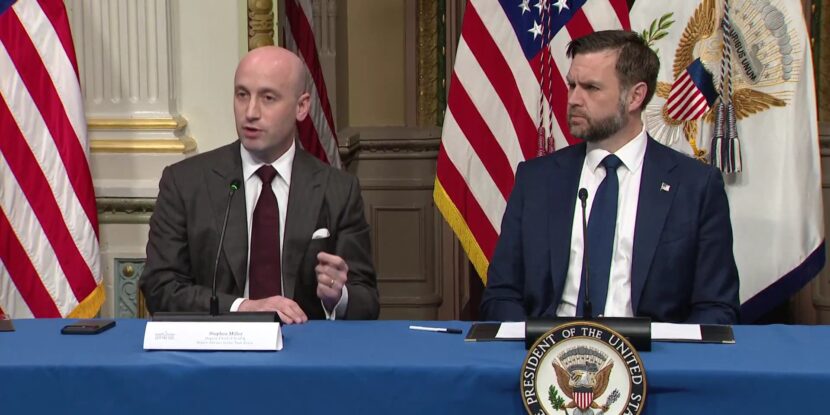
Image by Simon Dawson / No 10 Downing Street.

Join Pulse+ to comment below, and receive exclusive e-mail analyses.

show less
show more

MIGRANT WELFARE RANKINGS: Guess Which Groups Cost YOU The Most to Host?

PULSE POINTS

WHAT HAPPENED: A new report released by the Center for Immigration Studies (CIS) sheds critical light on the scope of American welfare benefits accessed by noncitizens, revealing surprising variation by country and level of educational attainment.

👤WHO WAS INVOLVED: Noncitizen households—including both permanent legal residents and illegal immigrants, American taxpayers, and the Center for Immigration Studies (CIS).

📍WHEN & WHERE: The study was released on March 18, 2026.

💬KEY QUOTE: “Although most new legal immigrants and illegal immigrants are barred from accessing most means-tested programs, these restrictions have not prevented a large share of noncitizen-headed households from accessing the welfare system.” — CIS

🎯IMPACT: According to the data, 47 percent of households headed by a noncitizen—both permanent legal residents and illegal immigrants—utilize at least one government-funded welfare program. This number jumps to 54 percent when including refundable tax credits, such as the Earned Income Tax Credit (EITC) and the Additional Child Tax Credit (ACTC).

IN FULL

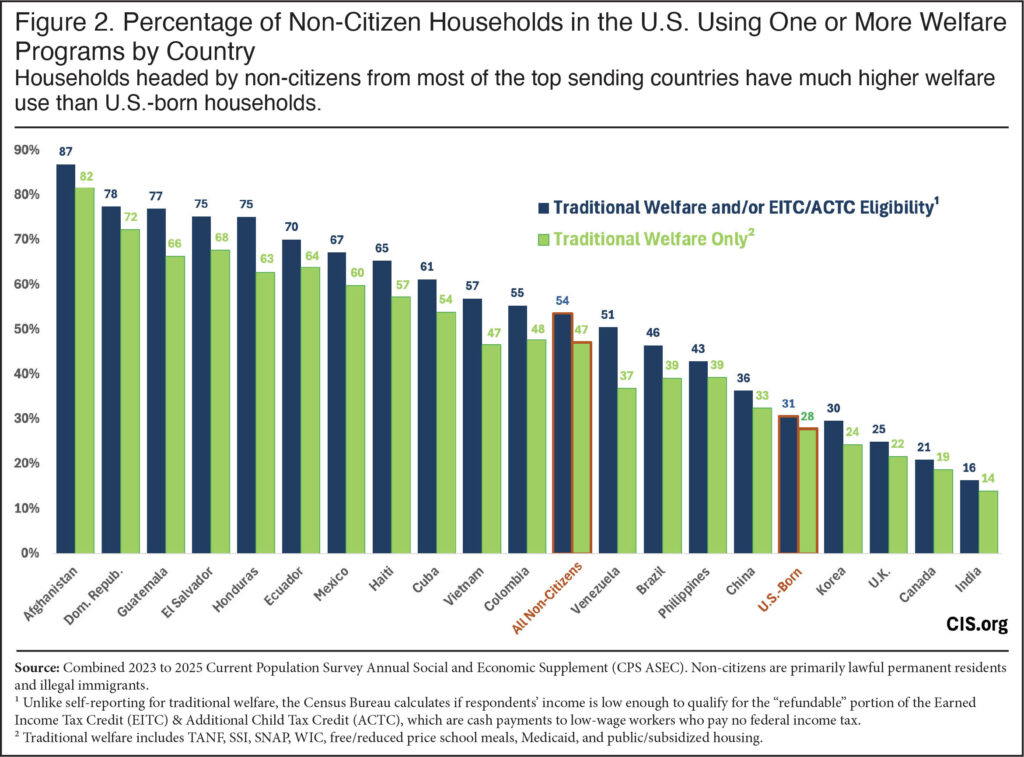
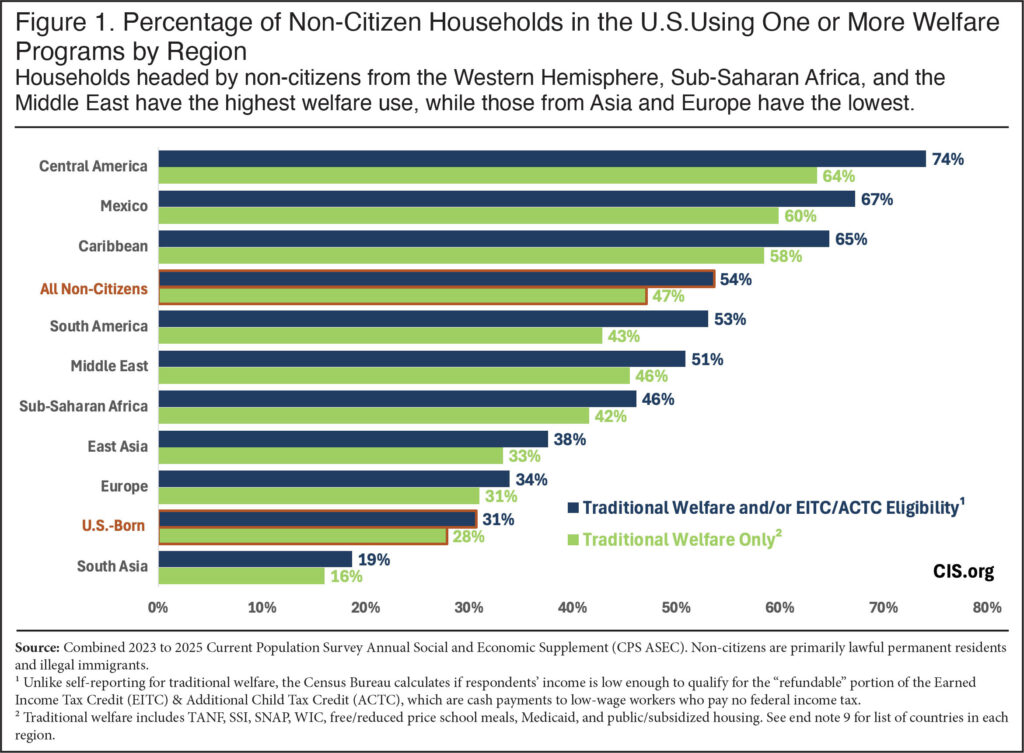
A new report released by the Center for Immigration Studies (CIS) sheds critical light on the scope of American welfare benefits accessed by noncitizens, revealing surprising variation by country and level of educational attainment. According to the data, 47 percent of households headed by a noncitizen—both permanent legal residents and illegal immigrants—utilize at least one government-funded welfare program. This number jumps to 54 percent when including refundable tax credits, such as the Earned Income Tax Credit (EITC) and the Additional Child Tax Credit (ACTC). For native-born Americans, the percentages are 28 percent and 31 percent, respectively.

“Although most new legal immigrants and illegal immigrants are barred from accessing most means-tested programs, these restrictions have not prevented a large share of noncitizen-headed households from accessing the welfare system,” CIS explains, continuing, “This is primarily because non-citizens often receive benefits on behalf of their U.S.-born children and the restrictions only apply to some programs. These facts coupled with the large share of noncitizens who have modest levels of education and their resulting low incomes mean many can use means-tested anti-poverty programs.”

Households headed by noncitizens from Afghanistan are the top beneficiaries of American welfare programs. The CIS report shows that 82 percent of Afghan immigrant households are dependent on traditional government welfare assistance. This number rises to a stunning 87 percent when the EITC and ACTC are included.

After Afghanistan, noncitizens originating from the Dominican Republic are the next largest welfare users. Next in line, 78 percent of Dominican households rely on either traditional welfare programs or refundable tax credits. Similarly, 77 percent of households headed by noncitizens from Guatemala are reliant on the same.

The lowest welfare use among noncitizen households is by those headed by individuals from South Korea, the United Kingdom, Canada, and India, respectively. Other national origin groups falling below the average welfare use for all noncitizens are Venezuela, Brazil, the Philippines, and China.

When broken down by region, Central American noncitizens are the most likely to use welfare, with 74 percent utilizing government aid programs or refundable tax credits. Interestingly, immigrants from South Asia are the only regional group to utilize welfare programs less than native-born Americans, with just 19 percent benefiting from both traditional and non-traditional government assistance. Noncitizen households headed by individuals of European origin, meanwhile, are nearly on par with native-born Americans, with just 34 percent accessing refundable tax credits or traditional welfare programs.


Join Pulse+ to comment below, and receive exclusive e-mail analyses.

show less
show more

Minnesota Woman Locked Up for $325K SNAP Fraud.

PULSE POINTS

WHAT HAPPENED: A Minnesota woman was sentenced to just one year in prison for defrauding the federal government of more than $325,000 in Supplemental Nutrition Assistance Program (SNAP) benefits.

👤WHO WAS INVOLVED: Latasha Thomas, two of her relatives, federal prosecutors, and federal taxpayers.

📍WHEN & WHERE: The fraudulent actions took place over two years in Minnesota, with sentencing announced last week.

🎯IMPACT: Thomas was ordered to repay $325,159 in restitution to the United States Department of Agriculture.

IN FULL

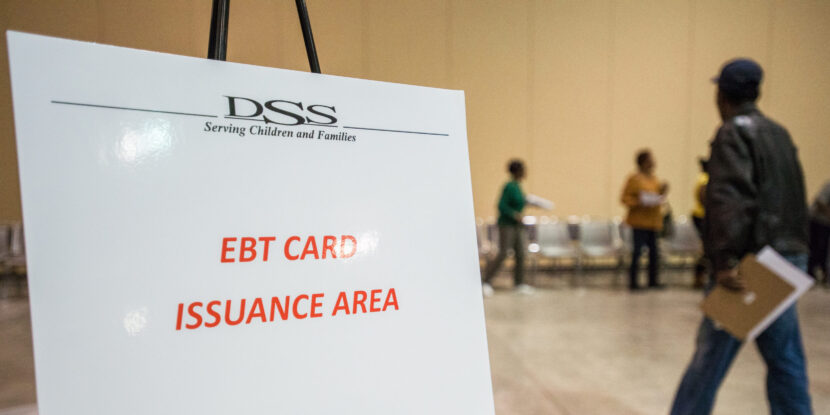
Latasha Thomas, a 39-year-old Minnesota resident, has been sentenced to one year in federal prison after being convicted of mail fraud for orchestrating a scheme to steal benefits from the Supplemental Nutrition Assistance Program, or SNAP. Federal prosecutors said Thomas worked for more than two years with her daughter, Ambrosia Thomas, and another relative, Cynthia Thomas, to unlawfully obtain Electronic Benefit Transfer (EBT) cards funded through SNAP. Investigators said the group used fake Minnesota temporary driver’s licenses containing false names and photographs of the Thomases to apply for benefits through Hennepin County.

Prosecutors said the defendants also submitted fabricated medical documentation, falsely claiming they were women experiencing “high-risk pregnancies” in order to increase the amount of SNAP benefits loaded onto the cards each month. The EBT cards were mailed to an apartment in Roseville linked to Cynthia Thomas, who allegedly lived there under the alias Sofia Gold. Law enforcement later found mail addressed to multiple fictitious identities and notes instructing postal carriers to deliver items for those names to the same apartment.

Authorities said the fraudulently obtained SNAP funds were withdrawn from ATMs, used for purchases, or trafficked to others. Customers were allegedly charged between 50 and 60 percent of a card’s monthly balance in exchange for temporary access to the EBT cards, which were returned after an agreed portion of the benefits had been spent.

As part of her sentence, Latasha Thomas was ordered to pay $325,159 in restitution to the U.S. Department of Agriculture, which administers SNAP at the federal level. Cynthia Thomas was convicted last year and sentenced to three years of probation. Ambrosia Thomas has agreed to plead guilty to mail fraud and is awaiting sentencing.

SNAP is a federally funded program designed to help low-income individuals and families afford food, with benefits issued monthly through EBT cards that can be used at authorized retailers. The program has faced increased scrutiny in recent years following multiple large-scale fraud investigations and federal findings that benefits were improperly issued in hundreds of thousands of cases, including to dead people. The U.S. Department of Agriculture has sought expanded access to state data to detect ineligible recipients, with Democrat state officials resisting.

Join Pulse+ to comment below, and receive exclusive e-mail analyses.

show less

show more

$7 Million SNAP Fraud Scheme Uncovered, Run by Haitian Immigrant Duo.

PULSE POINTS

WHAT HAPPENED: Federal prosecutors have charged two Haitian immigrants in Massachusetts with operating a $7 million food stamp fraud scheme.

👤WHO WAS INVOLVED: Antonio Bonheur, 74, a naturalized U.S. citizen originally from Haiti, and Saul Alisme, 21, a lawful permanent resident.

📍WHEN & WHERE: The fraud occurred in Boston’s Mattapan neighborhood, with charges filed by federal prosecutors on December 15, 2025, and announced on December 17.

💬KEY QUOTE: “Fraud is not isolated, but widespread.” – U.S. Attorney Leah Foley

🎯IMPACT: The case underscores systemic failures in welfare oversight, with taxpayers bearing the cost and legitimate recipients facing increased scrutiny.

IN FULL

The U.S. Department of Justice (DOJ) has announced charges against two Haitian immigrants accused of perpetrating an estimated $7 million fraud scheme involving Supplemental Nutrition Assistance Program (SNAP) benefits, also known as food stamps. According to federal prosecutors in Massachusetts, Antonio Bonheur, a 74-year-old naturalized U.S. citizen originally from Haiti, and Saul Alisme, a 21-year-old lawful permanent resident, operated two small bodegas in Boston’s Mattapan neighborhood where the fraud scheme took place.

Despite observably low inventory and minimal business transactions, one of the bodegas reportedly redeemed upwards of $500,000 in SNAP benefits in a single month. The figure, prosecutors note, is one that would be expected for a major retail grocery chain and not a small independent convenience store.

The DOJ indictment details how undercover federal agents visited the two stores and found that the establishments exchanged SNAP benefits for cash payments, exchanged liquor for SNAP benefits, sold international humanitarian aid food packages, and laundered the fraud profits through secondary bank accounts to avoid detection. Prosecutors allege that Bonheur fraudulently redeemed an estimated $6.8 million in SNAP benefits over the past three years alone.

“Fraud is not isolated, but widespread,” U.S. Attorney Leah Foley said of the scheme, while criticizing Massachusetts officials and other Democrat-controlled states who have refused to share SNAP data with the federal government.

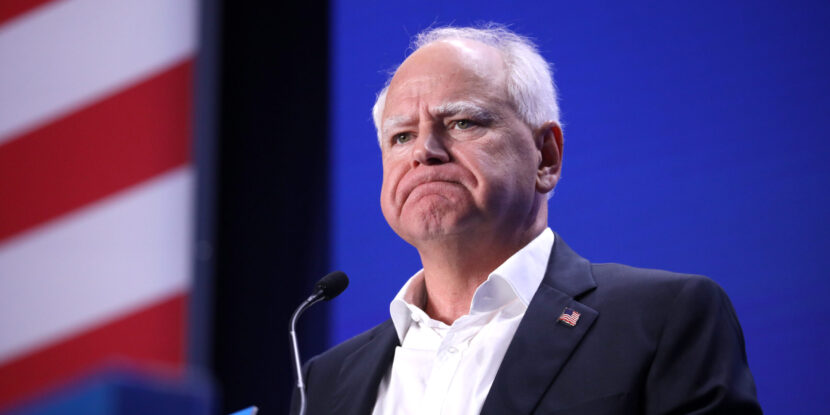
Notably, the Massachusetts case comes on the heels of multiple sprawling social services fraud schemes being investigated in Minnesota. The National Pulse previously reported that state government whistleblowers accuse Governor Tim Walz (D) and his administration of having discovered the over $1 billion fraud schemes—connected to the Somali immigrant community—as early as 2019, but having done little to stop the criminal activity.

Join Pulse+ to comment below, and receive exclusive e-mail analyses.

show less

show more

Trump Cabinet Member Demands Tim Walz Resign Amid Fraud Scandal.

PULSE POINTS

WHAT HAPPENED: U.S. Education Secretary Linda McMahon is calling for Minnesota Governor Tim Walz (D) to resign over widespread fraud allegations in the state.

👤WHO WAS INVOLVED: Sec. McMahon, Governor Walz, and others accused of fraud links, including Somali-linked nonprofits like Feeding Our Future and Representative Ilhan Omar (D-MN).

📍WHEN & WHERE: The letter was sent on Tuesday, addressing fraud in Minnesota during Walz’s tenure as governor, which began in 2019.

💬KEY QUOTE: “Shame on you, Governor Walz, for allowing this to happen—and for benefiting from it.” – Linda McMahon

🎯IMPACT: Alleged fraud has cost taxpayers over $1 billion, with calls for accountability and potential political consequences for Walz.

IN FULL

U.S. Department of Education Secretary Linda McMahon is demanding Minnesota Governor Tim Walz (D) resign over his administration’s handling—and alleged enabling—of a massive social services fraud scandal tied to his state’s Somali immigrant community. In a letter sent to the Democrat governor and failed 2024 vice presidential candidate on Tuesday, McMahon accused Walz of failing to prevent widespread fraud in federal programs, including education aid, which saw several nonprofit organizations and Somali community leaders funnel an estimated $1 billion in taxpayer dollars into their personal coffers.

“You have been Minnesota’s Governor since 2019. During that time, your careless lack of oversight and abuse of the welfare system has attracted fraudsters from around the world, especially from Somalia, to establish a beachhead of criminality in our country,” McMahon wrote, adding: “As President Trump put it, you have turned Minnesota into a ‘fraudulent hub of money laundering activity.’”

The Education Secretary went on to reveal her discovery of fraud within Minnesota’s college education system, noting that nearly 2,000 “ghost students” were identified as having received $12.5 million in taxpayer-funded grants and loans. “They collected checks from the federal government, shared a small portion of the money with the college, and pocketed the rest—without attending the college at all,” McMahon wrote.

McMahon accused Walz of overseeing a “massive scandal of welfare fraud” that spanned programs such as housing benefits, food stamps, and small-business relief, among others. Secretary McMahon also criticized Representative Ilhan Omar (D-MN), alleging she borrowed “tens of thousands” in student loans and has been unwilling to repay them despite her taxpayer-funded salary.

The Trump administration’s Education Secretary concluded her letter with a call for Walz to step down as governor.

Image by Gage Skidmore.

Join Pulse+ to comment below, and receive exclusive e-mail analyses.

show less

show more

Biden Judge Delays Trump Admin Effort to Restrict SNAP Benefits for Migrants.

PULSE POINTS

WHAT HAPPENED: A federal judge extended the grace period for states to comply with Supplemental Nutrition Assistance Program (SNAP) eligibility rules after a legal challenge by 20 states.

👤WHO WAS INVOLVED: The Trump administration, 20 state attorneys general, U.S. District Court Judge Michael Simon Kasubhai, and the U.S. Department of Agriculture (USDA).

📍WHEN & WHERE: The lawsuit was filed on November 26, and the ruling was issued on December 15. The issue involves SNAP programs across the U.S.

💬KEY QUOTE: “The inability to provide compliance in the time period in which they were forced to by virtue of the guidance contributed to an erosion of trust.” – Judge Michael Simon Kasubhai.

🎯IMPACT: The ruling mandates that the Trump administration extend the grace period for states to comply with changes to SNAP eligibility.

IN FULL

A federal judge ruled on Monday that the U.S. Department of Agriculture (USDA) must allow states additional time to bring themselves into compliance with new guidance regarding Supplemental Nutrition Assistance Program (SNAP) eligibility. The order follows a coalition of 20 state attorneys general filing suit on November 26, arguing that the administration failed to provide a legally required 120-day compliance period.

The issue centers on guidance issued by the USDA on October 31, 2025, which would bar SNAP benefit eligibility for certain lawful permanent residents—including refugees and asylum seekers. Notably, the USDA guidance stems from changes to SNAP, also known as food stamps, made under the One Big Beautiful Bill Act, signed into law by President Donald J. Trump on July 4. Provisions in the law significantly reduced the number of immigrants who can qualify for the supplemental food assistance.

States were initially told to comply immediately with the new SNAP eligibility rules or face significant fines. However, after an initial legal challenge, the Trump administration reversed course on December 10 and reinstated eligibility for all lawful permanent residents. Other SNAP restrictions under the One Big Beautiful Bill Act remain in place, and the USDA continues to contend that the compliance grace period ended on November 1.

In his ruling, U.S. District Court Judge Michael Simon Kasubhai—a Biden appointee—agreed with the 20 state attorneys general, ruling that the USDA’s position was unlawful and inconsistent with past practices. “The inability to provide compliance in the time period in which they were forced to by virtue of the guidance contributed to an erosion of trust,” Judge Kasubhai wrote, extending the grace period to April 9, 2026.

Join Pulse+ to comment below, and receive exclusive e-mail analyses.

show less
show more

Over 80% of Somali Refugee Households Are Taking Welfare in Walz’s Minnesota.

PULSE POINTS

WHAT HAPPENED: New data from the Center for Immigration Studies (CIS) reveals that more than eight-in-ten Somali refugee-headed households in Minnesota are on one or more forms of taxpayer-funded welfare.

👤WHO WAS INVOLVED: Somali refugee households in Minnesota and the Center for Immigration Studies (CIS).

📍WHEN & WHERE: Based on ten years of data from the Census Bureau’s American Community Survey (ACS) in Minnesota.

💬KEY QUOTE: “Nearly every Somali household with children… receives some form of welfare,” said CIS researcher Jason Richwine.

🎯IMPACT: The data highlights significant disparities in welfare use, poverty rates, education, and English proficiency between Somali refugees and native-born Minnesotans.

IN FULL

Minnesota’s Somali refugee community shows significantly higher reliance on welfare compared to native-born residents, according to a new analysis of a decade of American Community Survey data. The Center for Immigration Studies report finds that 81 percent of Somali refugee–headed households in the state use at least one form of taxpayer-funded welfare. That includes 27 percent receiving cash assistance, 54 percent using food stamps, and 73 percent enrolled in Medicaid. Among native-born Minnesotan households, 21 percent use welfare programs, with six percent on cash aid, seven percent on food stamps, and 18 percent on Medicaid.

The gap is even larger among families with children. The study shows that 89 percent of Somali-headed households with children rely on public assistance, compared to 30 percent of native-born households with children. “Nearly every Somali household with children… receives some form of welfare,” said researcher Jason Richwine.

The report also highlights broader socioeconomic issues, including a finding that more than 66 percent of Somali refugees in Minnesota live in or near poverty. Nearly 60 percent report limited English proficiency, and 40 percent lack a high school diploma, compared with five percent of native-born Minnesotans.

World Bank data show that personal remittances—money sent back to Somalia by migrants—have historically accounted for roughly one-fifth of Somalia’s GDP. The United States is also the largest donor of foreign aid to Somalia, providing over $1 billion to the country in 2023 alone.

The release of the welfare data comes as Minnesota faces increasing federal scrutiny over alleged large-scale fraud involving state social programs. The U.S. Treasury Department has launched an investigation into claims that significant amounts of taxpayer money were improperly obtained through Somali-related Medicaid and welfare schemes involving networks of nonprofits and service providers.

Whistleblowers have also alleged that Governor Tim Walz (D) was informed of potential irregularities tied to the Feeding Our Future nonprofit as early as 2019 but failed to take sufficient action. Nearly 500 Minnesota state employees have accused the administration of disregarding warnings and retaliating against whistleblowers who tried to raise concerns.

Federal Medicaid officials have warned that Minnesota could risk losing funding without more aggressive oversight and corrective action. Throughout the controversy, Governor Walz has defended Minnesota’s Somali community and even said he hopes it becomes larger, stating, “Instead of demonizing our Somali community, we’re going to do more to welcome more in.”

Image by Gage Skidmore.

Join Pulse+ to comment below, and receive exclusive e-mail analyses.

show less
show more

Trump Has REDUCED Food Stamp Dependence by 600,000.

PULSE POINTS

WHAT HAPPENED: President Donald J. Trump announced that over 600,000 Americans have stopped claiming Supplemental Nutrition Assistance Program (SNAP) benefits since he took office.

👤WHO WAS INVOLVED: President Donald Trump, the U.S. Department of Agriculture (USDA), and millions of Americans relying on SNAP benefits.

📍WHEN & WHERE: Trump made the announcement during the APEC summit in Gyeongju, South Korea, on Wednesday.

💬KEY QUOTE: “In nine months, we’ve lifted over 600,000 Americans off food stamps.” – Donald Trump

🎯IMPACT: While the exact cause of the drop in SNAP reliance isn’t entirely clear, declining inflation and increasing domestic industrial investment are two likely factors impacting the decline.

IN FULL

President Donald J. Trump announced that the number of Americans receiving Supplemental Nutrition Assistance Program (SNAP) benefits has dropped by more than 600,000 since he took office. The revelation was made during his address at the Asia-Pacific Economic Cooperation (APEC) summit in Gyeongju, South Korea, on Wednesday.

During his remarks, Trump stated, “In nine months, we’ve lifted over 600,000 Americans off food stamps.” According to U.S. Department of Agriculture (USDA) data, between January and May 2025, the number of SNAP recipients dropped by 645,315, from 42,380,525 to 41,735,210. Notably, the number of SNAP recipients has been gradually decreasing since October 2024. USDA data shows a reduction of 1,515,619 recipients between October 2024 and May 2025.

While the exact cause of the drop in SNAP reliance isn’t entirely clear, declining inflation and increasing domestic industrial investment are two likely factors impacting the decline. Since taking office in January, President Trump has secured billions in new corporate investment in American manufacturing to revive domestic production and support well-paying blue-collar jobs.

The USDA recently confirmed that food assistance, issued to just under 42 million low- and no-income Americans, will not be distributed on time in November due to the ongoing government shutdown. The shutdown, which began on October 1 when Senate Democrats blocked a continuing resolution (CR) temporarily extending appropriations, has caused nonessential federal services to cease, including programs like SNAP that depend on federal funding.

Join Pulse+ to comment below, and receive exclusive e-mail analyses.

show less

show more

The Senate Parliamentarian Is Gutting Trump’s ‘Big Beautiful Bill.’

PULSE POINTS

WHAT HAPPENED: The Senate Parliamentarian blocked several Republican provisions in the “One Big Beautiful Bill,” including the removal of SNAP eligibility for immigrants, a mandate that states with high SNAP payment error rates cover a larger portion of the costs, and granting President Donald J. Trump greater authority over the hiring and firing of federal workers.

👤WHO WAS INVOLVED: Senate Republicans, Senate Parliamentarian Elizabeth MacDonough, and Senate Democrats, including Sen. Jeff Merkley (D-OR).

📍WHEN & WHERE: The ruling was announced late Sunday in Washington, D.C.

🎯IMPACT: Key provisions of the GOP bill, including changes to federal hiring and firing, face significant procedural hurdles in the Senate.

IN FULL

The Senate Parliamentarian has ruled against Republican efforts to include provisions on federal hiring and firing in their budget reconciliation bill, championed by President Donald J. Trump and popularly known as the “One Big Beautiful Bill.” The decision, announced late Sunday, is the latest in a series of rulings dismantling key provisions of the GOP’s sweeping domestic policy plan.

The blocked provisions included a proposal to require new federal workers to pay higher retirement contributions unless they agreed to be “at-will” employees, effectively waiving traditional civil service protections. The Congressional Budget Office estimated that most workers would likely forgo protections rather than pay the increased contributions.

Other provisions being blocked by the Parliamentarian include the ending of SNAP benefits for immigrants, a requirement that states with high SNAP payment error rates cover a greater share of the program’s cost, a requirement for unions to pay for the use of government resources, and expanded authority for the President to implement federal reorganization plans without congressional approval. The Parliamentarian also blocked a proposal to give Congress greater oversight of agency regulations.

Democrats, predictably, are praising these moves by the Parliamentarian—though Senate Republicans have remained silent on whether they will seek to rework the provisions, drop them altogether, or move to overrule the Parliamentarian. Without changes, provisions deemed ineligible under the Byrd Rule would require a 60-vote threshold to pass, making bipartisan support necessary.

Join Pulse+ to comment below, and receive exclusive e-mail analyses.

show less

show more

Nearly Half of London’s Public Housing Occupied by Foreigners.

PULSE POINTS:

What Happened: Census data from 2021 reveals 48 percent of social housing (public housing) in London, England, is occupied by households with a foreign-born head, compared to a national average of 19 percent. This costs taxpayers the equivalent of around $4.8 billion annually.

👥 Who’s Involved: Office for National Statistics (ONS), Shadow Justice Secretary Robert Jenrick, and foreigners in social housing.

📍 Where & When: London, 2021 Census data.

💬 Key Quote: Robert Jenrick: “This research shows how the huge costs of mass, low-skilled migration are often hidden from the public.”

⚠️ Impact: $4.8 billion in taxpayer costs annually, 35 percent of foreign-born lead tenants in working-age groups are unemployed or economically inactive.

IN FULL:

Nearly half of London’s social housing (public housing) is occupied by foreigners, according to 2021 census data, imposing a significant financial burden on taxpayers. Office for National Statistics (ONS) data shows that 48 percent of lead tenants in London’s social housing were born overseas, compared to a national average of 19 percent.

The analysis highlights that 376,700 foreign-born lead tenants in London receive an average discount equivalent to around $15.9k annually compared to private rental costs, resulting in a total taxpayer cost exceeding $4.8 billion annually.

Shadow Justice Secretary Robert Jenrick, of the formerly governing Conservative Party, criticized the findings, stating, “This research shows how the huge costs of mass, low-skilled migration are often hidden from the public.” He added, “When you lift up the [hood], it’s clear that the level and composition of immigration have been hugely economically harmful for decades.”

Further analysis revealed that 68 percent of foreign-born lead tenants in London’s social housing hold British passports. This equates to 257,200 individuals who, while born abroad, have British citizenship.

The data also showed that 35 percent of working-age foreign-born lead tenants in London’s social housing are either unemployed or economically inactive despite living in one of Britain’s most productive regions. The Office for Budget Responsibility (OBR) previously reported that low-paid migrant workers cost taxpayers more than $202,000 each by retirement age, rising exponentially as they age.

Separate data from the English Housing Survey indicates ethnic disparities in social housing use, with 48 percent of Black Caribbean households and 40 percent of Bangladeshi households living in taxpayer-subsidized homes, compared to 16 percent of White British households.

show less

PULSE POINTS:

show more