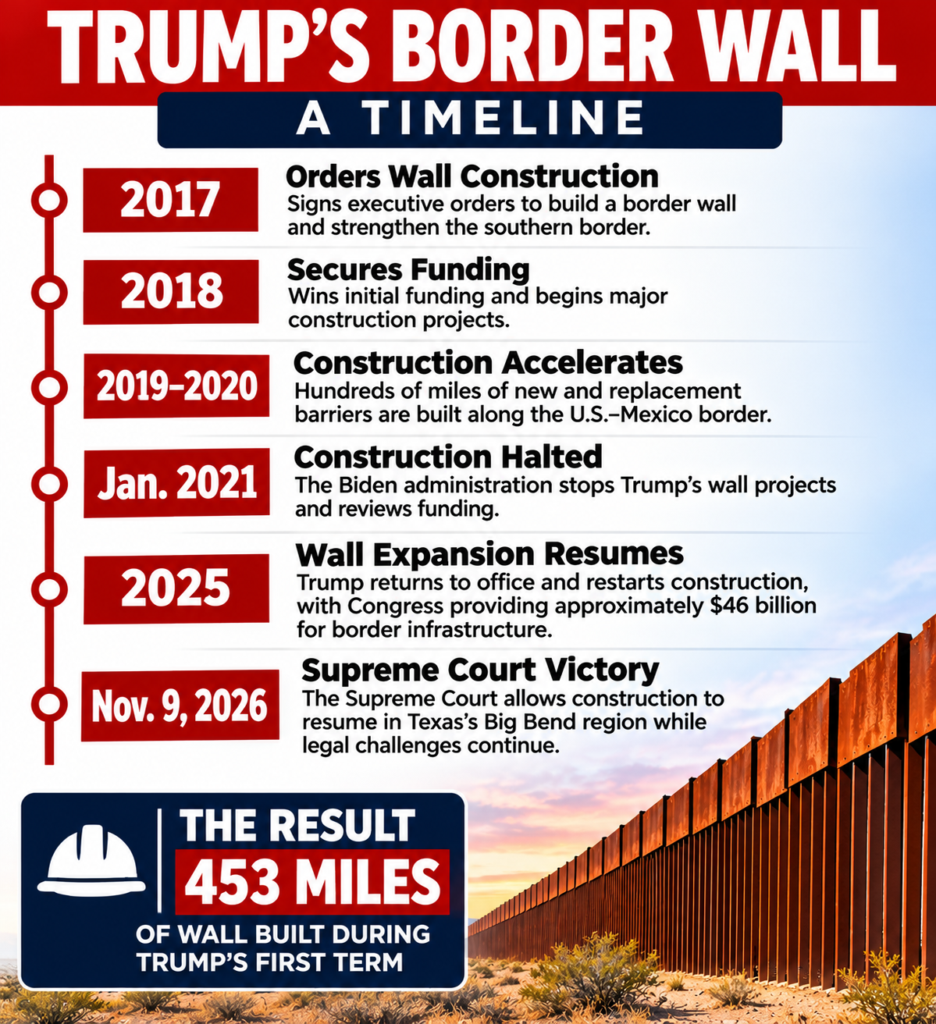
With approximately $46 billion allocated for border infrastructure, Trump is now exercising powers that were actually already established under previous Republican and Democrat administrations.
Clinton Laid the Legal Foundations.
The modern origins of Trump’s border authority date back to President Bill Clinton. In 1996, Clinton signed the Illegal Immigration Reform and Immigrant Responsibility Act, which authorized the federal government to construct additional barriers and roads along the southern border.
Section 102 of the legislation also permitted officials to waive certain environmental requirements, particularly those associated with the Endangered Species Act and National Environmental Policy Act. The legislation established an important precedent: securing America’s borders could justify exemptions from regulatory protections normally imposed on federal construction projects.
The Bush Legacy.
In 2005, President George W. Bush signed the REAL ID Act, dramatically expanding the authority originally established under Clinton. The legislation empowered the Homeland Security Secretary to waive “all legal requirements” considered necessary to accelerate border barrier construction.
According to a Congressional Research Service analysis, this authority can override environmental regulations and other legal obstacles that would ordinarily delay federal infrastructure projects. Congress also restricted judicial oversight.
Under the legislation, federal district courts can generally consider challenges to these waivers only when plaintiffs allege constitutional violations. Ordinary statutory challenges are excluded.
Biden Used the Same Powers.
During his presidency, Joe Biden also invoked the 2005 waiver authority to accelerate limited border-barrier construction in Texas, despite previously opposing Trump’s wall-building agenda.
The Supreme Court Sides With Border Security.
The latest dispute concerned construction in Big Bend, where environmental organizations and some local residents argued that the project threatened protected landscapes, historic sites, and local businesses. The administration maintained that additional barriers were necessary to combat illegal crossings and trafficking.
In its November 9 opinion, the Supreme Court concluded that the government was exceedingly likely to prevail on its argument that the lower court lacked jurisdiction over the challengers’ statutory claim. Biden-appointed Justice Ketanji Brown Jackson was the only justice to publicly oppose the stay.
The Court also recognized the government’s interests in border security, finding that those interests outweighed the environmental and recreational harms alleged by the plaintiffs at this preliminary stage. The ruling does not, however, finally settle the legality of the waivers; it allows construction to proceed while further challenges remain possible.
Congress Created the Power Trump Is Using.
Lawmakers have repeatedly delegated extraordinary authority to the executive branch while simultaneously restricting the ability of federal courts to scrutinize its exercise. These powers provide an essential mechanism for overcoming bureaucratic obstacles to securing America’s borders.
Trump has been attempting to build the wall for a decade, and this new legal victory in the Supreme Court brings him one step closer to achieving that promise.